Virtue RF Insulated Needle Effect: Improvement in Pores and Scars, and Pain
By Dr. Lee10 min read
If your pores are prominent or scars have been left behind by past acne, you've probably found that topical skincare alone barely makes a dent. That's because the problem isn't at the surface. It's a breakdown in the dermal structure underneath, which surface-level treatments simply can't reach. This is where Virtue RF often comes up as an option.
Virtue RF is a microneedling radiofrequency device that inserts fine needles, thinner than a strand of hair, into the dermis and delivers radiofrequency (RF) heat from their tips. Think of RF as a way of converting electrical energy into heat inside the skin. Its defining feature is the use of insulated needles, with the sides coated so that heat is released only at the needle tip. This protects the epidermis as much as possible while precisely targeting the deeper dermal layers that need attention. That said, large-scale clinical trials specifically on the Virtue RF brand are still limited, so when discussing its effectiveness, we're drawing on research covering the broader microneedling RF category that works on the same principle. Keep that in mind as you read the figures in this article. Below, we'll also look at how insulated and non-insulated needles differ, and how Virtue RF compares to Potenza and Sylfirm X.
What Kind of Device Is Virtue RF?
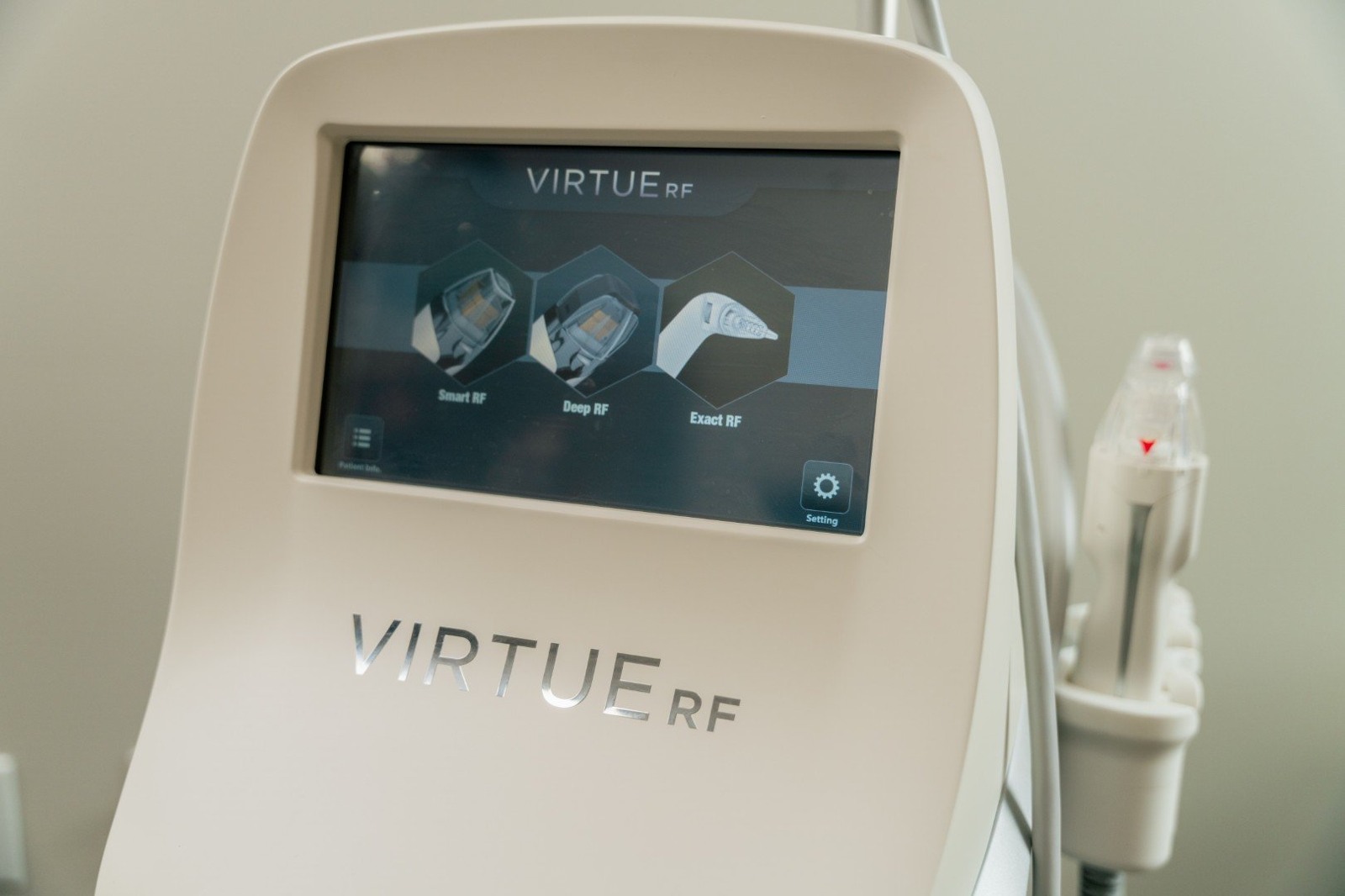
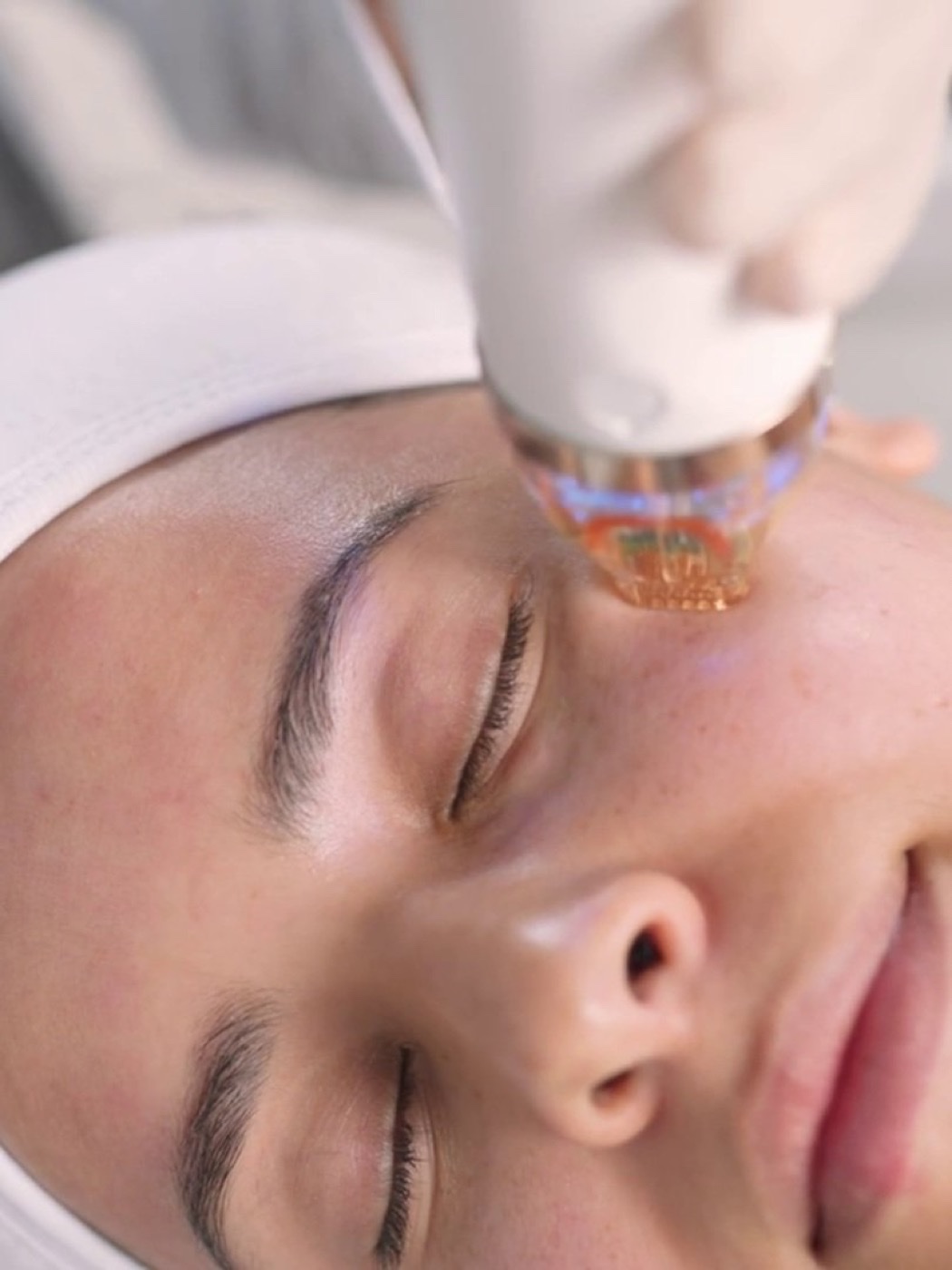
Virtue RF combines microneedles, needles finer than a strand of hair, with radiofrequency in a single handpiece. Multiple fine needles briefly puncture the skin and settle into the dermis, and radiofrequency heat is released from their tips. Heat is delivered in small points, only at the exact spots the needles reach inside the dermis.
The key here is that the epidermis stays protected. Because the sides of Virtue RF's needles are insulated, heat is released only at the tip, so almost no heat remains in the epidermis as the needle passes through. That's how it can treat deeper layers while reducing the risk of surface burns or pigmentation issues. As small points of heat accumulate throughout the dermis, the body responds by producing new collagen and gradually rebuilding the sagging structure. In effect, it rebuilds a compromised dermis from within, a different approach from resurfacing treatments, which work by removing the surface layer instead.
There are several settings a provider can adjust. How deep to insert the needles, and at what intensity and for how long to deliver the radiofrequency, are set according to the area and the goal. Shallow pores get a shallower setting, while deeper, pitted scars call for going deeper, and the depth can vary even within the same face, depending on the concern. In practice, treatment involves cleansing the skin, applying numbing cream, and waiting about 20 minutes. Once the skin is numb, the provider presses the handpiece point by point across the entire face. Sessions are typically spaced 3–4 weeks apart, and the total number of sessions depends on how severe the concern is.
How Do Insulated and Non-Insulated Needles Differ?
A point that often comes up when discussing microneedling RF is whether the needles are insulated. Whether the sides of the needle are coated with an insulating material changes where the heat is released, and that in turn changes which concerns it suits and what the risks are.
| Category | Insulated needles | Non-insulated needles |
|---|---|---|
| Where heat is released | Only at the needle tip | Along the entire needle length |
| Epidermal protection | Strong | Relatively weaker |
| Main target layer | Deep dermis | Shallow layer as well |
| Well-suited concerns | Scars, pores, laxity | Shallow pigment, vessels, redness |
| Hyperpigmentation risk | Lower | Relatively higher caution needed |
Insulated needles concentrate heat only in the dermis at the needle tip, making them well-suited to treating deep scars or sagging dermis while sparing the epidermis. This is the primary approach Virtue RF uses. Non-insulated needles, by contrast, release heat along the entire needle, warming both the epidermis and upper dermis together, which is why they're used to target shallow pigment or dilated blood vessels. Sylfirm X's pulse wave mode, which affects pigment cells and blood vessels at a shallow depth, falls into this category.
Neither is better across the board. They simply serve different purposes. That said, for treating scars or pores on skin prone to pigmentation, like Korean skin, the insulated approach carries a lower risk of hyperpigmentation since it causes less epidermal irritation. If shallow melasma or redness is the main concern, the non-insulated approach fits better.
Improvement Figures for Scars and Pores
As mentioned, large studies conducted specifically on the Virtue RF brand are rare. So the evidence for its effectiveness comes from research on the broader microneedling RF category that works on the same principle, and since Virtue RF belongs to that category, those findings apply to it as well.
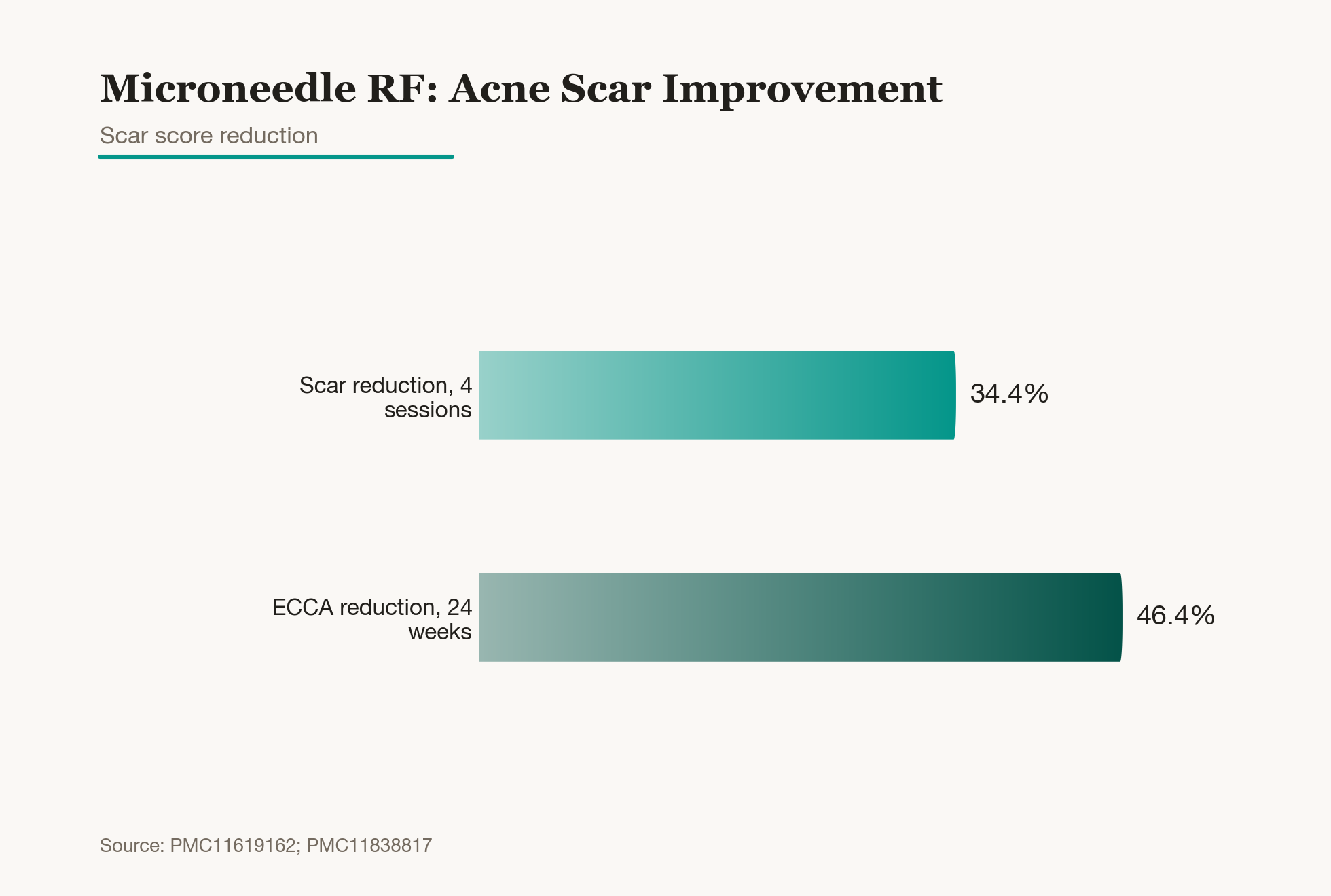
Look at the bar chart above. Scores for deep, pitted acne scars dropped by about 34.4% after 4 sessions. This is from a randomized study that scored scar severity and followed 40 people over one month. In another randomized study within the same category, the ECCA scar assessment score dropped by about 46.4%. ECCA is a scale that scores how severe acne scarring is, and this study followed 29 people over 24 weeks. This doesn't mean the scars themselves nearly vanished. It means the score measuring scar severity dropped by that much.
Pores tend to respond better than scars. In one pilot study using microneedling RF, more than half the patients, about 62.5%, fell into the 51–75% improvement range for pores. That said, the kind of precise single figure often seen in advertising, like "pores reduced by 41.7%," doesn't appear in the primary sources. The actual data is spread across ranges. It's also worth knowing how quickly the change unfolds. The visible reduction in scar volume usually becomes clear not right after treatment but between 12 and 16 weeks later, since it takes that long for new collagen to build up in the dermis. It's more accurate to look at the overall trend over several months rather than judging the effect of a single session on its own.
How Satisfying and How Painful Is It?
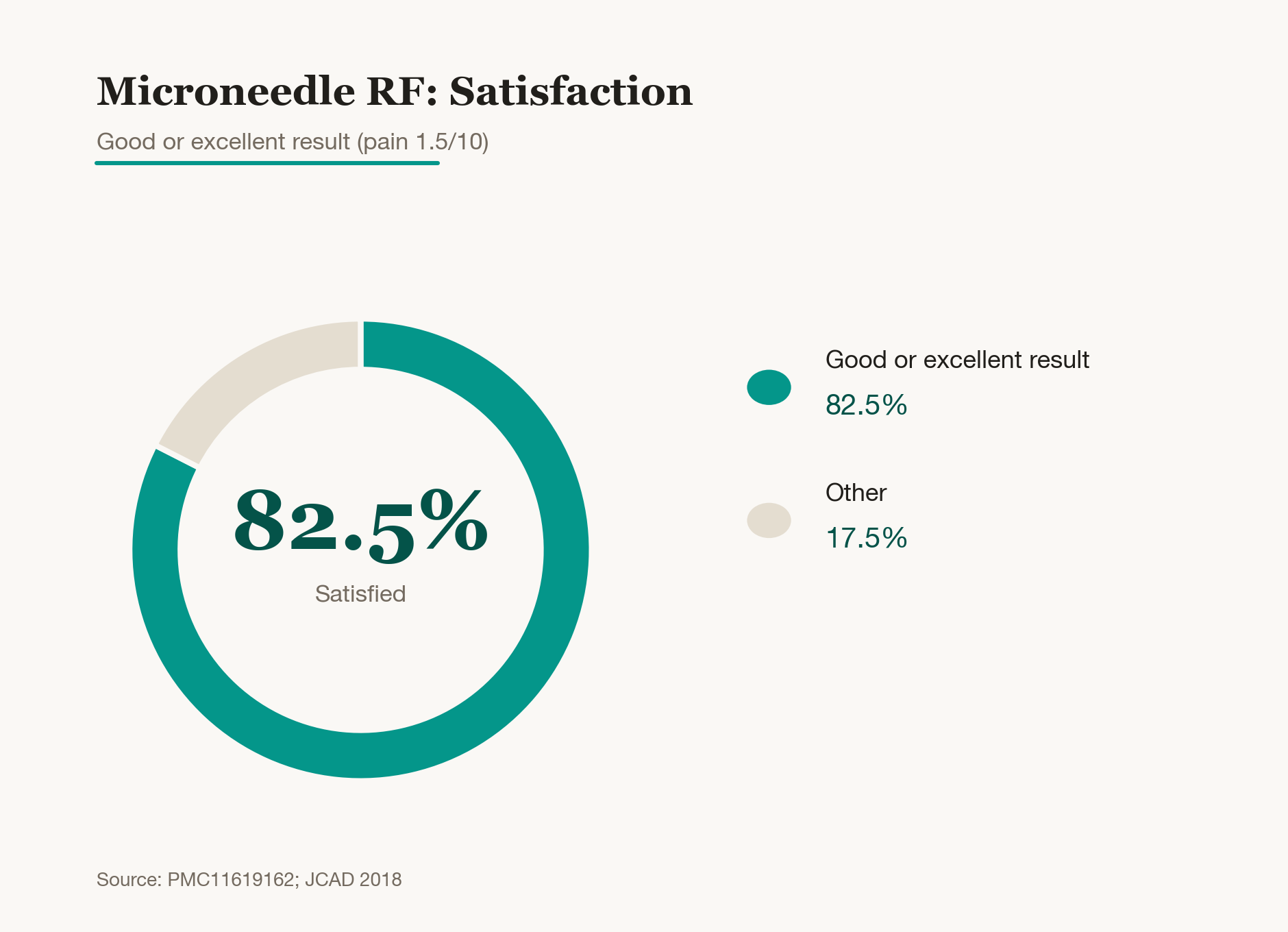
Looking at numbers from people who've had the treatment gives a clearer picture. In a microneedling RF study of 40 people, about 82.5% rated their results as excellent or good. That means roughly 8 out of 10 people were satisfied with how it turned out. In a separate report that specifically asked about willingness to recommend, about 94% said they would recommend it to others.
| Item | Figure | Note |
|---|---|---|
| Excellent or good results | About 82.5% | Study of 40 people |
| Willingness to recommend | About 94% | Separate report |
| Pain score | Average 1.5/10 | With numbing cream |
| Downtime | Usually about a day | Mainly redness |
Pain was reported at an average of 1.5 out of 10. Because numbing cream is applied beforehand, many people find it far less painful than the idea of needles being inserted might suggest. That said, areas that require deeper penetration, like scarred spots, or areas close to bone, like beside the nose or the forehead, can feel more sensitive than other areas.
Recovery is on the shorter side. Almost everyone experiences redness right after treatment, but it typically settles significantly within a day, sometimes along with mild swelling. Short downtime is a major factor in how satisfied people are. That said, keep in mind that these satisfaction figures are based on patients' own subjective ratings, and the sample size comes from microneedling RF studies involving several dozen people.
How Does It Compare With Potenza and Sylfirm X?
Since Virtue RF, Potenza, and Sylfirm X are all grouped under microneedling RF, people often ask which one is better. But the three devices each emphasize different things, so it's less about one being superior and more about choosing based on the concern you want to address.
Virtue RF focuses on concentrating heat only in the dermis at the needle tip using insulated needles, targeting scars, pores, and laxity while sparing the epidermis. Potenza offers a choice between delivering current deeply through a single needle, called monopolar, or shallowly between two needles, called bipolar, and can also use the channels the microneedles create in the epidermis to deliver active ingredients, a drug delivery function. Sylfirm X is known for its dual wave feature, combining continuous and pulse modes, and its strength lies in using non-insulated pulse mode to target shallow pigment and blood vessels for melasma and redness.
In short, Virtue RF leans toward deep dermal scars and pores through its insulated approach, Potenza toward a wide range of adjustable settings and drug delivery, and Sylfirm X toward pigment and blood vessels. That said, there's essentially no clinical study that has directly compared all three devices under the same conditions. So it's worth being cautious about any claim that one is absolutely superior, and it makes more sense to first identify whether your concern is scarring or pigment, and at what depth, rather than starting from the brand name.
Who It Suits and What to Watch For
The people who tend to do well with Virtue RF are fairly clear: those bothered by enlarged pores, those with pitted scars left behind by past acne, those whose rough texture makes makeup sit poorly, and those looking to address early sagging just as it starts. Because it's an insulated approach, it also poses less risk even for skin prone to pigmentation.
| Category | When it applies |
|---|---|
| Good candidates | Pores, pitted scars, rough texture, early laxity |
| Timing may need adjusting | During a flare-up of active acne |
| Consultation needed beforehand | Keloid-prone or scar-thickening tendency |
| Should avoid | Pregnancy, infection or active inflammation at the treatment site |
It also helps to know what to expect afterward. Small marks or a fine crust may remain at the needle sites for a few days. Forcing them off or irritating them slows recovery, so it's best to leave them be. You can wash your face starting the next day, gently, with lukewarm water, and it's safer to hold off on makeup for a day or two until the skin settles. If your skin tone is naturally darker, the risk of hyperpigmentation is relatively higher, so the intensity is set more conservatively and progress is monitored. Sun protection is essential for everyone after treatment.
Virtue RF is a treatment that slowly rebuilds a compromised dermis over multiple sessions. Rather than fixating on the single, precise reduction figure often seen in advertising, people who go in with realistic expectations, expecting texture to smooth out and scars to fade gradually across several sessions, tend to come away more satisfied in the end. Knowing that dedicated clinical trials on the brand are still limited, and setting expectations based on the broader category's evidence, is the safest approach.
Was this helpful?
About this article
Written by a practising aesthetic physician and intended for general education — not a substitute for individual medical advice.
Read next
Potenza Results: How Much Do Pores and Acne Scars Improve?
A clinical breakdown of how Potenza's microneedle radiofrequency remodels acne scars, minimizes enlarged pores, and refines skin texture, covering the real trial data behind the claims, how it compares to Thermage FLX and Ultherapy, satisfaction rates, and honest expectations.
By Dr. Lee

DoubleTite: RF Microneedling and Skin Booster Effects
What DoubleTite actually does, how its two needle lengths deliver radiofrequency energy and skin booster directly into the dermis, and what published studies say about collagen synthesis and skin firmness. An evidence-grounded look at a Korean-made device built on the well-validated RF microneedling platform, with dual-depth needles and simultaneous drug delivery added.
By Dr. Kim
Potenza Needle RF: How It Improves Acne Scars and Pores
Potenza needle RF uses fine needles to bypass the skin surface and deliver heat directly into the dermis. Here is a plain walk through why that heat improves scars and pores, how many sessions it usually takes, and what the downtime looks like.
By Dr. Lee