Potenza Results: How Much Do Pores and Acne Scars Improve?
By Dr. Lee11 min read
One of the most consistent complaints I hear in the office isn't dramatic sagging or deep wrinkles. It's pores. The kind that make foundation settle unevenly, or that show as shadow-pitting across the cheeks in flash photography. Right behind pores: acne scars. The red marks tend to fade on their own, given enough time. But structural damage is a different story. When active acne breaks down the dermis underneath, the dermis doesn't simply refill. Patients describe looking fine straight-on in soft light, then cratered under harsh overhead fluorescents or in a high-resolution selfie. That's not perception. It's physics. Raking light reveals topography that flat-on illumination hides entirely.
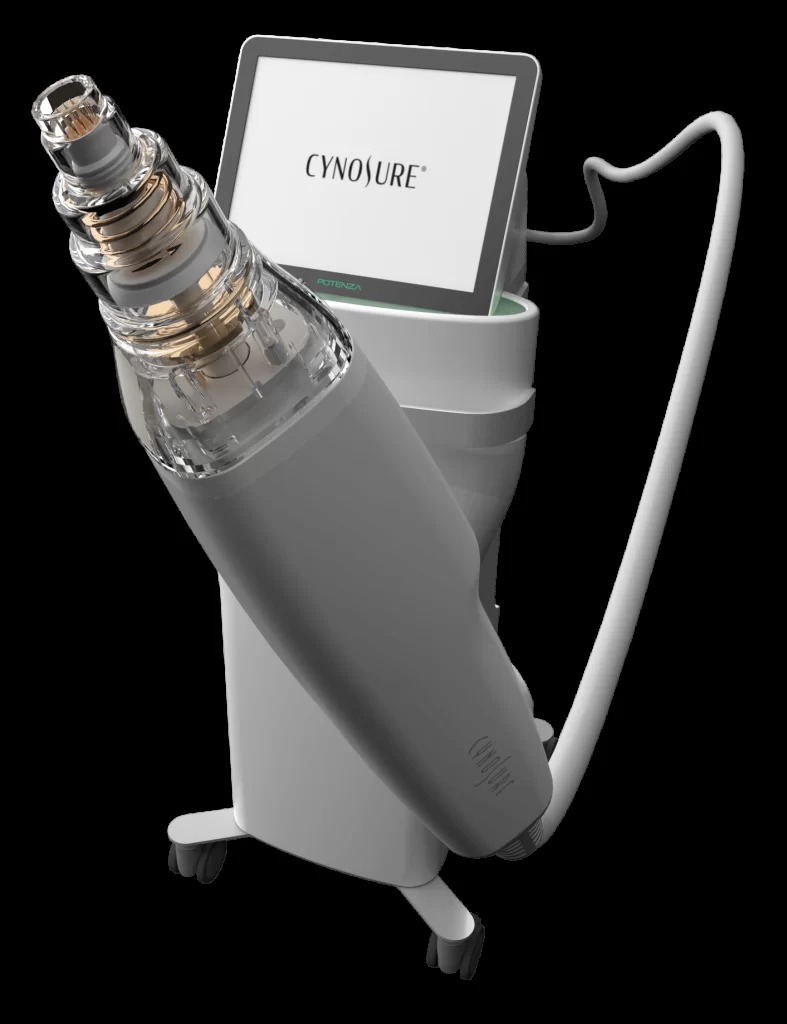
For both concerns, Potenza comes up regularly in my consults. It's a microneedling radiofrequency device, manufactured by Cynosure, that delivers RF energy directly into the dermis via an array of fine needles rather than through the skin surface. The difference in delivery location is the whole point.
How does Potenza work?
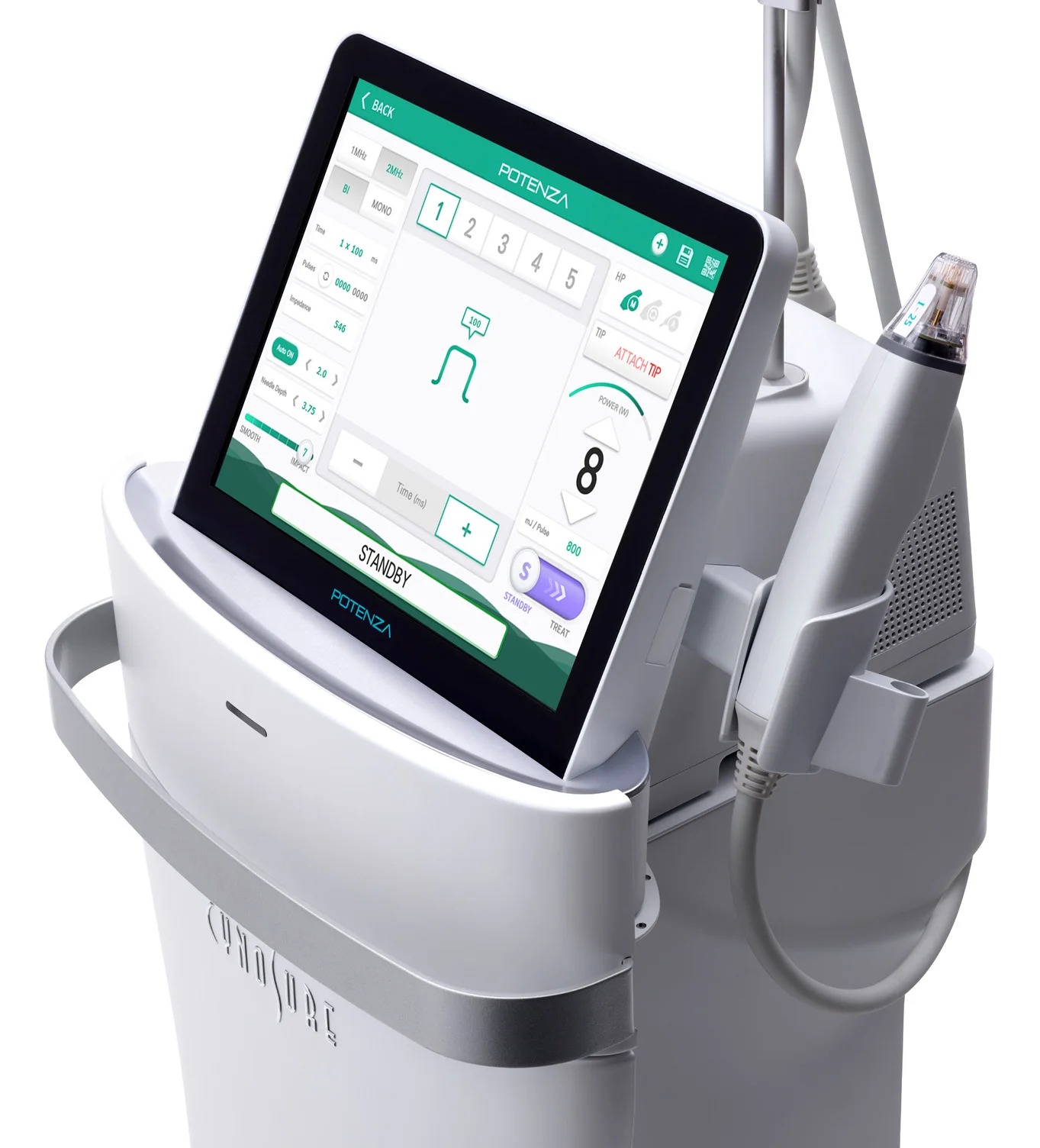
The needles, finer than a strand of hair, penetrate to a preset depth, and the RF energy fires at the tip rather than radiating from above. The epidermis above is largely bypassed; the thermal injury is concentrated in the dermis, where the pathology actually lives.
That bypass matters because the epidermis is where melanin is concentrated. Surface-based energy systems (certain lasers, resurfacing devices, IPL) have to pass through the epidermis to reach the dermis, which introduces pigmentation risk, particularly in patients with darker skin tones. Microneedling RF sidesteps that by going around the epidermis rather than through it. The small needle-entry wounds at the surface heal quickly. The fibroblasts in the mid and deep dermis take the thermal hit, mount a healing response, and that's what drives the collagen remodeling.
Clinicians have several parameters to work with. RF can be delivered in monopolar mode, where energy flows from the needle tip to a grounding pad, penetrating deeper and more diffusely, or bipolar, where energy passes between adjacent needles and concentrates in a shallower zone between them. Frequency (1 MHz and 2 MHz) is adjustable, and needle depth is set per pass, per zone. Shallower settings for pore reduction, deeper settings for atrophic scars, with adjustments across different regions of the same face within a single session. That precision is what allows Potenza to address pores, acne scars, skin texture, and early laxity with the same device, different problem, different depth, different mode.
A typical session runs under 60 minutes, including numbing cream wait time. Most protocols space sessions 3 to 4 weeks apart. One additional feature: the microchannels the needles create briefly open a pathway through the epidermal barrier. Immediately post-treatment, topical actives (peptides, growth factors, repair-oriented serums) penetrate significantly more efficiently than on intact skin. What's used in that window depends entirely on the treating clinician's protocol and clinical judgment.
How much do acne scar scores drop?
A fair disclaimer upfront: large-scale trials specific to the Potenza device are limited. The evidence base I draw on here is the broader microneedling RF literature (devices operating on the same mechanism and physics). Potenza fits within that category, so the data is directionally applicable, but it isn't Potenza-specific.
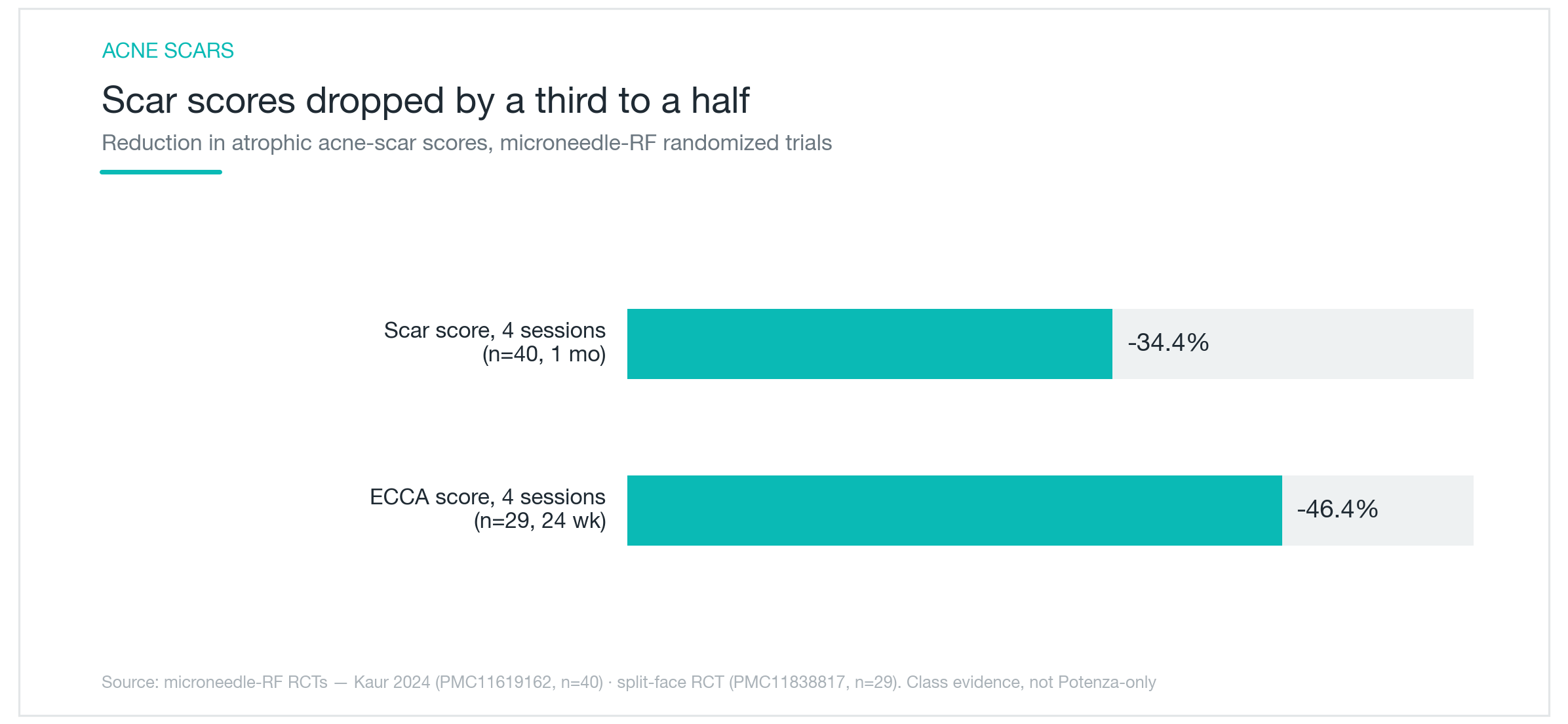
The chart above shows two data points from randomized controlled trials. In a 40-patient RCT, atrophic acne scar severity scores fell by roughly 34.4% after four sessions. A separate RCT, with 29 patients followed to 24 weeks, showed that ECCA scores (Echelle d'Évaluation Clinique des Cicatrices d'Acné, a standardized clinical severity scale) dropped approximately 46.4%. To be precise about what those numbers mean: the ratings on a clinical scale declined by those percentages. Not that scar volume was cut in half. The distinction matters, and it's one that gets lost in promotional summaries.
Scar morphology also predicts response. Rolling scars (wide, gently sloped depressions) respond well to deeper needle placement targeting the fibrous tethering at the base of the scar. Boxcar scars, with their sharper vertical walls, require adjusted depth and energy to soften that architecture. Ice pick scars are the hardest subtype: narrow, deep, slow to respond, and rarely resolve completely with RF alone. Most patients don't present with one clean scar type. The typical cheek has all three in various proportions, which is why I vary needle depth zone by zone across a single session rather than using one setting throughout.
The timeline also needs to be set correctly at the outset. Clinically visible volumetric improvement typically emerges around 12 to 16 weeks post-treatment. Collagen synthesis and cross-linking take time to mature. There is no meaningful result walking out of the first session. This is a cumulative process, and the full picture develops over months, both across sessions and after the final one.
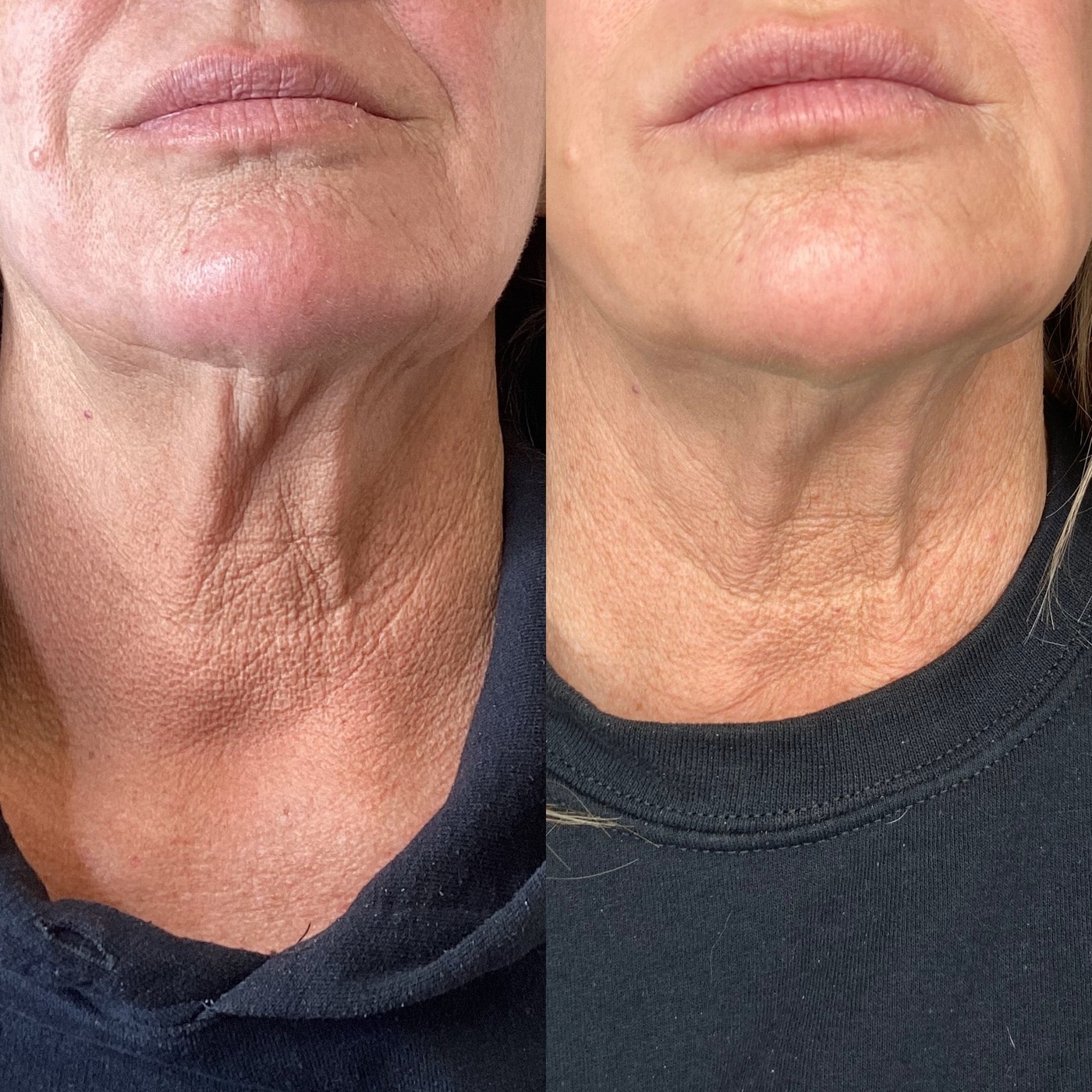
The images above show representative results from microneedling RF treatments.
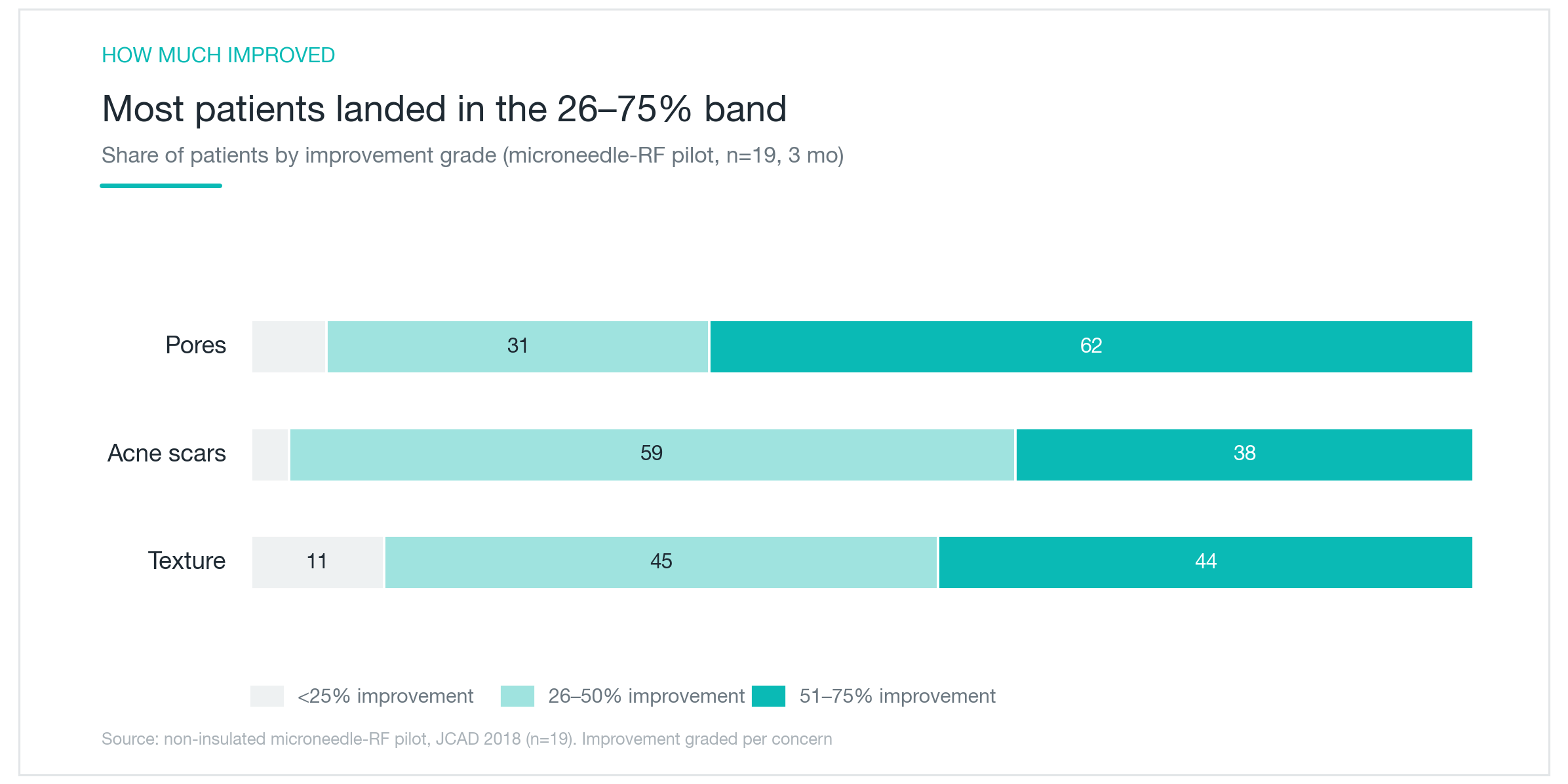
Differences in how fast pores and scars respond
Marketing for microneedling RF devices loves a clean single number: "41.7% pore reduction." When I go to the primary literature, that kind of precision isn't there. What the data actually shows is a distribution: what percentage of patients fell into which improvement band. That's the more honest picture, and it's what the chart above illustrates.
In a pilot study of microneedling RF for skin quality, roughly 62.5% of patients achieved 51 to 75% improvement in pore appearance. That's a strong result. Texture improvements distributed more broadly, spanning the 26 to 50% and 51 to 75% bands about equally. Acne scar improvement clustered in the 26 to 50% range, with approximately 59.4% of patients there, meaningful, but more modest than pore response.
Understanding why pores enlarge helps set the right expectations for that result. There are two primary mechanisms. The first: excess sebum production physically stretches the follicular opening. The second: progressive loss of dermal support. The collagen lattice surrounding the pore, which holds it taut, weakens with age and sun damage. Potenza directly addresses the second. Dermal heat tightens and remodels the peri-follicular scaffold. If enlarged pores are primarily a sebum problem, RF alone won't resolve them fully. Managing sebaceous activity through other means has to run in parallel.
That "41.7% pore reduction" circulating in device marketing? I've looked for it in primary sources. It doesn't appear as a validated number in peer-reviewed literature. It looks like a marketing distillation, possibly an average compressed into a specific-sounding figure. The actual data is distributed, less tidy, and still positive. Pores respond faster than scars, which tracks with what I see clinically. The evidence is strong enough to stand without invented precision.
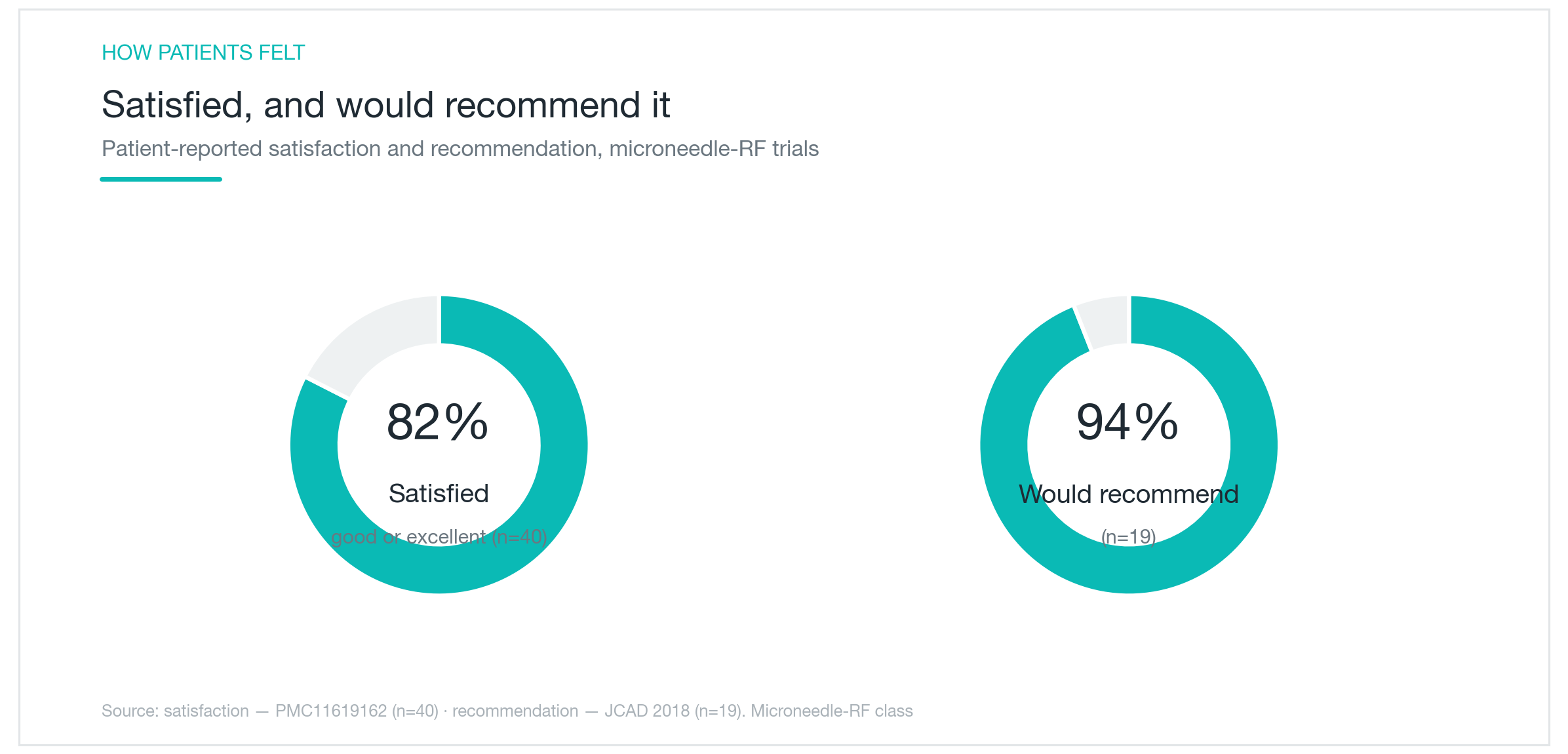
Patient satisfaction and pain level
The two charts above summarize the patient experience side. In a 40-patient microneedling RF study, 82.5% of participants rated their outcomes as good or excellent. A separate dataset on recommendation intent found 94% would refer a friend or family member for the treatment.
Pain scores were also tracked. Across studies, patients averaged roughly 1.5 out of 10 on a pain scale, with topical anesthetic in place. That's lower than most patients anticipate when they hear "microneedles" and "radiofrequency" together. The experience isn't painless. Bony areas, like the nasal bridge and forehead, where soft tissue is thinner, feel sharper than the cheeks. But the overall discomfort level is manageable for most people.
Recovery perception has an outsized effect on satisfaction. Patients who are briefed beforehand on what to expect (redness for the first several hours, some pinpoint scabbing at needle-entry sites, mild swelling) treat these as expected checkpoints and move through them calmly. Patients who weren't warned see the same post-procedure skin and come back alarmed. Same healing trajectory, entirely different experience of it. Walking through the recovery course in every consult before committing is essential.
These satisfaction figures are self-reported and come from studies of modest size within the broader microneedling RF literature. The directional signal is consistent, though: patients who entered with appropriate expectations came out satisfied at high rates.
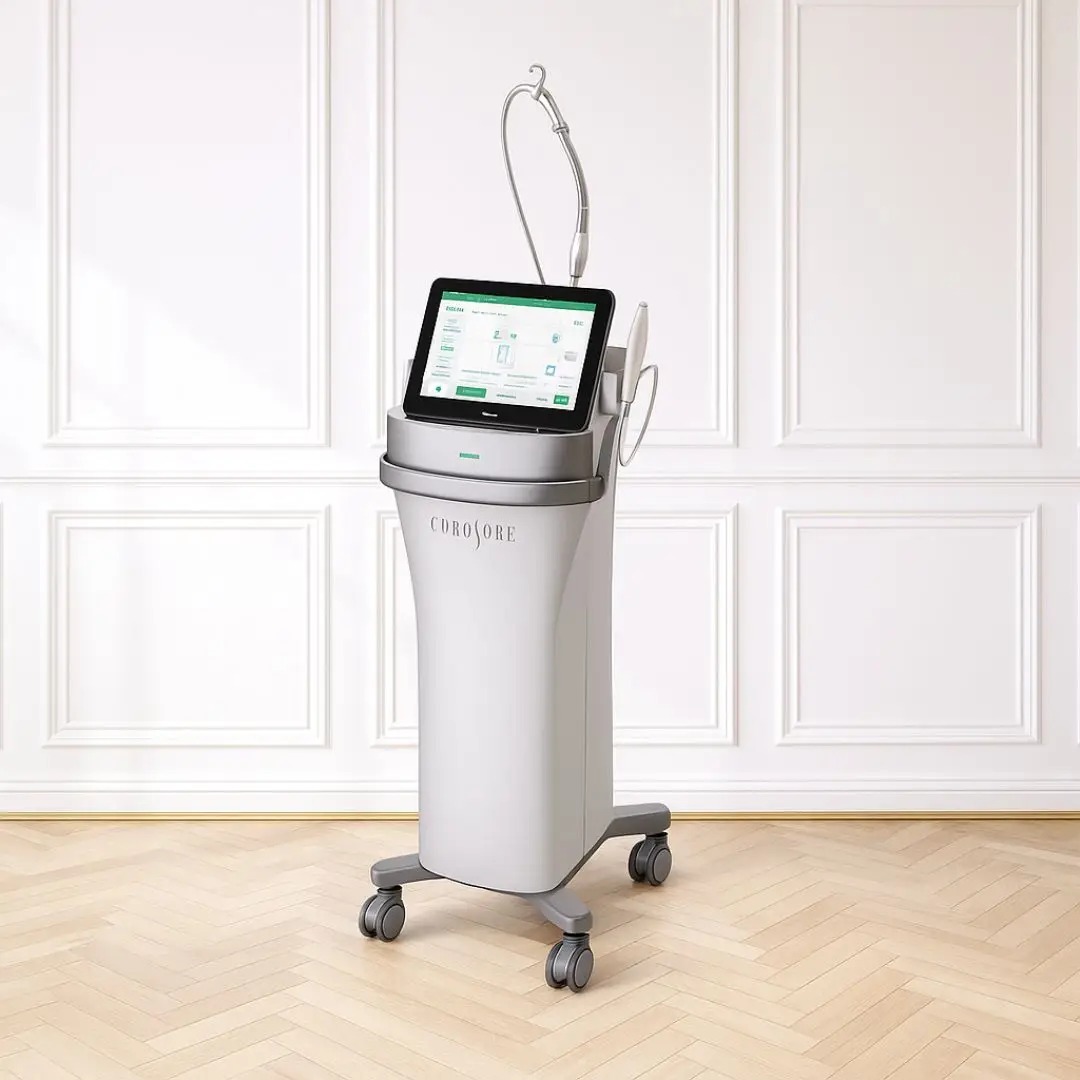
How is it different from Thermage and Ultherapy?
I get this comparison question constantly. In US aesthetic medicine, Thermage FLX, Ultherapy, and Potenza all carry "skin rejuvenation" positioning, so patients arrive wanting to know which one is better. The honest answer is that they're not competing for the same target.
Potenza delivers point-by-point RF heat via needles into the dermis (focal thermal zones at precisely set depths), driving collagen remodeling exactly where scar and pore pathology lives. It's a dermal texture and structural repair device.
Thermage FLX uses monopolar RF through a large surface handpiece (no needles), heating the dermis broadly across a treatment area. The collagen mechanism is similar, but the energy distribution is areal rather than focal, reaching into the deeper reticular dermis. It's optimized for global skin laxity, surface firmness, and mild volumetric change across larger regions. It is not a scar or pore treatment.
Ultherapy uses micro-focused ultrasound (HIFU) to deposit energy in discrete columns that reach the SMAS (the superficial musculoaponeurotic system), the fibromuscular layer beneath the subcutaneous fat. Nothing else in non-invasive aesthetics consistently targets SMAS. The application is deep lifting and facial contour, not dermal texture.
Put simply: pore and acne-scar concerns belong to Potenza. Global skin laxity and firmness point toward Thermage FLX. Deep structural lifting points toward Ultherapy. In practice, these run in combination: Potenza handles the texture and scar layer while another modality addresses the lifting component separately. No head-to-head trials across these three devices exist, so any claim of absolute superiority is not data-supported.
For patients researching this space: Morpheus8 by InMode operates on the same core mechanism as Potenza (fractional microneedling RF) and is one of the most widely used devices in its category across US aesthetic practices. If you're looking at Potenza, you'll encounter Morpheus8 in that same conversation; they share overlapping indications and a similar evidence base.
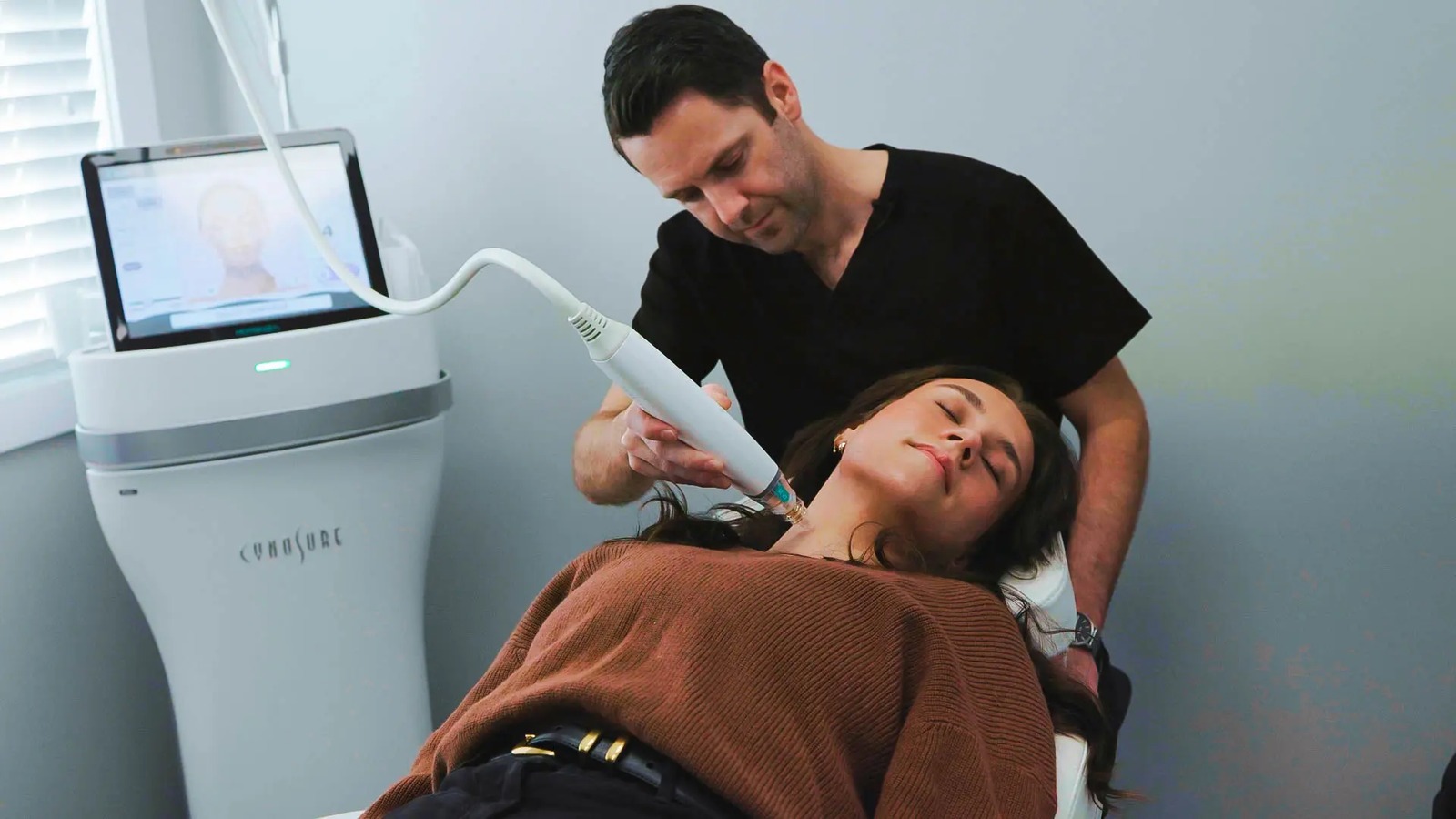
Who it suits and when to postpone
Candidates who tend to do well are fairly easy to identify: enlarged pores (particularly those with a dermal-laxity component rather than pure sebum), atrophic acne scars, rough skin texture that resists makeup, early-to-moderate laxity where a restorative stimulus, not dramatic lifting, is the goal. Multiple sessions are standard. Most protocols run 3 to 4 sessions, spaced 3 to 4 weeks apart, allowing each round of collagen remodeling to progress before layering in another stimulus.
Where I pause or decline: active acne flares. Treating scarring while active inflammation is disrupting the dermis is counterproductive. The acne management comes first. Patients with a documented tendency toward keloid formation need careful discussion; RF-induced thermal injury carries theoretical risk of activating that same fibroblast response, even though the needle wounds are small. Pregnancy is a categorical exclusion for elective energy-based treatments.
Post-treatment, the course is predictable if you know what to expect. Redness for several hours, largely resolved by the following morning. Some microswelling. Pinpoint scabbing at needle-entry sites over the first few days, which should be left completely alone. No picking, no exfoliants, no active serums until the barrier re-establishes. Gentle lukewarm cleansing starting the morning after treatment, and holding off on makeup for a day or two until the skin surface has stabilized. Sun protection is mandatory throughout the healing window. UV exposure on disrupted skin accelerates post-inflammatory pigmentation.
Patients with darker Fitzpatrick skin tones (IV to VI) receive more conservative energy parameters. The dermal mechanism is identical, but the risk of post-treatment dyspigmentation is meaningfully higher, and settings need to reflect that.
A final word on marketing language. "400% collagen increase." "41.7% pore reduction." These figures appear across promotional materials for microneedling RF platforms. They are not supported by the primary peer-reviewed evidence. What is supported: clinically meaningful reductions in acne scar severity scores, improvement in pore appearance for a majority of patients, and high satisfaction rates. That's a solid evidence base. It doesn't need invented specificity to hold up.
Patients who start this process understanding that improvement is gradual, cumulative, and best assessed at four months rather than four days are the ones who finish it satisfied. Set expectations early, and Potenza is a genuinely useful tool for what it actually does.
Was this helpful?
About this article
Written by a practising aesthetic physician and intended for general education — not a substitute for individual medical advice.
Read next
Virtue RF Insulated Needle Effect: Improvement in Pores and Scars, and Pain
Virtue RF treats pores, acne scarring, and skin laxity with insulated microneedling radiofrequency. We'll cover how insulated needles differ from non-insulated ones, how it compares to Potenza and Sylfirm X, and its current limitation: dedicated clinical trials on the brand itself are still limited.
By Dr. Lee
Titanium Lifting Effect and Limits, and How It Differs From Ultherapy and Thermage
What Soprano Titanium's triple-wavelength diode laser actually does for skin laxity, texture, and tone, with a clear-eyed look at the clinical evidence and its real limitations.
By Dr. Lee
Rejuran PDRN Injection: Evidence for Scars and How Long Results Last
PDRN, the salmon-derived DNA fragment at the heart of Rejuran injections, has more published clinical evidence behind it than most injectable skin treatments. A clinician's breakdown of how it activates collagen production and microvasculature, what the research actually demonstrates, where the evidence runs thin, and which patients genuinely benefit.
By Dr. Kim