AllTight Lifting: Does Heating Only the Dermis Hold Up?
By Dr. Kim8 min read

If you've been researching non-surgical skin tightening, you've probably already landed on the usual names: Thermage FLX, Ultherapy, maybe Sofwave. AllTight is newer, less familiar, and increasingly showing up in conversations about radiofrequency lifting. The pitch: it heats the dermis and deeper fascial layers without irritating the surface, which means less discomfort, no real downtime, and a subtle tightening you can feel right away.
That's a compelling claim. The question worth asking is how much of it is engineering reality versus marketing ambition. RF lifting as a category has a legitimate body of evidence behind it. AllTight as a specific device is a different story, and a shorter one. Knowing the difference between "this is how RF energy behaves in skin" and "this is what AllTight has actually proven" is what lets you walk into a consultation with the right expectations.
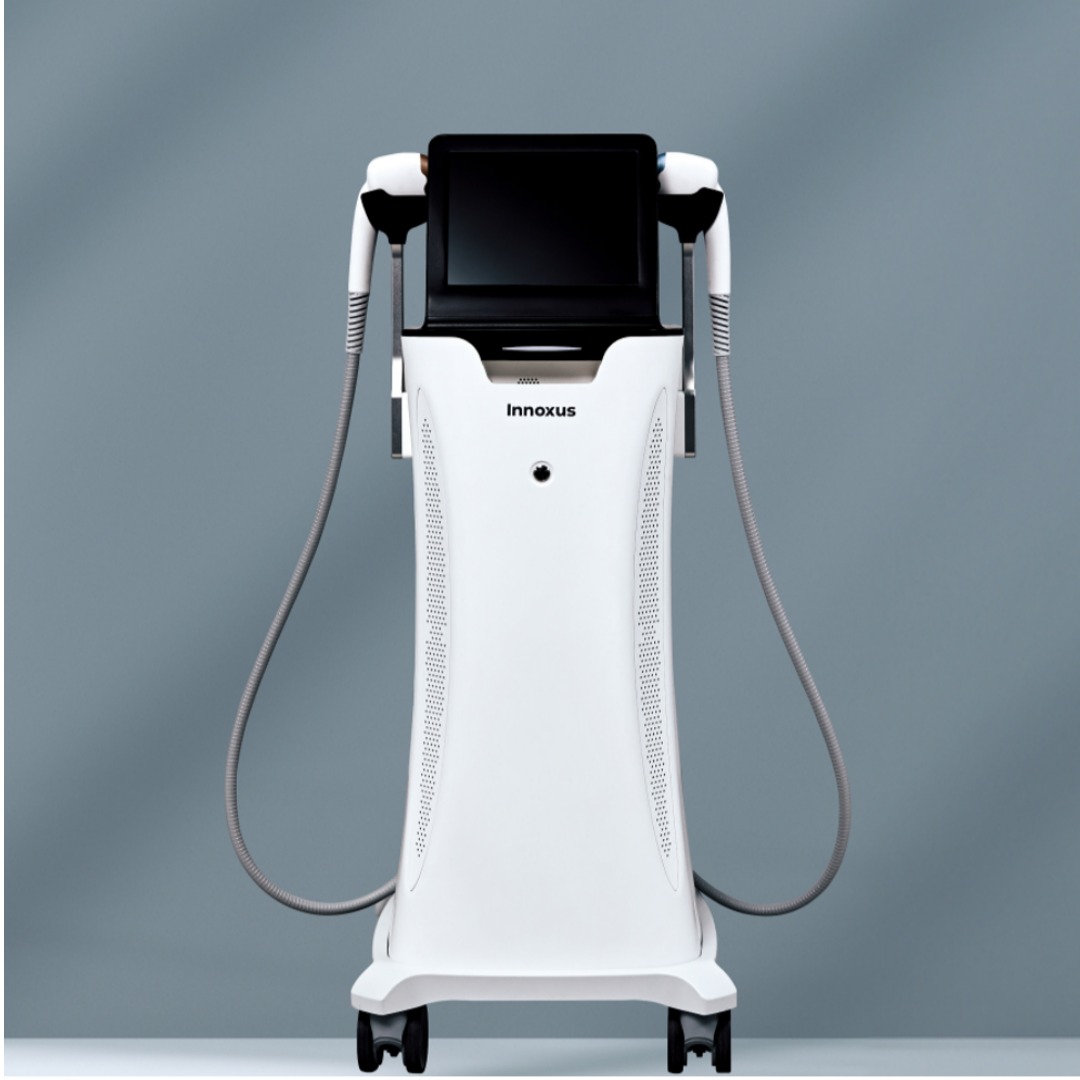
What kind of treatment is AllTight?
AllTight is a non-invasive RF device made by Inosys, a South Korean company founded around 2022. Its proprietary technology is called DLTD, a dielectric heating approach the company describes as targeting the dermis from within, using the tissue's own water content to concentrate heat at depth rather than at the surface. No needles, no ablation. In terms of device category, it sits alongside Thermage FLX and Onda in the capacitive and monopolar RF lifting space, though each uses a different frequency and electrode design.
The differentiating claim is selectivity. AllTight is designed to heat the dermis and superficial muscular aponeurotic system (SMAS) while keeping the epidermis cool. Per Inosys, the dermis is water-rich and absorbs the applied RF frequency more readily, while subcutaneous fat, being water-poor, heats less. Cool the surface, concentrate energy in the dermis, and you theoretically get collagen stimulation with minimal surface irritation. That's the rationale for low pain and zero downtime.
A few things worth flagging before going further. Inosys is a young company that has attracted significant investment, but its regulatory clearance history (FDA, CE, or otherwise) isn't clearly documented in publicly available sources. Before booking a session, ask your provider directly about device certification and whether the unit they're using is commercially registered. The fact that it's new is simultaneously what makes it interesting and what makes the evidence base thin. AllTight gets mentioned alongside Thermage and Ultherapy as a competing option, but that framing reflects market positioning, not head-to-head clinical data.
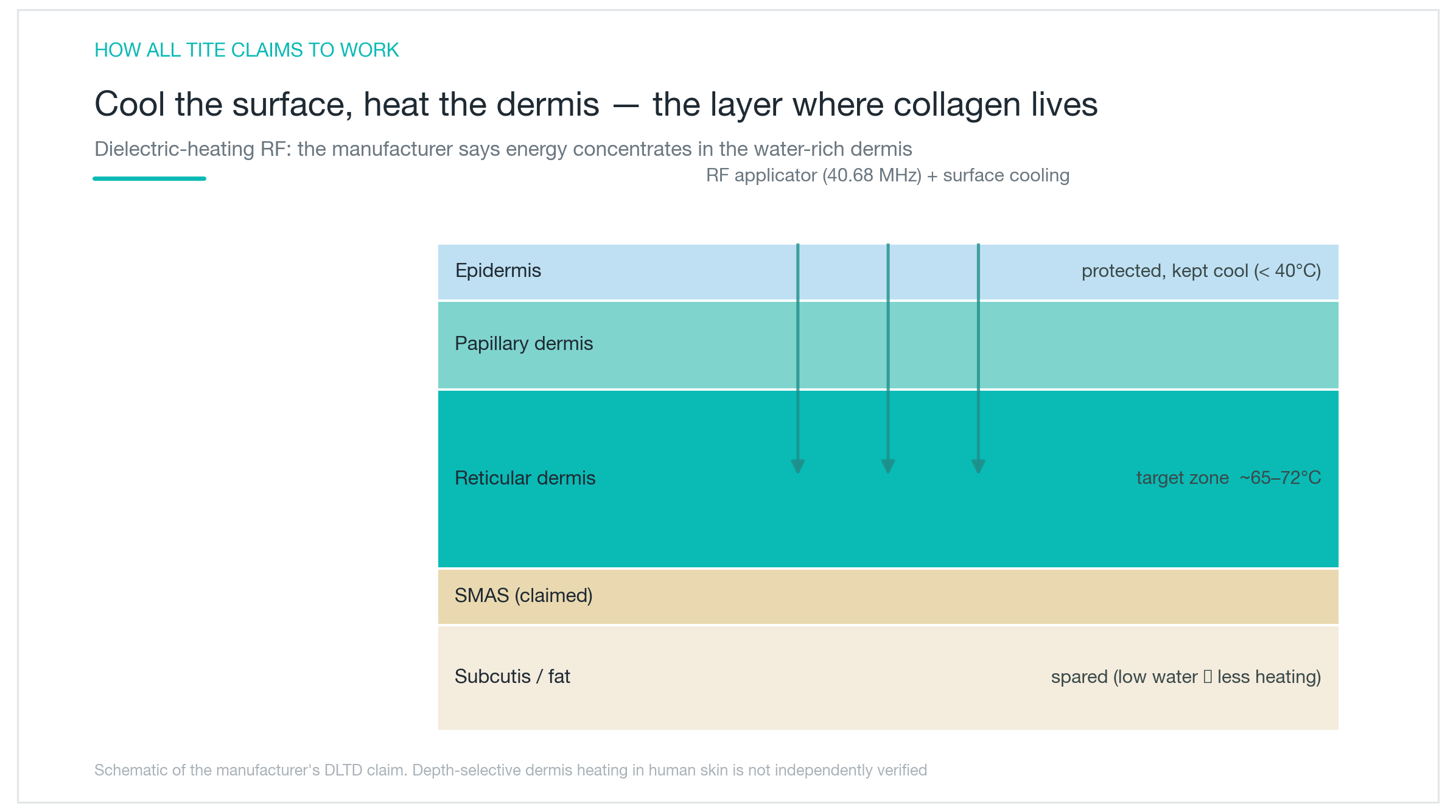
How does it cool the epidermis and heat only the dermis?
The diagram above illustrates the concept. Radiofrequency current oscillates charged molecules in tissue, generating heat through friction. AllTight uses a relatively high RF frequency chosen to maximize energy absorption in water-rich tissue, the dermis, while actively cooling the skin surface during delivery. The logic: protect the epidermis, concentrate heat where collagen actually lives.
When dermal tissue reaches a threshold temperature, collagen fibers contract immediately. That's the subtle "snap" of tightening people describe right after treatment. Over the following two to three months, the mild controlled injury triggers a wound-healing cascade: fibroblasts lay down new collagen and elastin, which is where the longer-term improvement comes from. Immediate firmness plus delayed remodeling: that's the dual mechanism all RF lifting platforms are chasing.
The selective heating concept has a legitimate physical basis. Water does absorb RF energy more efficiently than fat at certain frequencies, and surface cooling is standard practice across RF platforms; Thermage has used a cryogen spray for exactly this reason for years. What doesn't yet exist is independent, in-vivo thermal mapping confirming that AllTight achieves its claimed dermal-versus-epidermal heat gradient in actual human skin. The company's figures on differential heating between dermis and fat haven't been externally validated. The physics are sound in principle; whether this particular device achieves that precision in living tissue is a separate and still-open question.
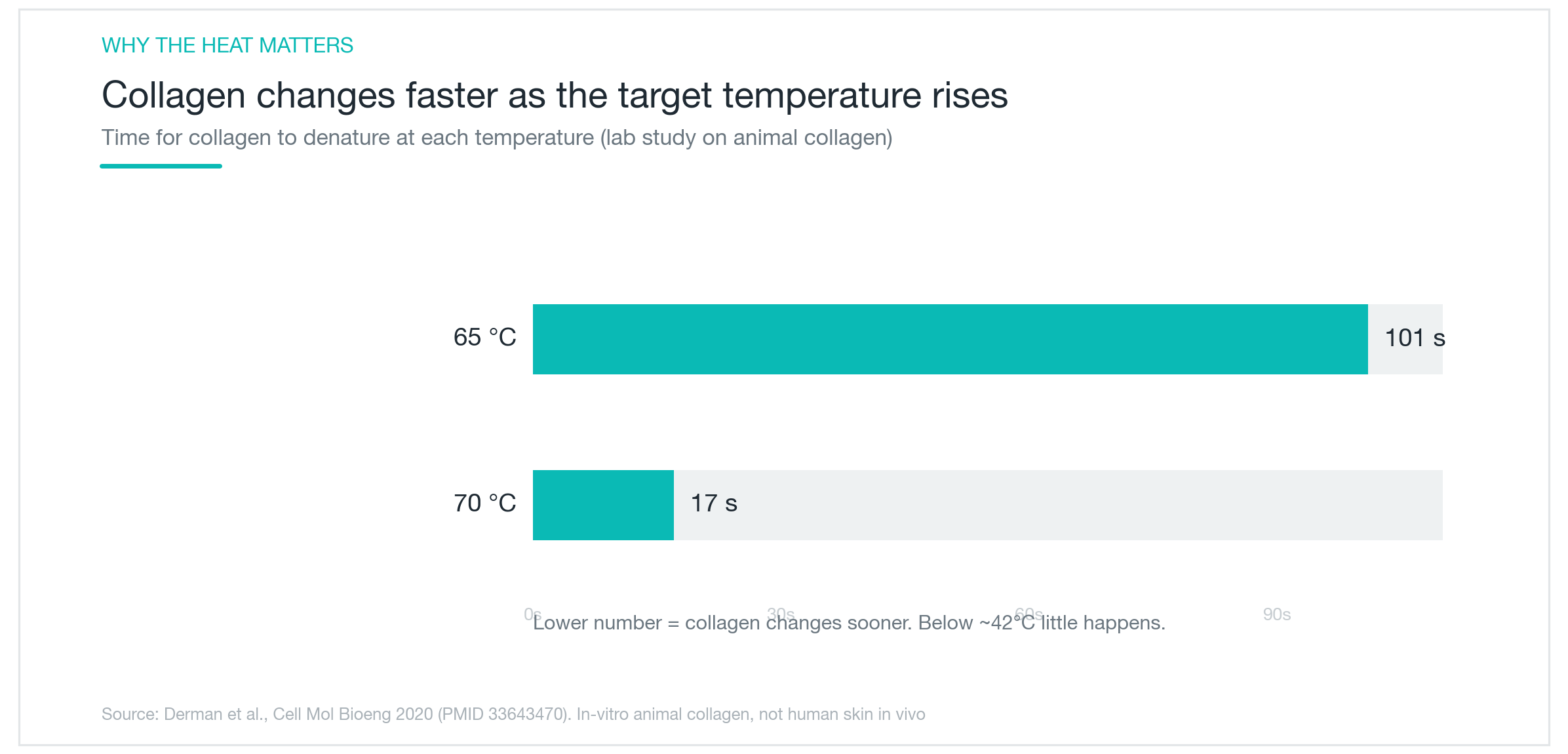
Does RF really increase collagen?
The graph above reflects real laboratory data. Collagen begins to denature at specific temperature-time combinations: around 65°C for roughly 100 seconds, and 70°C for about 17 seconds. RF lifting devices are calibrated around this thermal window: heat the dermis enough to trigger remodeling without damaging the epidermis above it. Even modest heating above 42°C starts producing some immediate collagen contraction; meaningful remodeling requires higher sustained temperatures.
Human studies on RF lifting, primarily using Thermage, do support this framework. Biopsies after monopolar RF treatment have shown measurable increases in dermal collagen and elastic fibers at two to three months. Smaller controlled studies on peri-orbital and mid-face laxity have reported improved skin texture and reduced fine lines. The general principle that calibrated thermal injury to the dermis stimulates collagen production is reasonably well established at this point.
Two honest caveats. The temperature figures in that graph come from in vitro testing on animal-derived collagen, not probes placed in living human dermis during treatment. They're reference benchmarks, not precise clinical targets. And the human RF studies, while directionally consistent, are mostly small and uncontrolled: ten to thirty patients, no sham arm, observer-rated outcomes. Effect sizes vary considerably across papers. The direction is clear; the confidence in specific magnitudes is not.
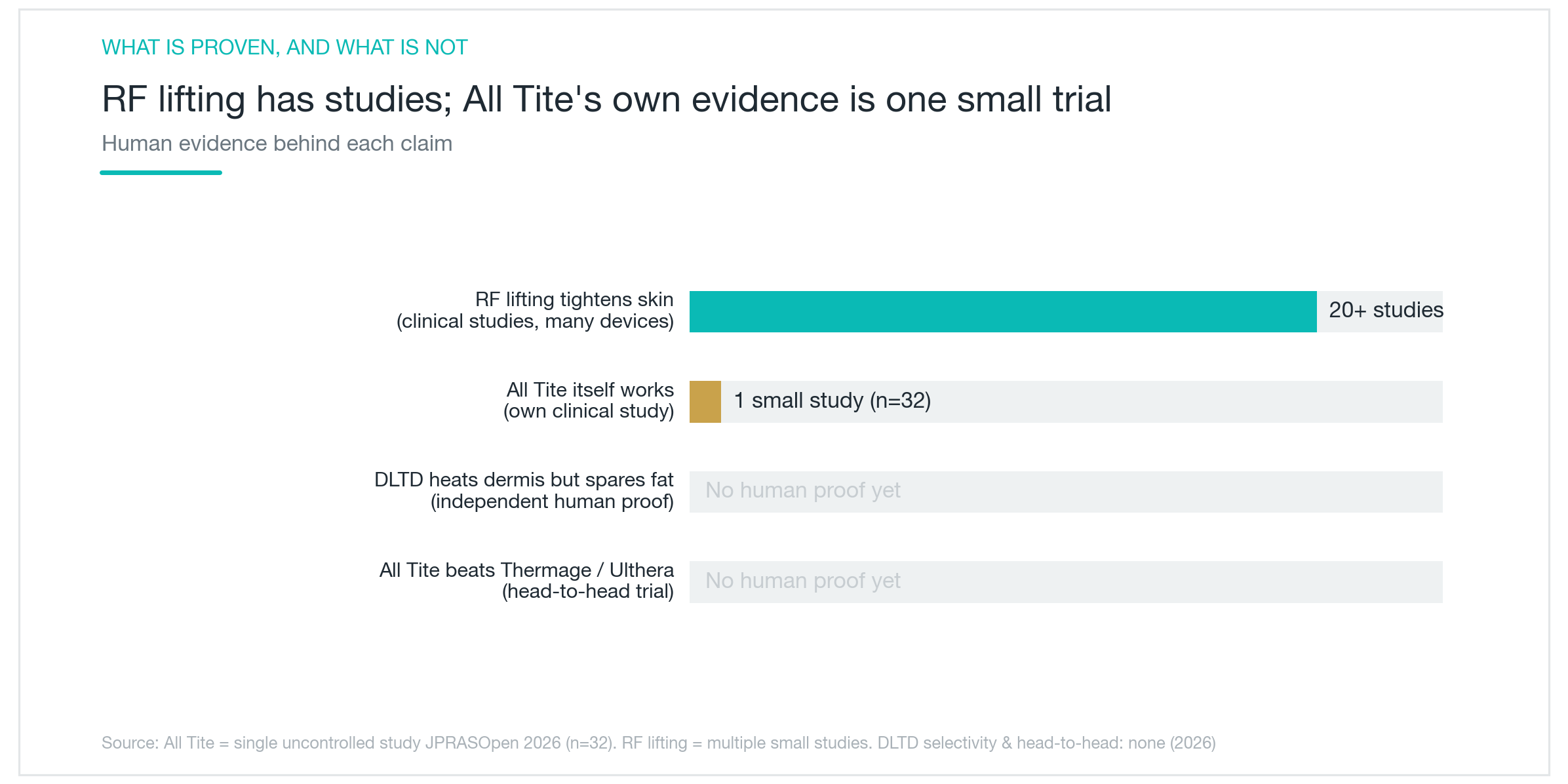
How much AllTight-specific clinical evidence exists?
AllTight's distinguishing claims rest on two things: dielectric heating and selective dermal targeting. Both are reasonable engineering concepts. Neither has been tested against established RF platforms in a controlled clinical trial. There is no published study comparing AllTight to Thermage FLX, Ultherapy, Sofwave, or any other device on direct efficacy or safety measures. The evidence chart above makes this concrete: RF lifting has a clinical literature; AllTight has one paper.
That paper, published in 2026, followed 32 patients who received AllTight treatment to the face. Single-arm, observational, no control group, no blinding. Patients reported reduced wrinkles and high satisfaction, which is a reasonable early signal. But one uncontrolled study of 32 people is a thin foundation for superiority claims. And the core assertion, that this device preferentially spares fat while heating dermis, has not been verified by histology or thermal imaging in human subjects.
To put it plainly: AllTight is a new Korean RF device operating within a category that has legitimate evidence behind it. Its design approach is logical. The leap from "this is a smart design" to "this outperforms Thermage or Ultherapy" simply hasn't been made yet in the published literature. Expect modest improvement consistent with RF lifting generally. The dielectric heating framing doesn't mean this is a categorically different experience; that remains a hypothesis, not a finding.

Pain, side effects and how long results last
The most consistently cited upside of AllTight is comfort. Because the surface is cooled and energy concentrates at depth, patients typically report less discomfort than with conventional monopolar RF, the kind that often requires topical anesthesia and can still be uncomfortable at adequate Thermage energy settings. Post-treatment, most people can wash their face and apply makeup the same day. Redness and mild swelling are the expected reactions, and they typically resolve within hours.
The risks are real, even if uncommon. High-energy RF to the face carries a documented risk of fat atrophy, a localized hollowing of the cheeks from inadvertent heating of subcutaneous fat. It's relatively rare and often correctable, but it's a recognized complication across RF platforms when settings are too aggressive. Inosys argues that AllTight's fat-sparing mechanism lowers this risk, which is mechanistically plausible, but it hasn't been verified with comparative incidence data. Provider experience with dosing parameters matters here, probably more than the device itself.
Realistic expectations are the other thing. AllTight is a treatment for mild-to-moderate skin laxity, early jowling, a softening jawline, the loss of firmness that accumulates through your 30s and 40s. It is not a substitute for a thread lift or surgical facelift in patients with significant tissue descent. If you're looking at visible ptosis rather than texture and firmness, have that conversation before booking. Effects typically last 12 to 18 months; maintenance sessions are the norm as aging continues.
The right candidate wants to preserve or modestly restore skin firmness without surgery, is comfortable with gradual improvement over several months, and isn't expecting the kind of lift that only tissue repositioning can achieve. AllTight fits that profile, with the caveat that its evidence base is still being built. Approach it as a promising new entrant in a legitimate device category, calibrate your expectations to what RF lifting as a class delivers, and the treatment can absolutely be worthwhile.
Was this helpful?
About this article
Written by a practising aesthetic physician and intended for general education — not a substitute for individual medical advice.
Read next

10THERMA Lifting: Effect and Pain, and How It Differs From Thermage
A look at what 10THERMA actually is, how it compares to Thermage as a monopolar RF device, what dedicated clinical evidence shows, how much it hurts, and who it suits best.
By Dr. Kim
Sofwave Lifting Effect: How Is It Different From HIFU?
Sofwave works by firing seven parallel ultrasound beams that each independently create a heat coagulation zone in the mid-dermis, without focusing them together. This article explains, in plain terms, why the beams pass through the epidermis without heating it, why they only heat up at the collagen-rich layer, and how that heat leads to new collagen production.
By Dr. Lee
Radiesse Filler: Results, How Long It Lasts, and Collagen Production
Radiesse is a filler whose calcium microspheres fill volume instantly while also triggering new collagen production. Here is a mechanism-focused look at why the particles create volume, how that leads to collagen stimulation, why diluted Radiesse is used as a skin booster, and how long results actually last.
By Dr. Lee