10THERMA Lifting: Effect and Pain, and How It Differs From Thermage
By Dr. Kim8 min read

When skin starts losing firmness and you look into RF lifting, the name 10THERMA often comes up right next to Thermage. It's made by Tentec, a Korean device company, and because its cooling method and output are similar to Thermage's, it's frequently mentioned as a Korean alternative.
But the name alone doesn't tell you how similar or different the two really are. What does it actually mean to be in the same family? How much has 10THERMA's own effect been verified? Is the pain and downtime manageable? These are all fair questions to ask.
Devices grouped under the same category can still differ in tip design, cooling method, and confirmed clinical outcomes from one manufacturer to the next. That's why it's worth looking past the spec sheet and into the actual clinical evidence.
Here's a quick side-by-side of 10THERMA and Thermage.
| Item | 10THERMA | Thermage |
|---|---|---|
| Method | Monopolar RF | Monopolar RF |
| Frequency | 6.78 MHz, up to 400 W | 6.78 MHz |
| Cooling | Contact cooling tip | Contact cooling tip |
| Position | Korean-made, more accessible pricing | Original, 20 years of clinical evidence |
Here's a closer look at 10THERMA's basic specs, how the tightening actually works, what the head-to-head studies with Thermage show, and who it fits best.
What Kind of Device Is 10THERMA?
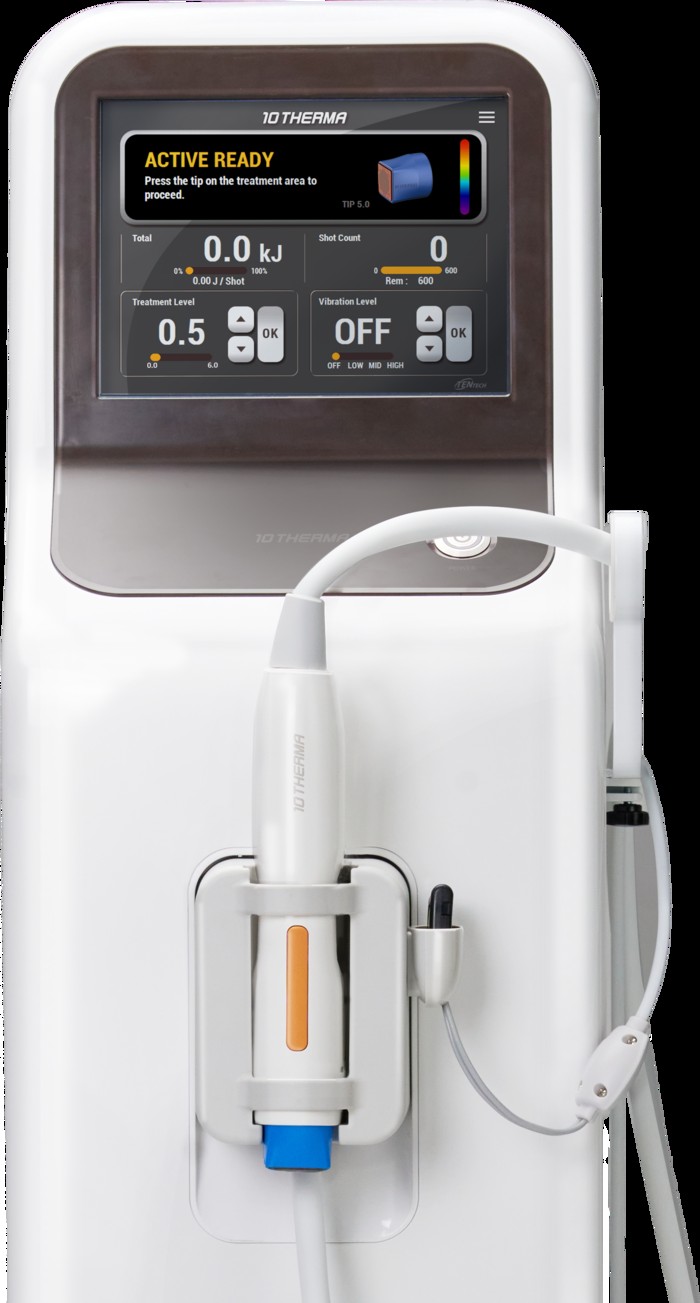
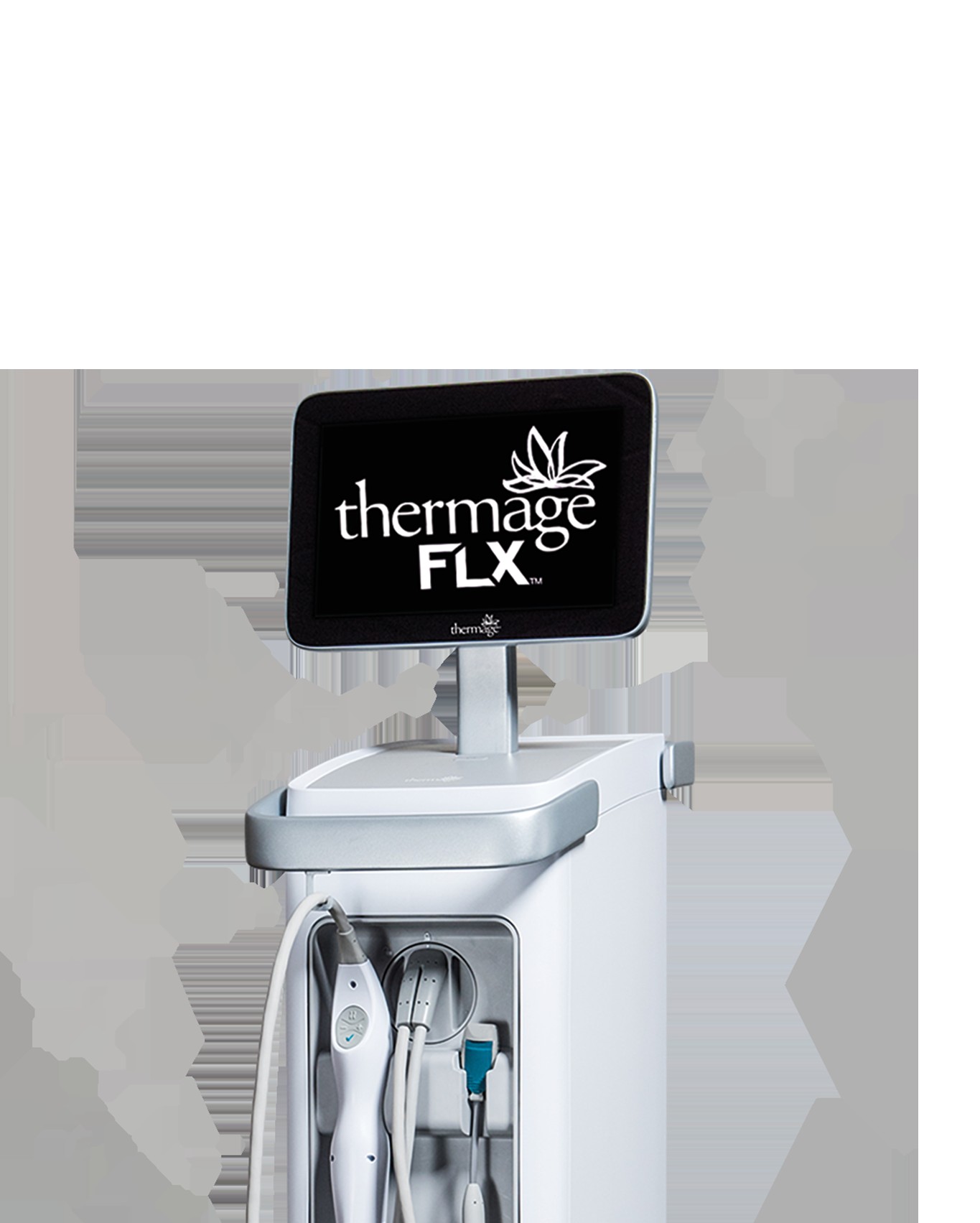
10THERMA is the full name of the device, a monopolar RF lifting machine made by Tentec, a Korean medical device company. It delivers RF energy in the 6.78 MHz band at up to 400 W, and the newer model adds a dual mode that also runs at 2.0 MHz.
Tips come in different sizes by area. A 5 cm² tip is used for the face, a smaller tip around the eyes, and larger tips for broader areas like the body. Each tip has a contact cooling device built into the end that cools the skin surface the moment it touches, and this cooling approach is the same family Thermage uses. That's why 10THERMA sits in the same broad category as Thermage, a monopolar RF device with contact cooling, and it's often called the Korean version of Thermage. In terms of price and effect, think of it as a Korean device positioned somewhere between Density and Thermage.
It has the regulatory credentials to back it up. It received US FDA 510(k) clearance in December 2023, along with Korean MFDS approval and European CE marking. For a relatively new brand, it has worked through the certification process thoroughly.
How Does Radiofrequency Heat Tighten Collagen?
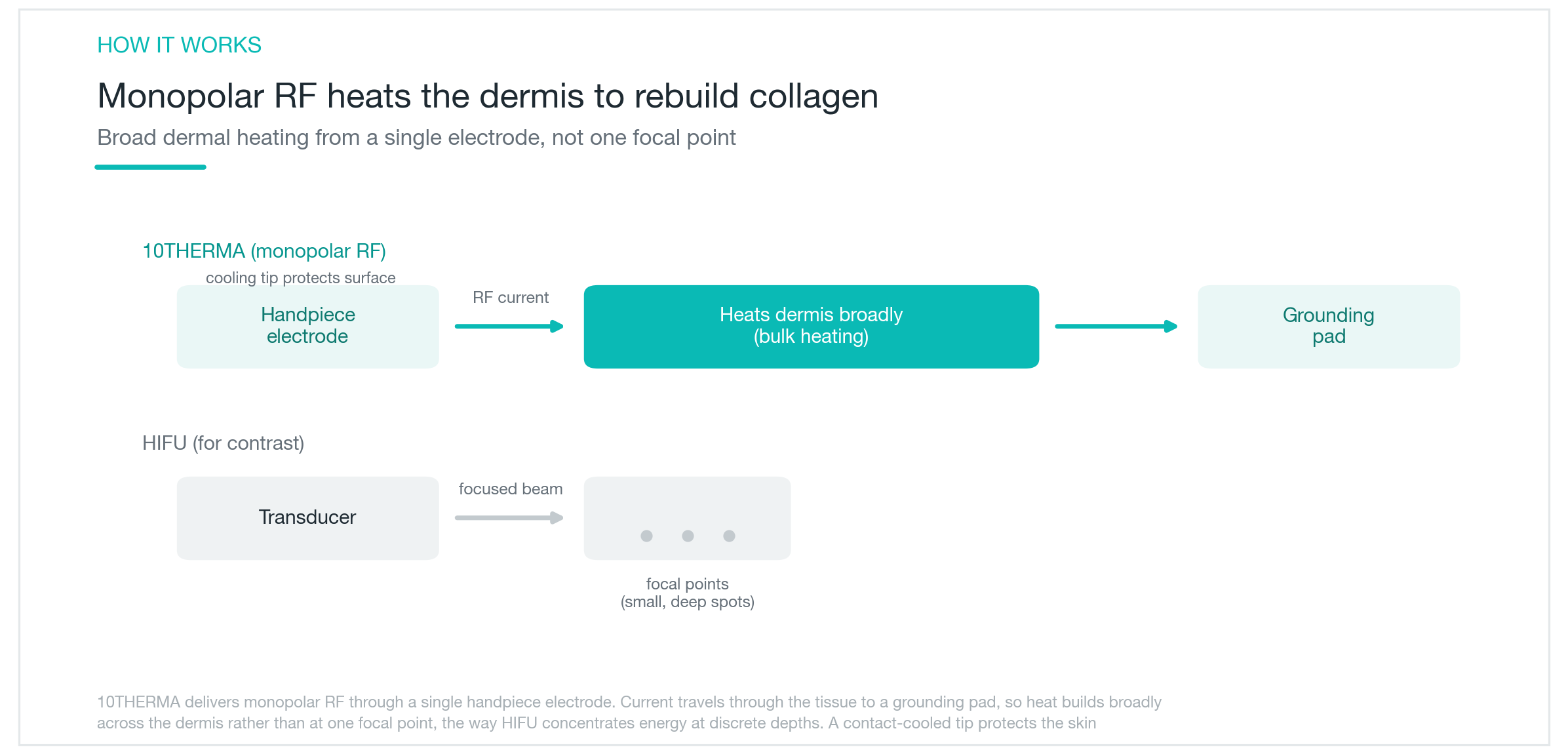
10THERMA runs on the monopolar principle. RF current flows from the tip toward a grounding pad attached to the body, and resistance along that path generates heat in the tissue it passes through. Because the current's path is wide, it's well suited to heating the entire dermis at once. That's what sets it apart from HIFU, which focuses energy into a narrow point aimed only at the fascia layer.
Collagen contracts immediately once it's heated past a certain point. Research shows that collagen denatures and contracts between 55°C and 65°C, and this heat has been reported to reach as deep as 6 mm into the skin. It's a similar reaction to how fabric shrinks when it hits hot water.
That contraction is only the start. Once the dermis is heat-stimulated, it goes on to produce new collagen over the following weeks and months, gradually filling back in firmness. Meanwhile, the contact cooling at the tip protects the surface from burning during this process. Heating the dermis while protecting the surface is the core design behind 10THERMA and monopolar RF lifting as a whole.
A single session involves moving the tip across the whole face repeatedly, building up energy shot by shot, so the outcome depends on how much energy goes where. That's why output and shot count planning tends to vary with the practitioner's experience.
Is the Effect Different From Thermage?
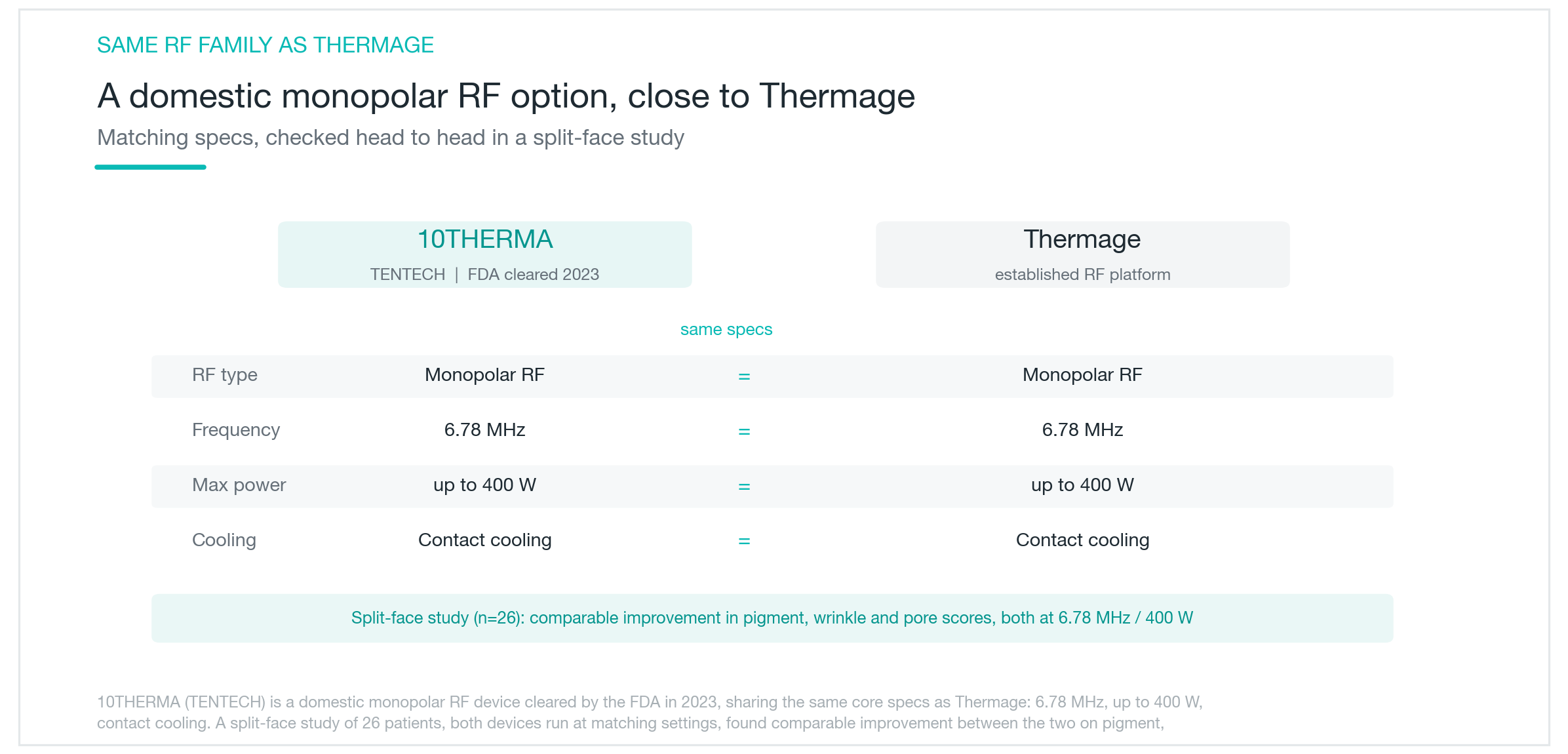
10THERMA and Thermage overlap on quite a few fronts. Both run at 6.78 MHz with up to 400 W output, and both use a contact cooling tip to protect the surface. In the broad strokes, they run on the same underlying principle.
There's an actual study that treated one side of the face with each device and compared results directly. In this 26-person study, researchers looked at four measures: melanin index, a pigmentation score graded separately on each half of the face, wrinkles, and pores. Both sides improved significantly, and there was no clinically meaningful difference between the two devices. Given that they run at the same frequency and output, the similar outcome tracks.
There are differences too. The newer 10THERMA model adds a dual mode that also runs at 2.0 MHz, and tip design and treatment protocols vary subtly between brands. There are several Korean devices on the market claiming similar specs, so it's worth confirming exactly which device is being used when you consult. 10THERMA doesn't yet match Thermage's 20 years of evidence, but it shares the same core mechanism as devices in that family while lowering the price barrier.
Results From 10THERMA-Specific Studies
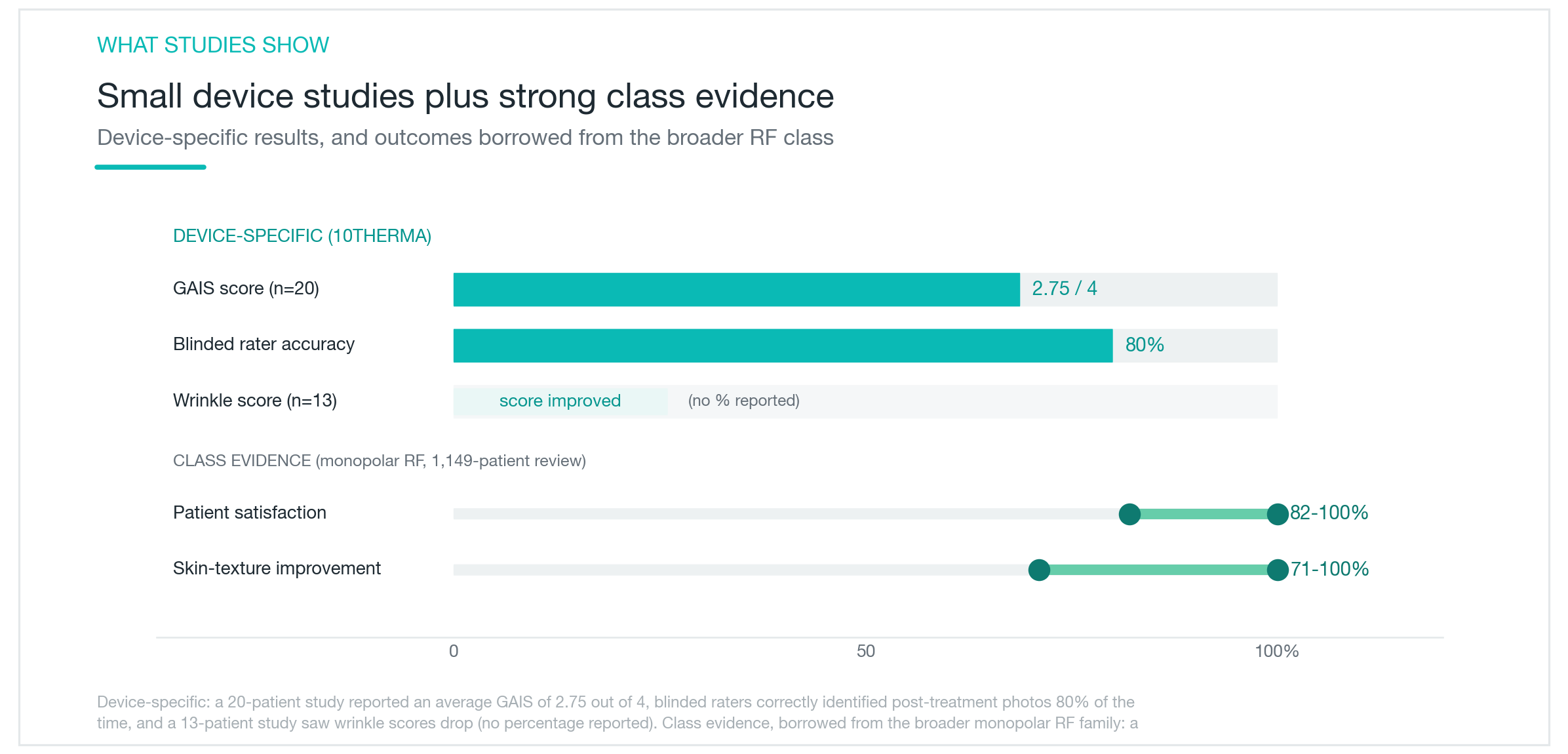
There are a handful of clinical studies dedicated to 10THERMA specifically. One study of 20 adults aged 28 to 63 measured overall improvement on a 4-point scale at 12 weeks after a single treatment and recorded an average score of 2.75. Among raters who judged before-and-after photos blind, 80% correctly identified the post-treatment photo, participant satisfaction came in above 7 out of 10, and there were no adverse events. A separate multicenter study of 13 people, focused on the eye area and cheeks, also confirmed improvement at 4 and 16 weeks.
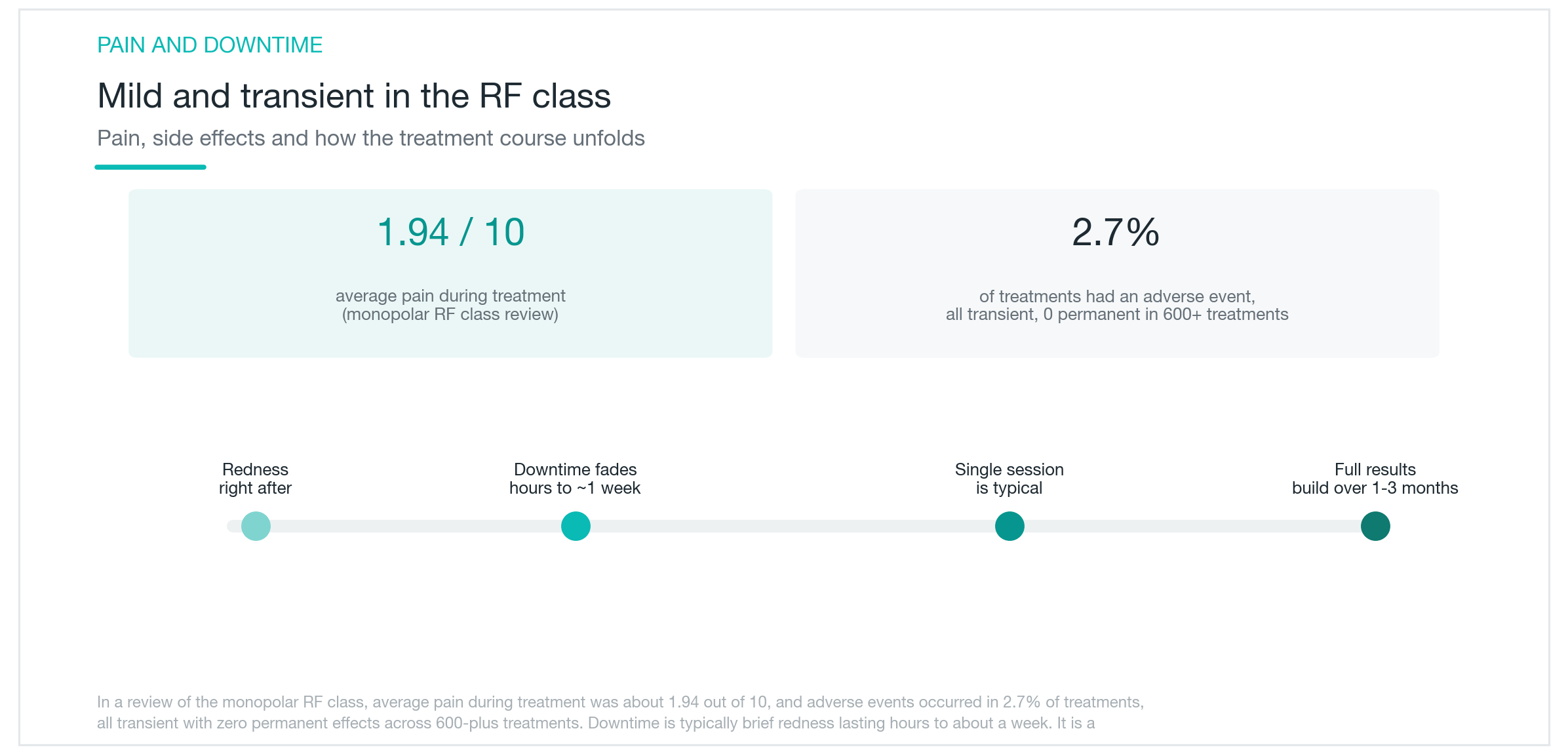
Add in the head-to-head study with Thermage mentioned earlier, and 10THERMA's dedicated evidence now spans three studies of 20, 13, and 26 people. That's not a large body of evidence yet, but it's building. On top of that, there's the much larger, longer-standing dataset for monopolar RF as a class. A review covering more than 1,000 patients found an adverse event rate around 2.7%, all temporary with no permanent complications, and a pooled review of multiple studies reported satisfaction between 82% and 100%, with pain scores under 2 out of 10.
The effect isn't fast to show up. Separate from the tightening you feel right after the session, the real change from new collagen filling in typically unfolds slowly over a month or two, sometimes longer.
How Painful Is It, and What Is the Downtime?
Because the treatment heats the dermis with RF energy, you'll feel a stinging, hot sensation during the session. That said, the contact cooling at the tip lowers the surface temperature at the same time, and both the dedicated studies and the broader class data describe the pain as generally manageable.
Mild redness or swelling is common afterward, and these usually settle within a day to a week. Reactions like burns or nodules are reported only rarely. There's no dedicated recovery period needed, and going straight back to normal activities the same day is one of the advantages.
The real change, from new collagen filling in, shows up over one to three months after treatment. That said, there's no dedicated 10THERMA study tracking outcomes beyond 16 weeks yet, so how long results hold beyond that point is estimated based on Thermage data from the same device family.
A numbing cream can be applied beforehand if pain is a concern. Still, keeping intensity too low just to avoid discomfort can reduce the effect, so the goal is to deliver enough energy, at a tolerable level, to get a real result. Since this is a heat-based treatment, avoiding saunas and strong sun exposure, and keeping the skin moisturized for a few days afterward, helps recovery.
Who 10THERMA Suits
10THERMA suits people with early to moderate laxity, where firmness has just started to slip, as well as those who want to get ahead of it preventively. Since the pain and downtime burden is low, it's an easy treatment to try, and it particularly suits people who want Thermage-like results at a lower cost.
It's worth setting expectations realistically. RF lifting works by rebuilding collagen to tighten skin, not by cutting away and lifting sagging tissue the way surgery does, so it has real limits for a face that's already significantly lax. There's a common assumption that Thermage delivers a more certain immediate tightening effect given its longer track record, but as the comparison study above showed, there was no clinically meaningful difference in improvement between the two devices.
Since collagen takes time to build back in, it helps to watch results unfold over time rather than expect a dramatic change from one session. The dedicated clinical evidence isn't large yet, but it's growing, and given that 10THERMA shares its core mechanism with a well-established class of devices, it's a reasonable option to consider.
Rather than treating it as a one-time fix, approaching it as ongoing maintenance timed to the skin's natural collagen cycle helps results last longer. And since it's an easy treatment to start with, it's a comfortable option for anyone trying RF lifting for the first time.
Was this helpful?
About this article
Written by a practising aesthetic physician and intended for general education — not a substitute for individual medical advice.
Read next

Density Lifting Effects: How Does It Compare With Thermage?
A plain look at what Density RF actually is, how its dual monopolar-bipolar mode differs from single-mode RF like Thermage, what the clinical evidence shows, how much it hurts, what downtime to expect, and who is and isn't a realistic candidate.
By Dr. Kim
Emface Lifting Effect and Wrinkle Improvement, Including Number of Sessions
Here is what EMFACE actually does, how HIFES and synchronized RF work on facial muscles and skin at the same time, and how far the wrinkle and lifting results hold up under real research. We also look at how it differs from surgical facelifts and who tends to suit it best.
By Dr. Kim

Sylfirm X Pulse Wave: Effect on Melasma and Redness, and Downtime
A clear-eyed look at how Sylfirm X works as a microneedle RF device, how pulsed wave addresses melasma and facial redness, what the clinical evidence actually shows, what pain and downtime to expect, and who is most likely to benefit.
By Dr. Lee