DoubleTite: RF Microneedling and Skin Booster Effects
By Dr. Kim7 min read

When exploring lifting and skin rejuvenation treatments, you'll likely come across DoubleTite. It's described a little differently from other devices: fine needles deliver radiofrequency energy into the dermis while simultaneously introducing a skin booster. The needles also come in two lengths, meaning the device addresses different depths of the dermis in a single pass.
This article goes through exactly what DoubleTite is, what it means to deliver RF and a drug agent at the same time, and what kind of results you can realistically expect, drawing on actual published research. RF microneedling as a platform has a solid body of evidence behind it, and DoubleTite inherits the same core mechanisms. Going through the needle lengths, cooling system, and drug delivery one by one should make it easier to decide whether this treatment fits your goals.
What kind of device is DoubleTite?
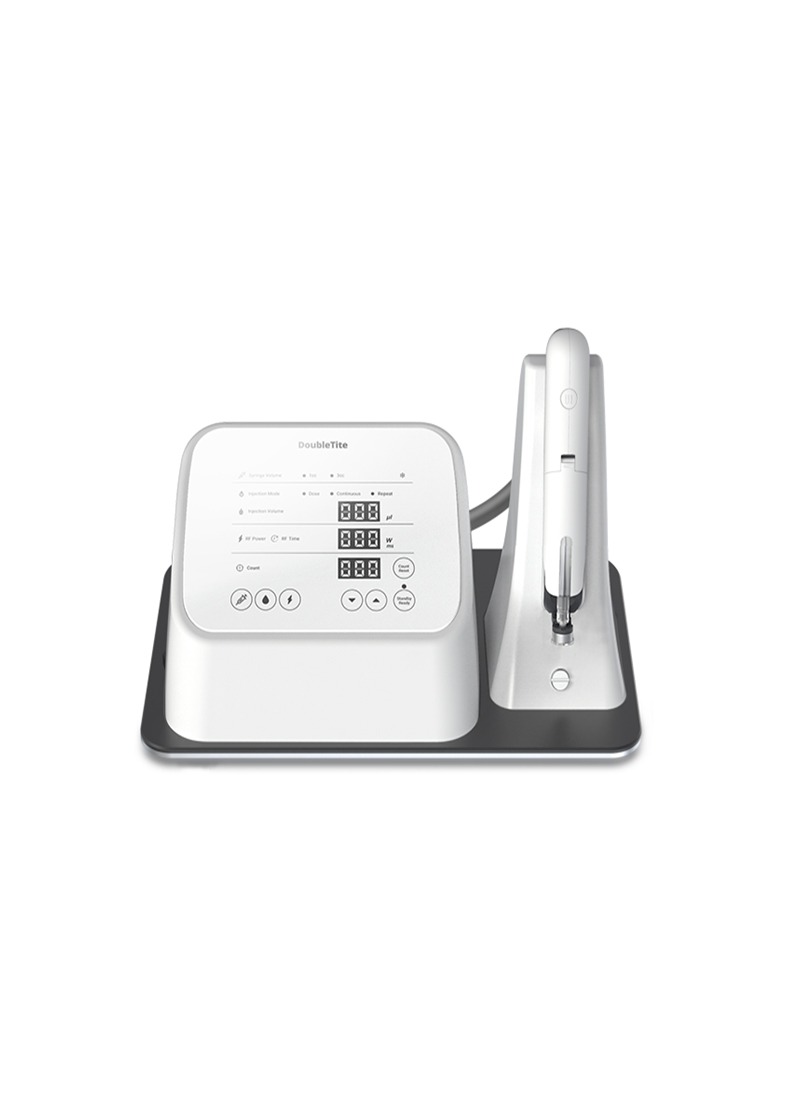
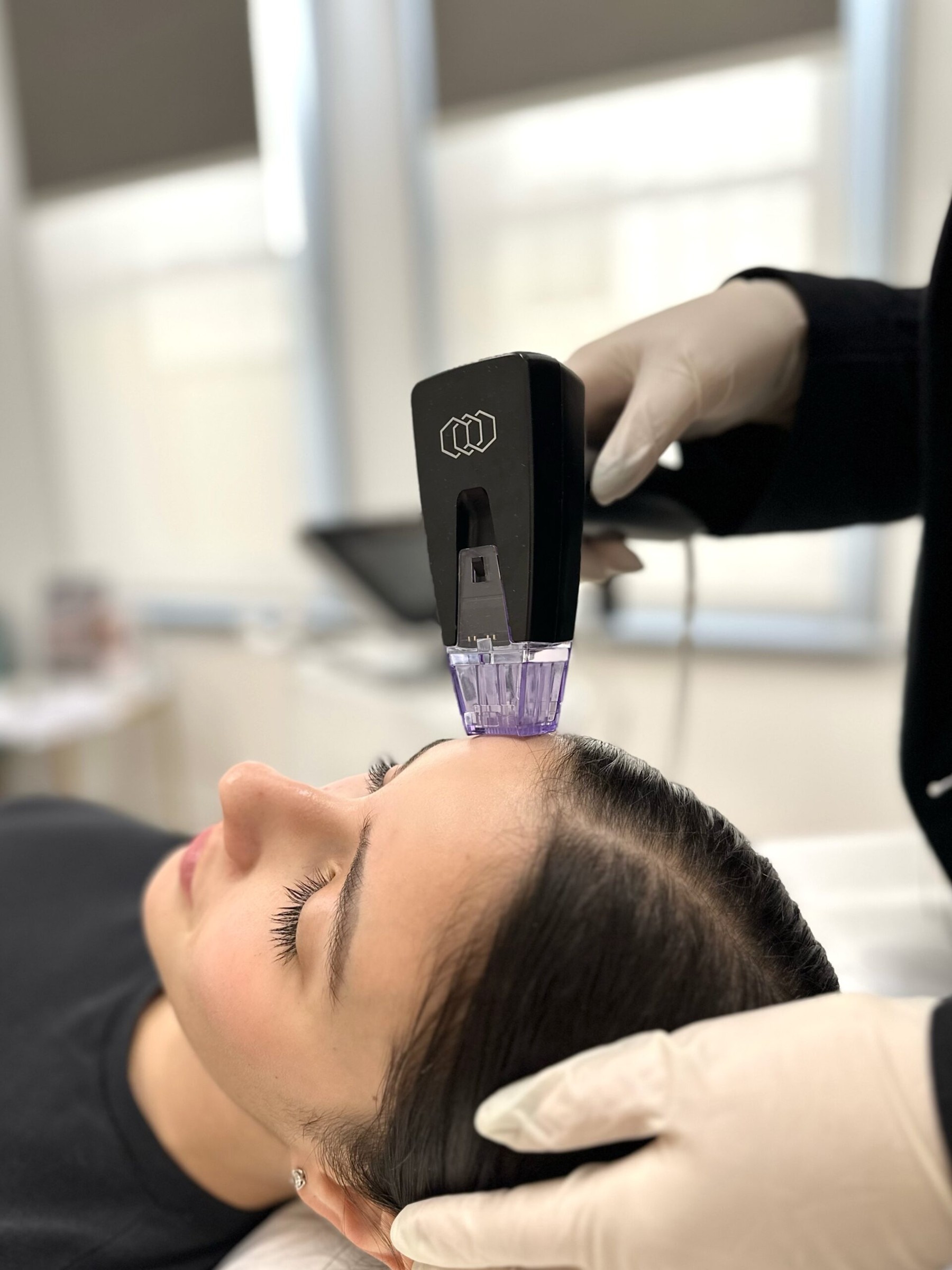
DoubleTite is an RF microneedling device made by AGNES Medical. RF microneedling works by inserting fine needles into the skin and releasing radiofrequency energy at the tip, selectively heating the dermal layer where the needles land. Because the heat originates at needle depth rather than at the surface, the epidermis is relatively protected while the dermis gets stimulated. It belongs to the same family as Potenza and Infini.
What sets DoubleTite apart is its two needle lengths. A single tip holds eight short needles (approximately 0.4mm) and five long needles (approximately 1.0mm), treating both the superficial papillary dermis and the deeper reticular dermis in one pass. While standard RF microneedling devices address one depth at a time, DoubleTite's design targets both simultaneously. The RF frequency is 1MHz monopolar at 20W output, which is on the conservative side compared to higher-powered devices.
A second distinguishing feature is the ability to inject a skin booster through the needles while delivering RF energy. Since the needles already reach the dermis, the same pathway carries hyaluronic acid or similar agents directly into that layer. The device is cleared by Korea's Ministry of Food and Drug Safety, having met safety and performance standards. The needle tip is also blade-shaped rather than round, engineered for smoother entry into the dermis.
What happens at the needle tip?
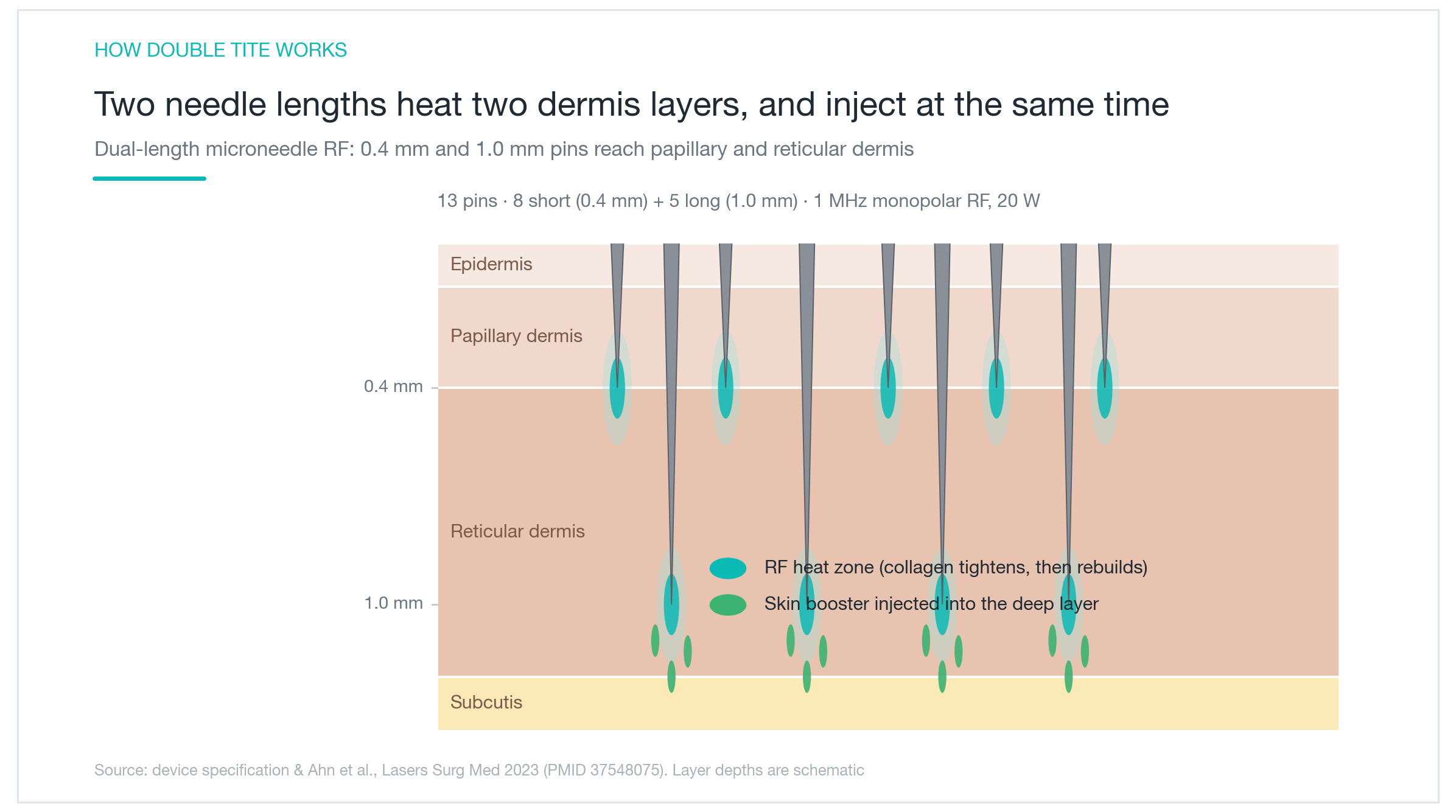
The diagram above shows how DoubleTite works in cross-section. Once the needles pass through the epidermis and reach the dermis, RF current flows from their tips, generating heat in the surrounding tissue. Radiofrequency oscillates tissue ions rapidly, and the resulting friction produces thermal energy. When that heat reaches a critical threshold, collagen contracts immediately at the site, and over the following months, new collagen and elastin gradually fill in, firming the skin.
That two-needle design serves a specific purpose. The short needles heat the upper papillary dermis while the long needles heat the deeper reticular dermis, stimulating both layers in a single session. The superficial layer influences skin texture and fine lines, while the deeper layer affects firmness and laxity, so treating both together widens the range of potential outcomes. The epidermis is protected by active cooling during the procedure.
Skin booster injection through the needles adds another layer to the treatment. The idea is that drug delivery through a needle track already in the dermis is more direct than surface application. One clarification worth making: while needle-based dermal delivery is mechanically sound, the claim that RF energy independently boosts drug absorption has not been confirmed in clinical studies. It's more accurate to think of the needle as simply creating a path for the drug to travel deeper. Because collagen remodeling takes time, results often become more visible gradually over two to three months rather than immediately after treatment.
Did collagen actually increase?
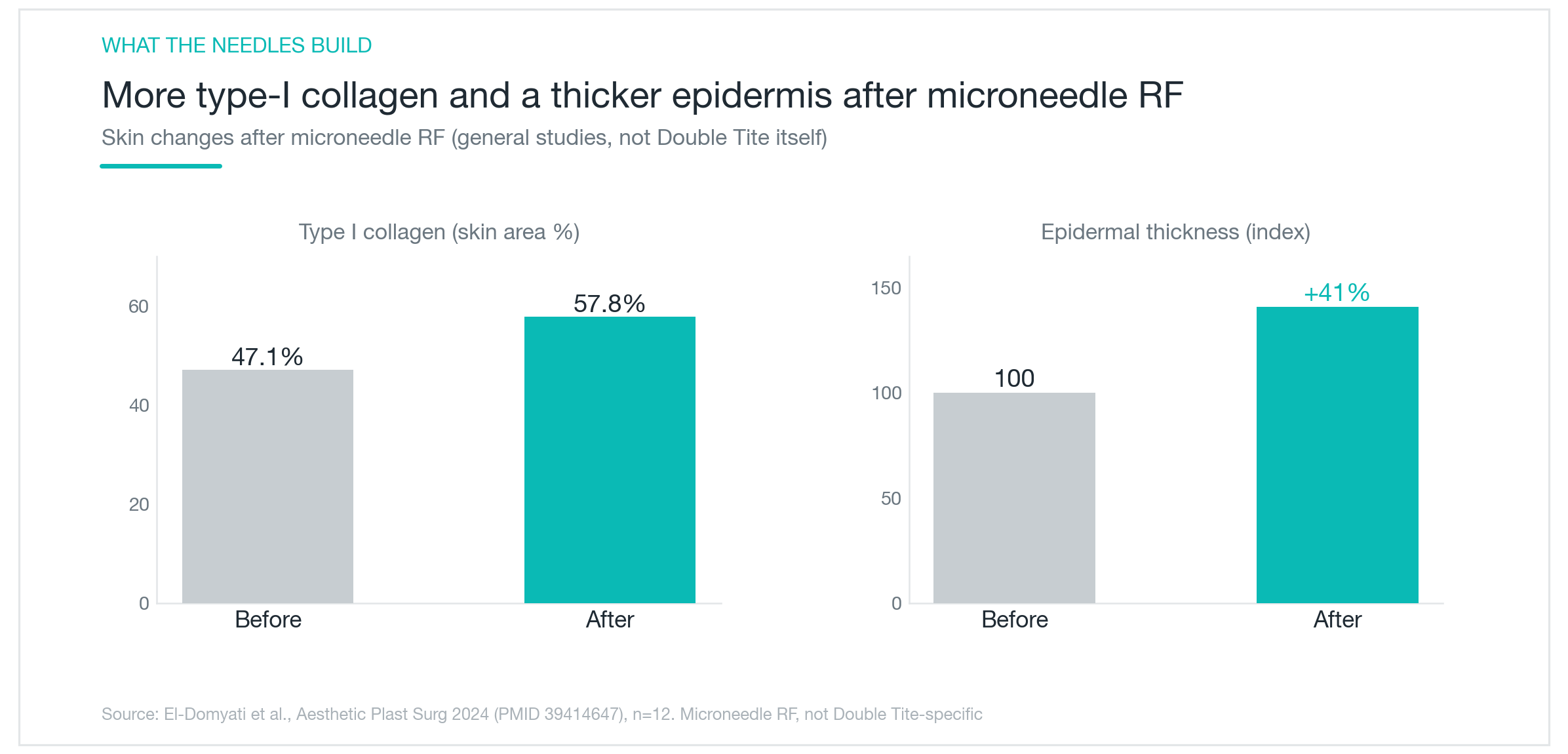
RF microneedling as a platform has a reasonably solid evidence base. Multiple clinical studies have reported increases in dermal collagen, thicker epidermis, and improvements in wrinkles and skin elasticity after treatment. In one study shown in the graph above, type I collagen area rose from 47.1% to 57.8%, and epidermal thickness increased by approximately 41%. Across other studies, skin density and firmness showed meaningful improvement. A number of peer-reviewed papers back up the broader picture: RF microneedling drives dermal regeneration.
Research specific to DoubleTite also exists. A study by teams from Chung-Ang University Hospital and Harvard, using actual human skin tissue, was published in an international journal (Ahn 2023 PMID37548075). It found that after DoubleTite treatment, gene expression for type I and type III collagen synthesis increased, the epidermis thickened, and the dermal-epidermal junction became more complex, resembling younger skin. That directional evidence points toward real collagen stimulation.
One important point of context: the DoubleTite-specific research used ex vivo skin tissue taken during surgery, not clinical trials on real patients' facial skin. The direction toward collagen regeneration is clearly established; specific improvement metrics in live facial skin will become clearer as clinical data accumulates. The percentage figures in the graph above also come from general RF microneedling studies, not DoubleTite-specific data.

Strengths of two needle depths and simultaneous injection
What distinguishes DoubleTite from other devices is the two-length needle design and simultaneous drug injection. Treating two depths at once and delivering agents directly into the dermis is a practical idea, and it offers real convenience in a single treatment session. There are no head-to-head clinical comparisons of DoubleTite versus Potenza or Infini yet, but given how strong the overall RF microneedling evidence base is, DoubleTite can reasonably be expected to share those benefits.
DoubleTite's own research is still at the tissue study stage, with collagen increase confirmed as a general trend rather than a precise figure. Improvement figures from facial clinical use will sharpen as studies accumulate. For now, the most accurate way to frame it is: proven RF microneedling benefits, with the added convenience of dual-depth needles and simultaneous drug delivery built into the design.
Simultaneous drug injection through the needle track is mechanically sound as a delivery method. DoubleTite is a Korean-made device built on the well-validated RF microneedling platform, refined with dual-depth needles and co-injection to make the treatment both more convenient and more versatile.

Pain, side effects and who it suits
Pain is an honest part of the RF microneedling experience. Studies report in-procedure pain scores ranging from about 3 to 5 out of 10, and topical anesthetic cream is typically applied beforehand. Redness, mild swelling, and pinpoint bleeding are common immediately after and usually resolve within a day to a few days. A transient grid pattern where the needles passed may be briefly visible. Compared to laser treatments, RF microneedling carries a relatively lower risk of post-inflammatory hyperpigmentation, which makes it a more approachable option for darker skin tones.
Rare but serious adverse events are worth knowing. The US FDA has noted reports related to RF microneedling devices including burns, scarring, loss of subcutaneous fat, and nerve damage, most associated with non-physician operators or excessive energy settings. The frequency is very low, but because this treatment delivers heat deep into tissue, it's safer when performed by a physician with solid anatomical knowledge using genuine consumable tips.
The limitations are also straightforward. DoubleTite is designed to improve dermal quality: fine lines, skin elasticity, texture, and pore appearance. It is not a significant lifting treatment for pronounced facial sagging. If laxity is the primary concern, thread lift, HIFU, or surgical options are worth discussing alongside it. Results typically last a few months to around six months based on reports, and multiple sessions are generally part of the plan rather than a one-off procedure. DoubleTite is a good fit for people who want to strengthen and refine the skin itself rather than achieve major repositioning. Those expecting the steady, cumulative firmness improvement that RF microneedling provides tend to find it worthwhile.
Was this helpful?
About this article
Written by a practising aesthetic physician and intended for general education — not a substitute for individual medical advice.
Read next
Secret Microneedle RF: How Insulated Needles Work, and Recovery Care
Secret Microneedle RF delivers radiofrequency energy straight into the dermis through insulation-coated needle tips. Here is how it leaves the epidermis untouched while warming just the target depth to trigger collagen renewal, plus what recovery and aftercare actually look like.
By Dr. Kim
Morpheus8: How It Works, Results, Recovery, and Aftercare
Morpheus8 is a microneedle RF device that delivers radiofrequency heat through coated needles down into the deeper layers of the skin. Heat at the needle tip stimulates fat and connective tissue, producing an immediate tightening effect alongside long-term collagen renewal. Here is how the depth control works and why recovery tends to be faster.
By Dr. Kim

HILO WAVE Skin Booster: How It Works, When Results Appear, and Aftercare
HILO WAVE is a skin booster that fuses two hyaluronic acids of different molecular sizes into a single structure. The low and high molecular weight forms are said to act at different depths and speeds, stimulating collagen and elastin production together inside the skin. This article breaks down how that dual hyaluronic acid structure actually works, focusing on the underlying mechanism.
By Dr. Kim