Ultherapy and Thermage: Which Suits Your Sagging?
By Dr. Kim7 min read

If you've been researching lifting treatments, you've almost certainly seen Ultherapy and Thermage mentioned side by side. Both claim to lift and tighten skin without surgery. So what actually separates them, and which one should you choose?
The short answer: these two are not competing versions of the same thing. They work on completely different tissue layers. Ultherapy's focused ultrasound reaches deep into the face, including the SMAS layer that holds the structural foundation of the lower face. Thermage's monopolar RF heats the dermis broadly, firming skin texture and surface quality from the inside out. Head-to-head clinical research exists, and when you look at the data, neither comes out as a clear winner. What the research does show is that Ultherapy tends to be more painful. Below, I'll walk through the mechanisms, the direct comparison data, the pain picture, and how to match each treatment to the right concern.
How Does the Depth Reached by the Two Devices Differ?
The most important difference is energy type and penetration depth. Ultherapy uses focused ultrasound, energy converged to a single point, bypassing the skin surface and depositing heat precisely at a preset depth. Depending on the cartridge, that depth is 1.5mm, 3.0mm, or 4.5mm. The 4.5mm setting is what reaches the SMAS, the fibromuscular layer that surgeons work in during a facelift. Stimulating this deep layer is what drives structural lift.
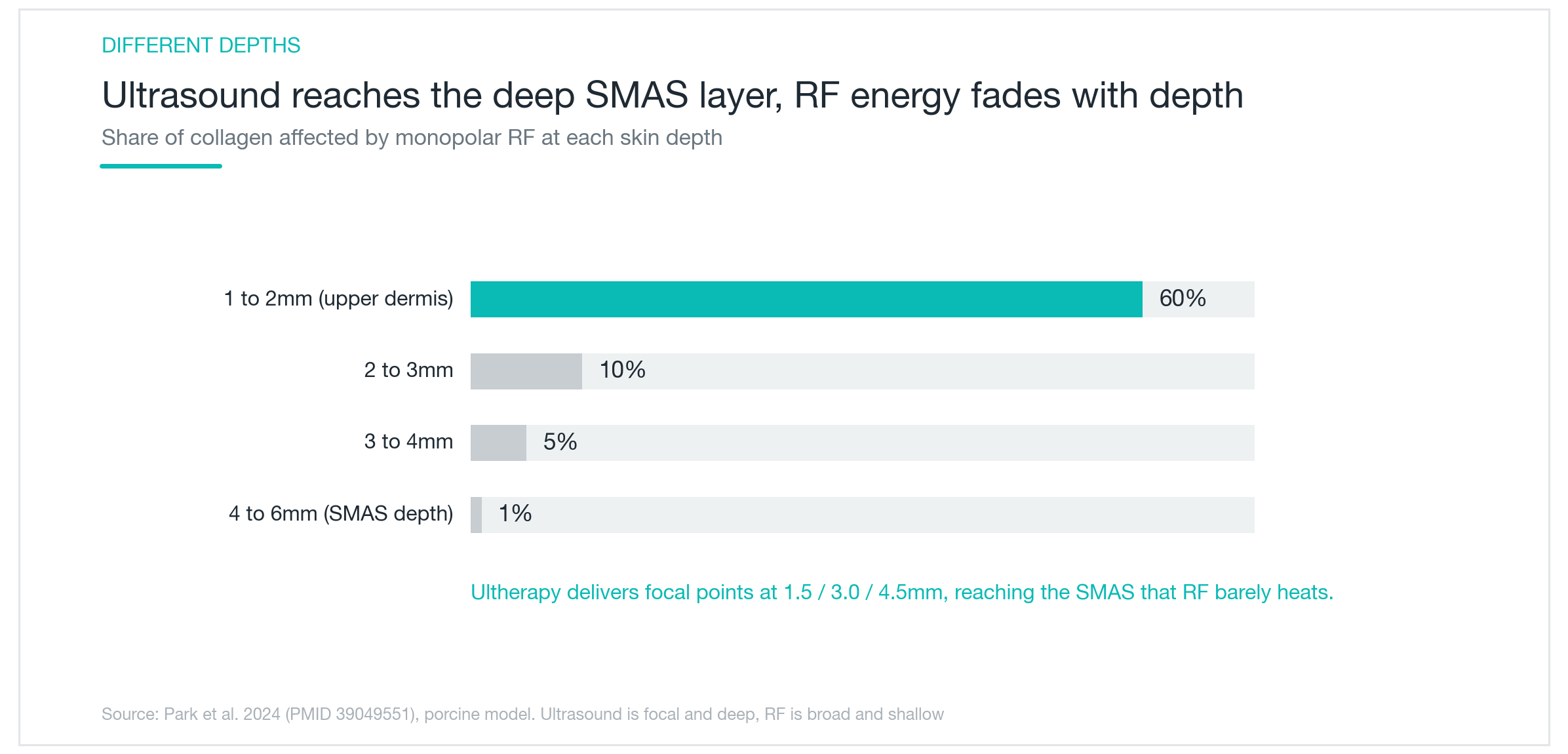
Thermage works differently. Monopolar RF energy doesn't concentrate at a focal point; it spreads volumetrically through the dermis, heating a broad plane of tissue. As the chart above shows, that heating effect drops off significantly with depth. Animal data suggests roughly 60% of collagen in the 1-2mm zone is affected, dropping to about 10% at 2-3mm, about 5% at 3-4mm, and about 1% at 4-6mm. Thermage doesn't reach the SMAS. It heats the dermis.
Put plainly: Ultherapy wins on depth, Thermage wins on breadth. Neither is inherently better. They target different tissue, which means they suit different concerns.
Is Ultherapy for Sagging and Thermage for Laxity?
Because these treatments reach different tissue layers, they suit different problems. Ultherapy's access to the deep fascial plane makes it the stronger option when the concern is actual structural descent: a jawline that's lost definition, a neck that's begun to droop, or brow heaviness that's making the eyes look heavier. One study of 75 subjects found physician-assessed improvement rates exceeding 80%, with patient satisfaction above 78%.
Thermage is better matched to diffuse surface concerns. Skin that's lost its snap and feels dull, fine lines multiplying, pores enlarging, or body areas like the abdomen and inner arms where the skin has softened but not dramatically descended. One clinical trial found that 53% of subjects rated their skin laxity as improved by 50% or more at 2 months post-treatment.
The practical rule: if your primary concern is a sagging contour or structural descent, consider Ultherapy first. If it's overall firmness, texture, or skin quality, consider Thermage. One caveat applies to both: significant structural descent, where skin has genuinely dropped, is not reliably addressed by either. That's a surgical conversation, whether facelift or neck lift, and no non-invasive treatment currently replaces it.
Studies Comparing the Two Treatments Directly
This is where the data matters. Two split-face studies exist in which one side of the face or neck received Ultherapy and the other received Thermage, and results were then compared directly.
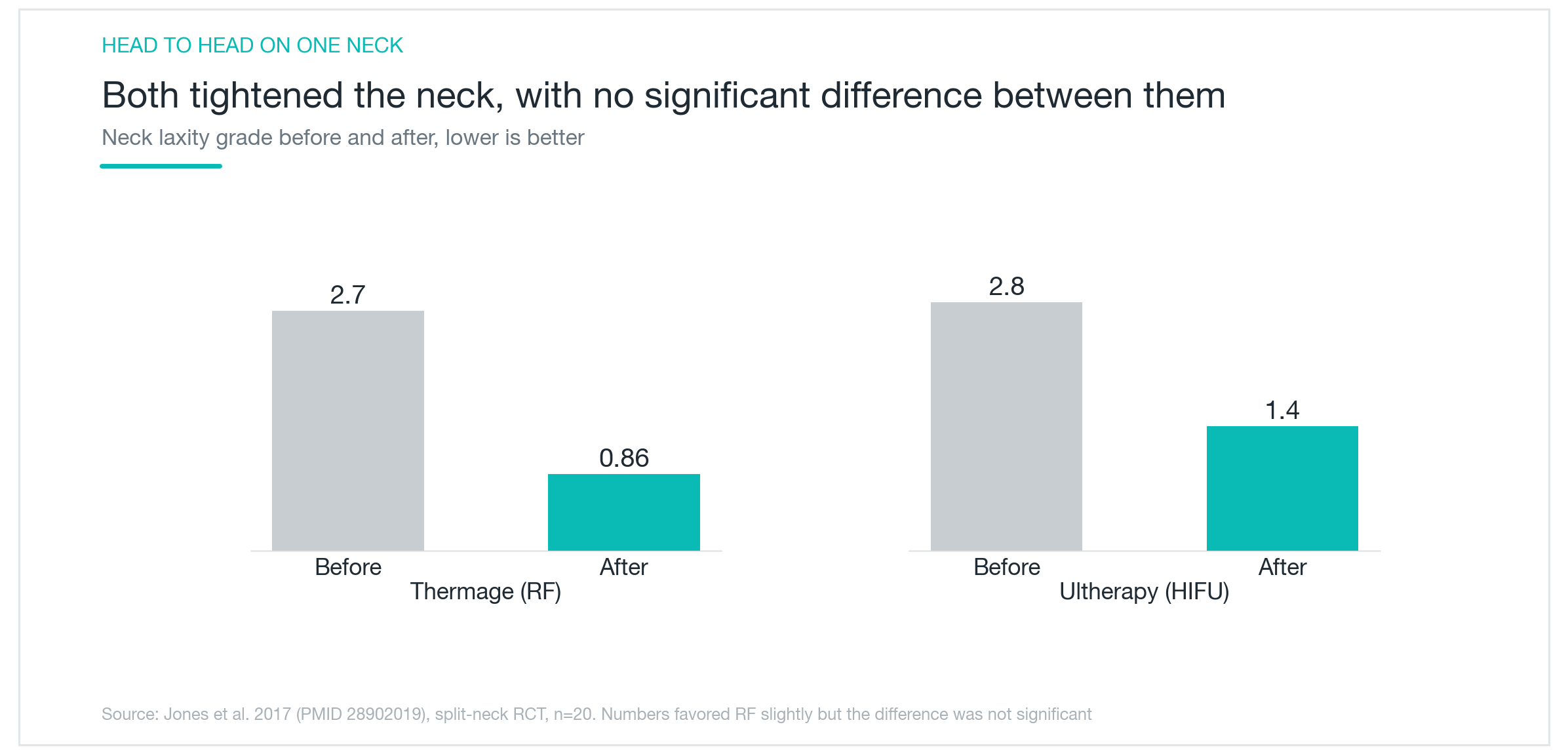
The chart above comes from a neck study (Jones 2017, n=20). Laxity scores improved from 2.7 to 0.86 on the Thermage side, and from 2.8 to 1.4 on the Ultherapy side. Both improved substantially. The Thermage numbers look slightly better, but the difference was not statistically significant. A separate study examining the face and upper neck (Serdar 2020, Panithaporn 2025) found the same pattern: both treatments produced meaningful improvement, and no significant difference between them was detected.
This means there's no data-supported basis for declaring one categorically superior. A few important caveats, though: both direct comparison studies enrolled n=20, making them small enough that meaningful differences could exist without being detectable. Follow-up was around 6 months, so long-term durability comparisons aren't available from this data alone. And while outcomes were similar, the pain experience was not, as covered below.
The practical takeaway: choose based on which tissue layer your concern lives in, not on which treatment is supposedly "stronger."
How Do Pain and Downtime Differ?
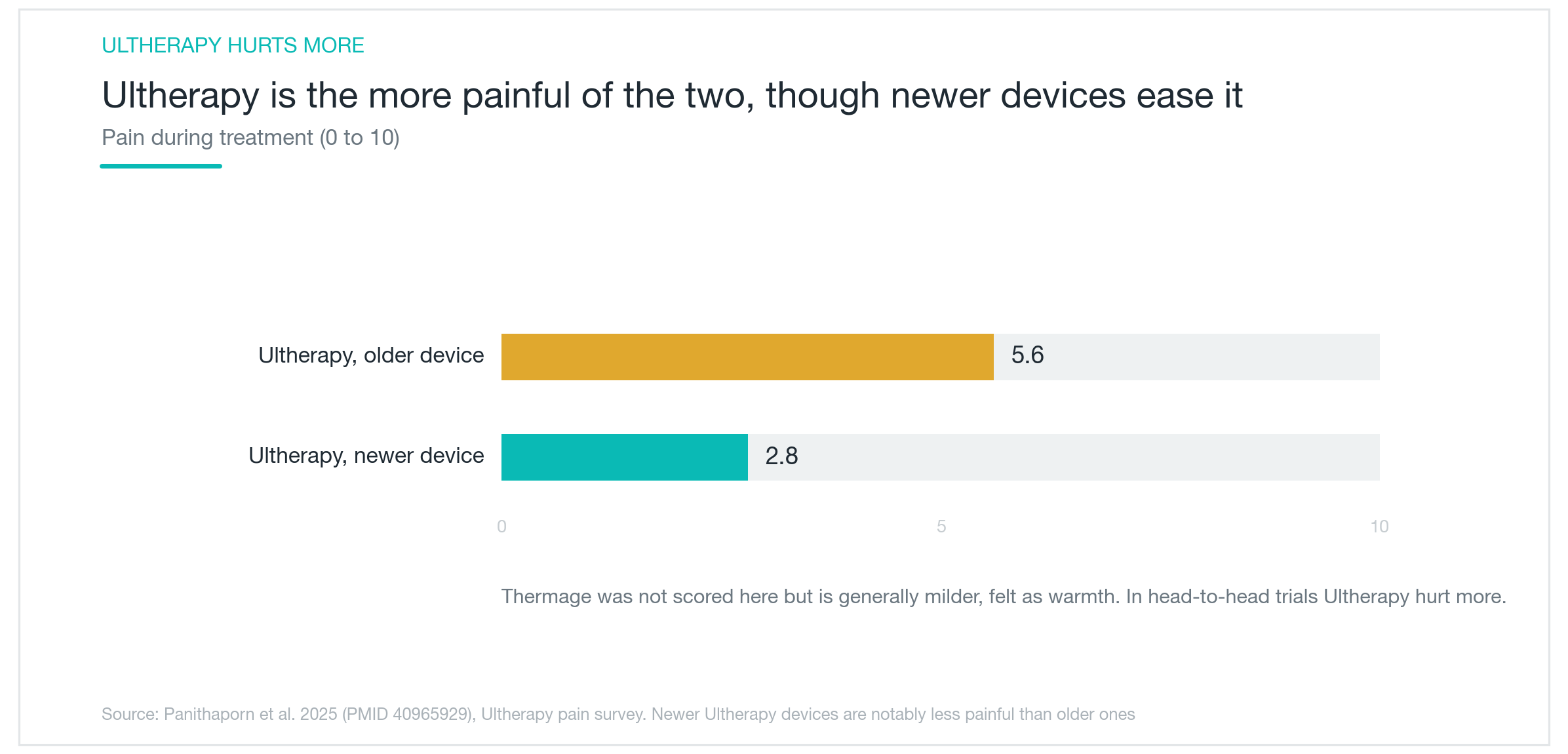
Pain is where Ultherapy and Thermage diverge most noticeably in practice. Ultherapy's focused energy, deposited at depth in a concentrated burst, tends to produce sharper, more intense sensations than Thermage. The chart above reflects this: older Ultherapy devices scored around 5.6 out of 10 on pain scales; newer systems have brought that down to around 2.8 (Park 2024). Thermage typically comes in lower than either Ultherapy generation, described by most patients as a warm pulsing rather than sharp discomfort.
If pain tolerance is a real concern, it's worth confirming which generation of Ultherapy device a clinic uses, and discussing anesthesia options in advance. Thermage's newer FLX platform with vibration-assist is also considerably more comfortable than older Thermage generations.
Downtime is similar for both. Expect some redness and mild swelling immediately after either treatment, usually resolving within hours to a day. Most patients return to normal activity the same day. Results from both don't arrive immediately; collagen remodeling takes time, and visible improvement typically builds from about one month out, peaking around 2-3 months. Durability runs 1-2 years for both, after which most patients treat again on a maintenance basis. Patients who want to sustain results over time tend to schedule sessions roughly once a year.
How to Choose a Treatment for Your Concern
Here's a clear framework. If your concern is a descending jawline, early jowling, neck laxity, or brow heaviness (structural descent rooted in the deep fascial layers), Ultherapy is better positioned to address it. It reaches the SMAS, which Thermage does not.
If your concern is diffuse firmness loss (skin that feels lax or dull across the face without dramatic structural descent), growing fine lines, pore enlargement, or laxity on body areas like the abdomen or arms, Thermage is a better fit. Its broad dermal heating is well suited to these surface-layer concerns.
Many people have both concerns at once. In those cases, combination treatment (Ultherapy for depth, Thermage for the dermis) is sometimes used. No large study has confirmed that combination clearly outperforms either treatment alone, so the decision should follow your specific presentation rather than a default "more is better" logic.
Pain sensitivity matters here too. If you're genuinely pain-averse, that's a reason to factor in device generation when consulting on Ultherapy, or to lean toward Thermage if the treatment targets overlap.
The most important point to carry away: both treatments have real limits. Neither is a substitute for surgery in the setting of significant structural descent. Beyond the device name, what matters most is an honest assessment of your degree of laxity and the experience of the provider doing the treatment; that combination determines outcome more than the equipment alone.
Was this helpful?
About this article
Written by a practising aesthetic physician and intended for general education — not a substitute for individual medical advice.
Read next
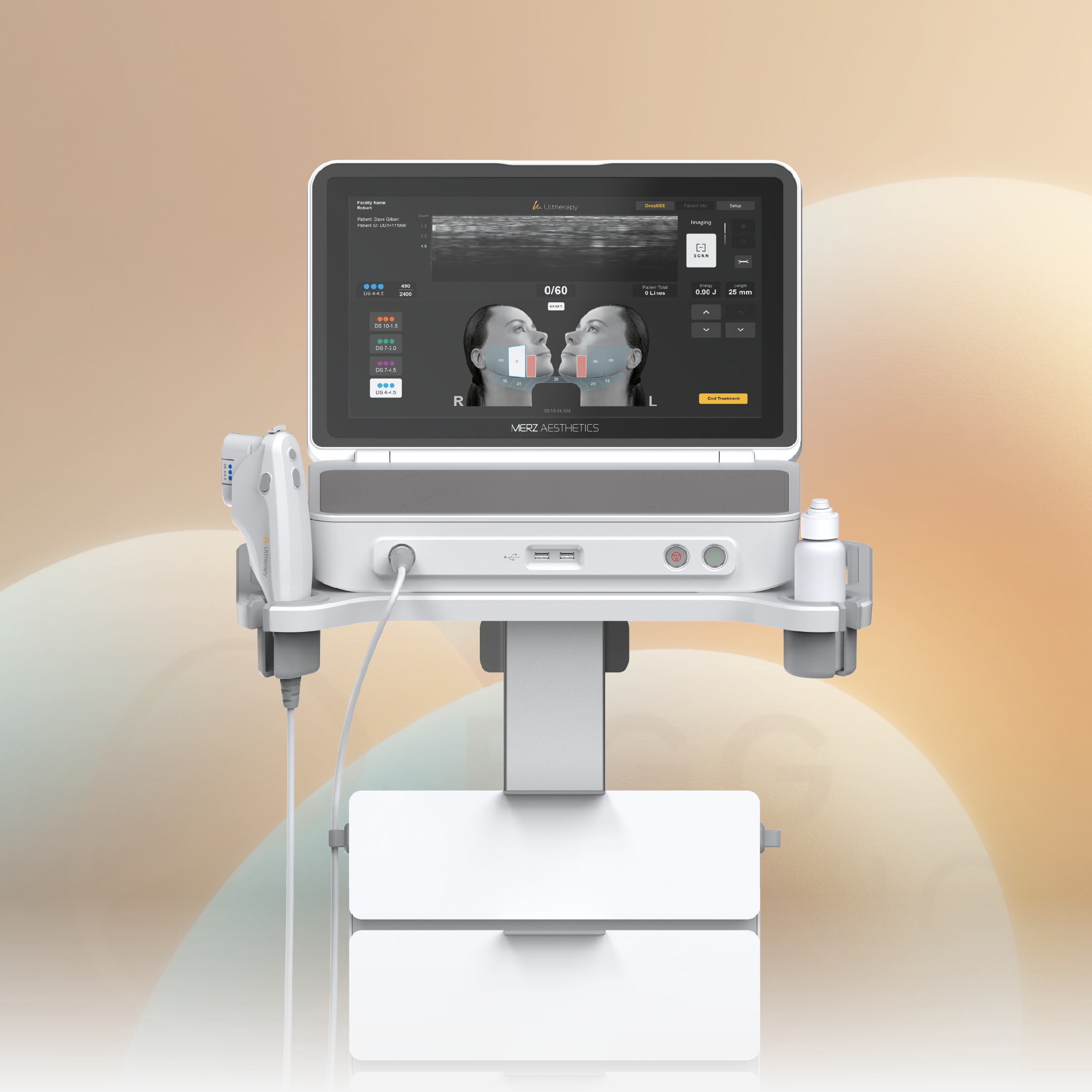
Ultherapy, Shurink, Sofwave, and Linear Z: Differences and Effects Compared
Ultherapy, Shurink, Sofwave, and Linear Z are all marketed as HIFU lifting treatments, but the differences in penetration depth, real-time imaging, and clinical evidence are substantial. An honest breakdown of how deep each device reaches, why SMAS stimulation matters, what the evidence actually shows on efficacy and pain, and how to choose based on your specific concern.
By Dr. Kim

Shurink and Ultherapy: Differences in Effect, Pain and Price Compared
Shurink Universe and Ultherapy are both HIFU lifting devices, yet they diverge on real-time imaging, default energy, pain, and price. A balanced breakdown to help you choose based on your degree of sagging and budget.
By Dr. Lee
Nevus of Ota Treatment: Q-Switched Laser Sessions and Intervals
Nevus of Ota sits deep in the dermis rather than on the skin's surface, which is exactly why no amount of concealer can hide it. Here is a mechanism-focused look at why only a laser with a specific wavelength can reach that depth, and why treatment is spread across 6 to 10 sessions at 6 to 8 week intervals instead of being done all at once.
By Dr. Lee