Ulfit Body HIFU Fat Reduction Effect: How Many Sessions Do You Need?
By Dr. Kim8 min read
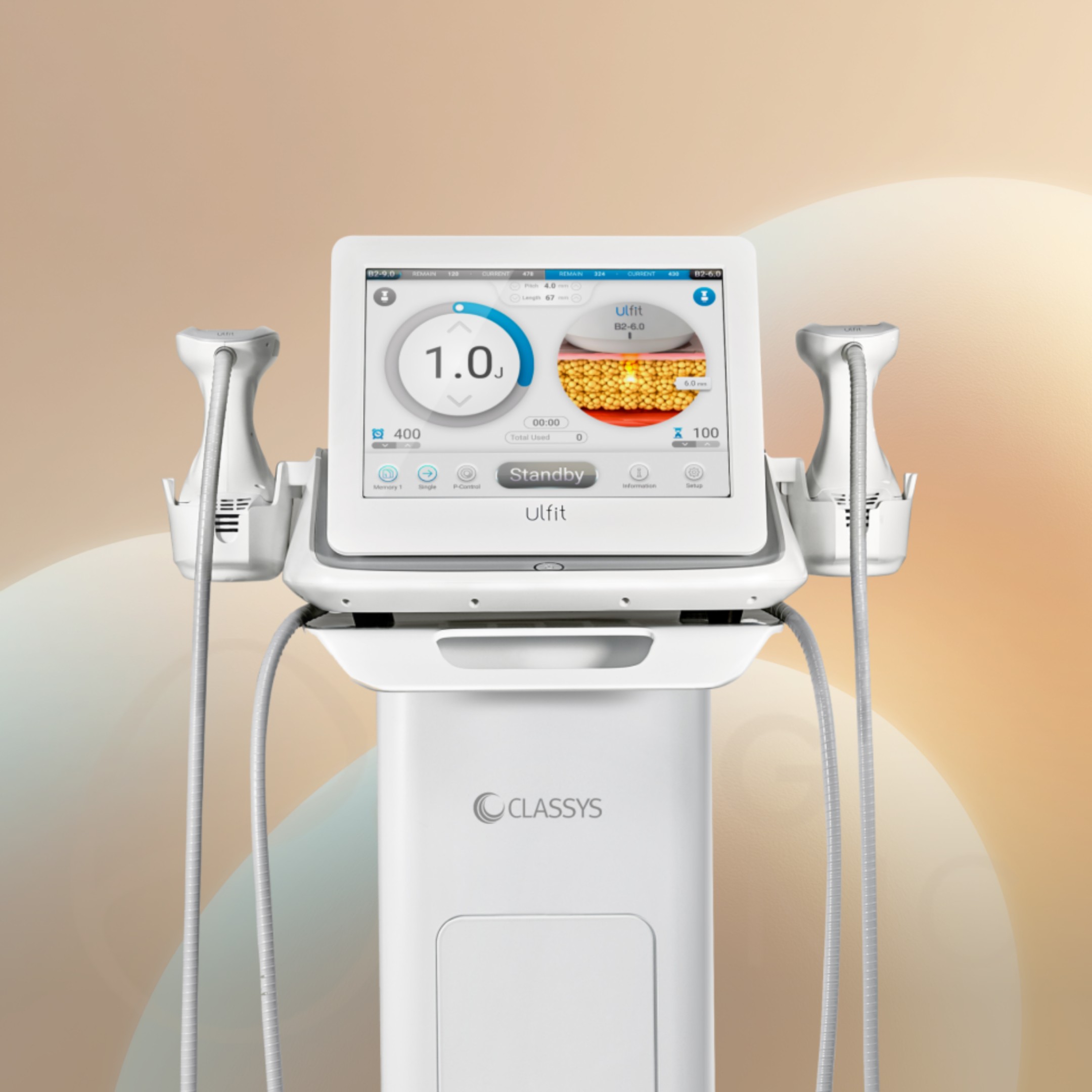
Belly fat and thigh fat are notorious for hanging on no matter how much weight you lose elsewhere. That is exactly why so many people look into treatments like Ulfit Body HIFU, which promises to trim fat without a single incision. HIFU stands for High Intensity Focused Ultrasound, and in plain terms, it is a device that gathers ultrasound waves into one tight point.
If you know facial HIFU for lifting, you might assume the body version runs on the same logic. It does, but the depth it targets and the tissue it goes after are both different. Below, we go through why the ultrasound heats only fat and nothing else, how that fat actually leaves your body, what separates body settings from facial ones, and roughly how many sessions and how much maintenance to expect.
What Kind of Treatment Is Ulfit Body HIFU?
Ulfit Body is a non-surgical body contouring device that focuses ultrasound energy on a single point within the fat layer under your skin, instantly pushing just that spot to a very high temperature. There is no needle, no blade. The device simply glides across the surface of your skin.
Unlike liposuction, which physically suctions fat out, this treatment damages fat cells with heat and lets your own body clear them away. That means no incisions, no scarring, and almost no downtime. The trade-off is that results do not show up all at once. They unfold gradually over 4 to 12 weeks after treatment.
It works especially well on fat that has settled into one stubborn spot, like the lower belly or inner thighs, the kind that barely budges even with regular exercise. If your overall body fat is high across the board, though, this treatment alone will not solve it. Results are known to hold up best when it is paired with everyday habits like a balanced diet and regular exercise.
How Does Ultrasound Converge on a Point in the Fat Layer?
Think of how a magnifying glass can set paper on fire by focusing sunlight onto one point. Light that was once spread wide gets pulled together by the lens, and that single spot heats up sharply. Focused ultrasound, or HIFU, runs on the exact same idea.
Inside the device, an ultrasound transducer fires sound waves from several directions at once, and those waves converge on a single point at a set depth inside the body. The skin and fat tissue the waves pass through barely warm up, but at the exact spot where the waves overlap, the temperature spikes instantly to somewhere around 60 to 70 degrees Celsius. It works a bit like several people aiming flashlights at the same wall from different angles. Only that one patch lights up brightly, while everything else stays dim.
Ulfit Body tunes the depth of that focal point so it lands right inside the fat layer. That way, the skin's surface barely registers the treatment, while a sudden burst of intense heat forms only in the layer where fat cells are packed together just beneath it.
How Are Fat Cells at the Focus Cooked?
The instant the beam converges at its focal point, the temperature shoots well past what any fat cell can tolerate. At that kind of heat, a fat cell's membrane and internal structure reportedly collapse almost immediately, in a process called coagulative necrosis. The cell essentially cooks in place and loses all function right there.
Tissue just outside that focal point, meaning skin, blood vessels, and nerves, does not heat up nearly as much in that same instant. Since the sound waves converge only at that one point, the energy stays thin and scattered along every path leading up to it. That temperature gap is exactly what lets the treatment single out the targeted fat cells while leaving everything around them relatively untouched.
If that is still hard to picture, think about hot water. Water at 60 to 70 degrees Celsius can scald skin within seconds of contact, and now imagine that much heat crammed into a space no bigger than a single cell. A fat cell simply has no way to survive that. Meanwhile, the tissue along the path leading to the focal point only feels a brief brush of that heat, never enough to cause real damage.
Who Clears Away the Dead Fat Cells?
Damaged fat cells do not disappear the moment the treatment ends. Once coagulative necrosis strips a cell of its function, your body flags it as foreign material and clears it away gradually.
That cleanup job falls to macrophages, immune cells whose name literally means "big eater." True to their name, macrophages engulf the debris from damaged cells and break it down. The remains of dead fat cells get broken into smaller components like fatty acids, which then travel through the blood and lymphatic system to the liver, where they are reportedly metabolized and eventually cleared from the body.
This process plays out slowly over 4 to 12 weeks. That is why changes in circumference or texture usually feel far more noticeable somewhere in that 4 to 12 week window than right after the treatment. Staying well hydrated and keeping up light activity like walking for the first 4 weeks after treatment is thought to support this metabolic process.
If it helps, think of it as similar to how a wound heals and new skin forms underneath. The difference is that instead of a visible scab, the cleanup happens quietly, out of sight, in the fat layer beneath your skin. So there is no reason to feel discouraged if the mirror looks the same the morning after treatment. Underneath the surface, macrophages have already started hauling the debris away. It just takes time for that work to show up on the outside.
How Is It Different From Face HIFU?
Even though both rely on the same focused ultrasound technology, facial and body HIFU go after different tissue at different depths. Three things account for the difference.
- The target depth is different. Facial HIFU focuses down at the SMAS layer (Superficial Musculo-Aponeurotic System, the thin fascia wrapping the facial muscles) to lift sagging tissue back into place. Body HIFU instead focuses on the shallower subcutaneous fat layer to shrink fat cells themselves, so the two are not even aiming at the same type of tissue.
- The cartridge's focal depth is different. Facial skin is thin and the distance to the fascia is short, so facial cartridges typically focus at just 1.5 to 4.5mm. The belly and thighs have a much thicker fat layer, so treatment there calls for deeper cartridges reaching 8 to 13mm, deep enough for the heat to hit the middle of that fat layer.
- The treatment area and power output are different. On the face, precision on a small area matters most, so treatment moves through at lower power with tightly spaced shots. The belly and thighs cover a much larger area, so providers typically use wider spacing and calibrated power output to sweep the whole region evenly.
The reason depth and output get tailored to each body part comes down to one thing: where that focal point lands is what determines the outcome. Fat layer thickness varies from person to person and from area to area, so the safest approach is considered to be checking the actual fat layer thickness with ultrasound imaging first, then adjusting the cartridge and power output accordingly.
Why Is It Split Into Sessions 4 to 8 Weeks Apart?
There is a limit to how many fat cells a single session can safely treat. The total energy that can be delivered within a safe range is capped, and pushing past that raises the risk of burns or tissue damage.
Picture a frying pan. Low heat cooks food evenly all the way through, but crank the burner to maximum in an attempt to finish faster, and you end up with a scorched outside and a raw center. Push the entire belly at maximum power in a single pass, and you risk heat damage not just to fat cells but to the skin sitting above them. That is why treatment is spread across multiple points within one area, and why the overall course is broken into several sessions.
For that reason, treatment is usually spread across 2 to 4 sessions, spaced 4 to 8 weeks apart. Macrophages need time to finish clearing the fat debris from the previous session, and letting the body recover before moving to the next round is thought to help results build up steadily. It is safer to stick to the recommended interval than to try to compress the timeline.
Will You Regain Fat If You Gain Weight After Treatment?
A fat cell that has been wiped out through coagulative necrosis reportedly does not regenerate. That is why the results from this treatment tend to hold up fairly well over time.
That said, the fat cells that remain can still grow larger. Even with fewer fat cells left in the treated area, gaining weight afterward can cause the surviving cells to expand, and the area can look fuller again as a result. That is why Ulfit Body is reported to work best not as a one-and-done fix, but as part of an ongoing routine built around eating well and staying active, since that is what makes results last longer.
A balloon comparison makes this easier to picture. The treatment reduces the number of balloons, but keep pumping air into the ones that are left, and the total volume grows right back. Fat cells work the same way. Regardless of how many cells were removed, keeping the remaining ones from expanding is the real key to holding onto your results.
Avoiding big swings in body weight is the single most reliable way to extend how long results last. Rather than rushing the changes from this treatment with an aggressive crash diet, building on them slowly through steady lifestyle habits pays off better in the long run.
References
Korean Dermatological Association, Ministry of Food and Drug Safety (MFDS), American Academy of Dermatology (AAD), and U.S. Food and Drug Administration (FDA).
Was this helpful?
About this article
Written by a practising aesthetic physician and intended for general education — not a substitute for individual medical advice.
Read next

Body Onda: Effects, Approach by Area, Number of Sessions and How Long It Lasts
Body Onda is a non-surgical body contouring treatment that uses microwave energy to selectively heat the fat layer beneath the skin, shrinking fat cells while tightening the skin above them. Here is why the heat targets fat rather than skin, why fat reduction and tightening happen together, how the approach differs for the abdomen, arms, and flanks, and how many sessions it takes to see lasting results.
By Dr. Kim
HPL Fat-Dissolving Injection: How It Works, Number of Sessions, and Swelling
A principle-first look at how HPL fat dissolving injections break down fat cell membranes and how the broken-down fat actually leaves the body. We also cover why dosing and session counts differ by treatment area, and how much swelling and downtime to expect.
By Dr. Lee
Onda Microwave Treatment: How Many Sessions, and How Long Do Results Last?
Onda uses microwave energy, the same technology behind a microwave oven, to heat the skin from within and act on fat cells and collagen at once. This article breaks down why microwaves reach deep into the fat layer, and why fat reduction and skin tightening happen together in a single session.
By Dr. Kim