Tranexamic Acid for Melasma: What's the Difference Between Oral and Topical?
By Dr. Lee8 min read
Most people have never heard of tranexamic acid before, and that makes sense, because it wasn't developed with skin in mind at all. Since it was first described in Japan in 1962, it's spent more than six decades as a hospital drug, prescribed to reduce bleeding after surgery or to control heavy menstrual periods.
The story changed when doctors noticed something unexpected: patients taking this bleeding control drug were seeing their melasma fade. Once you understand why a clotting-related drug would affect pigment on the face, it makes perfect sense why tranexamic acid ended up as a melasma treatment.
Why Isn't Melasma Only a Pigment Problem?
It's easy to think of melasma as simply excess melanin sitting in the skin. But look closer at melasma-affected skin, and pigment turns out to be only half the story.
In melasma, melanocytes (the cells that produce melanin) are simply more reactive than normal. Add UV exposure, female hormones, or heat, and these cells keep getting the signal to churn out more pigment. On top of that, studies have found that melasma-affected skin also has more blood vessels, and those vessels are more active than in normal skin. In other words, melasma is really two things tangled together: a pigment-production signal and a blood vessel response.
Think of it like a small ember that never fully goes out. As long as the ember is there, you get smoke (the pigment) and the surrounding area stays warm (the vessel response). Wipe away only the smoke, and it's usually just a matter of time before it comes back.
This is exactly why tranexamic acid stands out. Multiple studies have shown it can act on both pathways at once.
How Does Tranexamic Acid Block the Melanin Signal?
Our bodies make an enzyme called plasmin, whose main job is dissolving blood clots. It turns out plasmin is also quietly active in the epidermis, the outermost layer of skin, all the time. The catch is that plasmin moonlights there in a second job.
Plasmin triggers keratinocytes (skin cells) to release substances that switch on melanocytes. Think of plasmin as a messenger running back and forth, telling melanocytes to make more pigment. UV exposure or irritation sends that messenger into overdrive, melanin production rises, and melasma gets darker.
Tranexamic acid blocks the very first step in making plasmin. Plasmin only forms once a precursor called plasminogen gets activated, and tranexamic acid interrupts that activation step, so less plasmin gets made in the first place. Fewer messengers means a weaker signal reaching the melanocytes, and a weaker signal means less new melanin gets produced.
This explains a familiar pattern: melasma often looks noticeably darker the morning after a full day at the beach. UV exposure ramps up plasmin activity in the skin, so the messenger count spikes, and with more messengers on the move, the signal reaching the melanocytes gets that much stronger.
Blocking the Vessel-Side Signal Too
As mentioned, melasma-prone skin runs unusually active blood vessels. And those vessels aren't just pipelines delivering blood, the vessel cells themselves release substances that stimulate nearby melanocytes. Two well-documented examples are signals that trigger new vessel growth and signals that constrict vessels.
Research has consistently found higher levels of these substances in melasma patches. More vessel signaling means more stimulation for melanocytes, and the two feed off each other. Reports show that as tranexamic acid lowers plasmin, it also dials down these vessel-driven signals along the way.
Many people notice their melasma looks more obvious when their face flushes or feels warm, and the same vessel-signal mechanism explains why: more vessel activity means more stimulation for melanocytes. That's also why melasma advice almost always includes avoiding heat and irritation.
Treating melasma as a pigment-only problem addresses just half of what's going on. Tranexamic acid stands apart from other brightening ingredients precisely because it dampens both the pigment signal and the vessel signal at the same time.
How Do Oral and Topical Forms Differ?
Tranexamic acid comes in both oral and topical forms, and the two take completely different routes to reach the skin.
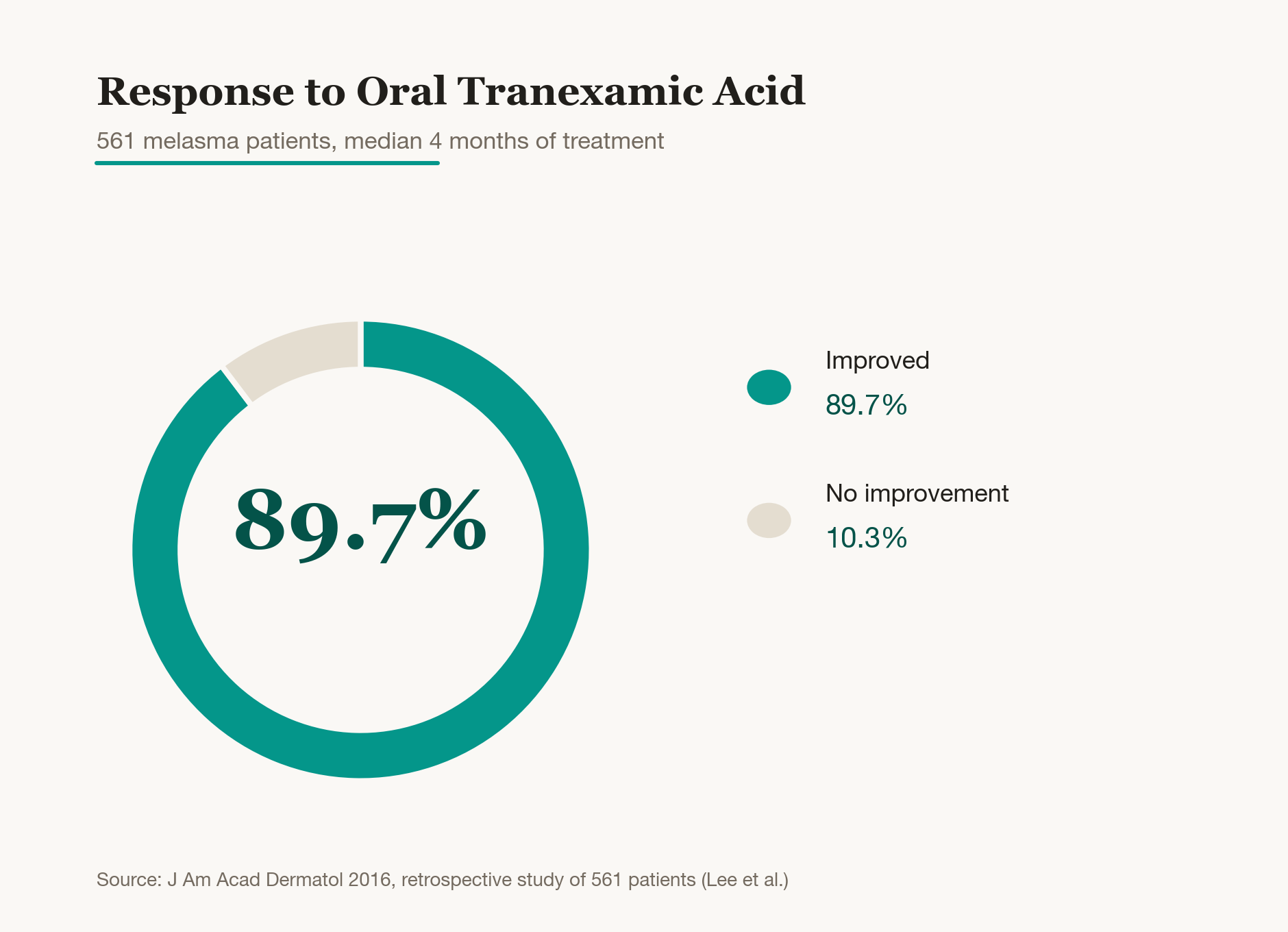
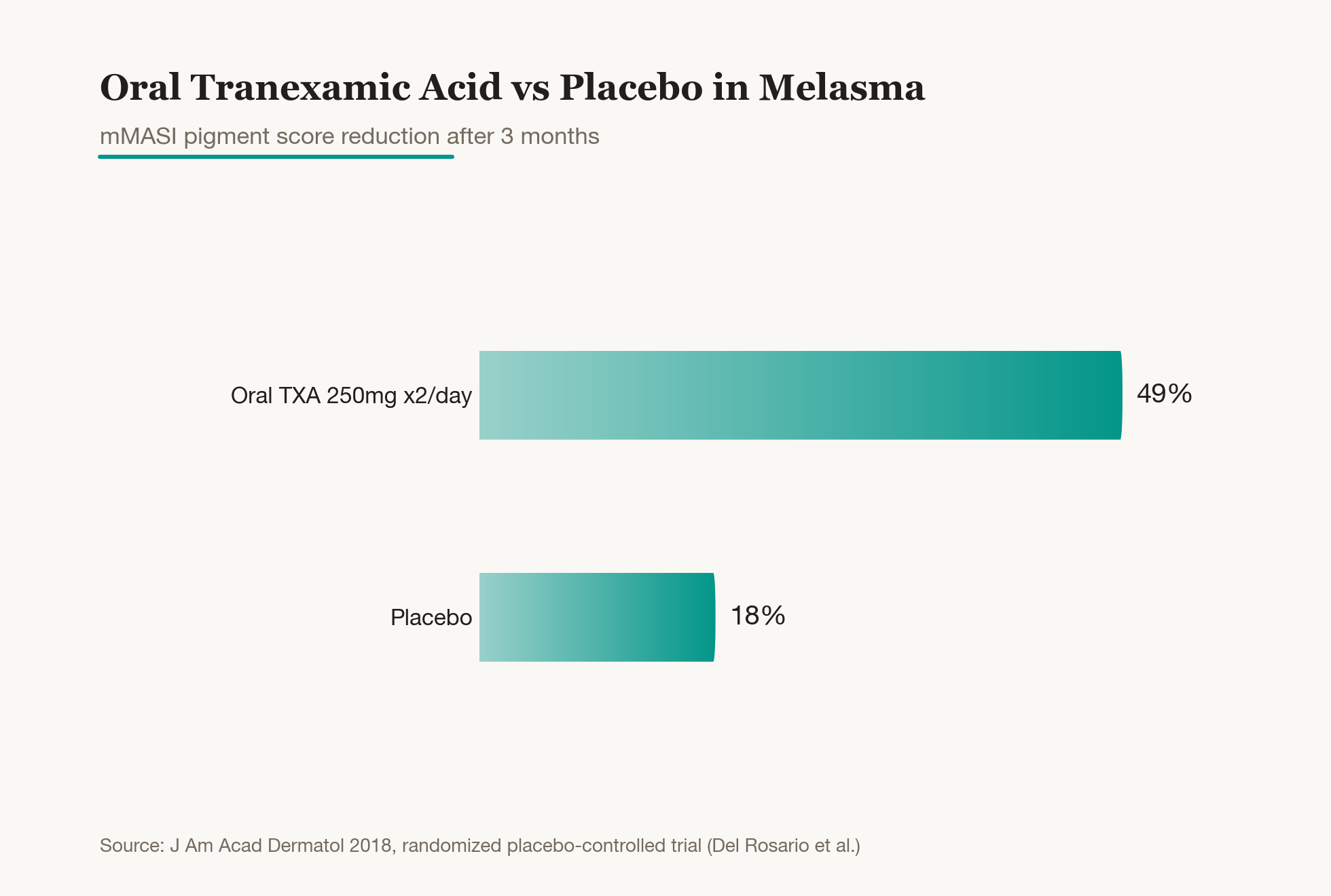
The oral form travels through the digestive system, gets absorbed into the bloodstream, and circulates through the whole body before reaching the skin. Because it rides through the blood, it reaches the entire face evenly, including faint patches that are barely visible. Many reports note that this tends to produce a relatively more noticeable effect.
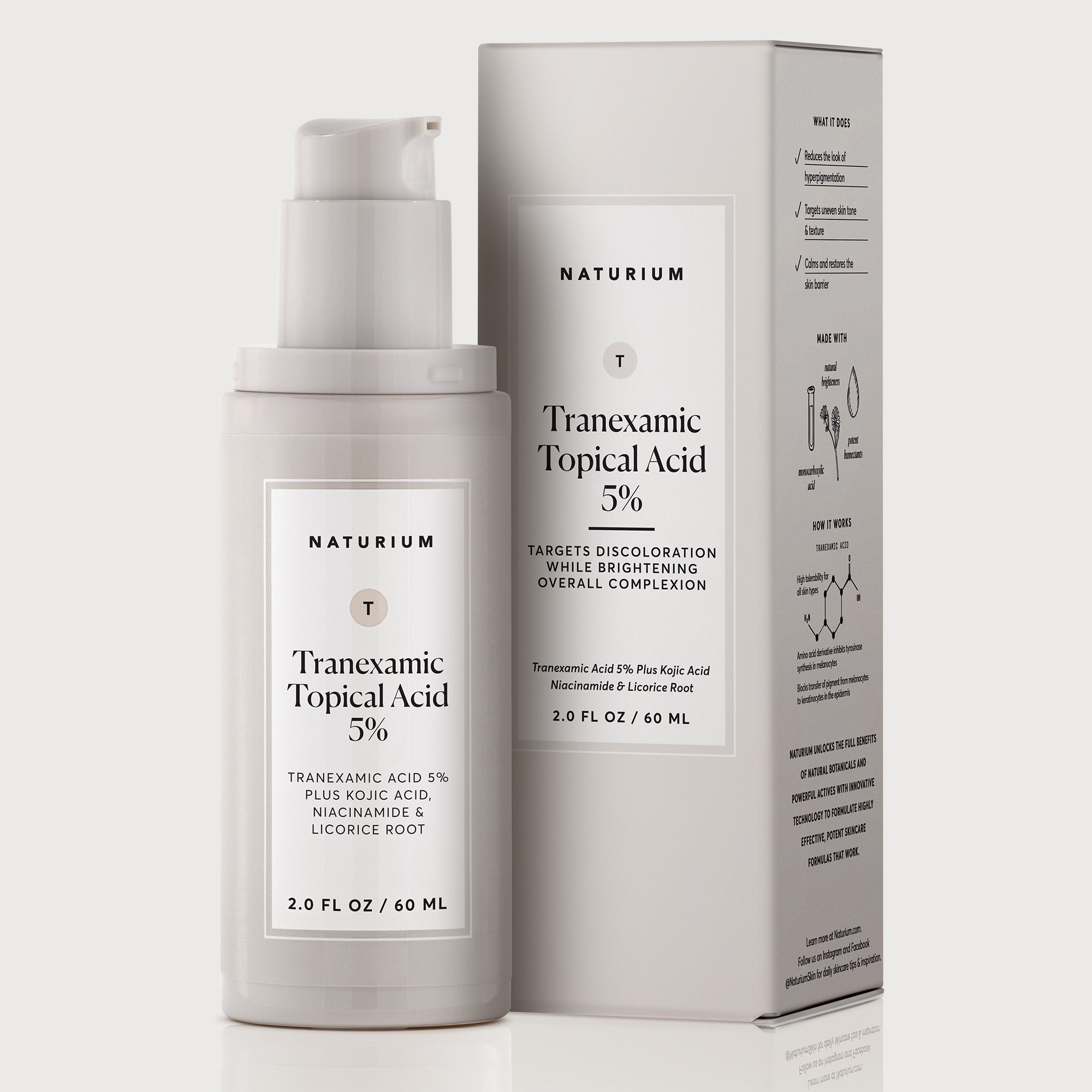
The topical form, on the other hand, has to soak through the skin surface all the way down to the dermis, and getting past the stratum corneum is surprisingly hard. Tranexamic acid actually has a small molecular weight, around 157 Da, so size isn't the obstacle. The real issue is its chemistry. It's hydrophilic, meaning it dissolves well in water, but the stratum corneum is a tightly packed lipid barrier that resists letting water-loving molecules through. Picture a drop of water landing on oiled paper: it just beads up on the surface instead of soaking in. Rather than forcing it through, it works much better to open a separate path for it. That's why topical formulas are typically paired with penetration-enhancing ingredients, or combined with procedures like microneedling that create tiny channels in the skin, to get a better result. The upside is that because it stays local instead of circulating through the body, topical use carries a lower burden of systemic side effects.
Why Is It Used With Other Brightening Ingredients?
Different brightening ingredients block pigment at different points. Hydroquinone works by directly inhibiting tyrosinase, the key enzyme that builds melanin. Niacinamide takes a different route: instead of blocking an enzyme, it interrupts the step where melanosomes (the pigment granules made inside melanocytes) get handed off to keratinocytes. Tranexamic acid works even further upstream than either of these, cutting down the stimulation signal that tells melanocytes to make pigment in the first place.
Because each ingredient targets a different point in the pathway, combining them is thought to suppress pigment production from multiple angles at once. This is exactly why dermatologists often prescribe or pair tranexamic acid with other brightening ingredients in practice.
Think of it as a factory analogy. Hydroquinone slows down the machine that assembles pigment on the factory floor. Niacinamide is closer to stopping the delivery truck that hauls finished pigment over to the warehouse (the keratinocytes). Tranexamic acid cuts back the purchase order that sends raw materials to the factory in the first place. Since each one intervenes at a different point, using them together tends to leave less visible pigment in the end than relying on any single ingredient alone.
Some people find that after three to four months on a single ingredient, their skin seems to adapt and the effect gradually plateaus. Combining ingredients that act on different pathways leaves room for at least one route to keep working even during that kind of plateau, which is another reason combination use is commonly recommended.
What to Check Before Taking It
Because tranexamic acid works by blocking the enzyme that dissolves clots, the flip side is that it can tip the body's balance slightly toward clotting more readily than usual. That makes the following points worth going over carefully.
- Anyone with a history of blood clots, or a condition that raises clotting risk, should talk to a doctor before starting this. Since the drug suppresses the body's clot-dissolving process, that risk can be amplified in people already prone to clotting. For example, someone who has previously had a clot in a leg vein could see their risk of recurrence rise as the balance shifts toward weaker natural clot breakdown, so this is not something to start on your own.
- If you're pregnant or planning a pregnancy, a doctor's judgment should come first. Hormones shift so much during this time that whether to use the drug needs to be checked on a case-by-case basis.
- Oral use can cause stomach upset or indigestion in some people. Taking it after meals is reported to ease these symptoms in many cases.
- Topical formulas carry a relatively lighter systemic burden, but when combined with procedures like microneedling, temporary irritation or redness at the treatment site can occur, so proper care before and after the procedure matters.
Melasma tends to darken again with UV exposure or hormonal changes, so even while using tranexamic acid, consistent sun protection is recommended alongside it. Rather than expecting one ingredient to solve everything, pairing a signal-suppressing treatment with habits that reduce daily irritation is the approach most commonly recommended in actual clinical practice.
References
Korean Dermatological Association, Ministry of Food and Drug Safety (MFDS), American Academy of Dermatology (AAD), and U.S. Food and Drug Administration (FDA).
Was this helpful?
About this article
Written by a practising aesthetic physician and intended for general education — not a substitute for individual medical advice.
Read next

Tranexamic Acid for Melasma: Which Is Better, Oral or Topical?
A drug originally used to stop bleeding turns out to quiet melanocytes, too. Here is how oral and topical tranexamic acid performed in actual studies, where the evidence holds up, and where it does not.
By Dr. Lee
Why Skin Peels After a Chemical Peel: Does It Work on Acne and Pigment Too?
A chemical peel isn't about acid burning your skin. It works by loosening the bonds holding dead cells that are already due to shed, speeding up turnover that was happening anyway. Here's the difference between AHA and BHA, and how recovery time changes with strength.
By Dr. Lee

Freckles Versus Melasma: How Do Their Laser Treatments Differ?
At a glance, freckles and melasma both look like brown spots, which makes them easy to mix up. But where the pigment actually sits in the skin, and why it shows up in the first place, are completely different. That difference decides whether you need a strong laser or a gentle toning session, and why one of the two keeps coming back.
By Dr. Lee