Why Skin Peels After a Chemical Peel: Does It Work on Acne and Pigment Too?
By Dr. Lee7 min read
You hear the word "peel" thrown around at dermatology clinics and skin care studios all the time, but few people actually know what happens underneath the skin during one. And when the only explanation you get is "we're applying an acid solution to your face," it's natural to feel a little uneasy.
Here's the thing: a chemical peel isn't acid burning or dissolving your skin away. It's closer to unlocking the bonds holding onto dead skin cells that were already on their way out, nudging along a turnover process your skin does on its own anyway, just faster and more evenly.
How does acid exfoliate dead skin?
At the very top of your skin sits a layer of old, dead cells stacked tightly against each other. Tiny connector structures, like little adhesive buttons, hold these cells together. In healthy skin, those bonds loosen naturally over time, so the dead cells shed on their own.
The trouble starts when oily skin or aging keeps those bonds locked in place longer than they should be. Dead skin that doesn't shed on schedule builds up, leaving the surface looking dull and clogging pores more easily. The acids used in chemical peels chemically loosen exactly those connector buttons. Once the grip between cells weakens, dead skin that would normally take 2 to 4 weeks to shed on its own comes off faster and more evenly.
The two acids most commonly used for this are AHA (alpha hydroxy acid) and BHA (beta hydroxy acid). AHA dissolves in water, so it loosens dead-skin bonds broadly across the surface. BHA dissolves in oil, so it can work its way into oil-clogged pores and clear out the dead skin buildup inside them too.
Even within the AHA family, molecule size changes how far an acid reaches. Glycolic acid has smaller molecules, so it penetrates deep into the dead skin layer quickly. Lactic acid has slightly larger molecules, so it works more slowly and stays closer to the surface. The simple rule of thumb: the smaller the molecule, the faster and deeper it goes. That's why two peels at the same concentration can feel completely different on your skin, depending on which acid is used.
What changes with peel depth?
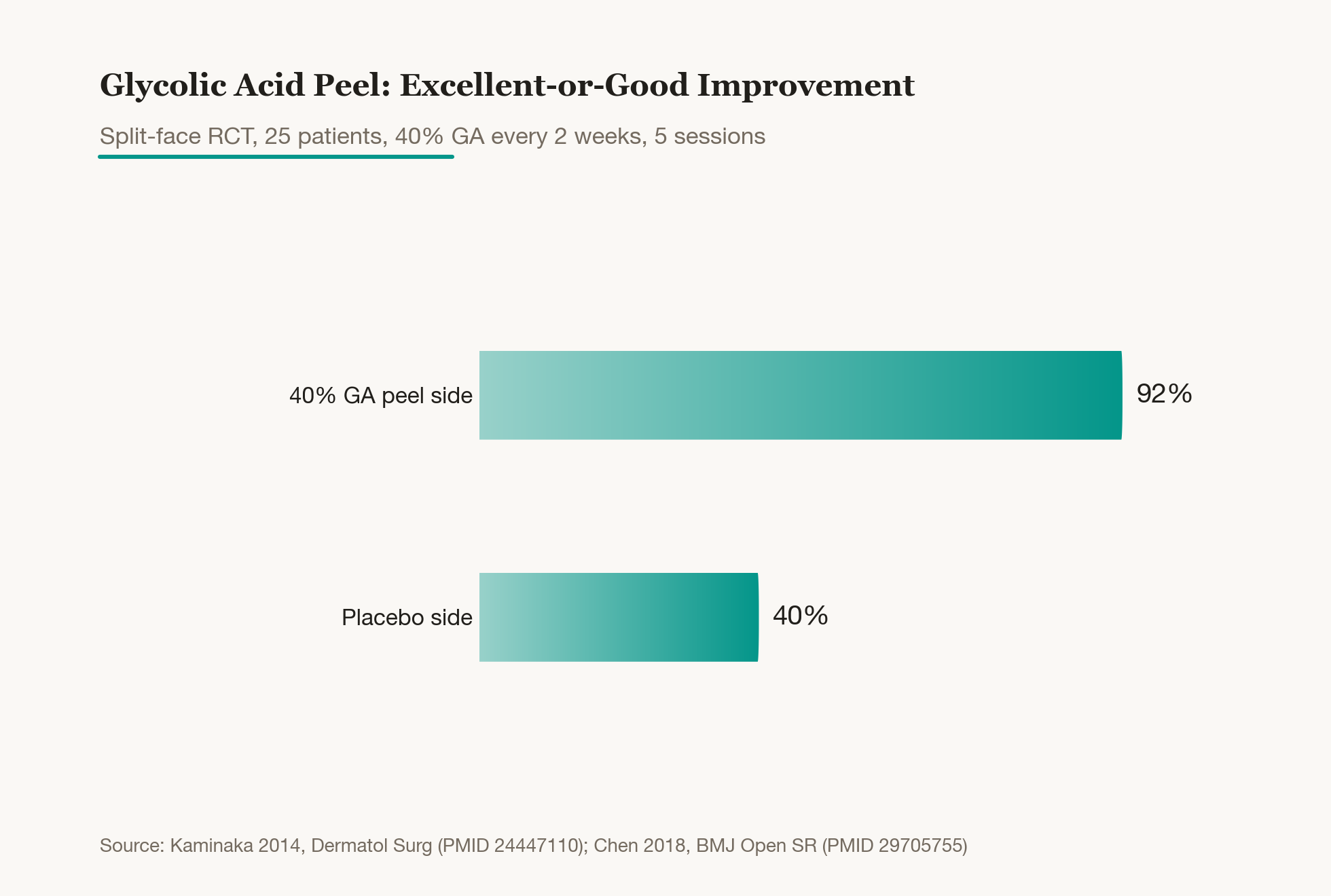
Even with the same acid, how deep it reaches depends on concentration and how long it sits on the skin. A light peel works only down to the top of the epidermis, the outermost layer of skin. Low-concentration glycolic or salicylic acid applied briefly falls into this category.
A medium-depth peel pushes past the epidermis to right at the boundary of the dermis underneath. Trichloroacetic acid at a set concentration is the classic example here. It sheds a thicker layer of dead skin than a light peel, and the redness that follows tends to last a bit longer too.
A deep peel reaches into the dermis itself, which is why clinics today use it only in very limited cases. As a general rule, the deeper the acid reaches, the more dead skin sheds, and the longer recovery takes.
Acids used for acne and clogged pores
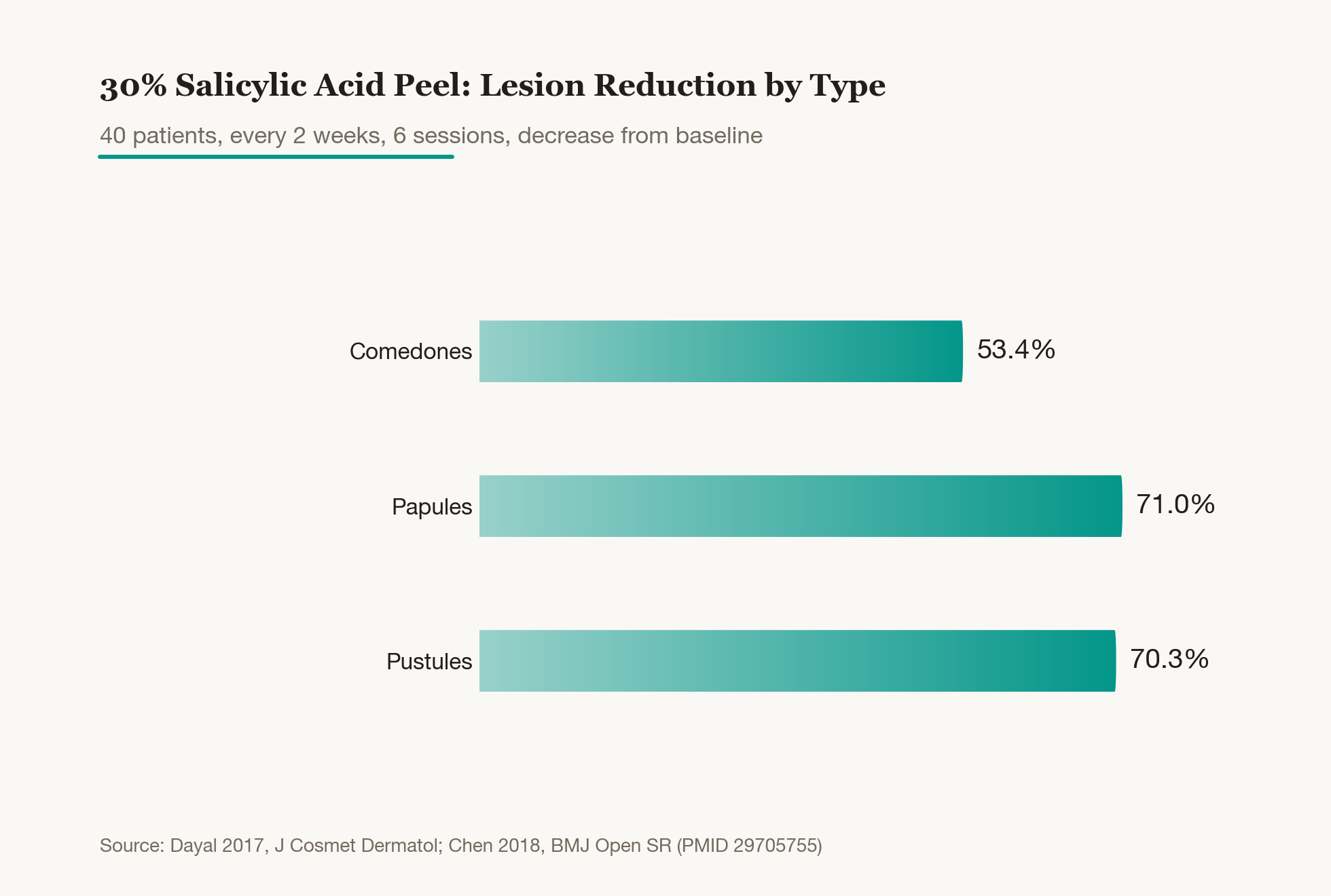
Acne often starts when a pore gets blocked at the opening by a mix of dead skin and oil. This is where salicylic acid, a BHA, gets used so often. Because it dissolves in oil, it can travel into an oil-clogged pore and loosen the dead skin packed inside it too.
Once the plug of dead skin blocking the pore loosens up, oil has a path to flow again, and the sealed, oxygen-starved environment that acne-causing bacteria love shrinks along with it. Salicylic acid itself is also reported to have some calming, anti-inflammatory properties, which is thought to help settle the redness of active breakouts as well.
This is also why acne-prone skin is so often recommended low-concentration peels done regularly. Instead of a single intense treatment, spacing out 4 to 6 mild sessions at 2 to 4 week intervals is considered more effective at consistently slowing how fast dead skin rebuilds inside pores.
Can pigment and dark spots fade too?
Brown pigmentation, whether it's melasma or an acne scar, comes down to melanin granules that have built up inside skin cells in the epidermis. A chemical peel doesn't break down that melanin directly. Instead, it speeds up how quickly the melanin-carrying dead cells make their way out of the skin.
When turnover speeds up, those old, pigment-carrying cells shed more often, and fresh cells with less pigment rise up to replace them. Repeated 4 to 6 times at 4 to 6 week intervals, this process is reported to gradually fade visible pigmentation. That said, it's worth knowing that pigmentation sitting deep in the dermis usually can't be resolved with peels alone.
Does a higher concentration mean longer recovery?
As acid concentration rises, it loosens dead-skin bonds more forcefully, and more skin sheds in a single session. At low concentrations, the shedding is so fine it's barely visible to the naked eye. At higher concentrations, the surface can visibly turn white or peel off in thin sheets.
Recovery time tends to scale with concentration too. Low-concentration peels often let you apply makeup the same day or the next morning, but higher-concentration peels can leave redness and flaking for 7 to 14 days.
- Low concentration: bonds loosen only slightly, so just a thin surface layer of dead skin clears. Irritation is minimal, and recovery usually wraps up within a day or two.
- Medium concentration: bonds loosen across a wider area, giving the sense that the whole epidermis is turning over. Redness can last 3 to 5 days.
- High concentration: the effect reaches close to the dermal boundary, shedding a thicker layer of dead skin. Reported improvement in pigmentation or scarring tends to be greater, but recovery takes longer too.
How long is skin sensitive after a peel?
Once the acid has loosened those dead-skin bonds, the layer that used to cover your skin is temporarily thinner. That layer normally acts as a shield against outside irritants and moisture loss, so right after it thins out, skin can react more sharply than usual to things like UV exposure or friction.
This is exactly why sun protection gets emphasized so heavily during this window. With a thinner barrier, UV rays reach deeper more easily, which can actually darken the very pigmentation the peel was meant to fade.
For the same reason, it's best to skip other exfoliating products or hot compresses for 5 to 7 days right after a peel. Piling more irritation onto an already-thinned barrier doesn't give skin the time it needs to recover, and can leave redness and sensitivity lingering longer than necessary. Keeping things simple with just moisturizer and sunscreen is the better-known approach for letting new skin settle in undisturbed.
What is the right interval between peels?
It's known to take roughly 28 to 30 days for a skin cell to form at the bottom layer of the epidermis, rise to the surface, and finally shed. Even if a peel speeds up the shedding of the top layer, the new cells underneath still need that same amount of time to move up and settle in.
If peel sessions are scheduled too close together, the young, not-yet-settled cell layer underneath ends up getting hit with irritation over and over. Without ever getting the chance to do its job, a barrier that stays thin can end up weakening and turning more reactive to irritation instead. Space sessions out appropriately, though, and the timing lines up with skin's natural renewal cycle, cutting down on irritation while letting the benefits build up over time.
References
Korean Dermatological Association, Ministry of Food and Drug Safety (MFDS), American Academy of Dermatology (AAD), and U.S. Food and Drug Administration (FDA).
Was this helpful?
About this article
Written by a practising aesthetic physician and intended for general education — not a substitute for individual medical advice.
Read next

AHA and BHA Differences: Choosing by Skin Type and Comparing Effects
AHA and BHA are both acids that clear away dead skin cells, but where they actually work depends on one simple thing, whether they dissolve in water or in oil. AHA breaks down the bonds holding surface buildup together, while BHA rides through oil to reach the sebum sitting deep inside your pores. Here is how each one works, and which fits which skin type.
By Dr. Kim
FCR Peeling Effects: Is It Okay for Sensitive Skin?
FCR peeling is a physical peel that works by massaging tiny needle-shaped crystals from coral into the skin to clear away dead skin and sebum together. Because it stimulates the skin differently than acid-based chemical peels, it tends to be more comfortable to try even on sensitive or acne-prone skin. Here's how it works and how to care for your skin afterward.
By Dr. Kim
Cafe-au-Lait Spots Returning After Laser: Causes, Number of Sessions and Expectations
A café au lait spot forms because the pigment-making cells in that one patch of skin are locally overactive. Laser treatment breaks up the pigment that has already built up, but it doesn't switch off those cells, which is why the color so often returns. Here's the biology behind it, why results differ so much from person to person, and what a realistic treatment timeline actually looks like.
By Dr. Kim