Thread Lift Effect and Duration: Does It Really Last Over a Year?
By Dr. Lee7 min read

A thread lift uses absorbable sutures inserted under the skin to pull sagging tissue upward, without a scalpel or general anesthesia. Recovery is short, which is why it is one of the most popular options in the non-surgical lifting category. Plenty of patients come in at lunch and are back at the office by the afternoon.
The phrases "lasts over a year" and "keeps generating collagen" are everywhere in thread lift marketing, but they often outpace what the research actually shows. Here is a look at how PDO, PLLA, and PCL threads differ in absorption time and effect duration, what barbed versus smooth threads each accomplish, and what the published satisfaction and complication rates actually look like. If you are weighing up a thread lift, this should help you set realistic expectations before you book.
How Does a Thread Lift Pull Up Sagging Skin?
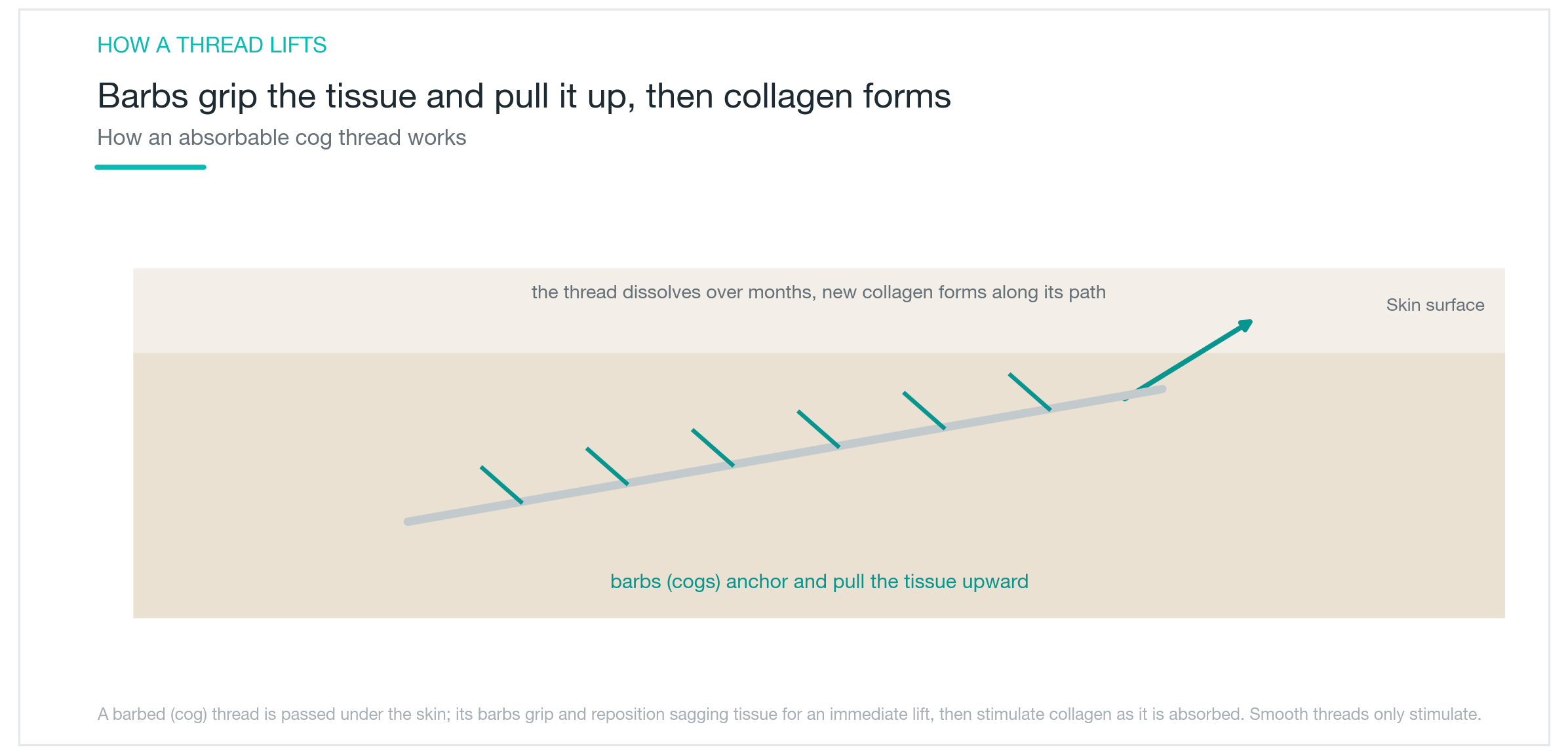
There are two mechanisms at play. First, the cogs on barbed threads, small hook-like projections along the suture surface, catch the fat layer or fascia beneath the skin and physically pull sagging tissue upward. Second, as the threads slowly break down inside the body, the mild inflammatory response around them triggers collagen synthesis in the surrounding tissue.
Once a barbed thread is placed, the hooks anchor tissue along the needle track. Tensioning the thread lifts the sagging area, and this is what causes the stiff, slightly pulled look you may notice right after the procedure. Over the following 1–2 weeks, the tissue settles and the result softens into something more natural.
How much lift to actually expect is usually the first question that comes up in consultation. In a 2018 study by Ali, objective measurements put soft-tissue displacement at 3mm to 10mm. That is meaningful, but it is not the line-reshaping you get from a surgical facelift. Thread lifts address mild-to-moderate laxity, and knowing that upfront prevents disappointment.
The collagen-stimulation benefit continues even after the threads have been fully absorbed. The degradation process produces a low-level inflammatory signal that prompts fibroblasts to lay down new collagen, improving skin firmness and texture. This effect is more about skin quality than structural lift.
Absorption Time of PDO, PLLA and PCL
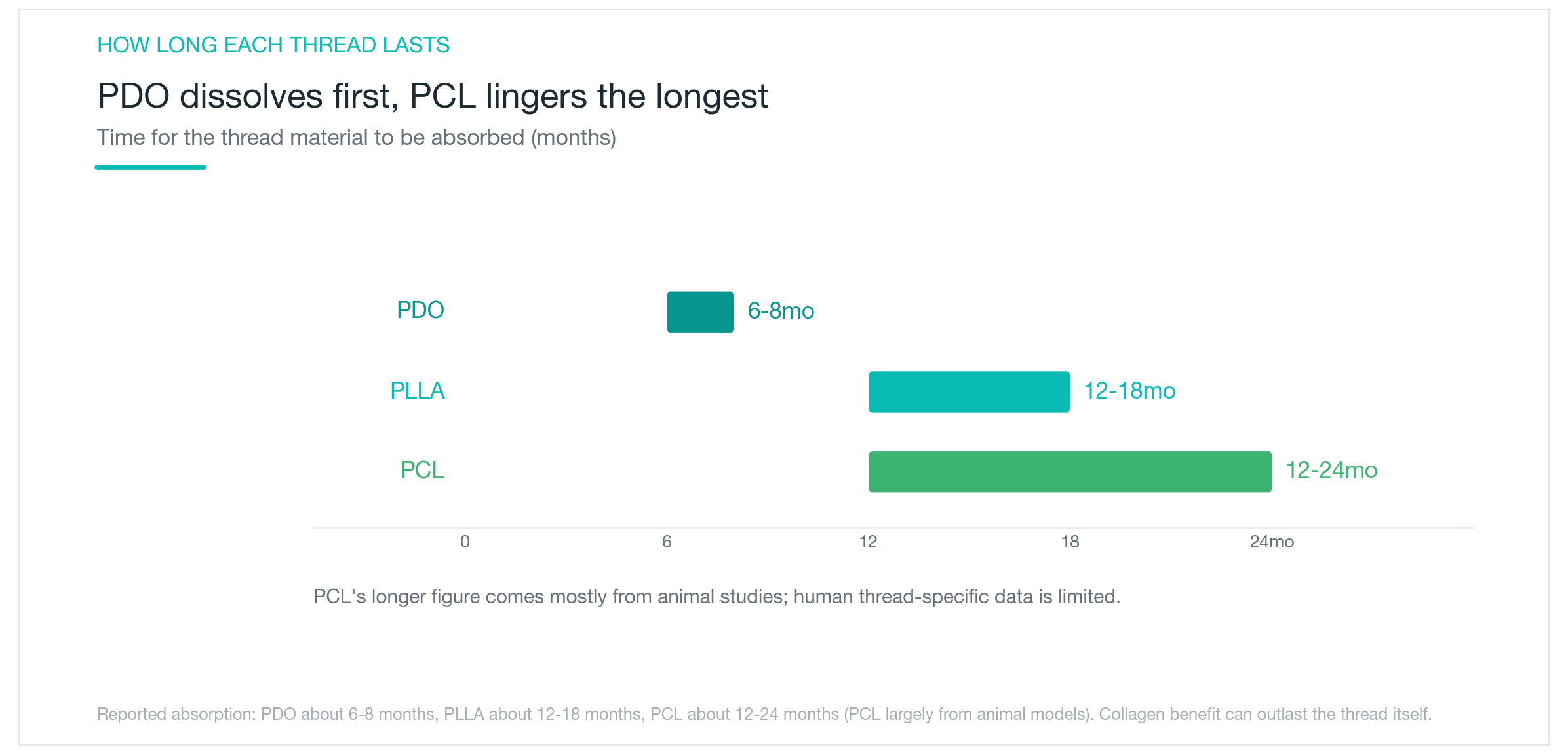
The most important difference between these three materials is how long they take to be absorbed.
PDO (Polydioxanone) breaks down in about 6–8 months. It has been used in surgical sutures for decades, so the safety record is the most established of the three. Its shorter absorption window also means that if a complication develops, it tends to resolve faster.
PLLA (Poly-L-Lactic Acid) is absorbed over 12–18 months. It is the same ingredient found in fillers like Sculptra and is said to be a stronger driver of collagen production during degradation. That said, there are not many long-term human trials specifically tracking what PLLA threads do to the face over time. The collagen-boost claims are plausible but not fully confirmed by clinical data yet.
PCL (Polycaprolactone) is the slowest to dissolve, commonly quoted at 12–24 months. It is worth noting that this figure comes largely from laboratory conditions, not from studies that followed real patients for two years and confirmed the effect was still there at that point. The "longest-lasting" marketing claim deserves some healthy skepticism.
All three materials ultimately break down into water and carbon dioxide. Which one a doctor recommends depends on your goals, skin condition, and their clinical experience with each material.

How Are Cog Threads and Mono Threads Different?
Barbed threads (cog threads) have hooks along the suture surface. Those hooks grip subcutaneous tissue and hold the lift, making them the go-to choice for physically repositioning sagging cheeks, softening nasolabial folds, and reshaping a blurred jawline.
Smooth threads have no hooks. They do not produce a mechanical lift. Instead, the act of inserting them creates a wound-healing response that stimulates collagen and elastin production. They are used when the goal is to improve skin density, reduce fine lines, and restore overall firmness. If sagging is your primary complaint, smooth threads alone will not be enough to fix it.
Screw threads (twisted threads) add a small amount of volume to the insertion site along with a light lifting effect, making them a useful adjunct for hollowness under the eyes or flat cheek areas.
In practice, a session often combines types. Barbed threads handle the structural lift while smooth threads are added to improve skin quality in the treated area. The exact combination depends on the patient's anatomy, goals, and what the skin looks like on the day.
Does the Effect Really Last Over a Year?
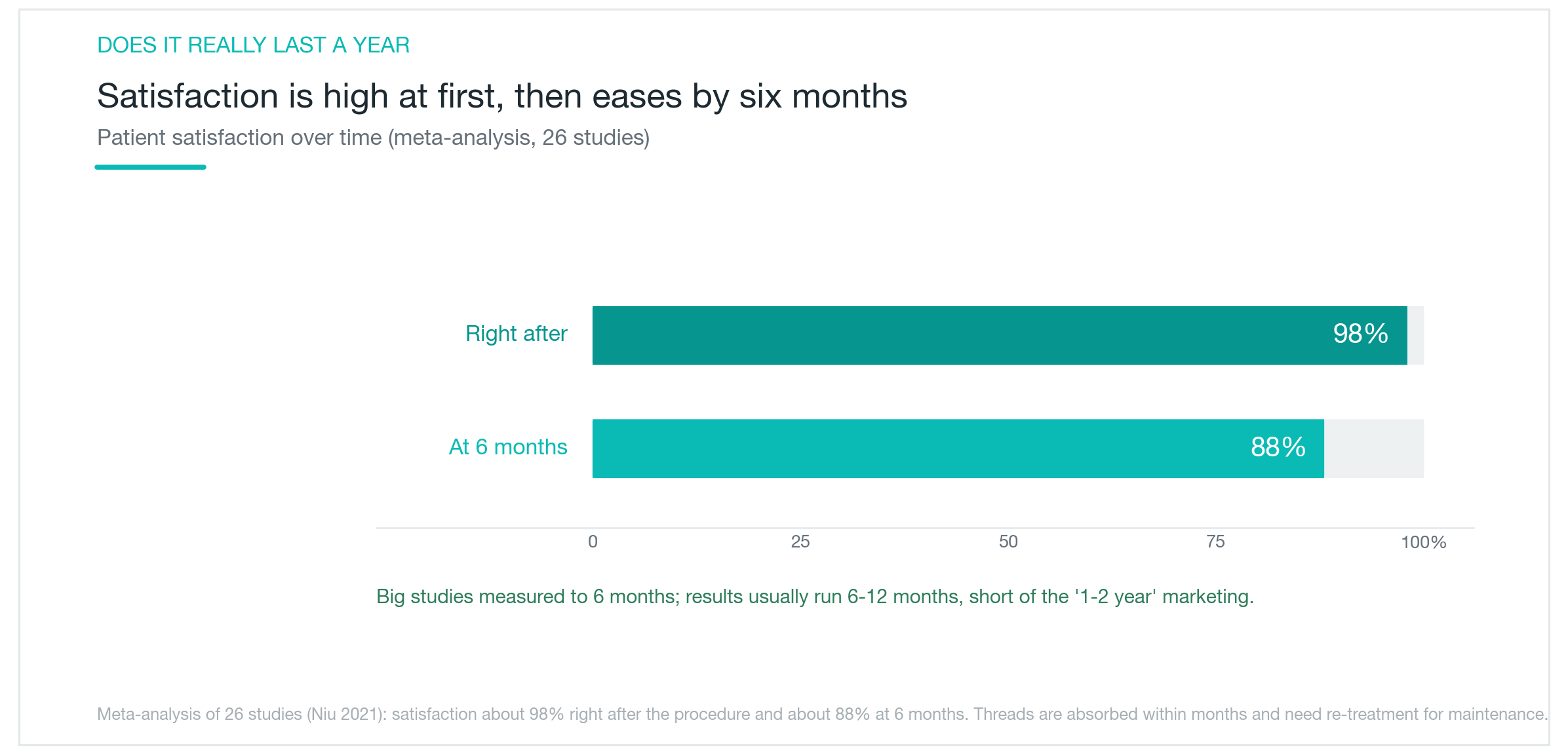
Pooled data from multiple studies put immediate post-procedure satisfaction at around 98%. By six months, that number drops to roughly 88%. The bigger issue is what the studies actually tracked: most only followed patients for 6–12 months. Any claim that results last beyond a year is drawing on data that simply does not exist yet.
Whether PCL effects really persist for 24 months, or whether PLLA delivers a sustained collagen benefit past 18 months, has not been confirmed in long-term studies on real faces. The fact that major trials all use six months as their primary endpoint signals that what happens afterward is not well understood.
Realistically, the peak effect tends to land somewhere between 6 and 12 months, after which it gradually fades. That is why many patients return for repeat treatments within 1–2 years. Compared to the 7–10 year durability of a surgical facelift, the gap is obvious. Thread lifts are a legitimate non-surgical option, but they are not a substitute for surgery in either longevity or degree of correction.
Planning for repeat sessions, both the timing and the cost, from the start makes the whole experience much easier to manage.
Side Effect Rates and Aftercare
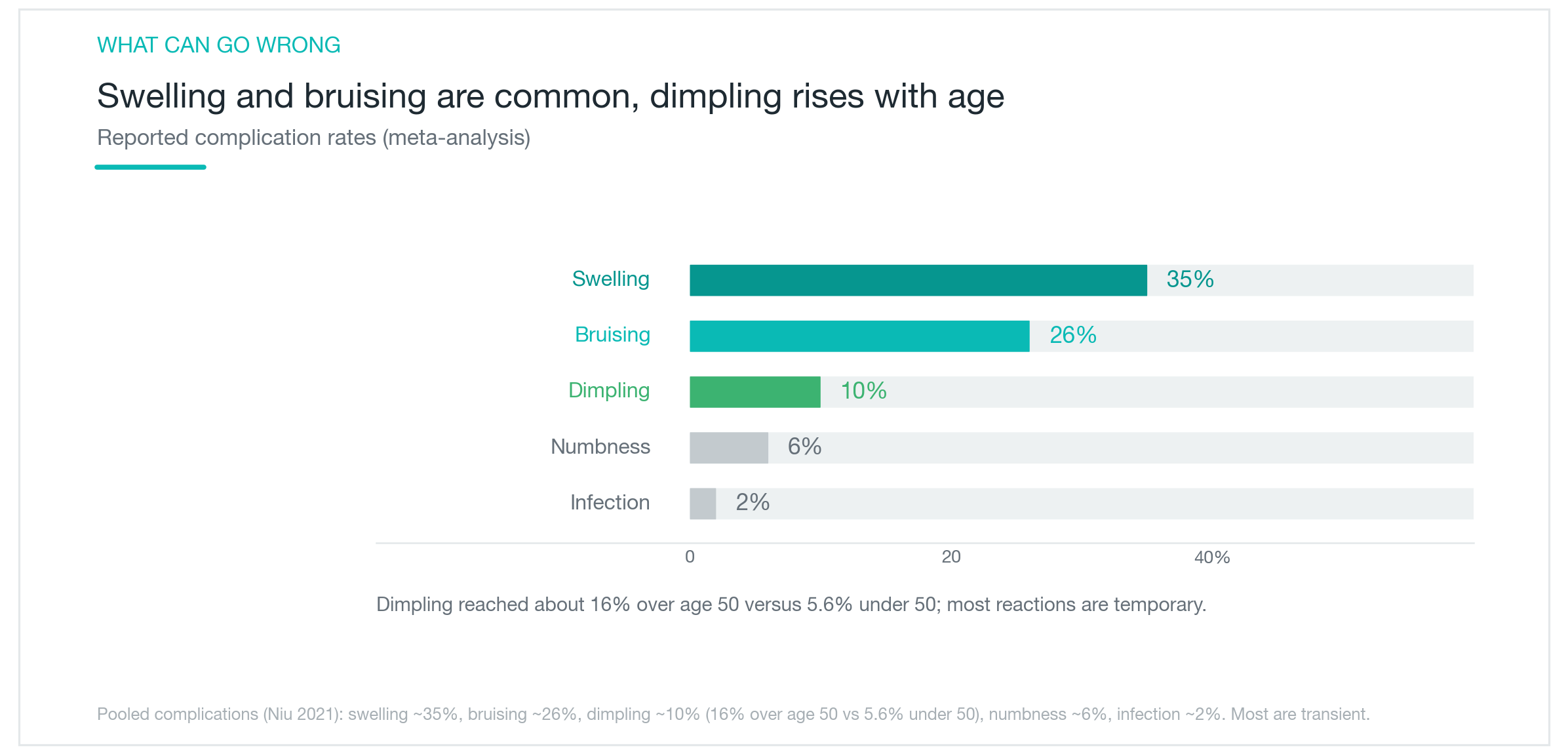
Across the published literature, swelling occurred in about 35% of cases and bruising in about 26%. Both are predictable responses to needle insertion and typically resolve within a few days to two weeks. If you have something important coming up, give yourself a comfortable buffer.
Dimpling (skin puckering or sinking) was reported in about 10% of cases overall. The breakdown by age matters here. In patients under 50, the rate was about 5.6%. In patients 50 and older, it rose to about 16%. Skin that has lost some elasticity has a harder time keeping up with the thread's pull, so the surface can fold or indent. Most dimpling is temporary, but it can take weeks to months to fully resolve.
Sensory changes occurred in about 6% of cases, infection in about 2%, and thread extrusion, where a thread works its way to the surface, in about 2%. If a thread extrudes, it needs to be removed.
Most patients can return to their normal routine the same day or the next. For about two weeks after the procedure, avoid extreme facial expressions, deep massage of the treated area, and alcohol. Mechanical stress on the threads before they have integrated can shift their position. Sleeping face-down is also best avoided in the first couple of weeks.

Who It Suits Well
A common misconception is that anyone with sagging will get good results. The patients who respond best are those with mild-to-moderate laxity who are not ready or willing to have surgery. Typically this means someone in their early-to-mid forties noticing early cheek descent or a slightly softened jawline.
Patients with significant laxity or excess skin volume are unlikely to achieve their goals with threads alone. When there is redundant skin that needs to be excised, surgery is the more realistic path, and a good consultation will make that clear before any procedure is booked.
Expectations need to be calibrated from the outset. You will feel a noticeable pull right after the procedure, but it takes 3–6 months for the threads to fully integrate and the collagen response to build. The realistic outcome is a subtle, refreshed lift, not a dramatic transformation, more the kind of result that gets people telling you that you look well rested.
Because the effect fades for most patients within 1–2 years, repeat treatments are part of the plan. Patients who understand the difference between a surgical and a non-surgical result, and who go in with that framing, are consistently the most satisfied.
Was this helpful?
About this article
Written by a practising aesthetic physician and intended for general education — not a substitute for individual medical advice.
Read next
Ultracol PDO Effect and Duration, Including Differences From Lifting Threads
Ultracol isn't a thread lift. It's a skin booster made by grinding PDO into microscopic particles, suspending them in liquid, and injecting them to trigger new collagen. Here's how the particles work as they break down, where they're placed, what determines how long results last, and how to care for your skin afterward.
By Dr. Lee
Mint Thread Lift: Differences Between PDO and PCL, and How Long It Lasts
Mint thread is a cog thread with tiny barbs packed along its surface, made from either PDO or PCL. Here is how those barbs physically grip and lift tissue, and how each material's breakdown speed shapes how long the results last.
By Dr. Lee
Restylane Types and Results: How Long They Last and Side Effects
A clear breakdown of what Restylane is, how NASHA and OBT technology differ, which products go where across Lyft, Defyne, Refyne, Kysse, and Contour, and what the honest safety picture looks like, including how to reverse it with hyaluronidase.
By Dr. Lee