Thigh Fat Treatments: Types, How They Work, Effect Differences and Aftercare
By Dr. Kim7 min read
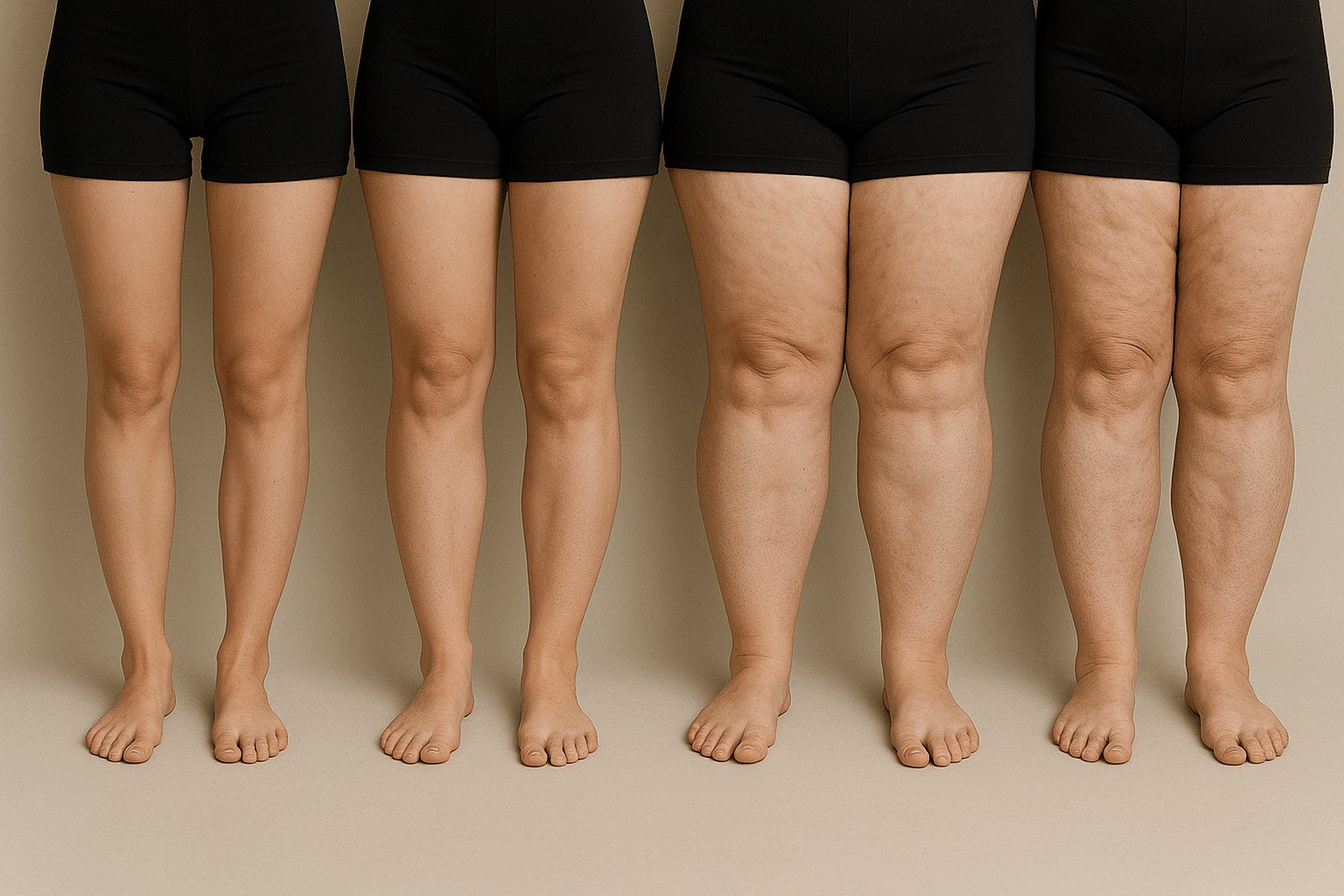
Plenty of people feel like their thighs barely change no matter how hard they exercise or how carefully they eat. The number on the scale drops, but the thigh measurement stays about the same. That frustration is part of why localized fat treatments, ones that act directly on fat cells, have become more popular. Here is why diet alone struggles to reach thigh fat, and how cooling, injections, and heat energy each work to reduce it.
Why Doesn't Thigh Fat Go Away?
The number of fat cells in the body does not change much once you reach adulthood. Losing weight mainly means each fat cell shrinks, not that the cells themselves disappear. The catch is that fat cells are not distributed evenly across the body.
Areas like the thighs and hips carry fat that responds strongly to female hormones. Fat cells in these regions tend to have more receptors that pick up signals to store fat, and fewer receptors that respond to signals telling the cell to release fat for energy. So even with the same calorie deficit, thigh fat tends to shrink later and less than fat on the belly or arms.
It is also well known that spot reduction, losing fat from one chosen area through exercise alone, does not really work. Working a specific muscle harder does not make the fat sitting on top of it disappear first. This is the gap that fat cell targeted treatments were designed to fill.
How Treatments Reduce the Number of Fat Cells
The basic premise behind localized fat treatments is reducing the number of fat cells, not just their size. Diet and exercise pull stored fat out of cells and shrink them. Treatments instead damage the fat cells themselves through cooling, chemical agents, or heat energy, cutting down the cell count.
Damaged fat cells do not clear away on their own. Macrophages, the immune cells that clean up cellular debris, move in and process the remains. This does not happen right after treatment. It unfolds gradually over weeks to months, which is why most people notice the volume change starting weeks later rather than right away.
This approach is not meant to drive major weight loss. It works better as a way to refine specific areas that stay stubborn while someone is already managing their weight through other means. Treatment alone is not a solution for overall obesity.
How Does Cryolipolysis Work?
Cryolipolysis takes advantage of the fact that fat cells are more sensitive to cold than the cells around them. Skin and muscle tissue tolerate a certain degree of low temperature fairly well, but the fat inside a fat cell starts to solidify, shifting from liquid toward something closer to solid, once it drops below a specific temperature.
Once fat solidifies, the cell can no longer function normally and enters apoptosis, a gradual and programmed form of cell death. Rather than rupturing suddenly, the cell essentially switches on its own death signal, which is why the surrounding tissue is not subjected to sudden, severe damage.
A mild inflammatory response accompanies this process at the treated site. Immune cells gather to clear away the dying fat cells, and the swelling and firmness that follows can last for several weeks. Visible volume reduction tends to show up as that reaction settles down. In rare cases, an unusual response where fat cells actually increase has been reported, so the treatment area and intensity should be chosen carefully.
How Do Injections Dissolve Fat Cell Membranes?
Injection lipolysis places an agent directly into the fat layer that damages the fat cell membrane itself. The best known ingredient, deoxycholic acid, is naturally present in the body's bile and has the property of dissolving the fatty components that make up a cell membrane.
Once the membrane is compromised, the fat cell does not die off slowly the way it does with cooling. It undergoes necrosis, a comparatively fast process where the cell essentially collapses. The contents that spill out from the ruptured cell trigger inflammation in the surrounding tissue, and white blood cells move in to clear the area. The swelling and firmness felt for several days after treatment is a sign that this inflammatory response is underway.
This ingredient was originally developed and approved to target submental fat under the chin, but the same mechanism is often applied to other areas such as the thighs or upper arms. For larger areas, it is common practice to split the treatment into several sessions.
How Do Radiofrequency and Ultrasound Work?
Treatments that use radiofrequency (RF) or ultrasound take the opposite approach from cooling or injections, damaging fat cells by adding energy rather than removing it or dissolving membranes. RF delivers heat energy into the fat layer beneath the skin, raising the temperature to a certain level. That heat is described as disrupting the fat cell's normal function and pushing it toward apoptosis.
Focused ultrasound, often called HIFU, works a bit differently. It concentrates sound energy at a single point, creating a rapid, localized pressure change. That pressure mechanically shakes and breaks down the fat cell membrane, somewhat like a small bubble bursting underwater and sending a shockwave through the surrounding area, except this happens inside the fat cell itself.
Both approaches share the advantage of being less invasive than cooling or injections. RF's heat is also said to stimulate collagen production in the dermis, so alongside fat reduction, the skin can end up looking slightly firmer as a side benefit. That said, the fat destroying power of these energy based methods is often reported as somewhat weaker than what cooling or injections achieve.
Why Do Results Differ With the Same Treatment?
Several factors explain why the same treatment produces different results in different people. The thickness and distribution of the fat layer, along with the condition of the skin, all affect how evenly the energy or medication actually reaches the fat cells.
- Fat layer thickness: A thicker fat layer makes it harder for the treatment device or medication to reach deeper areas evenly, which often means multiple sessions are needed for consistent results.
- Skin elasticity: In areas where skin elasticity is already weak, the skin cannot contract to match the reduced fat volume, so even after the fat shrinks, some sagging can remain.
- Blood flow in the treated area: Clearing away damaged fat cells and inflammatory byproducts ultimately depends on blood and lymphatic circulation, so areas with slower circulation may see slower recovery and slower volume reduction.
- Habits after treatment: The fat cells that remain after treatment can still grow larger, so if eating habits slip afterward, the remaining cells can expand again and bring the volume back.
Because of this, checking the fat layer thickness and the condition of the area before treatment is considered an important part of predicting the outcome.
Aftercare and Eating Habits
The specific aftercare varies by treatment type, but the general principles are similar across the board. The key is not to interfere with the process of clearing out the damaged fat cells.
- Avoiding intense massage or heavy pressure for the first few days after treatment is generally recommended, since stimulating tissue that has not yet been processed can prolong the swelling.
- Drinking enough water is said to help, since hydration and circulation both play a role in clearing away the debris from damaged fat cells.
- Swelling and bruising typically settle on their own over time, though recovery speed varies from person to person.
- Keeping up regular eating habits and activity levels after treatment matters for holding onto the results long term, since preventing the remaining fat cells from growing back is what keeps the effect in place.
If itching or swelling lasts longer than expected, or if the treated area keeps feeling unusually firm or lumpy, it is worth having the area checked at the clinic where the treatment was performed.
References
Korean Dermatological Association, American Academy of Dermatology (AAD), and Ministry of Food and Drug Safety (MFDS).
Was this helpful?
About this article
Written by a practising aesthetic physician and intended for general education — not a substitute for individual medical advice.
Read next
Fat-Dissolving Injection Effects and Swelling, Dose by Area and Number of Sessions
Why is a fat-dissolving injection said to work on stubborn areas like a double chin or upper arms that diet alone won't touch? Here's an easy breakdown of how the drug breaks down fat cell membranes, how the dissolved fat actually leaves the body, how dosing and sessions differ by area, and why swelling happens along the way.
By Dr. Lee

AHA and BHA Differences: Choosing by Skin Type and Comparing Effects
AHA and BHA are both acids that clear away dead skin cells, but where they actually work depends on one simple thing, whether they dissolve in water or in oil. AHA breaks down the bonds holding surface buildup together, while BHA rides through oil to reach the sebum sitting deep inside your pores. Here is how each one works, and which fits which skin type.
By Dr. Kim
Eye Shurink, Eye Thermage and Eye Oligio: Differences and Effects Compared
Eye Shurink, Eye Thermage and Eye Oligio are the three names that come up most often for eye area lifting, and they work through two different kinds of energy: ultrasound and radiofrequency. Here is how each one actually works on the delicate skin around the eyes, and which one fits which concern.
By Dr. Lee