When Do Thermage Results Appear? How Collagen Changes
By Dr. Kim8 min read
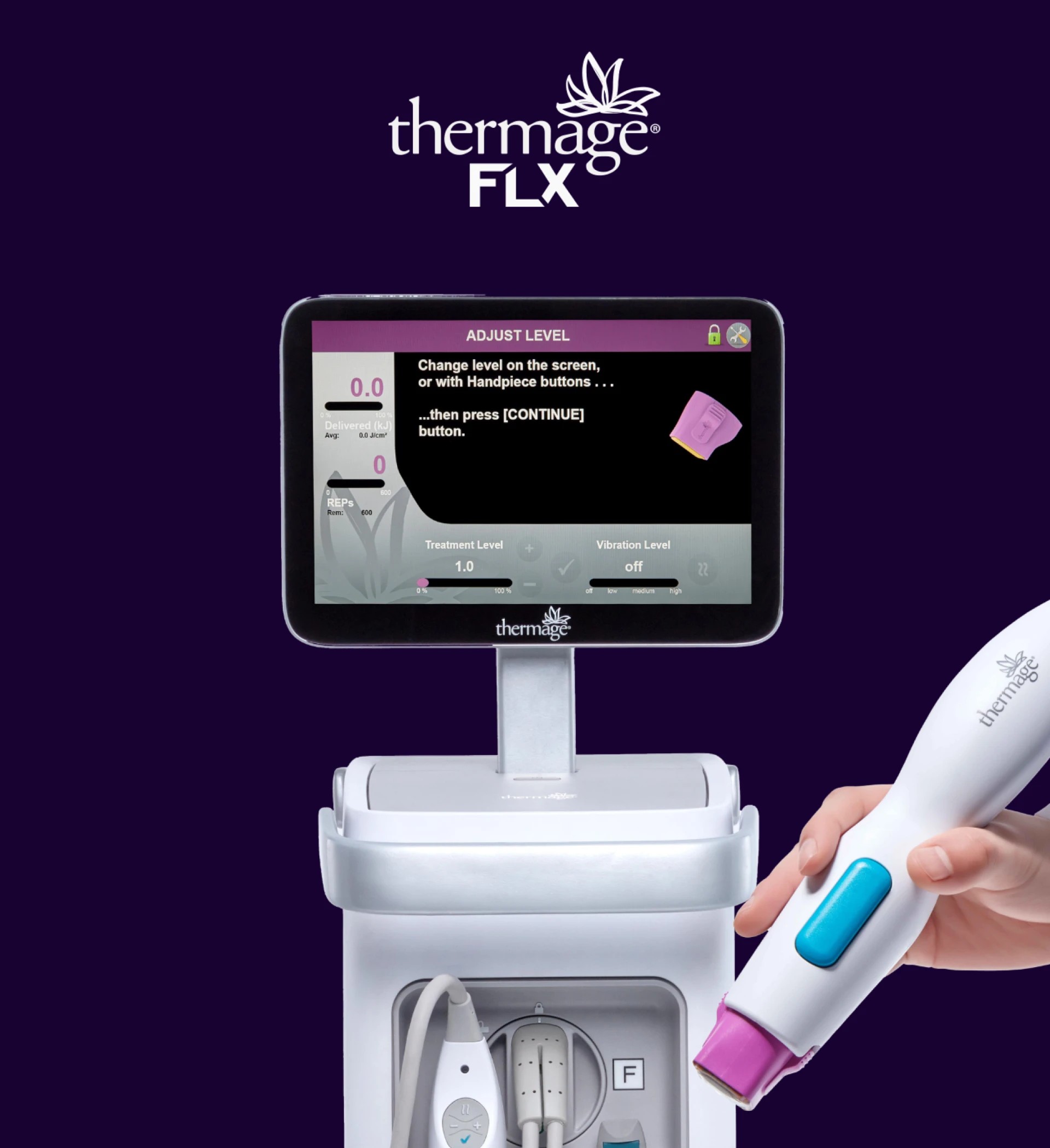
Thermage is a radiofrequency treatment known for lifting skin without cutting it or placing any threads under it. Ask how it works and you tend to hear the same short answer: heat the dermis, the collagen tightens, and over time fresh collagen fills back in.
What rarely gets explained is why heat makes collagen shrink in the first place, and why the effect doesn't end right away but keeps unfolding over 2 to 6 months. Once you break the process down into three pieces, heat, collagen, and the skin's own resistance, the order everything happens in starts to make sense.
How Does Thermage Create Heat Inside Skin?
Thermage runs on radiofrequency, RF for short, a form of electrical energy. When current passes through body tissue, the tissue itself resists that flow, and resistance is exactly what turns electrical energy into heat.
Think of the nichrome wire in a toaster. Current flowing through a section of wire with resistance heats up that section, and nothing else. Thermage's tip sends current into the skin the same way: the tissue acts as the resistor, so the heat is generated inside the tissue itself rather than applied from outside. Because the skin is heating itself, the warmth spreads evenly all the way down to the deeper layers of the dermis, not just the surface.
Thermage does this using a monopolar setup, where current leaves the tip and travels through the body to a grounding pad on the other side, completing a large loop. Since that loop runs deep, the heat has an easier path to the deeper dermis, letting it reach collagen sitting well below the surface rather than just the layer right under the epidermis.
The contrast with lasers makes this clearer. A laser generates heat when its light is absorbed by a specific pigment or by water molecules, so the heat only reaches as deep as that target exists. Radiofrequency, by relying on the tissue's own electrical resistance, spreads more evenly along the current's path regardless of pigment or water content. That makes it well suited to warming something as thick as the full dermis.
Why Is It Warm Instead of Sharp?
The radiofrequency Thermage uses reverses direction millions of times per second, an extremely fast alternating current. That speed puts it in a different category from the low-frequency current used to stimulate nerves and muscles.
Low-frequency stimulators, the kind used in EMS devices, switch direction slowly enough that ions in the body have time to drift one way, then the other, and cells register that movement. That drift is what triggers nerves and makes muscles twitch, and even at low intensity it can feel like a sting.
Thermage's radiofrequency switches direction far too fast for that. Ions barely start moving in one direction before they're pushed back the other way. It's a bit like whipping a jump rope so quickly that it never forms a real arc, just a tight, rapid vibration in place. Because the ions are only jittering in place, they never get the chance to trigger a nerve. Instead, the friction of ions colliding with each other converts into heat.
That's why people getting the treatment feel a steady warmth rather than any stinging or muscle twitching. That warmth is also the signal that collagen in the dermis is being reshaped in real time.
How Does Collagen Change When Heated?
Collagen is the protein that acts like scaffolding, holding the skin up from underneath. Three thin strands twist together into a rope-like structure, and it's that twist that keeps skin from sagging and lets it hold its shape.
Heat starts to unwind that twist. It's similar to what happens when heat is applied to hair that's already curled from a perm, the curl only tightens further. Once collagen's rope structure is heated past a certain point, the protein chains denature, the overall length shortens, and the collagen contracts immediately.
What holds the three strands of that rope together in the first place are hydrogen bonds, tiny bridges formed by water molecules. Those bonds are the reason the strands stay twisted instead of coming apart. Heat starts breaking those bonds one by one.
Picture a bundle of threads held together by small knots that come undone with heat. Once the knots give way, the twisted threads bunch up into a shorter, denser shape, and collagen does much the same thing the moment its bonds break: it contracts and its overall length shrinks.
That instant contraction is why skin can feel slightly firmer right after treatment. This early tightening does partially fade over time, though, which is why Thermage's real transformation happens in the next stage.
When Do Results Appear, and When Does New Collagen Form?
Heat-induced collagen denaturation reads to the skin as a form of subtle damage. The body doesn't ignore damage like this, it starts a repair response.
Fibroblasts drive that repair. These are the cells that actually manufacture collagen, and heat stimulation switches them on, prompting them to start weaving new collagen fibers. This process is called new collagen synthesis, or neocollagenesis.
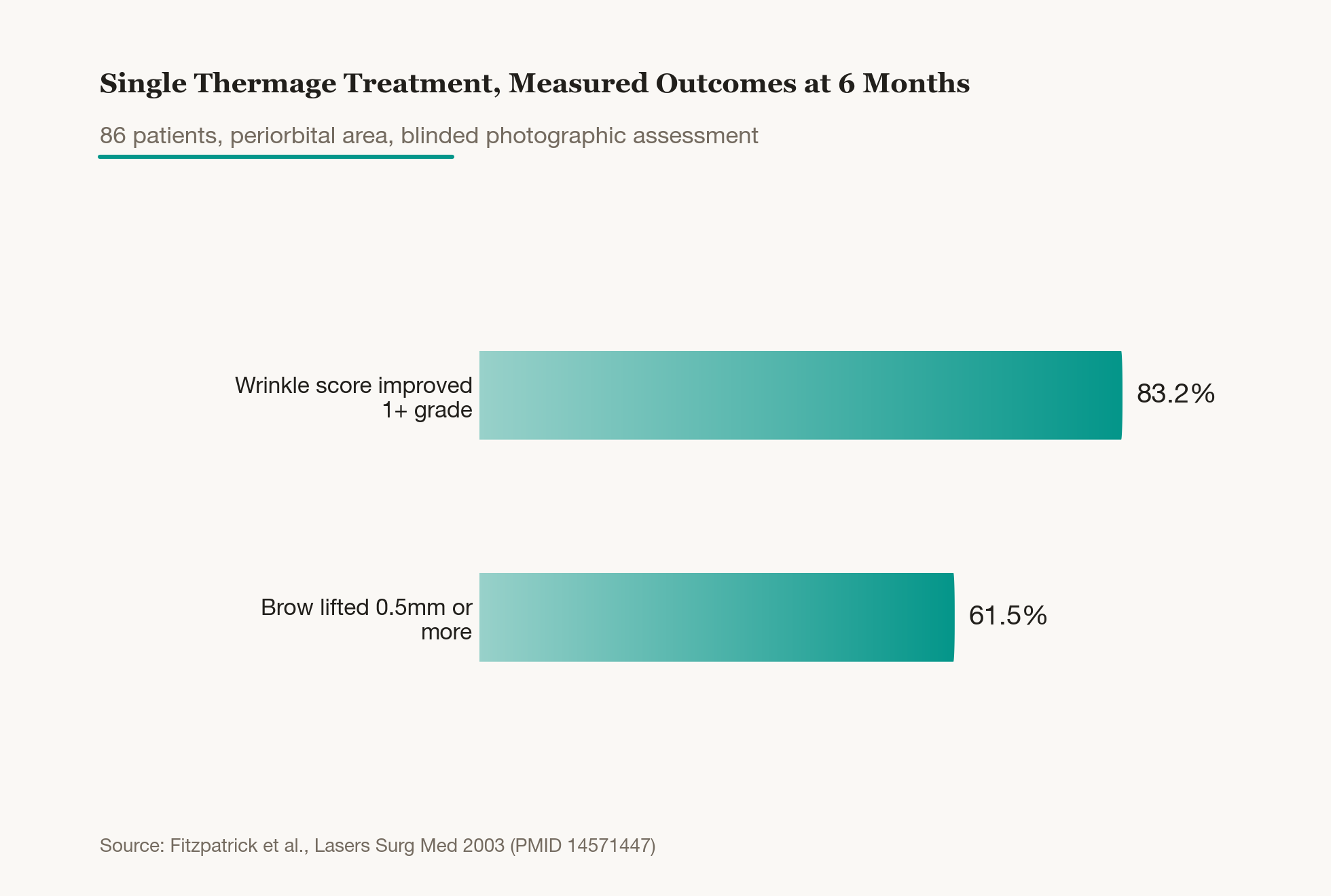
The catch is that these cells can't turn out a finished product overnight. It typically takes 4 weeks to 6 months for enough new collagen to accumulate and align before the skin visibly firms up. That's why Thermage's results are known to build gradually, usually becoming noticeable 2 to 3 months after treatment and continuing to develop for up to 6 months.
On top of that, freshly made collagen isn't neatly organized from the start. It's closer to a piece of fabric that's just been woven, with loosely tangled threads rather than a tight weave.
Over time, those fibers gradually align themselves along the direction of the forces the skin experiences and interlock more tightly, and only then do they gain the strength to actually support against sagging. Because that alignment process takes time, the results build slowly and last.
How Is Surface Burning Prevented?
If this much heat is reaching the deep dermis, you'd expect the epidermis, the outermost layer of skin, to get even hotter. Yet surface burns are rare with Thermage.
The answer is the cooling device built into the tip. The moment the tip touches the skin, it cools the surface while simultaneously sending radiofrequency energy through it. The epidermis stays at a low temperature thanks to that cooling, while the heat concentrates in the deeper dermis, where the cooling effect barely reaches.
- Why cooling is applied to the surface repeatedly before and after treatment: it keeps epidermal temperature low to reduce the risk of burns, while letting heat build up only in the deeper dermis.
- Why the tip needs to sit flush against the skin: a loose contact means uneven cooling and energy delivery, which can leave some spots hotter than others.
- Why energy levels are adjusted for each person's skin thickness and treatment area: dermal thickness and fat distribution differ from area to area, so the same energy setting reaches a different depth and produces a different sensation of heat depending on where it's applied.
Why Does Heat Feel Different by Area?
People often notice that the forehead, cheeks, and jaw feel differently hot even at the same treatment setting. That's because the skin's internal structure varies slightly from area to area.
Dermal thickness is one factor. Thin areas like around the eyes or the forehead let heat reach the deeper layers quickly, while thicker areas like the cheeks or jaw tend to hold the same heat closer to the surface for longer.
Proximity to bone or cartilage changes things too. Bone conducts heat faster than fat or muscle, so skin directly over bone can end up with heat concentrated in one spot instead of spreading out sideways. That's part of why areas near bone, like the jawline or cheekbones, tend to feel hotter.
Nerve ending density also differs by area. Sensitive spots like around the mouth or eyes have a denser concentration of nerve endings, so the same temperature registers more strongly there. Because of these differences, practitioners adjust energy levels by area and check in with the patient about how the heat feels as they go.
Why Isn't It Done Hard in One Go?
Collagen denaturation only produces the desired contraction and regeneration response within a specific temperature range. Too low, and the collagen doesn't denature enough for a meaningful effect. Too high, and tissue damage can go beyond what the skin can repair on its own.
That's why treatment stays within a defined energy range and moves forward in stages, checking the patient's sensation and response along the way. Dividing the area into a tight grid and passing over it repeatedly serves the same purpose, spreading the heat evenly through the dermis instead of letting it concentrate in a few spots.
The same logic explains why the results aren't treated as a one-time event, with follow-up sessions often mentioned alongside it. Collagen naturally declines again over time as part of normal aging, so even after new collagen has settled in, treatment intervals are often reported to be adjusted based on how the skin is holding up.
References
Korean Dermatological Association, Ministry of Food and Drug Safety (MFDS), American Academy of Dermatology (AAD), and U.S. Food and Drug Administration (FDA).
Was this helpful?
About this article
Written by a practising aesthetic physician and intended for general education — not a substitute for individual medical advice.
Read next
Oligio RF Lifting Results: How Many Sessions Do You Need?
A plain-language look at how Oligio's monopolar RF sends heat deep into the dermis while real-time temperature control keeps pain in check. We cover why collagen tightens instantly, how new collagen builds back in, and why results build up over 2 to 3 sessions spaced 4 to 6 weeks apart rather than just one.
By Dr. Kim
Density RF Effects: How Many Sessions and How Long Do Results Last?
Density RF pairs two radiofrequency modes with very different personalities to chase two goals at once: the instant tightening you feel right after treatment, and the collagen renewal that builds slowly over the following 4 to 12 weeks. Here is why two modes are needed, the order in which heat actually works inside the skin, and why the treatment is spread across multiple sessions instead of done all at once.
By Dr. Kim
Rejuran Results: When Do They Appear, and How Many Sessions and Intervals?
Rejuran places DNA fragments extracted from salmon into the skin, targeting the skin's own regeneration signals rather than adding volume. Here's a principle-first look at why this ingredient triggers fresh collagen production, how its purpose differs from a filler's, and why the treatment schedule and intervals are set the way they are.
By Dr. Kim