Density RF Effects: How Many Sessions and How Long Do Results Last?
By Dr. Kim8 min read
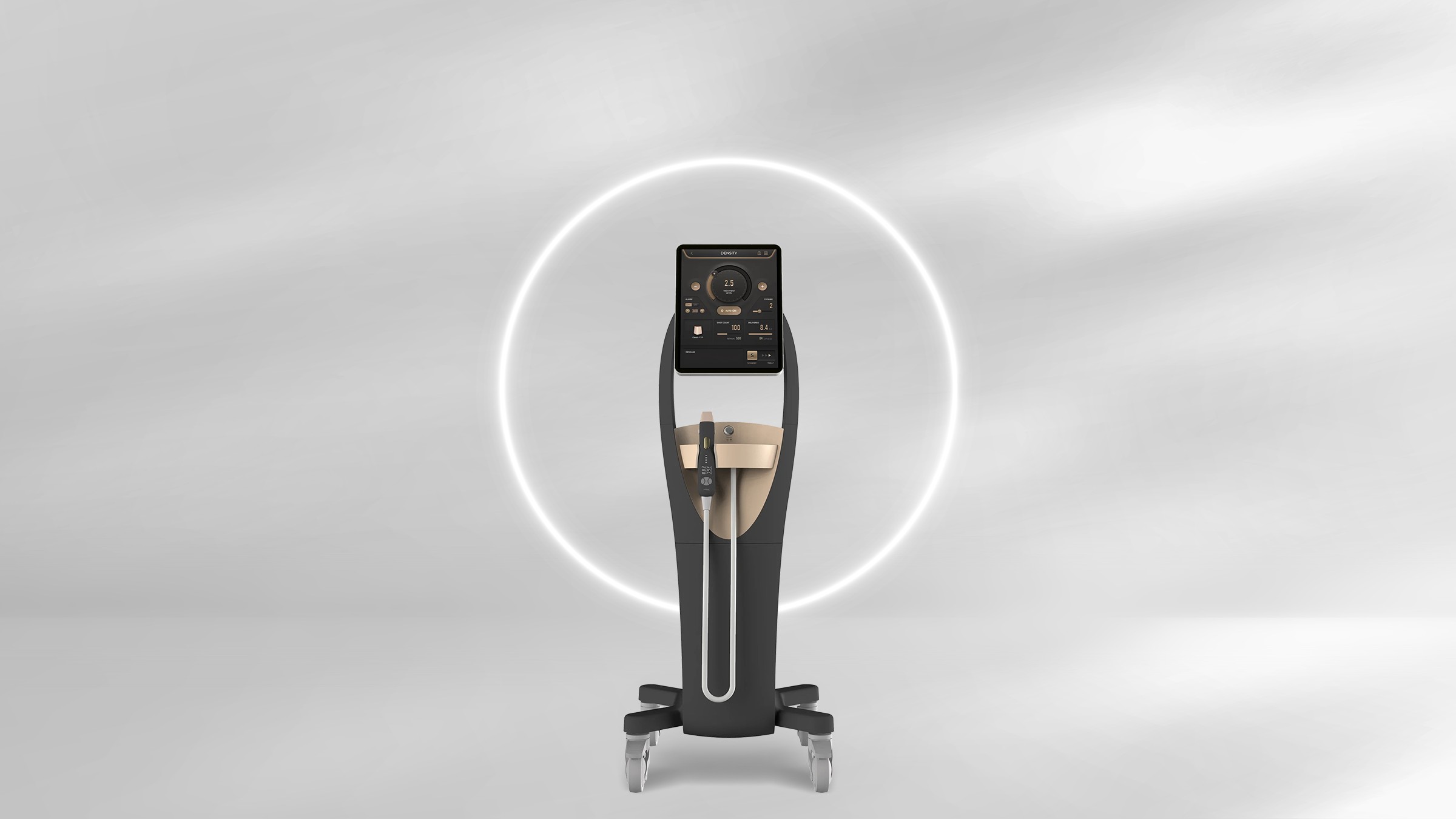
When facial elasticity starts to feel a little different from what it used to be, a lot of people look into radiofrequency treatments that tighten the skin with heat instead of a scalpel. Density RF stands out because it does not rely on a single approach. It runs two distinct radiofrequency modes together.
People often wonder why two modes are needed at all, and why the tightness you feel right after the session and the changes that show up 4 to 12 weeks later seem to arrive on completely different timelines. Once you understand the order in which heat actually works inside the skin, it becomes easy to see why both of these responses happen, and why they happen when they do.
How does RF tighten skin?
Radiofrequency, or RF, is a form of electrical energy. Think of an electric kettle: the current meets resistance in the water and turns into heat. RF energy behaves the same way as it passes through skin tissue, meeting resistance and converting into heat right where it travels.
That heat reaches the dermis, the layer beneath the skin's surface where collagen, a structural protein, is concentrated. Collagen works like the support beams holding up a house. As we age, those beams wear down and loosen, and the skin starts to sag. Radiofrequency delivers a heat stimulus to those beams, prompting the body to frame in new ones.
It is a bit like an old house left unattended: the wooden beams rot and the walls start to lean. Drive new beams in next to the rotted ones, one at a time, and the walls straighten back out. That is essentially what radiofrequency does under the skin. So it helps to think of RF not as something that shaves down the surface, but as something that rebuilds the framework underneath.
Density's two RF modes
Density does not rely on a single heating pattern. It runs two modes with very different personalities. One spreads energy broadly and deeply. The other concentrates energy into a tight, focused area.
The broad mode warms the entire dermis evenly, letting heat soak deep and uniformly across the treated area. The focused mode does the opposite: it concentrates energy on specific points, delivering a stronger stimulus to the collagen framework right there.
Because the two modes do different jobs, one picks up exactly where the other leaves off. Think of the broad mode as handling overall, even elasticity across the face, while the focused mode zeroes in on spots where sagging is more noticeable.
A useful comparison: the broad mode is like underfloor heating that warms an entire room gently, while the focused mode is more like a magnifying glass concentrating sunlight on a single point. Underfloor heating alone keeps the room comfortable overall but struggles to reach that one stubborn cold corner. A magnifying glass alone can heat one spot intensely but does nothing for the rest of the room. That is exactly why both are used together.
Why does skin tighten on the day of treatment?
Many people notice their skin feels slightly tighter starting the same day as their Density session. That change has nothing to do with new collagen being produced yet. It comes from existing collagen fibers contracting instantly under heat.
Collagen fibers are structured somewhat like a tightly twisted bundle of thread. Once they hit a certain temperature, that bundle twists even tighter for a moment, and the fiber shortens. That is the mechanism behind the tightened feeling right after treatment.
That instant contraction, though, is a temporary change in fiber structure, and it tends to relax back toward its original state over time. So this early response alone cannot deliver lasting elasticity, and what happens next matters more. This is also why some people look in the mirror right after treatment, feel like their skin has transformed, and then about 3 to 5 days later feel like it has drifted back close to where it started.
When does collagen start to fill in?
Separate from that initial contraction, the body reads the heat stimulus as a small signal of injury. Fibroblasts, the cells responsible for producing collagen, respond to that signal by ramping up their activity and starting to build new collagen.
At the same time, an enzyme called MMP, which acts like scissors that trim away old collagen, becomes more active too. So old beams get cut away and new ones get put up in their place, more or less simultaneously. This rebuilding process does not wrap up quickly. It is generally reported to unfold gradually over 4 weeks to 6 months.
Think of how a wound scabs over and new skin slowly forms underneath. A scab does not turn into new skin overnight, and collagen does not rebuild overnight either. It accumulates at whatever pace the body has set. So there is no need to feel let down looking in the mirror the day after treatment and seeing little change. The real transformation is only just getting started.
That is why the changes from Density unfold in two stages. The instant contraction right after treatment is the first response you can see. The gradual collagen buildup over the following 4 weeks to 6 months is the regenerative response that ends up producing the longer-lasting elasticity.
Difference between bulk heating and targeted heating
The two modes described above can also be understood by heating range. Bulk heating, which warms a broad area all at once, raises the overall temperature evenly across the face and triggers a baseline collagen response.
Targeted heating, which concentrates energy on a specific point, layers on top of that. It adds extra heat to areas where sagging tends to stand out, like the nasolabial folds or the jawline, giving the collagen response in those spots an additional boost.
Here is why both are used together.
- Bulk heating alone improves the whole face evenly, but noticeably sagging areas may still feel like they have changed less than the rest. Because the energy spreads broadly, it is hard to concentrate enough force on any one point.
- Targeted heating alone produces a strong response in a specific area, but it can throw off the overall balance. Stimulating just one narrow spot can make the elasticity gap between that area and its surroundings more obvious.
- Used together in sequence, bulk heating builds the overall baseline of elasticity, and targeted heating reinforces only the spots that need it. This combination is understood to keep the whole face balanced while giving the areas people actually worry about a more decisive result.
Why split it into 3 to 4 sessions?
There is a natural ceiling on how fast new collagen can be produced. Fibroblasts do not respond to a single stimulus by churning out collagen indefinitely, so there is a natural limit to how much benefit one session alone can deliver.
That is why Density is typically administered in 3 to 4 sessions, spaced 3 to 4 weeks apart. Adding another stimulus once the collagen-building process from the previous session has progressed to a certain point is reported to produce a cumulative effect, with the results becoming more pronounced over time.
Scheduling sessions too close together can pile a fresh stimulus on top of a regeneration process that is still underway, putting unnecessary strain on the skin. Spacing them too far apart, on the other hand, risks breaking the momentum from the previous session, making it harder to see that cumulative benefit. Sticking to the recommended interval between sessions is understood to produce more stable, reliable results.
How long do the effects last?
Even the new collagen produced by the treatment gradually declines over time through the body's normal metabolic processes. Collagen is not something that, once made, stays put forever. It is continually produced and broken down in an ongoing cycle inside the body.
So the elasticity gained from Density also tends to fade gradually, typically over 6 to 12 months after treatment, and repeating maintenance sessions every 6 to 12 months is understood to help extend how long the results last. Because skin aging speed and lifestyle habits vary from person to person, how long results last can also vary quite a bit.
The 4 to 12 weeks right after treatment are when collagen production is most active, so paying extra attention to sun protection and avoiding unnecessary irritation during this window is understood to help the newly formed collagen settle in more securely. In the end, how you spend those 4 to 12 weeks after treatment may matter almost as much as the treatment itself when it comes to how long the results hold.
References
Korean Dermatological Association, Ministry of Food and Drug Safety (MFDS), American Academy of Dermatology (AAD), and U.S. Food and Drug Administration (FDA).
Was this helpful?
About this article
Written by a practising aesthetic physician and intended for general education — not a substitute for individual medical advice.
Read next
HIFU Lifting Effects and How It Works, Including Sessions and Duration
Here's why HIFU lifting targets a deeper layer called the SMAS rather than the surface of your skin, starting with how focused ultrasound converges at a single point. We break down the two stages: the immediate tightness you feel right after treatment, and the collagen that builds gradually over 4 weeks to 6 months.
By Dr. Lee
Why Sculptra Takes 4 Weeks to Show, and How Long It Lasts
Sculptra volume does not appear right after injection. It builds gradually over 4 to 12 weeks because the ingredient itself does not fill space instantly, it works by stimulating collagen production in the skin. Here is a close look at how PLLA triggers that collagen response and why treatment is spread across 2 to 4 sessions.
By Dr. Lee
Juvelook: When Effects Appear and How Long They Last, Dewy Glow Versus Volume
The dewy glow you feel right after a Juvelook treatment and the collagen volume that slowly builds over 6 weeks to 6 months actually come from two completely different mechanisms. This article breaks down, step by step with simple comparisons, how PDLLA, Juvelook's key ingredient, drives your body to produce collagen.
By Dr. Kim