Why Sculptra Takes 4 Weeks to Show, and How Long It Lasts
By Dr. Lee7 min read
If you sit through a filler consultation long enough, you will hear the name Sculptra at some point. Unlike hyaluronic acid fillers, people are often puzzled to learn that their face does not look dramatically different on the day of treatment.
Instead of filling in right away, volume builds slowly over 4 to 12 weeks, which can sound strange at first. Let's break down why Sculptra works this way and what actually happens inside the body.
PLLA, the Main Ingredient in Sculptra
The main ingredient in Sculptra is PLLA, poly-L-lactic acid. Think of it as tiny microparticles that slowly dissolve and disappear once they are inside the body. The same material is used in surgical threads and absorbable sutures, so there is a long track record of safety data behind it.
Hyaluronic acid fillers work by having the gel physically occupy space, so volume shows up right away. PLLA microparticles are different, they do not fill volume on their own. What the particles actually do inside the skin is something else entirely.
How Does PLLA Build Collagen?
Collagen is a protein that works like pillars supporting the skin from underneath. When these pillars are strong, skin resists sagging and holds its volume. As we age, the pillars gradually thin out, and the face starts to look hollow.
When PLLA particles are injected into the deep layer of skin, the body recognizes them as a tiny foreign material. Immune cells, especially macrophages, the cleanup crew of the body, gather around the particles.
As macrophages slowly break down the particles, they send signals to nearby cells. Fibroblasts, the factory cells that produce collagen, pick up this signal, activate, and start making new collagen. In other words, PLLA does not add collagen directly, it stimulates the body to produce more of its own.
Why Don't You Feel Volume on the Day?
Right after the procedure, the face may look swollen or already fuller, but this is mostly from the fluid mixed into the injection and localized swelling. Within 2 to 5 days, this fluid clears and the face returns to its baseline state.
The real volume begins after that. Macrophages gathering and fibroblasts churning out collagen is a biological process that simply takes time. It is similar to a brick factory starting production, it still takes time before those bricks are actually stacked into pillars.
This process typically starts around 3 to 4 weeks after treatment and progresses gradually, with enough collagen buildup reported to take 3 to 6 months. That is why Sculptra is classified not as an instant treatment but as a delayed, gradually improving one.
Some people look in the mirror on treatment day and feel disappointed, but that expectation simply does not match how this treatment works. It is easier on the mind to understand that gradual, natural change over time is the normal course of things.
Why Is It Given in Several Sessions?
Sculptra is usually not finished in a single session. It is typically done in 2 to 4 sessions spaced 4 to 6 weeks apart. There are 3 reasons for this.
- There is a limit to how fast collagen can form. Fibroblasts produce collagen at a fixed rate, so injecting too much at once does not make the body respond any faster.
- It produces a more natural result. Spreading out the stimulation lets collagen build up evenly and gradually, so volume comes in without unnatural clumping.
- Response speed differs from person to person. Splitting sessions allows the amount and location of the next treatment to be adjusted based on how each person progresses in between.
This staged approach can be seen as a strategy that gives the body time to respond while also making the outcome look more natural.
Can Hyaluronidase Reverse It?
If you are not happy with a hyaluronic acid filler, hyaluronidase, an enzyme that dissolves the gel, can reverse it to some degree. That is what makes it reassuring even if you need to remove it quickly.
This does not work with Sculptra. As its name suggests, hyaluronidase only breaks down the specific substance hyaluronic acid. It works something like one key fitting only one lock.
But the volume created by Sculptra is not hyaluronic acid at all. It is collagen your own fibroblasts made. The dissolving enzyme is simply aimed at a different lock altogether.
That means if the result is not what you wanted, Sculptra is difficult to reverse right away. The only option is waiting for the natural collagen metabolism process to fade it over time. Because of this, starting with a small amount and slowly building up while checking how it looks is often recommended as the safer approach.
How Long Do the Results Last?
Once collagen is made, it does not stay in place forever. The body always has MMP, matrix metalloproteinase, an enzyme that slowly breaks down collagen, working in the background, think of it as scissors that cut collagen. As we age, these scissors get more active while the ability to make new collagen declines.
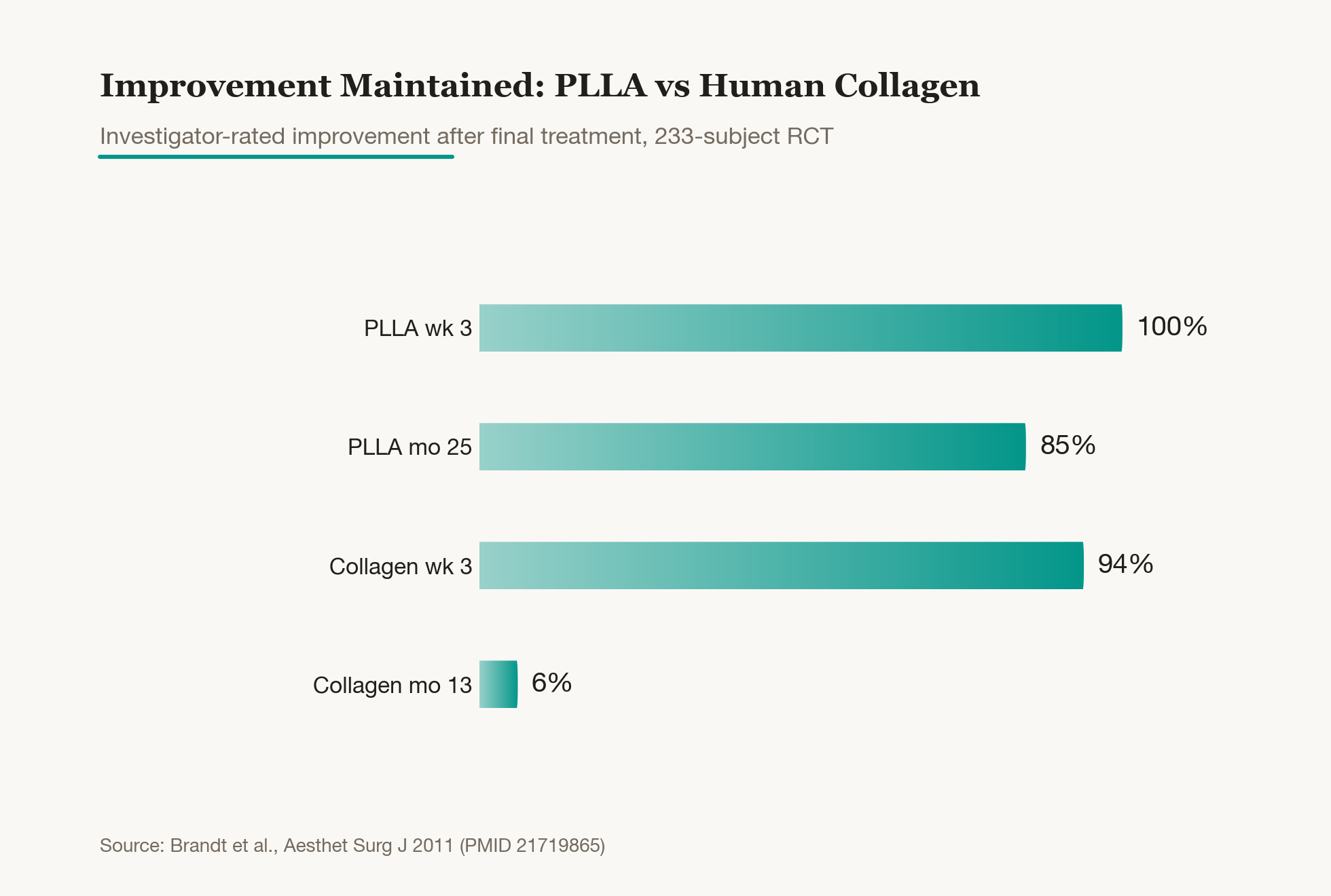
The collagen newly generated by Sculptra cannot escape this natural metabolic process either. Still, because a large amount of collagen is produced at once, the effect has been reported to last 1 to 2 years, with some cases known to last more than 2 years.
How long results last can vary depending on individual skin metabolism, age, treatment area, and lifestyle. Since the activity level of MMP, the collagen-cutting scissors, differs from person to person, this individual variation explains why some people hold onto results longer and others shorter. That is why many people consider a follow-up treatment 1 to 2 years later if they want to maintain the effect.
How It Differs From Hyaluronic Acid Fillers
The two treatments work on entirely different principles. Hyaluronic acid fillers create volume by having the gel physically occupy space, while Sculptra creates volume by inducing your own body to produce collagen.
This difference is known to affect how fast results appear, how long they last, and their impact on skin texture. Hyaluronic acid fillers are often chosen when fast volume is the goal, while Sculptra tends to be considered when someone wants a gradual, natural-looking fill with a relatively longer duration.
Neither can be called definitively better, the right choice depends on the facial area, the result you want, and your skin condition. Some people use both approaches together, which is explained as a way to get the benefit of fast volume alongside the gradually building collagen effect.
How to Massage After Treatment
After a Sculptra treatment, you will be told to do self-massage without fail. This is explained as helping the PLLA particles spread evenly through the skin instead of clumping together.
If particles clump in one spot, the collagen response can concentrate there, which is known to raise the chance of nodules, small firm bumps. When particles are spread evenly instead, collagen production also occurs evenly across a wider area, making a smooth result more likely. That is why massage care during the first 5 days after treatment is presented as a factor that can influence the outcome.
The window between 5 days and 4 weeks after treatment is described as especially important. This is when the particles settle into the tissue and the body's response is just getting started. It is similar to pressing and spreading out dough, you need to work it before it sets for the shape to come out right.
If this early care is neglected, a nodule that shows up later can be harder to reverse. In that sense, your massage habits during the first 4 weeks can influence the result for longer than you might expect.
References
Korean Dermatological Association, Ministry of Food and Drug Safety (MFDS), American Academy of Dermatology (AAD), and U.S. Food and Drug Administration (FDA).
Was this helpful?
About this article
Written by a practising aesthetic physician and intended for general education — not a substitute for individual medical advice.
Read next
Density RF Effects: How Many Sessions and How Long Do Results Last?
Density RF pairs two radiofrequency modes with very different personalities to chase two goals at once: the instant tightening you feel right after treatment, and the collagen renewal that builds slowly over the following 4 to 12 weeks. Here is why two modes are needed, the order in which heat actually works inside the skin, and why the treatment is spread across multiple sessions instead of done all at once.
By Dr. Kim
Radiesse Filler: Results, How Long It Lasts, and Collagen Production
Radiesse is a filler whose calcium microspheres fill volume instantly while also triggering new collagen production. Here is a mechanism-focused look at why the particles create volume, how that leads to collagen stimulation, why diluted Radiesse is used as a skin booster, and how long results actually last.
By Dr. Lee
HIFU Lifting Effects and How It Works, Including Sessions and Duration
Here's why HIFU lifting targets a deeper layer called the SMAS rather than the surface of your skin, starting with how focused ultrasound converges at a single point. We break down the two stages: the immediate tightness you feel right after treatment, and the collagen that builds gradually over 4 weeks to 6 months.
By Dr. Lee