HIFU Lifting Effects and How It Works, Including Sessions and Duration
By Dr. Lee7 min read
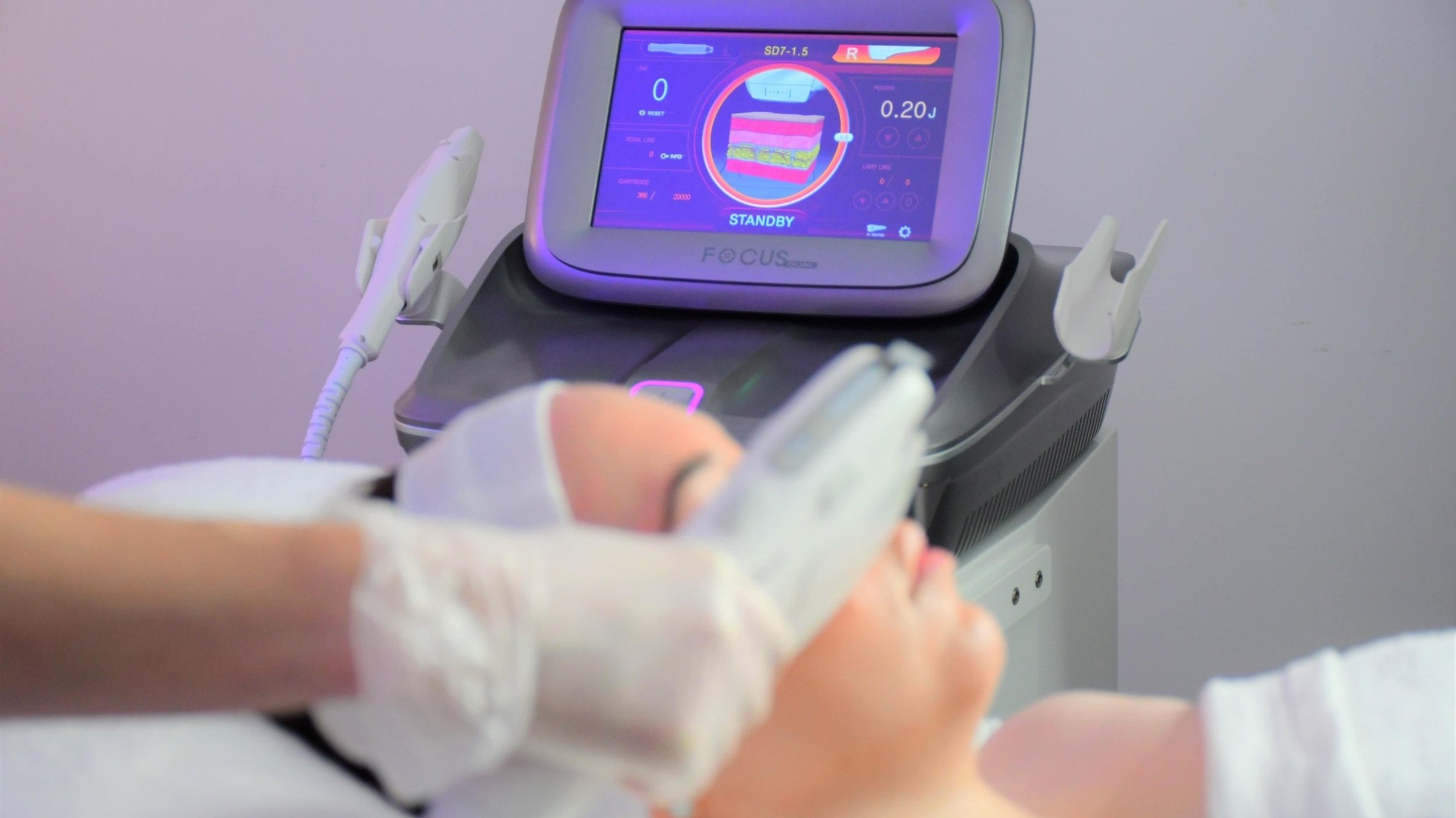
When your face starts looking a little less lifted than it used to in the mirror, HIFU is one of the first treatments people look into. HIFU stands for High-Intensity Focused Ultrasound, and Ulthera is one of the devices built on this technology.
Here's the strange part. Nobody is rubbing or pressing on your skin, yet plenty of people say their jawline feels subtly tighter right after the session. The secret is depth. HIFU doesn't stop at the surface, it drives straight past it to the SMAS, the thin fascial sheet wrapped around the facial muscles just beneath the skin, and generates heat only at that exact spot.
How does HIFU ultrasound converge on one point?
You've probably seen how a magnifying glass can burn a single spot on a sheet of paper while leaving the rest untouched. HIFU works on a similar principle.
The transducer inside the device, the part that fires the ultrasound, sends the waves out in a concave lens shape. As they pass through the surface of the skin, the waves are still spread wide, so the energy there stays weak and diffuse. Only once they reach a preset depth do waves arriving from multiple directions converge into a single tight point, called the focal point. That's why the epidermis and the upper dermis barely register anything, while all the concentrated heat lands at that one predetermined depth.
How collagen contracts at the thermal coagulation point
The ultrasound energy pooling at the focal point spikes the local temperature to somewhere near 60 to 70°C in an instant. That burst of heat sets the tissue protein there, creating a tiny spot known as a thermal coagulation point.
Egg whites make this easy to picture. Clear and runny at room temperature, they turn white and firm the moment heat hits them, and there's no going back. Collagen fibers behave much the same way. Normally coiled into a spiral, these protein strands instantly bundle up and contract into a firm, set structure the moment they hit that temperature. The device doesn't fire just one of these points, it moves the cartridge across the skin in controlled steps, stringing point after point together into dense lines of coagulation beneath the surface.
Why does HIFU target the SMAS layer?
The SMAS is a thin sheet wrapped over the facial muscles, think of it as the elastic layer connecting the skin to the muscle underneath. It's also the exact layer surgeons lift and anchor during a surgical facelift. Pulling the skin alone doesn't hold, it sags back before long. Pulling the SMAS instead drags the muscle and support structure beneath it along too, which is why the results last so much longer.
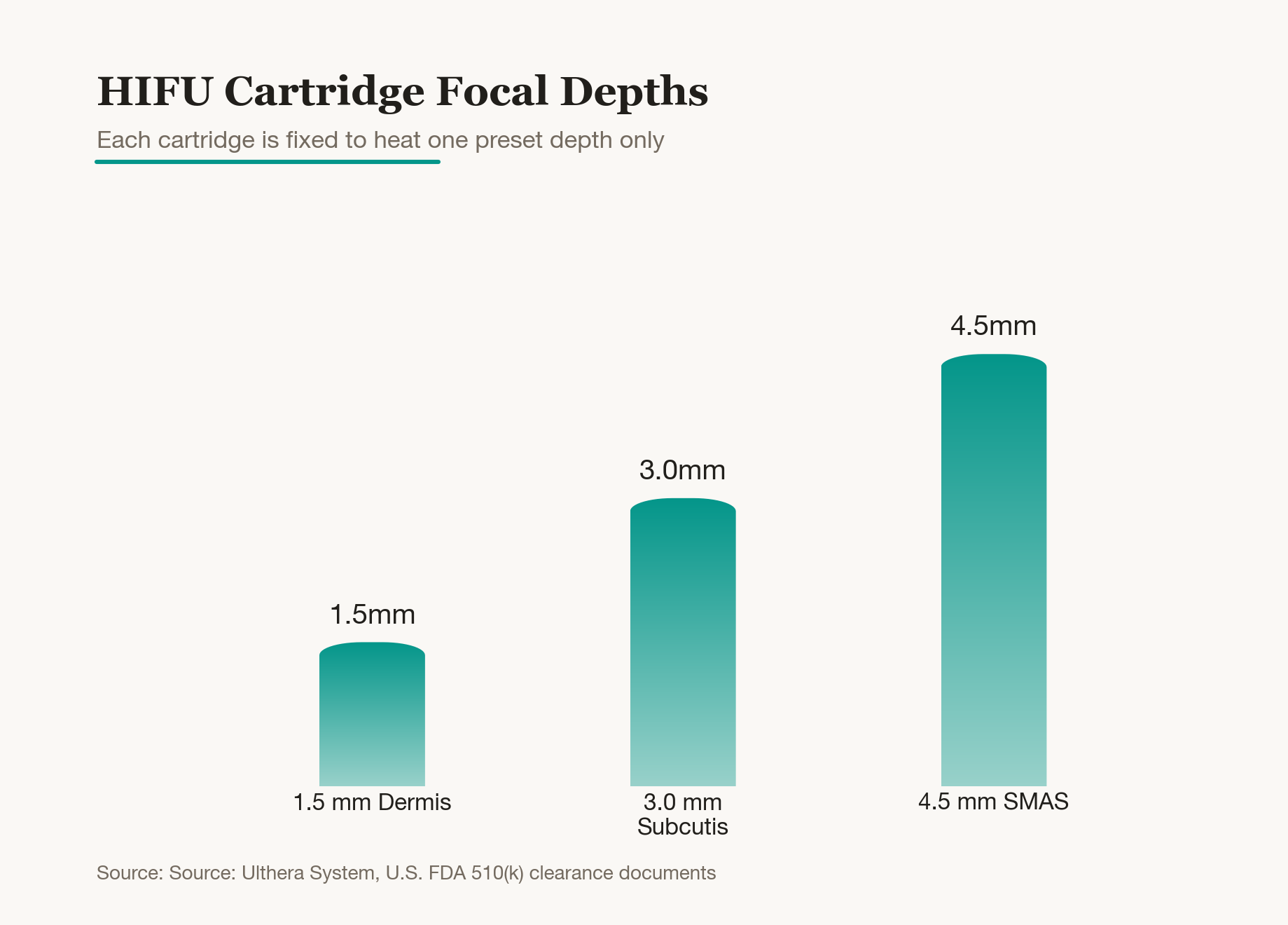
To reach that layer without surgery, HIFU relies on cartridges set to different focal depths.
- The 1.5mm cartridge targets the dermis, the layer where collagen fibers weave into a dense network. That depth is right for fine surface lines and pore tightness.
- The 3.0mm cartridge targets the area around the subcutaneous fat layer, stimulating the connective tissue that bridges fat and fascia to reinforce the support between them.
- Cartridges around 4.5mm go straight for the SMAS layer itself, on the logic that reaching the same support structure surgeons lift is what actually moves the needle on sagging, without an incision.
Skin and fascia thickness vary by area, so it's worth knowing that the face typically calls for something around 4.5mm, while thinner areas like the neck often use a shallower depth.
Why is the jawline pulled up right after treatment?
Collagen fibers normally sit coiled tight, like a spring. The instant the temperature spikes to 60 to 70°C, that coil unwinds on the spot and bundles back up shorter, a purely physical change. It's much like what happens when you heat a rubber band and it suddenly contracts.
When that contraction happens simultaneously across the SMAS, the tissue sheet making up that layer shortens by a small but measurable amount. That's why some people feel their jawline or cheeks pull slightly tighter the moment they walk out of the treatment room. That immediate effect is still modest, though, the real change builds gradually in the stage that follows.
When do HIFU results start to appear?
A thermal coagulation point is, from your body's perspective, a tiny injury. So your body treats the spot like a wound and kicks off its normal repair process.
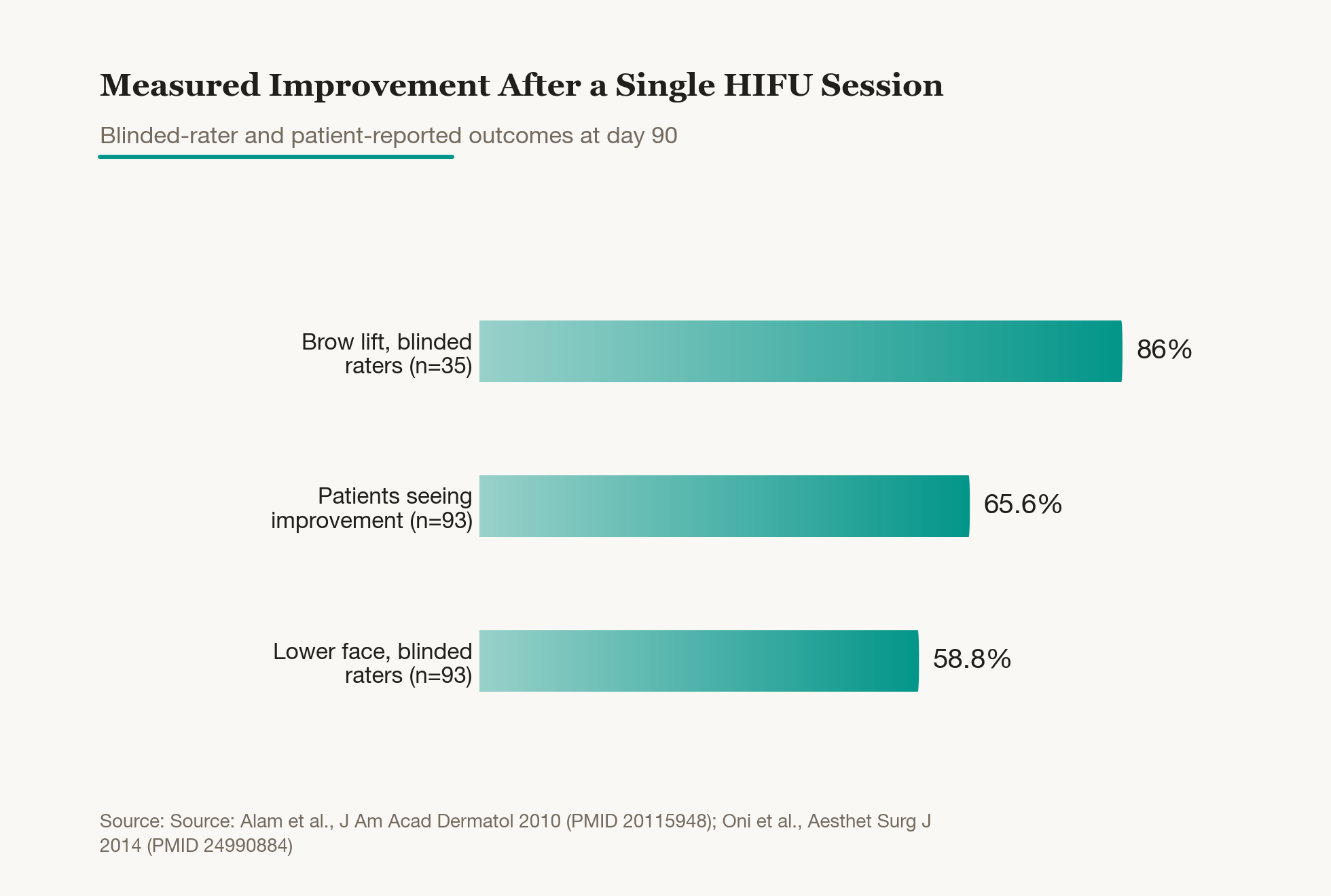
Fibroblasts nearby, the cells that spin new collagen fibers within the skin, pick up on the heat and the repair signals and start ramping up activity. Over 4 weeks to 6 months, they lay down fresh collagen fiber at that spot, layer by layer. This buildup, which thickens the support structure of both the SMAS and the dermis, is what's known as neocollagenesis. Many reports note that changes start becoming visible around 2 to 3 months after treatment, peaking most noticeably around the 3 to 6 month mark.
Immediate contraction is a physical reaction that clenches things down on the spot. Neocollagenesis is a biological process where your body spends time weaving a whole new support structure into place. The two work in fundamentally different ways.
Why is treatment split into several sessions?
Many clinics don't finish the same area in a single pass, they space sessions 4 to 8 weeks apart instead. There are three reasons for that.
- Tissue needs time to recover. Rebuilding collagen takes 4 weeks to 6 months, and stacking more heat into the same spot without giving it that window can push damage ahead of repair, raising the risk of burns or excess inflammation.
- Coagulation point density needs to build up gradually. Rather than packing in as many points as possible in a single pass, spacing sessions out lets density accumulate step by step, lowering the risk of side effects while still building support over time.
- Everyone's skin and fascia thickness, and degree of sagging, is different, so the number of sessions actually needed varies from person to person. That's why treatment plans tend to be worked out individually during a consultation.
How long do HIFU results last?
New collagen breaks down over time, just like the collagen you already had. It's well established that the enzymes responsible for breaking down collagen become more active as you age, and with gravity constantly pulling downward on top of that, skin gradually starts drifting toward sagging again.
So it's worth knowing upfront that the support HIFU builds doesn't stay in place permanently. That said, some reports suggest that while the newly formed collagen is still there, layering another round of treatment on top can reinforce that support structure further. Exactly how often you'd need to repeat it depends on your individual aging pace and skin condition, so it makes sense to check in periodically and discuss timing during a consultation.
For the same reason, this isn't a one-and-done treatment that locks your skin in place after a single session. Collagen was already cycling through creation and breakdown in your skin long before HIFU came into the picture, HIFU essentially adds a layer of support on top of that ongoing cycle. That's also why deciding how often to repeat treatment is worth discussing alongside your skin's age and how quickly it tends to sag.
References
Korean Dermatological Association, Ministry of Food and Drug Safety (MFDS), American Academy of Dermatology (AAD), and U.S. Food and Drug Administration (FDA).
Was this helpful?
About this article
Written by a practising aesthetic physician and intended for general education — not a substitute for individual medical advice.
Read next
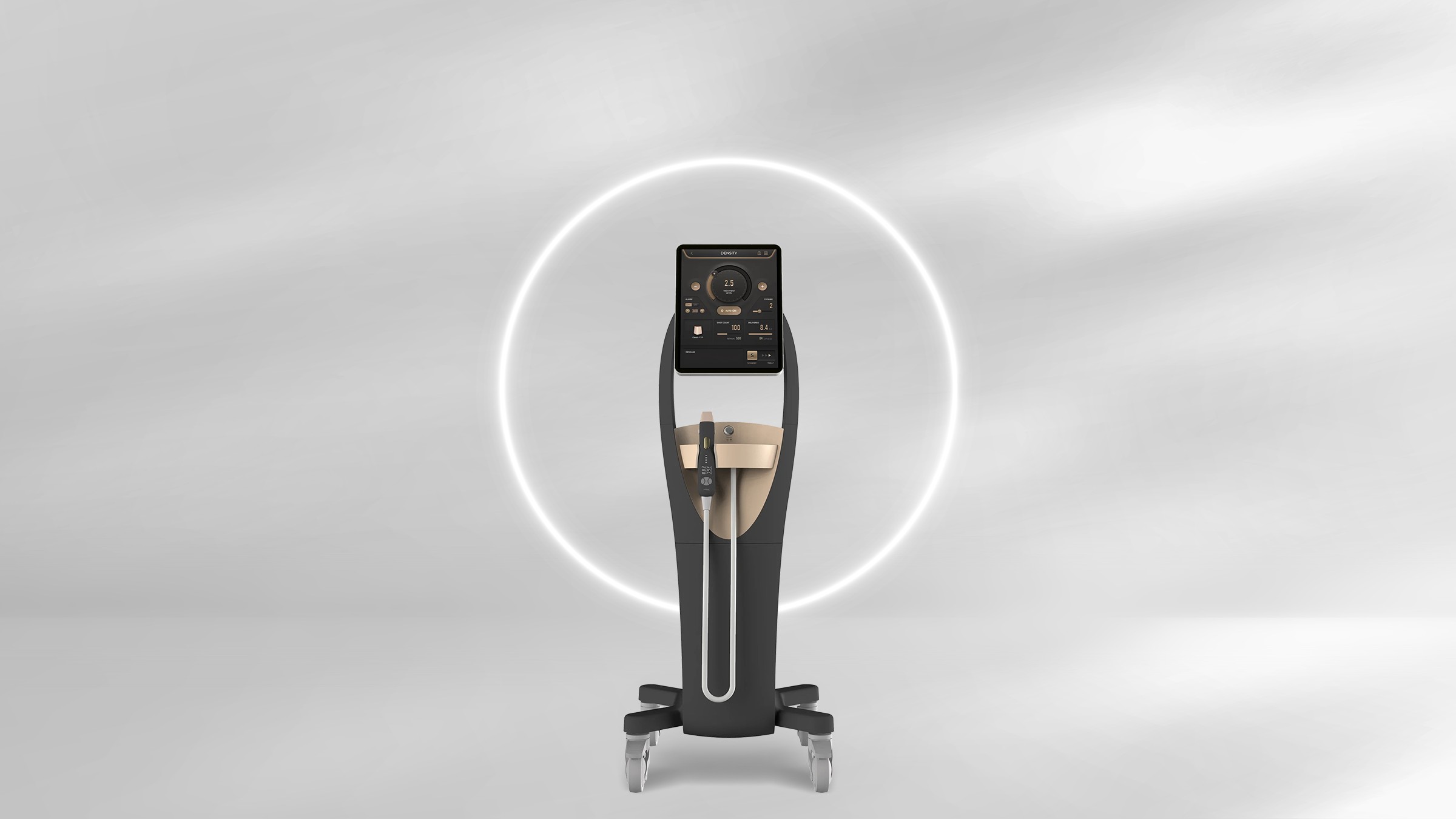
Density RF Effects: How Many Sessions and How Long Do Results Last?
Density RF pairs two radiofrequency modes with very different personalities to chase two goals at once: the instant tightening you feel right after treatment, and the collagen renewal that builds slowly over the following 4 to 12 weeks. Here is why two modes are needed, the order in which heat actually works inside the skin, and why the treatment is spread across multiple sessions instead of done all at once.
By Dr. Kim
Why Sculptra Takes 4 Weeks to Show, and How Long It Lasts
Sculptra volume does not appear right after injection. It builds gradually over 4 to 12 weeks because the ingredient itself does not fill space instantly, it works by stimulating collagen production in the skin. Here is a close look at how PLLA triggers that collagen response and why treatment is spread across 2 to 4 sessions.
By Dr. Lee
Juvelook: When Effects Appear and How Long They Last, Dewy Glow Versus Volume
The dewy glow you feel right after a Juvelook treatment and the collagen volume that slowly builds over 6 weeks to 6 months actually come from two completely different mechanisms. This article breaks down, step by step with simple comparisons, how PDLLA, Juvelook's key ingredient, drives your body to produce collagen.
By Dr. Kim