Juvelook: When Effects Appear and How Long They Last, Dewy Glow Versus Volume
By Dr. Kim8 min read
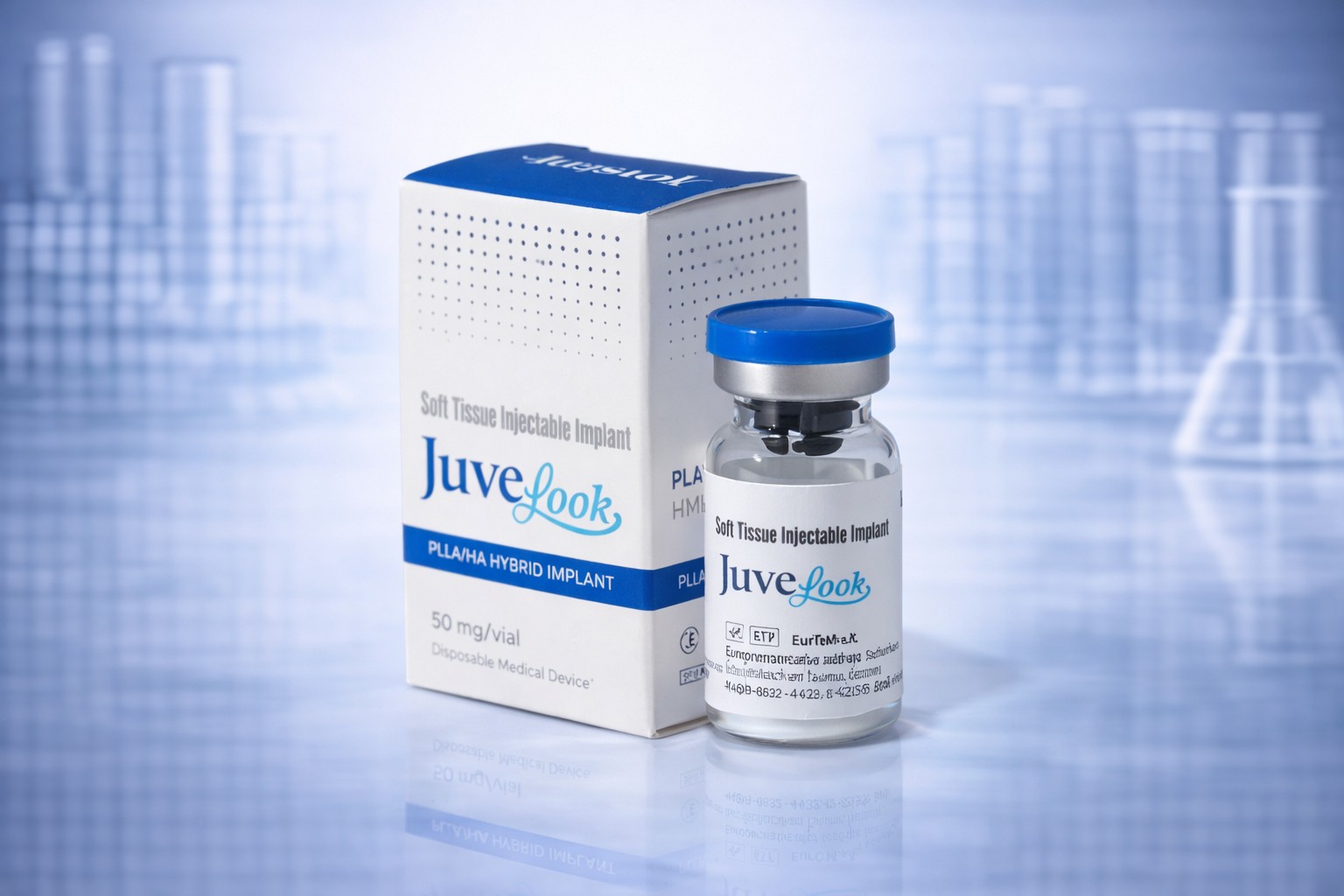
The day after a Juvelook treatment, many people notice their skin feels unusually dewy and hydrated. But the actual volume, the fullness in the cheeks or forehead, only shows up much later, gradually.
Same treatment, so why do the two effects arrive on such different timelines? The answer lies in how PDLLA, the ingredient inside Juvelook, actually works. Once you understand what this ingredient is and the sequence it follows inside your body to build collagen, that gap in timing makes complete sense.
What kind of ingredient is Juvelook PDLLA?
PDLLA stands for poly-D,L-lactic acid. The name sounds complicated, but the substance itself is simple. Think of it as a polymer particle that, over time, breaks down on its own into water and carbon dioxide and disappears from the body. It is a similar material to dissolvable surgical sutures.
Juvelook treatment involves mixing these microscopic particles into a gel carrier and injecting them into the dermis, the layer of skin that sits below the surface and provides structural support, where collagen fibers stand like pillars. The PDLLA particles settle into that dermal layer and stimulate the body to produce more collagen on its own.
Just as a surgical suture holds a wound together and then dissolves without a trace once its job is done, PDLLA provides stimulation only until collagen has built up, then breaks down quietly into water and carbon dioxide. So it is not the kind of substance that stays in the body as a permanent, solid foreign material. Once it finishes its job, it exits quietly.
How does PDLLA create collagen?
When PDLLA particles enter the dermis, the body recognizes them as foreign material. Immune cells move in and gradually process the particles, a response known as a foreign body reaction. In simple terms, it is the body dispatching cleanup crews to deal with unfamiliar granules.
During this cleanup, immune cells called macrophages surround the PDLLA particles and slowly break them down. But the process does not end quietly there. It sends signals to nearby cells called fibroblasts. Fibroblasts are essentially the factories that manufacture collagen. Once they receive the signal, fibroblasts become active and start producing new collagen fibers.
In other words, PDLLA itself is not collagen. PDLLA acts as a trigger that prompts the body to restart its own collagen factory. That is why Juvelook is understood not as a filler that adds volume directly, but as a treatment that induces your body to rebuild collagen on its own.
A construction site is a useful comparison. PDLLA is not the worker laying bricks. It is closer to the flare that calls the crew to the site. Once the flare goes off, macrophages and fibroblasts arrive in sequence and carry out the actual construction work, producing collagen. So it is not simply a matter of more particles meaning more collagen right away. What matters is how consistently the signal keeps firing.
Why is skin moist the day after treatment?
Building new collagen through the foreign body reaction takes time. So why does the skin look hydrated right after treatment? The reason lies elsewhere: the carrier gel that holds the PDLLA particles has its own water-attracting property.
The moment this carrier gel enters the dermis, it draws in surrounding moisture and smooths out the skin's texture. It works much like pouring water onto a dry sponge, which plumps up instantly. So the hydration and glow felt from right after the procedure through 1 to 2 weeks afterward is often not from an increase in collagen, but from this gel's water-holding effect.
The catch is that this early effect does not last as long as collagen does. The carrier gel gets absorbed into the body over time and gradually diminishes. So the initial dewy glow naturally fades within 1 to 2 weeks.
It is similar to putting on a sheet mask: the skin looks hydrated the moment you take it off, but returns to its usual state by the next day. The carrier gel only holds moisture temporarily and does not change the skin's underlying structure, so it is natural for the effect to fade over time.
The period after the glow fades and before volume arrives
The two effects come from different materials and last for different lengths of time. Here is the comparison broken down:
- The early dewy glow comes from the carrier gel's water-holding capacity and gradually fades over roughly 1 to 2 weeks after the procedure, as the gel is absorbed into the body.
- The later collagen volume comes from newly produced collagen fibers made by the body itself and builds up slowly over 6 weeks to 6 months, since fibroblasts need time to manufacture collagen.
- Between the two effects, there can be a transitional period where volume feels a bit uncertain, since the gel effect has worn off but collagen has not yet fully built up.
That is why some people feel their skin looks flatter around the one-month mark than it did right after treatment. This period is not a failure. It is best understood as the natural handoff, the baton passing from the gel's effect to collagen's.
Rather than checking the mirror anxiously during this in-between stretch, it helps to know ahead of time that the two effects arrive in sequence. Once the flatter-looking phase passes, volume naturally returns to the skin as collagen continues to build.
Why is nothing visible on treatment day?
Producing collagen is a biological process, and its pace is fundamentally different from physically filling in a space. It has to go through several stages: the foreign body reaction starts, macrophages send their signal, and fibroblasts manufacture collagen.
These stages happen in sequence, not all at once. The first 4 to 6 weeks is when the body recognizes the PDLLA particles and prepares its response, and collagen gradually starts building after that. It is much like how a tree does not grow the day after you plant the seed.
The same logic applies to vaccines: antibodies are not fully formed the day after a shot. The body has to recognize the stimulus, recruit the right cells, and produce the materials, step by step, and that process takes time. There is no way to skip or speed up this sequence. All you can do is let the body work at its own pace.
That is why Juvelook is understood as a treatment aimed at gradual, natural change over 6 weeks to 6 months rather than a dramatic result on the day of the procedure. It calls for patience while collagen builds up, rather than expecting quick results.
How many sessions are needed and how long does it last?
The stimulation that builds new collagen is not a one-time event. It tends to accumulate over 3 to 4 sessions spaced 3 to 4 weeks apart, according to reports. That said, the exact number of sessions and spacing vary depending on skin condition and the treated area, so these are typically decided individually during a pre-treatment consultation.
- The reason treatments are split into 3 to 4 sessions spaced 3 to 4 weeks apart is that repeated stimulation of collagen production is understood to lead to more stable, lasting volume.
- The reason sessions are spaced 3 to 4 weeks apart is to give the previously triggered collagen response enough time to run its course. Scheduling sessions too close together can cause the responses to overlap, making it harder to gauge progress.
- The reason results are reported to last longer than fillers is that the newly produced collagen fibers themselves remain settled within the skin. That is a different mechanism from fillers, where the material itself gradually breaks down.
For example, rather than injecting a large amount all at once, giving smaller doses of stimulation spaced 3 to 4 weeks apart is understood to let the body switch on its collagen-building response repeatedly, building it up layer by layer. It works on a similar principle to applying a wall coat in 3 to 4 thin layers rather than one thick one: the result sets more evenly and holds up better.
Ultimately, how well Juvelook's results last depends on how effectively the body produces and maintains collagen, which is typically reported to fall between 12 and 18 months, though individual experience can vary. Since the speed and amount of collagen produced differ by age, skin condition, and treated area, it helps to track your own skin's changes over time rather than comparing your results directly with someone else's.
The effect timeline to know before treatment
The core of Juvelook is that PDLLA uses the body's own foreign body reaction to induce collagen production. Understanding that the initial glow comes from the carrier gel's water retention, while the later volume comes from newly built collagen, can keep you from feeling thrown off during the in-between stretch.
Since this is a treatment where results unfold gradually, it helps to give yourself a generous window before judging the outcome. You need to wait through the phase where the early glow fades and let collagen build up sufficiently before you can properly see the result the treatment is meant to deliver. The safest approach is to get this timeline explained during your pre-treatment consultation, and to check in with your provider along the way if any questions come up.
References
Korean Dermatological Association, Ministry of Food and Drug Safety (MFDS), American Academy of Dermatology (AAD), and U.S. Food and Drug Administration (FDA).
Was this helpful?
About this article
Written by a practising aesthetic physician and intended for general education — not a substitute for individual medical advice.
Read next
Density RF Effects: How Many Sessions and How Long Do Results Last?
Density RF pairs two radiofrequency modes with very different personalities to chase two goals at once: the instant tightening you feel right after treatment, and the collagen renewal that builds slowly over the following 4 to 12 weeks. Here is why two modes are needed, the order in which heat actually works inside the skin, and why the treatment is spread across multiple sessions instead of done all at once.
By Dr. Kim
HIFU Lifting Effects and How It Works, Including Sessions and Duration
Here's why HIFU lifting targets a deeper layer called the SMAS rather than the surface of your skin, starting with how focused ultrasound converges at a single point. We break down the two stages: the immediate tightness you feel right after treatment, and the collagen that builds gradually over 4 weeks to 6 months.
By Dr. Lee
Why Sculptra Takes 4 Weeks to Show, and How Long It Lasts
Sculptra volume does not appear right after injection. It builds gradually over 4 to 12 weeks because the ingredient itself does not fill space instantly, it works by stimulating collagen production in the skin. Here is a close look at how PLLA triggers that collagen response and why treatment is spread across 2 to 4 sessions.
By Dr. Lee