Radiesse Filler: Results, How Long It Lasts, and Collagen Production
By Dr. Lee6 min read
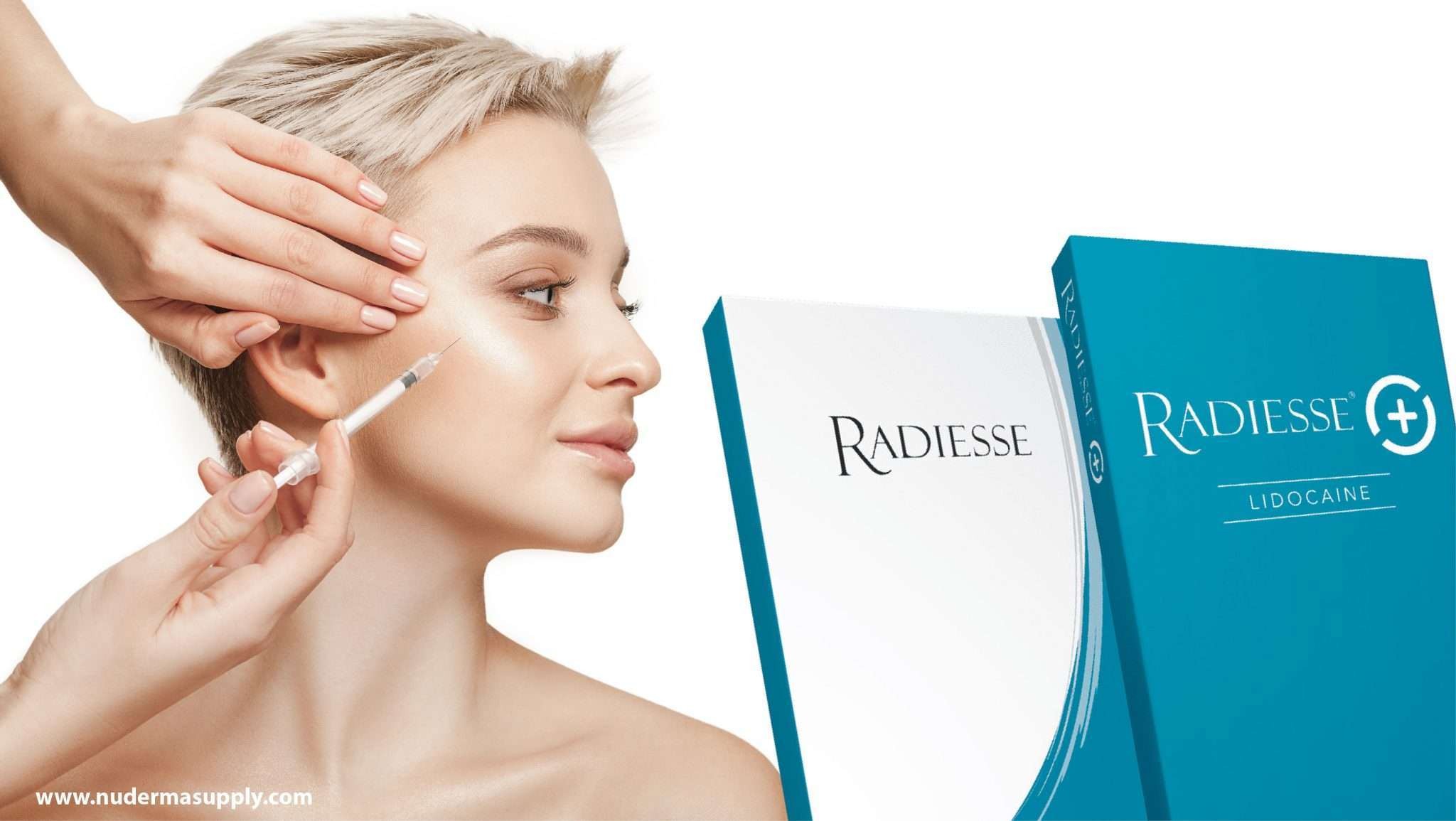
When people think of dermal fillers, hyaluronic acid, or HA, usually comes to mind first. But clinics also regularly use a calcium-based filler that works on a completely different principle: Radiesse. Its active ingredient is calcium hydroxylapatite, shortened to CaHA. It is made from the same calcium compound found in bone and teeth, formed into extremely small microspheres and suspended in a gel carrier.
What makes this filler unique is that it fills volume immediately after injection while also generating new collagen over the following 4 weeks to 6 months. In other words, one product is designed to deliver both an instant effect and a long-term effect. Understanding this mechanism makes it easy to see why the results are reported to last so long, and why diluted Radiesse is also used as a skin booster.
Even fillers built from different raw materials behave completely differently once inside the body. So to really understand Radiesse, it helps to start with what the ingredient itself looks like and the sequence of reactions those particles trigger under the skin.
How is Radiesse different from hyaluronic acid filler?
Radiesse is a product in which extremely fine calcium microspheres are densely suspended inside a gel carrier. Those microspheres are calcium hydroxylapatite, or CaHA. Because it is chemically similar to the mineral that makes up bone and teeth, the body is known to accept it relatively comfortably without mounting a strong foreign-body reaction.
The microspheres are small enough to be invisible to the eye and are spread evenly throughout the gel. The gel acts like a cushion, filling the spaces between particles and creating volume from the moment of injection. That is the filler's first defining feature: you can see the result immediately after treatment.
How it fills volume right after injection
The immediate effect is actually simple. The mass of gel and microspheres physically fills empty space beneath the skin, much like packing sand into a balloon makes that spot bulge out.
But because Radiesse is not pure gel, the firm microspheres mixed into it are reported to hold their position longer than a gel-only filler. The particles interlock with one another and act as a kind of scaffold, so the shape does not collapse easily under pressure. That is reportedly why it is often chosen for areas with a lot of movement, like the nasolabial folds, or areas where thin skin over the backs of the hands makes bone and tendons stand out.
When and how does Radiesse produce collagen?
This is where Radiesse diverges most from other fillers. When unfamiliar microspheres appear beneath the skin, the body does not simply ignore them. Even without an actual wound, the presence of a foreign material recruits and activates nearby cells.
During this process, fibroblasts, the cells that actually produce collagen, gather around the microspheres. Fibroblasts work like the crew that builds the collagen framework inside your skin. The microspheres act as a mild, ongoing stimulus that keeps waking these cells up, and new collagen gradually forms around the particles over 4 weeks to 6 months. So immediately after injection, the volume of gel and microspheres creates the effect, and over time newly formed collagen reportedly takes over that role.
Why doesn't the body push the particles out?
The key to this response is that the body treats the microspheres not as a dangerous foreign substance but as a mild irritant. Because calcium hydroxylapatite resembles bone mineral, the body does not try hard to reject it. Instead, it responds by sending a steady, gentle signal.
That gentle stimulation is described as the key to activating fibroblasts steadily over a long period. If the stimulus is too strong, it can lead to inflammation and scarring; if it is too weak, the material is simply absorbed with no response at all. Radiesse's microspheres are reported to be engineered to sit right in that middle zone, sustaining a moderate stimulus for an extended time. As a result, the particles themselves gradually break down and disappear from the body, while newly formed collagen remains behind to carry the volume forward.
Because this approach does not inject collagen directly but simply nudges the body into producing its own, it works on a fundamentally different principle than fillers made of other materials. That is also why the results do not appear instantly, but reportedly unfold gradually over 4 weeks to 6 months.
Can it be diluted and used as a skin booster?
Recently, instead of using Radiesse at full strength, practitioners have also been diluting it several times over in saline or lidocaine solution and injecting it in thin layers. This diluted approach is commonly called the skin booster technique.
Injected at full strength, the microspheres cluster in one spot and create a distinct mass of volume. A diluted solution, by contrast, has a lower concentration of particles, so instead of clustering in one place, it can be spread thinly across a broad area like the whole face or neck. Because the particles still perform their original job of stimulating collagen even without forming a noticeable volume mass, this approach is reportedly chosen when the goal is to improve the skin's own elasticity and texture rather than create obvious volume. That said, this technique reportedly requires more specialized judgment about site selection and injection method than full-strength treatment does.
How long does Radiesse last?
Radiesse's results are typically reported to last around 12 to 18 months. That is relatively long compared to hyaluronic acid fillers, which typically last around 6 to 12 months.
This longevity comes from the two-stage effect described earlier. Early on, the physical volume of the gel and microspheres holds the shape. As the particles gradually break down and disappear, newly formed collagen fills the resulting gap and carries the volume forward. That means even after the filler material itself is gone, the collagen your own body produced reportedly keeps the volume in place for roughly another 6 months. That said, how long results last reportedly varies considerably depending on the injection site, the amount used, and an individual's skin metabolism, so these numbers are best treated as a rough reference rather than an absolute guarantee.
Areas where Radiesse is mainly used
Radiesse is generally chosen for areas that can take advantage of both qualities the microspheres provide: structural support and collagen stimulation.
- Nasolabial folds and marionette lines: Even though these areas move constantly with facial expression, the interlocking microspheres reportedly hold their position well, so results do not sink easily despite the movement.
- Backs of the hands: In this area, thin skin makes bone and tendons stand out, and the combination of volume and gradually accumulating collagen is reported to build a natural thickness.
- Jawline and cheekbone area: Because it offers relatively strong support, it is reportedly often chosen to lightly lift and define contour.
- Overall facial texture: When diluted and spread thinly at a lower concentration, it is reportedly used with the goal of improving elasticity and texture rather than creating obvious volume.
If you are considering Radiesse, it helps to check with a specialist about whether full-strength or diluted treatment fits your target area and goals. Since it takes time for collagen to settle into place, allowing enough of an interval to watch the results unfold is also a natural part of the process.
References
Korean Dermatological Association, Ministry of Food and Drug Safety (MFDS), American Academy of Dermatology (AAD), and U.S. Food and Drug Administration (FDA).
Was this helpful?
About this article
Written by a practising aesthetic physician and intended for general education — not a substitute for individual medical advice.
Read next
Why Sculptra Takes 4 Weeks to Show, and How Long It Lasts
Sculptra volume does not appear right after injection. It builds gradually over 4 to 12 weeks because the ingredient itself does not fill space instantly, it works by stimulating collagen production in the skin. Here is a close look at how PLLA triggers that collagen response and why treatment is spread across 2 to 4 sessions.
By Dr. Lee
Radiesse Skin Booster: Results, How Long It Lasts, and Differences From Sculptra
Radiesse (CaHA) delivers immediate volume while triggering your body to produce new collagen in the neck, décolleté, and hands. What the biopsy data and ultrasound measurements actually show, how long results last, how it compares to Sculptra, and who makes a good candidate.
By Dr. Lee

Emface Results and Duration: How Radiofrequency and Muscle Stimulation Work
Emface is a non-invasive lifting treatment that stimulates collagen in the skin with radiofrequency while an electrical signal directly moves the expression muscles underneath. Here is an easy, principle-focused rundown of why skin and muscle need to be treated together for real firmness, why sessions are spaced out, and how long results actually last.
By Dr. Kim