Tear Trough Filler Duration and Side Effects, Including Vessel Risks
By Dr. Kim8 min read
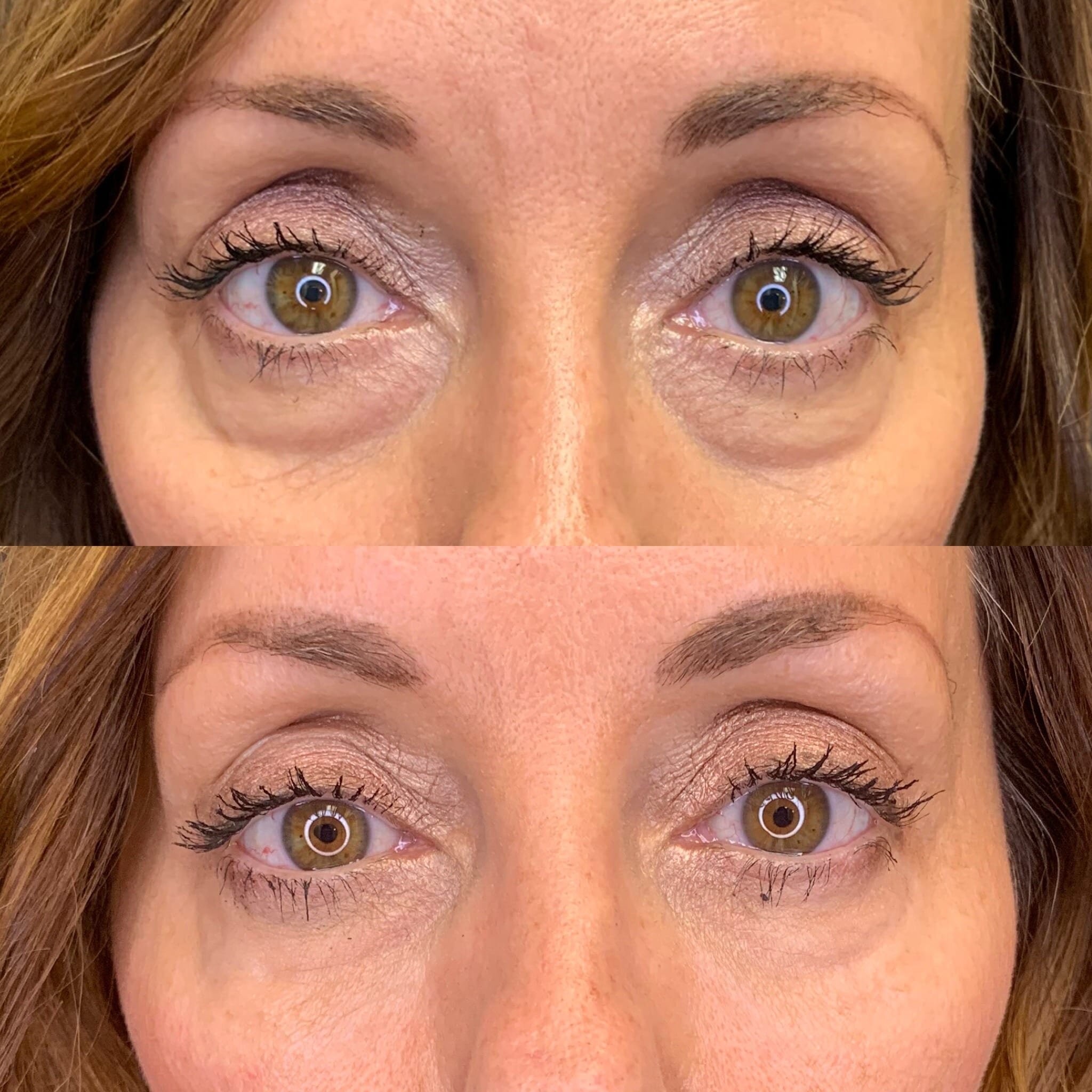
Look closely in the mirror and you might notice a dark groove running just under the fat pad beneath your eyes. That groove, the tear trough, is one reason people get told they look tired or older than they are. It forms as a shadow where the under-eye fat meets the cheek, so it often does not go away even with plenty of sleep.
Filler is the go-to way to fill in this area. But the tear trough has the thinnest skin on the face and a dense network of blood vessels running through it, so the approach here differs a bit from filler elsewhere. Let's walk through why this hollow forms, how filler fills it in, and why this particular area calls for extra care.
Why Do Grooves Form Under the Eyes?
Fat naturally cushions the eyeball beneath the lower eyelid. That fat sits in place, held by a thin membrane on the inside of the eyelid. As we age, this membrane loosens and the fat can push slightly downward or forward. That creates a step between the bulging fat and the cheekbone below it, and that boundary line reads as a dark shadow.
Add to this the fact that cheek fat also thins with age. Normally the under-eye fat and cheek fat form a smooth, gentle slope. But when cheek volume goes first, that boundary drops off more like a stair step, making the groove stand out even more. Some people are simply born with a hollow under-eye bone structure, so the tear trough can show up even in younger patients, regardless of age.
How Does Filler Fill the Hollow?
Most tear trough fillers are made of hyaluronic acid (HA). HA already exists naturally in our skin's dermis, and it has a strong ability to draw in and hold onto water molecules. So when this gel is placed into the hollow, it fills the empty space directly while also pulling in surrounding moisture to help maintain volume.
That said, filler used for the tear trough is chosen to be much softer and thinner than the products used on the cheeks or nose. Skin here is extremely thin, and a firmer gel would be visible as a lump or bump under the surface. So injectors use a low-viscosity, easily spreadable product in very small amounts, placed precisely into the gap between the fat pad and cheekbone. The goal is not to push the fat around or reposition it, but simply to fill the missing volume so the step at the boundary softens out.
Why Use a Cannula for the Tear Trough?
Tear trough treatment tends to favor a blunt-tipped cannula over a sharp needle. The reason is the sheer density of blood vessels in this area. The tissue around the eyes carries a tighter network of vessels leading to the eye than most other parts of the face, and a sharp needle risks piercing straight through one.
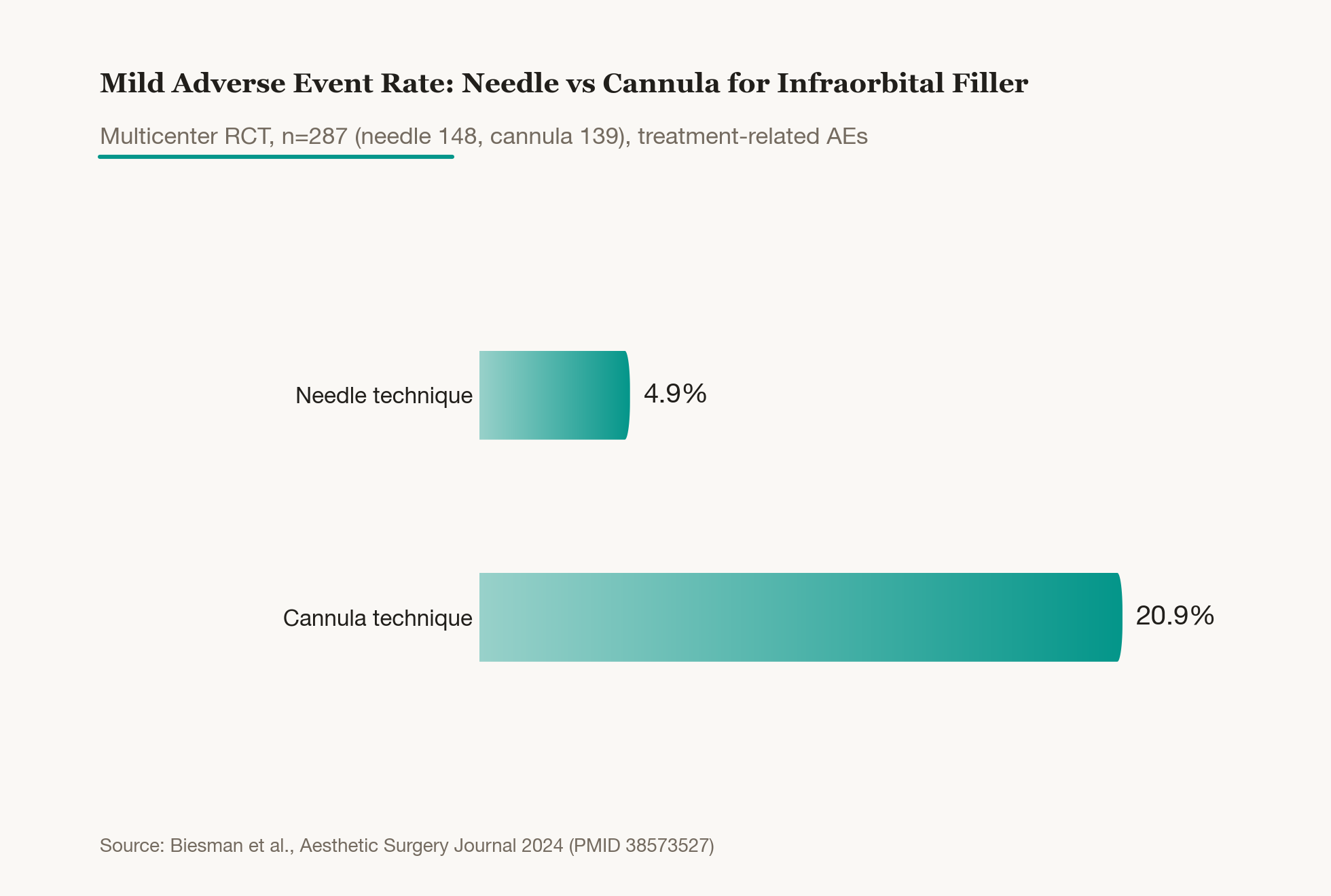
A blunt cannula, by contrast, tends to push vessels aside rather than puncture them when it meets one. Think of pushing chopsticks through a tangle of thread: a sharp point cuts the thread, while a rounded tip nudges it out of the way without damage. That is roughly the same idea. Because of this, a cannula can be inserted at a single entry point and then fan out to deposit filler across several directions, which does mean fewer puncture marks. That said, mild reactions like bruising and swelling are not necessarily reduced along with it. A 2024 multicenter study comparing needle and cannula injection for under-eye hollows found mild adverse events in 4.9% of the needle group versus 20.9% of the cannula group (Biesman et al., Aesthet Surg J 2024, PMID 38573527), and correction results were essentially the same between the two methods. The real reason to choose a cannula has more to do with avoiding a direct vessel puncture than with reducing bruising.
The Bluish Cast Known as the Tyndall Effect
One side effect that requires particular caution with tear trough filler is the Tyndall effect. This happens when filler sits too close to the skin's surface, causing a faint bluish tint to show through the thin skin above it. The mechanism relates to how light scatters. Shorter wavelengths of light scatter more easily when they hit an object, and a clear gel sitting shallow under thin skin causes that same kind of scattering, producing a bluish cast. It is the same basic principle that makes the sky look blue, just happening on a much smaller scale beneath the skin.
This is less a problem with the filler itself and more a matter of injection depth. Experienced injectors reduce this risk by placing filler in a deeper layer, close to the bone, so there is enough distance from the skin surface. If the Tyndall effect has already appeared, it can be reversed with a small injection of hyaluronidase, an enzyme that breaks down hyaluronic acid, to dissolve just the filler in that spot.
How Many Days Does Swelling Last, and How Long Does the Effect Last?
Some swelling and mild bruising can appear right after the procedure. Because the skin around the eyes is thin and richly supplied with blood vessels, swelling and bruising here tend to be more noticeable than in other areas, but they generally settle within one to two weeks. Right after treatment, the filler has not fully settled yet, so the area may look a bit odd or slightly uneven, which is simply a normal part of the tissue settling in.
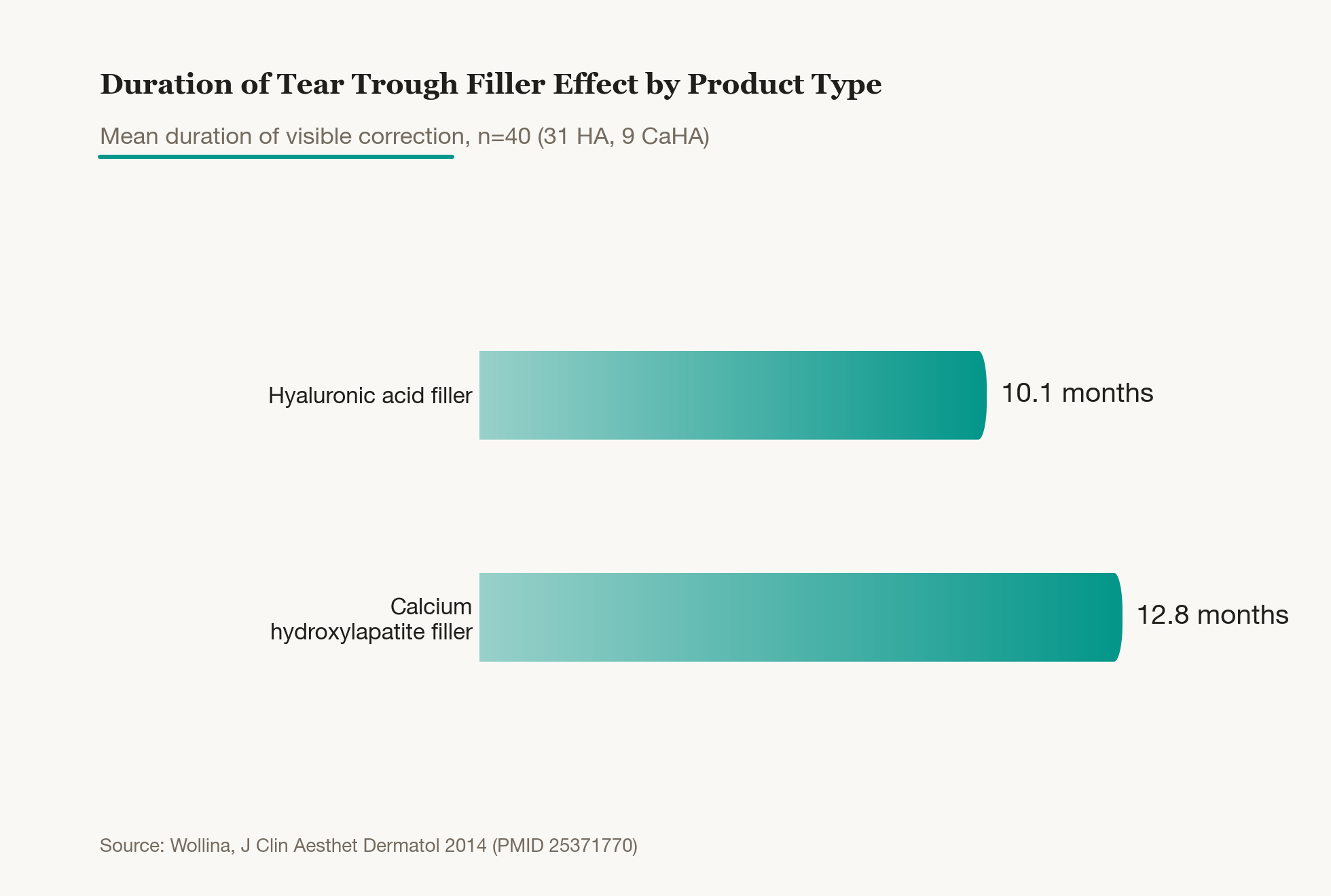
Final results are typically evaluated around the four-week mark, once swelling has fully resolved. The effect of the filler itself is generally reported to last around six to twelve months, and this area tends to break down a bit faster than others because the skin is thin and the surrounding muscles move constantly with facial expression. That said, how long results last can vary quite a bit from person to person depending on metabolism, the amount injected, and the type of filler used.
How Dangerous Are Vessel Side Effects?
Because the tear trough sits so close to blood vessels leading to the eye, this area calls for more vigilance around vascular complications than almost anywhere else on the face. If filler is accidentally injected into a blood vessel, it can block that vessel and cut off blood flow, which is an emergency that can lead to skin necrosis or, rarely, vision problems. If any of the following signs appear during or right after treatment, you should contact the clinic immediately.
- Skin turning white: this can signal a sudden interruption in blood supply, and if the color does not return quickly, it needs to be checked.
- Pain that is unusually severe for the area: unlike ordinary injection discomfort, pain from a compressed or blocked vessel is much sharper and lasts longer.
- Blurred or dimmed vision: because this area connects to vessels feeding the eye, any change in vision is a sign that needs immediate attention.
These situations are rare in practice, but because a fast response matters so much when they do happen, it is worth having your clinic walk you through this beforehand. If an emergency is confirmed, the standard response is an immediate injection of hyaluronidase to dissolve the filler and reopen blood flow.
What to Ask the Clinic Before Treatment
Results with tear trough filler tend to vary quite a bit depending on the injector's skill. Placed too shallow, it can leave the Tyndall effect behind, and if too much is used, the under-eye area can end up looking unnaturally puffy instead. A few things are worth checking before you go in.
- Confirm the clinic regularly treats the tear trough and has solid experience with cannula technique.
- Ask beforehand what type of filler will be used, how soft it is, and how much is planned.
- Check whether the product can be reversed with hyaluronidase, since that leaves room to make adjustments if the result is not what you wanted.
- If the under-eye fat pad is already quite prominent, filler alone may have its limits, so it helps to get a proper diagnosis first to see whether the issue is fat protrusion or bone hollowing.
The tear trough plays a big role in how tired or fresh a face looks, so an accurate diagnosis paired with careful technique is what leads to a natural result.
References
Biesman BS, et al. A Multicenter, Randomized, Evaluator-Blinded Study to Examine the Safety and Effectiveness of Hyaluronic Acid Filler in the Correction of Infraorbital Hollows. Aesthet Surg J. 2024 (PMID 38573527). Korean Dermatological Association, American Academy of Dermatology (AAD), and Ministry of Food and Drug Safety (MFDS).
Was this helpful?
About this article
Written by a practising aesthetic physician and intended for general education — not a substitute for individual medical advice.
Read next
Under-Eye Hollow Filler: Effect and Side Effects, and the Tyndall Effect to Watch
The dark, sunken look under the eyes often comes less from pigment than from hollowing and the shadow it casts. Here's how the tear trough ligament and lost volume under the eye create that shadow, how a soft hyaluronic acid filler placed shallowly and sparingly smooths it out, why thin skin and the bluish Tyndall effect make this area tricky, and how long results actually last, all backed by real published numbers.
By Dr. Kim

Temple Filler Effect and Duration, Including Vessel Precautions
The temples are one of the first areas to hollow out as fat and bone shrink together with age. When they sink in, the balance of the whole face profile shifts and the overall look changes. Here is how filler fills this space and why it needs to be handled with extra care.
By Dr. Kim
Gummy Smile Botox Effects, Duration, and Side Effects
A gummy smile happens when your gums show more than usual as you smile, and an overactive lip-lifting muscle is one of the most common causes. Botox works by slightly reducing the strength of that muscle so your lip doesn't rise as high when you laugh. Here's how to tell whether muscle is really the cause, plus how long the results tend to last.
By Dr. Lee