TCA CROSS for Icepick Acne Scars: Effect and Pigmentation Care
By Dr. Lee7 min read

Of all acne scar types, narrow and deep icepick scars are consistently the hardest to treat. Fractional lasers often can't deliver enough energy through the tight opening to reach the base, which is why results are disappointing after multiple sessions. That's where TCA CROSS comes in, a technique built specifically for this type of scar.
TCA CROSS works by applying a high-concentration solution of trichloroacetic acid (TCA) directly to the base of each scar, stimulating new collagen growth from the bottom up. No device is needed, which keeps costs accessible. It's also a practical option for darker skin types that are prone to pigmentation after aggressive laser treatments. Here's a look at how it works, what the research actually shows, how to manage pigmentation risk, and how to fit it into a broader scar treatment plan.
What Kind of Treatment Is TCA CROSS?
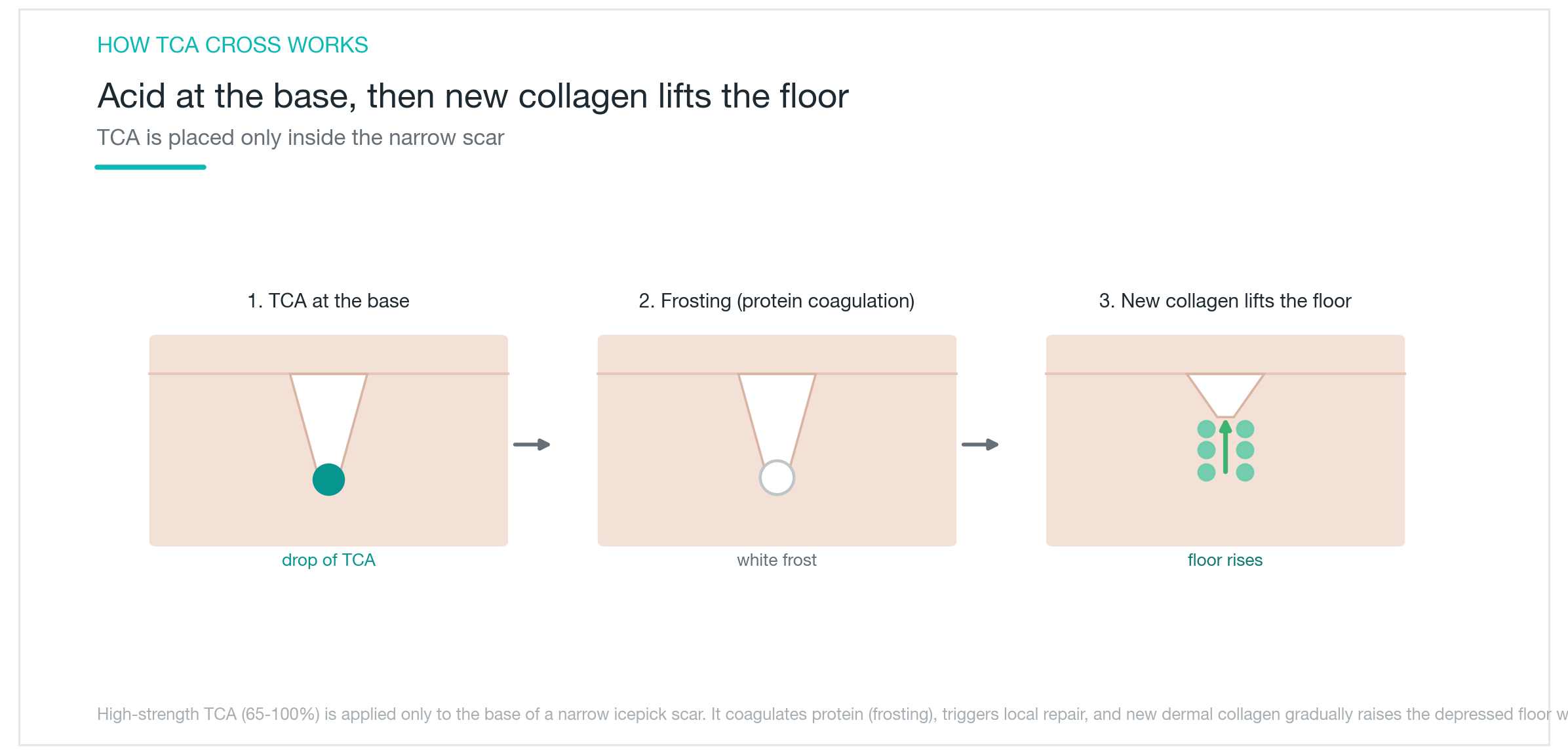
CROSS stands for Chemical Reconstruction of Skin Scars. The name describes it well: concentrated TCA is applied precisely to the base of a scar, and only there.
Here's how the procedure works. A solution of 65% to 100% TCA is loaded onto the tip of a fine applicator, similar to a toothpick, and pressed into the base of each icepick scar. Within seconds, the treated spot turns white and frosted. This is called frosting, and it happens when the acid causes protein coagulation. It's a sign that the solution reached its target.
The surrounding skin isn't touched at all. Unlike a peel that covers the full face, TCA CROSS is essentially a series of precise dots, each one placed inside a scar. The skin around each scar is protected. Focal inflammation follows, then new collagen builds up and gradually raises the scar floor. Because the treatment is so localized, it can be used safely on darker skin tones that would react poorly to full-face laser procedures. Concentration and volume are adjusted scar by scar based on depth.
Why Does It Suit Icepick Scars?
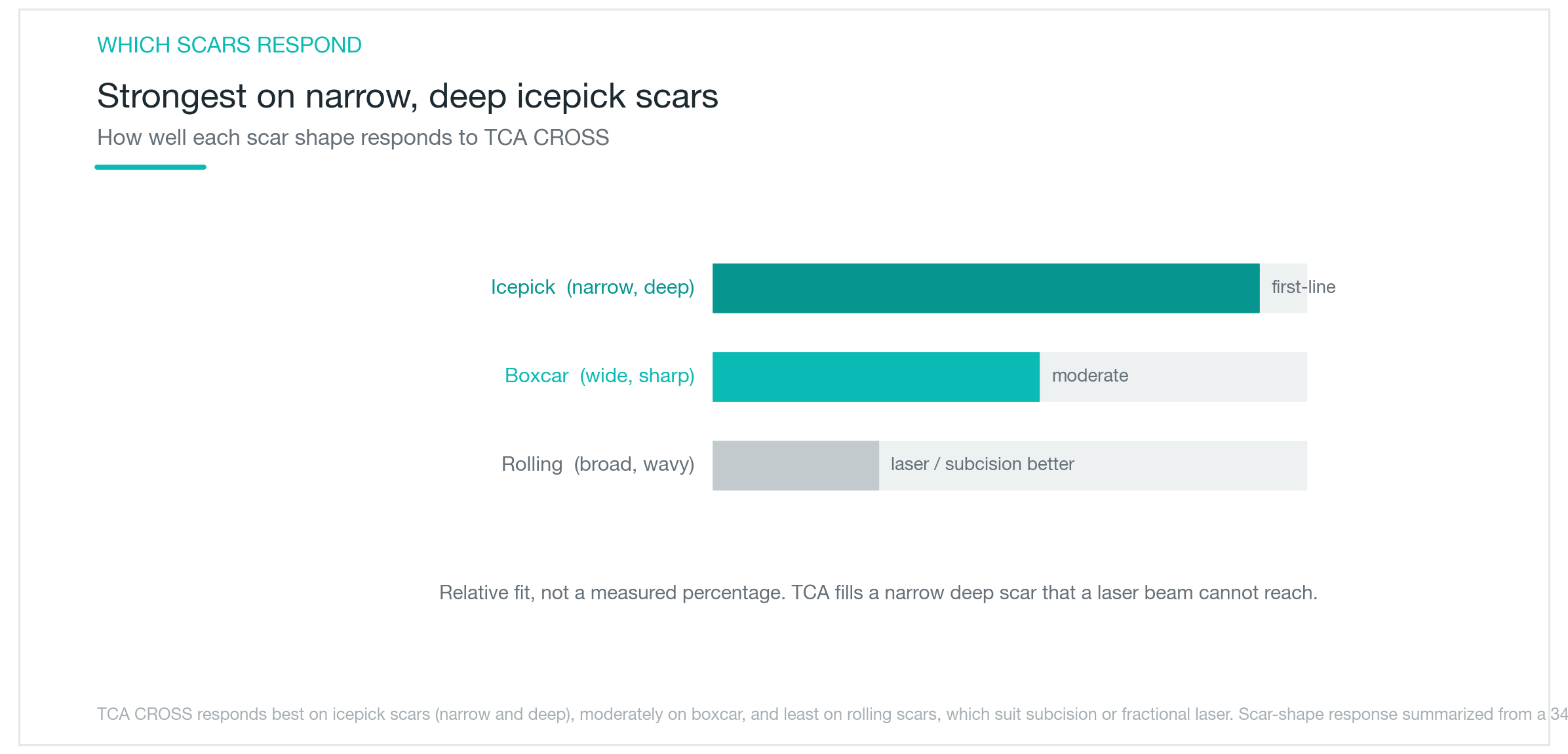
Acne scars fall into three main categories. Icepick scars are narrow and deep. Boxcar scars are wide with defined edges. Rolling scars are shallow with a wave-like surface. Each responds best to different treatments.
TCA CROSS shines on icepick scars. Because the opening is so narrow, laser energy simply can't travel deep enough to reach the base. TCA is a liquid, so it flows right into the scar and acts exactly where it needs to. Collagen fills in from there and lifts the floor over time.
Boxcar scars respond moderately, and rolling scars are less suited for this approach. Rolling scars form because of fibrous bands pulling from below, which is better addressed by subcision. Broad textural improvement calls for fractional laser. For that reason, TCA CROSS is widely considered the first-line option for icepick scars. In practice, most people have a mix of scar types on the same face, so identifying each scar's type becomes the starting point for a good outcome. If icepick scars have been the frustrating constant despite other treatments, TCA CROSS offers a more targeted path.
How Effective Is TCA CROSS?
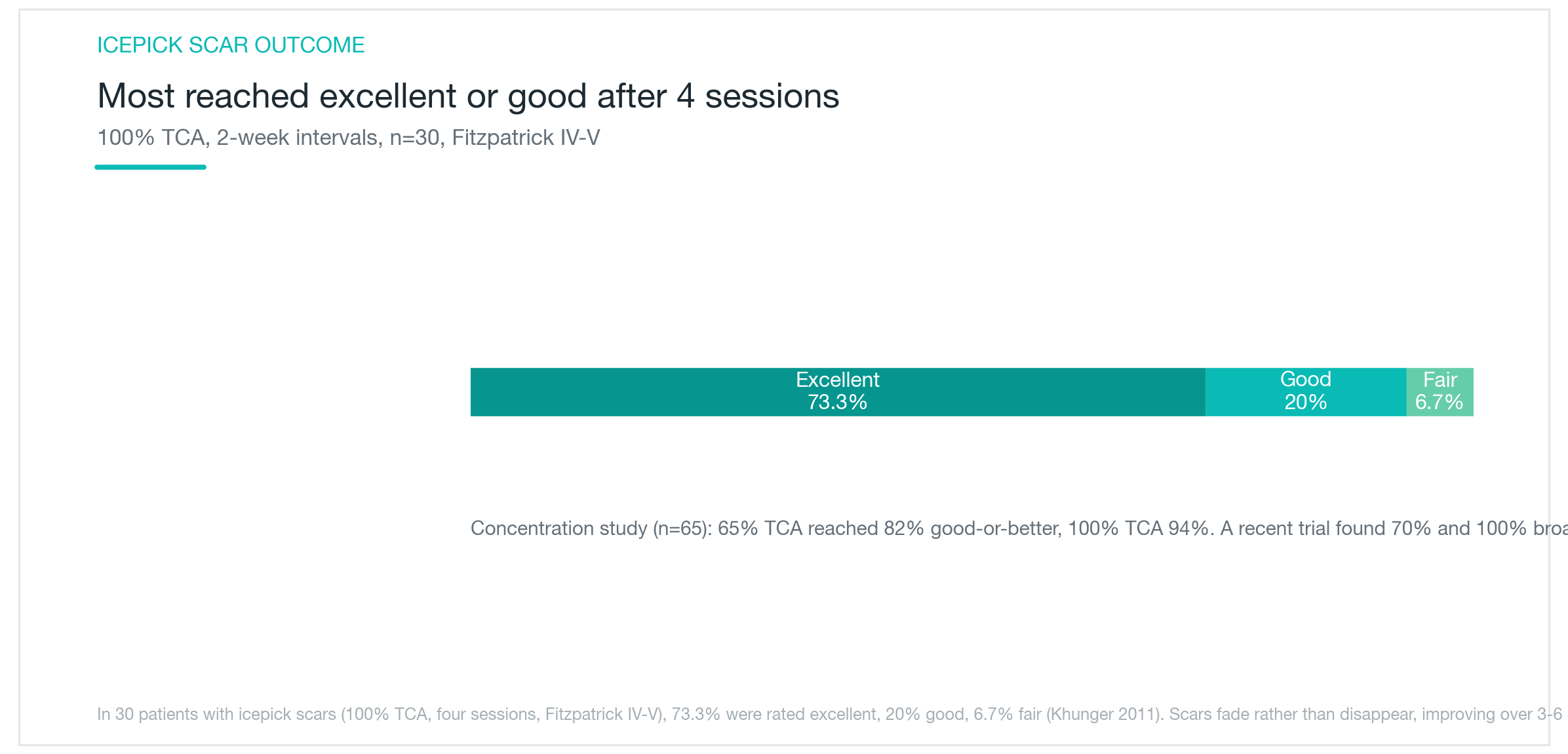
The evidence base is solid and growing. A study of 30 patients with darker skin (Fitzpatrick IV–V) who received 100% TCA four times at two-week intervals found that 73% achieved an excellent rating and 20% a good rating. Meaningful improvement was seen in the vast majority.
An earlier study comparing concentrations found that 82% of the 65% TCA group and 94% of the 100% group showed good or better results. The higher concentration looks better on paper, but a more recent randomized controlled trial found no statistically significant difference in overall outcomes between 70% and 100%. That said, for especially deep icepick scars, 100% does appear to have a consistent edge.
The goal is not to erase scars but to raise the floor so they become less visible. It's more realistic to expect gradual improvement across multiple sessions than a dramatic change after just one. Many people find it helpful to photograph treated areas between sessions, since the improvement builds slowly enough that it can be easy to miss in the mirror.
Can Pretreatment Prevent Pigmentation?
The main concern with TCA CROSS is post-inflammatory hyperpigmentation (PIH), the brownish discoloration that can linger at treated sites. Fortunately, the risk drops considerably with the right preparation.
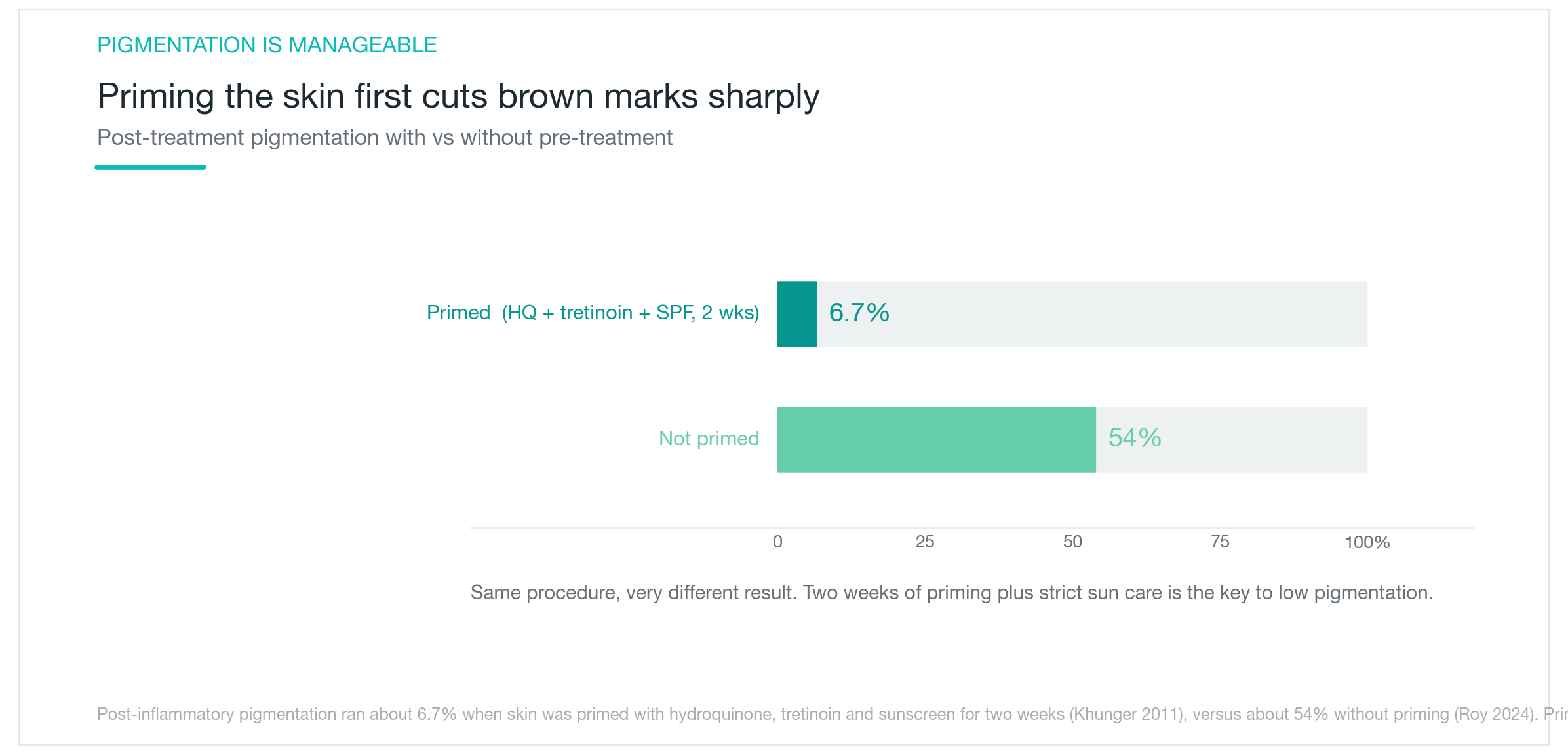
Pre-treatment prep is the key factor. In a study where patients applied hydroquinone, tretinoin, and sunscreen for two weeks before each session, PIH occurred in only about 6.7% of cases. When no preparation was used, the rate climbed to 54%. The same procedure led to dramatically different outcomes, depending entirely on what happened in the weeks before.
Post-treatment care matters too. Tiny scabs form at each treated site and typically resolve within three to seven days. Picking at them accelerates PIH risk, so leaving them to fall off on their own is important. Consistent sunscreen use during this period is the most effective single habit for keeping PIH at bay. For skin types that pigment easily, combining pre-treatment prep with diligent sun protection makes a real difference. The prep weeks before treatment turn out to be the most consequential part of the whole process. Done right, most people move through this phase without significant issues.

Number of Sessions and Combination Treatments
TCA CROSS is typically done in three to six sessions spaced two weeks apart. One early study found that all patients who completed five to six sessions achieved an excellent rating. Since collagen remodeling takes time, improvement continues for three to six months after the final session.
Scars rarely come in just one type, so in practice, combination approaches are common. A common three-part plan pairs TCA CROSS for icepick scars, subcision for tethered rolling scars, and fractional laser for broad surface improvement. Each method covers different ground, and together they address a wider range of what acne leaves behind.
The low overhead of TCA CROSS (no equipment, just a precise drop of solution) is a real strength. It allows targeted treatment of individual scars at a manageable cost, which is why it has been a mainstay of scar treatment for years. Spreading procedures out over time, based on how the skin is responding, tends to reduce recovery burden and produce more consistent results than trying to do everything at once. It's a treatment that rewards a calm, steady approach.

Who Does It Suit Best?
TCA CROSS is a particularly strong fit for anyone who has been through multiple fractional laser sessions without much improvement in narrow, deep icepick scars. For darker skin types where aggressive laser carries a high PIH risk, the localized nature of TCA CROSS makes it a safer alternative. It's also appealing for those who want an effective, low-cost option that doesn't require specialized equipment.
Expectations should stay grounded. This is a treatment for reducing the appearance of scars, not eliminating them. It takes multiple sessions, and the results build gradually over months. If rolling or wide scars are part of the picture, combining TCA CROSS with other approaches will give better overall results.
Above all, this is a precise technique that requires careful placement of a strong acid. Finding an experienced provider who can correctly categorize scar types and calibrate concentration and prep accordingly is what makes the difference between a safe, satisfying outcome and one that isn't. Scar treatment is a long process, and steady consistency matters more than urgency. Choosing a provider who will follow the progress with you over several months leads to higher satisfaction. With patience and the right approach, scars that have been a source of frustration for years can genuinely look better.
Was this helpful?
About this article
Written by a practising aesthetic physician and intended for general education — not a substitute for individual medical advice.
Read next

TCA CROSS Effect: How Many Sessions for Icepick Scars?
TCA CROSS places high-concentration acid precisely at the base of narrow, deep ice pick scars to trigger fresh collagen growth right where it's needed. Here's why this method works so well for narrow scars, how the scar gradually fills in, and why it takes multiple sessions to see results.
By Dr. Kim

Acne Scar Treatment by Scar Type: Effects, Downtime and Pigmentation
Acne scars respond differently to treatment depending on whether they are icepick, boxcar, or rolling type. Here is a rundown of the improvement rates and downtime for subcision, fractional CO2, microneedling RF, TCA CROSS, and HA filler, plus the pigmentation risk for Korean skin, backed by clinical research.
By Dr. Lee

Chemical Peel Types and Differences: BHA for Acne, AHA for Pigment
A guide to chemical peel types by depth and indication, covering AHA glycolic acid and lactic acid, BHA salicylic acid, TCA, Jessner solution, and mandelic acid. Backed by clinical study numbers on which peel fits acne, pigmentation, or pore concerns, and why.
By Dr. Lee