Tattoo Removal Laser Sessions: How Many Do You Need by Color?
By Dr. Kim9 min read
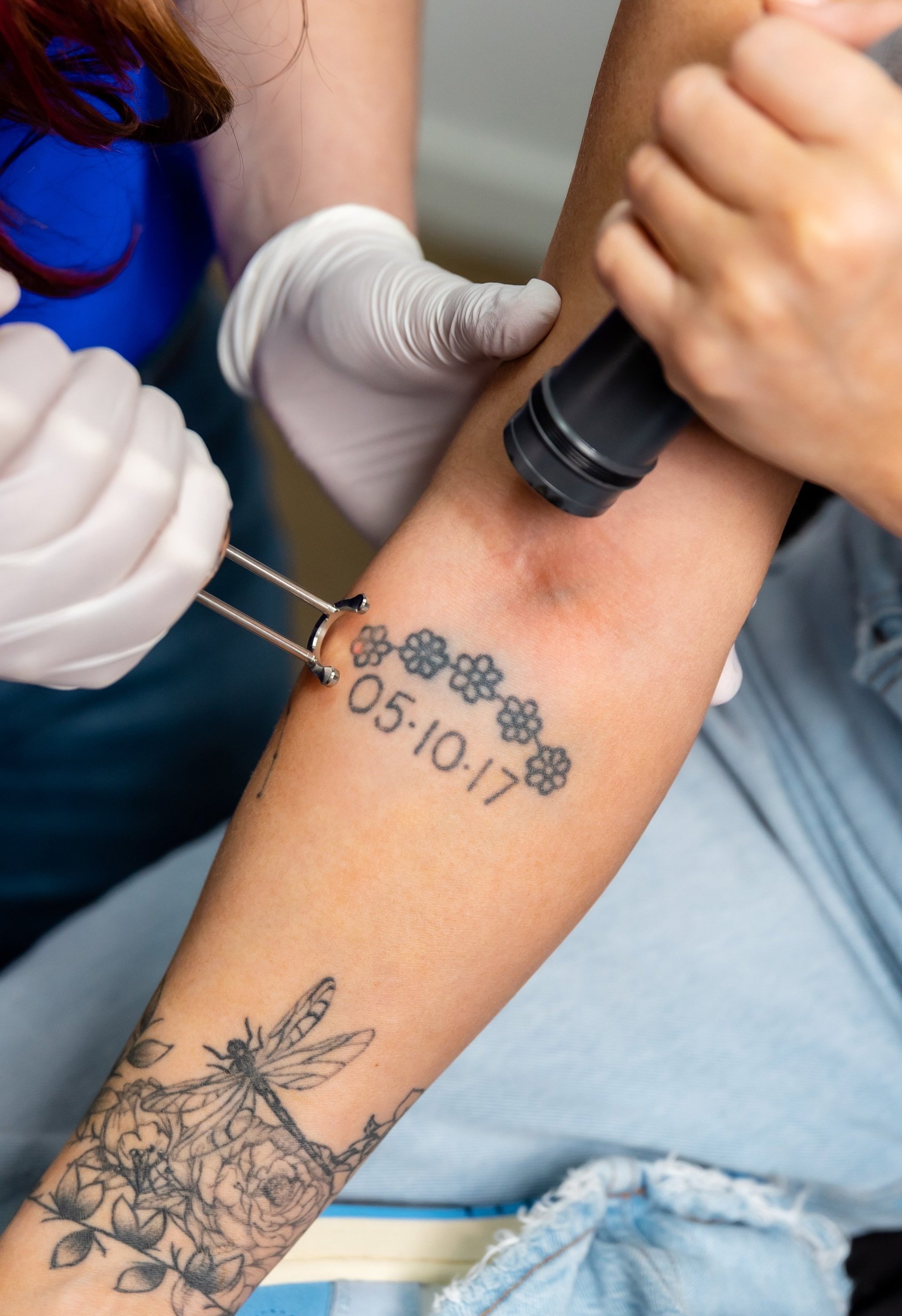
A tattoo you once loved, or eyebrow permanent makeup that once looked crisp and defined, can start to feel like a burden as time passes. Fortunately, laser removal is now the standard way to clear it. Because the process targets only the ink while leaving almost no scarring, it's a completely different experience from the old methods that involved cutting into the skin.
That said, it doesn't disappear in one visit. You need several sessions, and some colors fade faster than others. Once you understand the mechanism, it becomes much clearer why multiple sessions are needed, why black clears easily while green lingers, and why extra caution matters when removing permanent makeup in particular. Knowing that your results and session count depend on your tattoo's color and depth makes the whole process much easier to navigate. Here's what real research shows, from how tattoo removal lasers break down ink, to wavelengths by color, how many sessions you'll likely need, and why permanent makeup can turn darker.
How Does a Laser Erase Tattoo Ink?
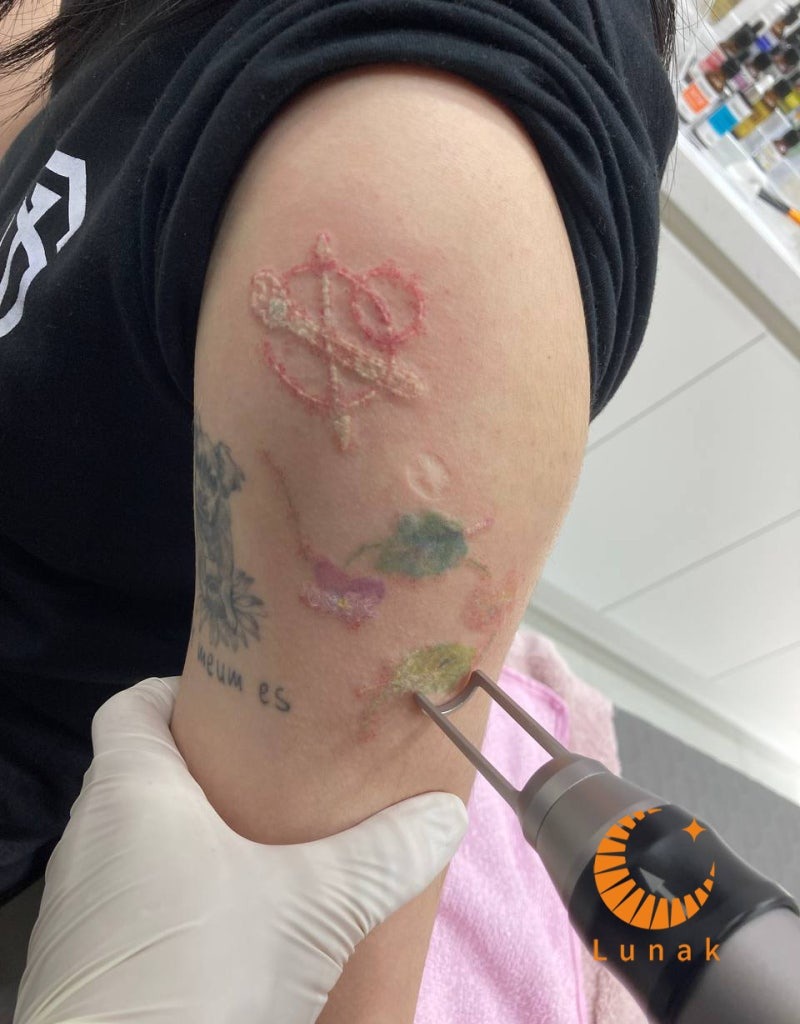
A tattoo is made of ink particles lodged in the dermis, the deeper layer of skin. These particles are too large for immune cells to clear away, so they stay put for life. What the laser does is break these large particles into much smaller pieces.
The key is delivering intense light in an extremely brief burst. Q-switched lasers, which fire in nanosecond pulses, or picosecond lasers, which are even faster, deliver a sudden physical shock to the ink that shatters the large particles into fragments. Because this works by physical disruption rather than heat, the surrounding skin takes less damage. It's similar to breaking up a large boulder into gravel so the current can slowly carry it away.
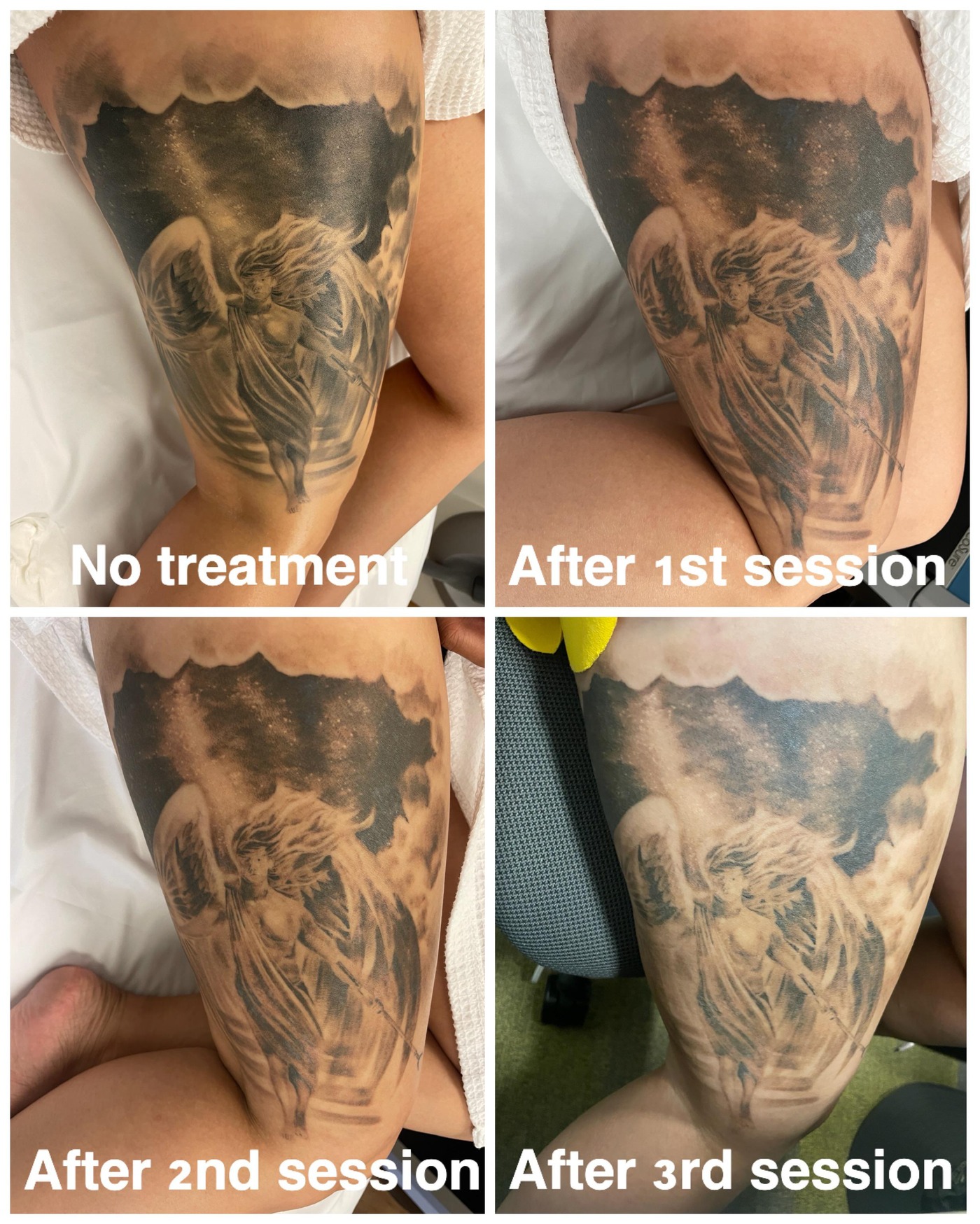
Immune cells then spend several weeks gradually clearing out the shattered fragments. This is exactly why multiple sessions are necessary. After one round of breaking down the ink, the immune system needs time to carry the debris away, and once enough has cleared, the next session breaks down what's left. That's why sessions are spaced several weeks apart. The ink doesn't vanish in a single magical moment. It takes time, because the fragments have to be flushed out of the body. Understanding this rhythm helps you avoid getting impatient after one or two sessions when the tattoo isn't fully gone yet.
Laser Wavelengths by Color and Which Colors Fade Well
To break down a particular ink, the laser needs to fire light that color absorbs well. That's why wavelength selection is matched to tattoo color. Wavelength is basically what defines different types of light, and each pigment absorbs a specific wavelength best.
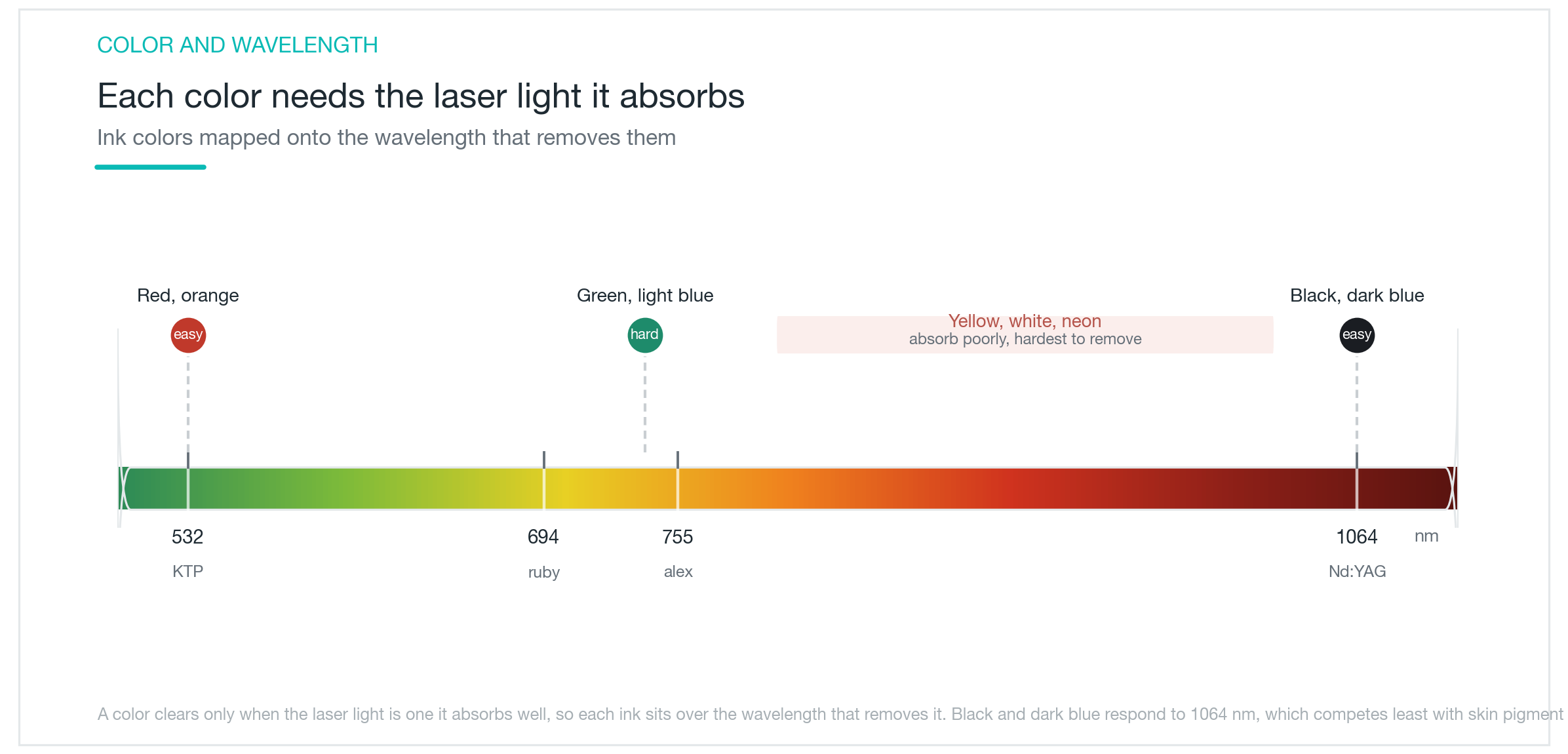
For the most common colors, black and deep navy, a 1064nm Nd:YAG laser is used. Because 1064nm has a longer wavelength, it penetrates deep into the skin and overlaps less with melanin, the skin's natural pigment, making it relatively safe even on darker skin tones. That's why it works best on deep, saturated black ink.
Red, orange, and yellow respond to the shorter 532nm wavelength. Shorter wavelengths are absorbed well by bright pigments closer to the surface. Green and sky blue respond well to the 755nm Alexandrite laser or the 694nm Ruby laser. These colors don't clear well with either 1064nm or 532nm, so a mid-range wavelength is needed instead.
Because each color absorbs a specific range of light best, black uses 1064nm, red tones use 532nm, and green tones use 755nm. A multicolored tattoo usually needs two or three different wavelengths combined, since each color requires its own match.
Some colors are simply stubborn. Green, sky blue, yellow, white, and fluorescent inks tend to clear more slowly. Current laser wavelengths simply aren't absorbed well by these pigments. Bright colors like white or peach in particular tend to reflect light rather than absorb it, so the response is weak. That's why it's common to see the black outline of a tattoo fade nicely while the colored fill lingers behind. Color is actually a good clue for predicting how easily a tattoo will clear. Black and navy respond best, and red and orange are also fairly manageable. So if your tattoo has a lot of color mixed in, it helps to go in knowing that each shade may respond differently.
Does Picosecond Laser Really Erase Better?
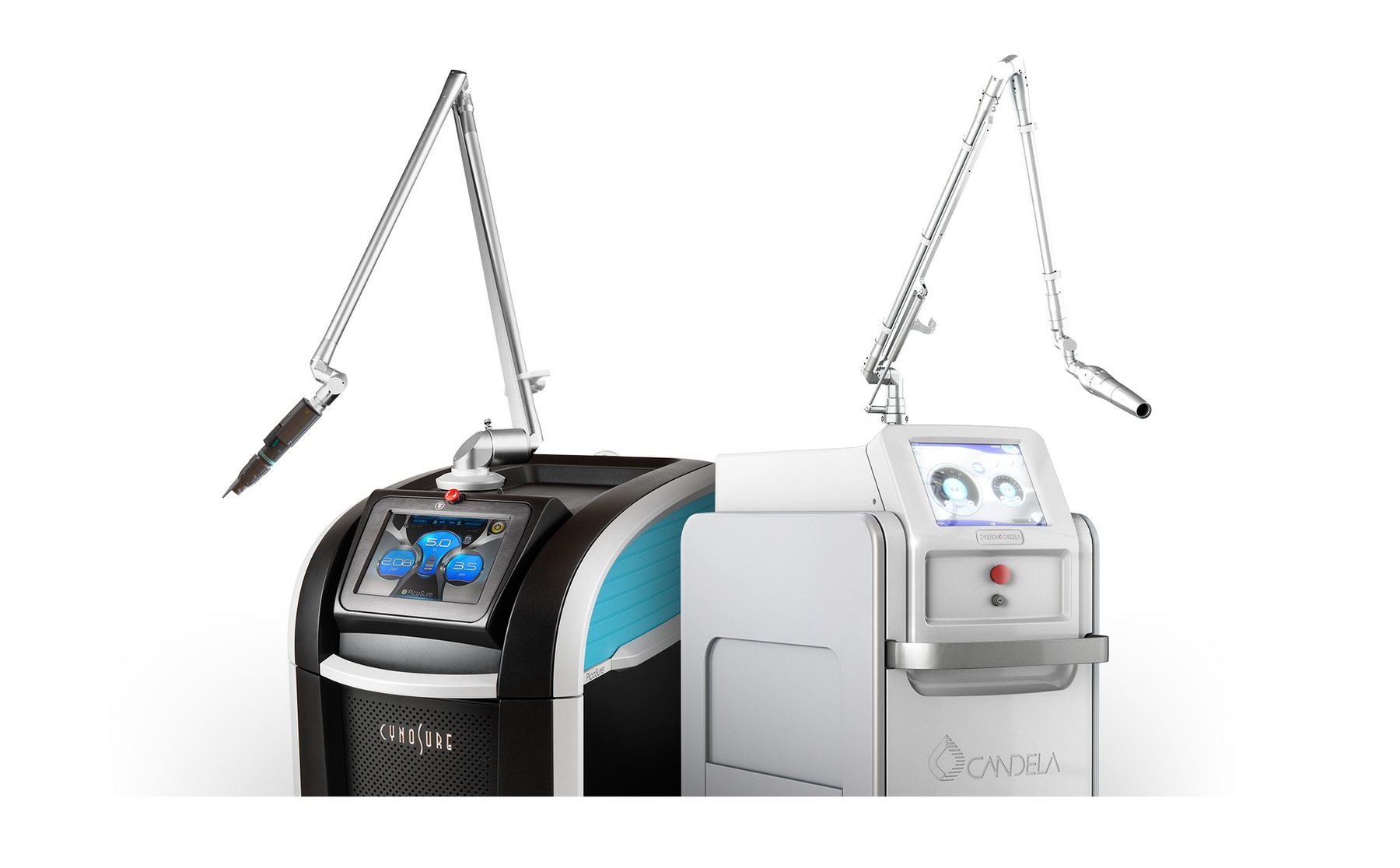
You've probably seen a lot of marketing around picosecond lasers lately. A picosecond is one trillionth of a second, meaning the light pulse is even shorter than before. The shorter the pulse, the more the ink breaks down through physical shock rather than heat.
Actual research shows picosecond lasers perform somewhat better, but the difference isn't dramatic. In a comparative study of 49 people where the same tattoo was split in half, one side treated with a picosecond laser and the other with a nanosecond laser, the picosecond side was more likely to clear beyond 75%. A large-scale review also found picosecond lasers outperform nanosecond lasers particularly on difficult colors like blue, green, and yellow. That said, the rate of fully clearing an entire tattoo averages around half, so picosecond doesn't guarantee complete removal either.
What matters more than the device name is choosing the right wavelength and settings for your specific tattoo, along with the practitioner's experience. If your tattoo is mostly black, a Q-switched Nd:YAG laser is already safe and effective. On the other hand, if you have a colorful tattoo mixing blue and green, or one that's cleared slowly despite multiple sessions, picosecond technology may reduce the number of sessions needed. Either way, a clinic that assesses your color and condition to plan out sessions is more trustworthy than one promising complete removal in just a few visits.
How Many Sessions Does Tattoo Removal Take on Average?
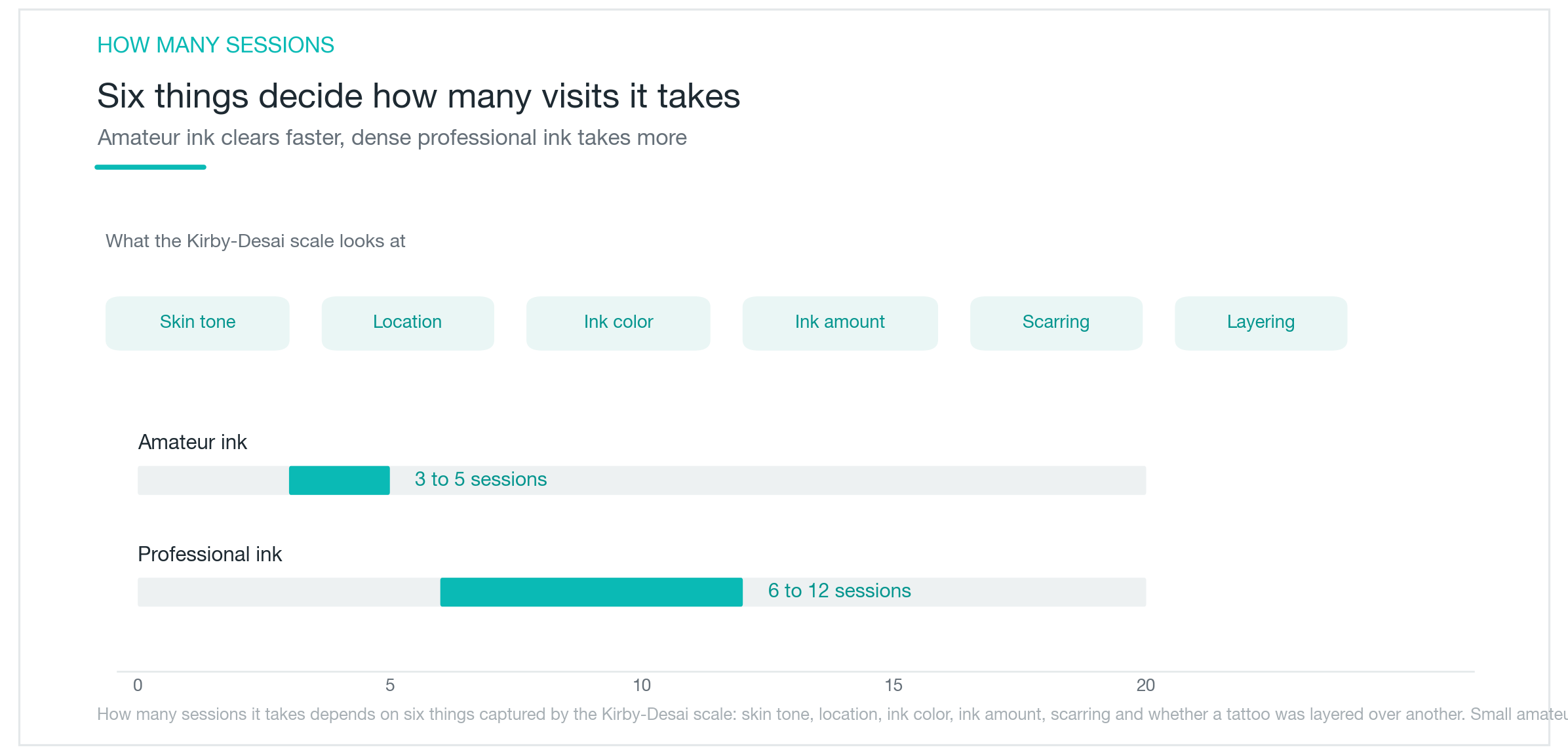
This is the question everyone wants answered most, but it varies by person. Fortunately, research offers a framework for estimating session count in advance. It's called the Kirby-Desai scale, and it looks at six factors: skin tone, tattoo location, ink colors, ink density, presence of scarring, and whether the tattoo was applied over an older one. In the study that developed this scale, all 100 participants successfully cleared their tattoos, needing anywhere from 3–20 sessions, averaging around 10.
Generally, lighter amateur tattoos with shallow ink fade noticeably in 3–5 sessions. Professionally applied tattoos with deeper, denser ink tend to take 6–15 sessions, and very densely packed ones can take even more. Sessions are typically spaced 6–8 weeks apart, giving immune cells time to carry away the shattered ink.
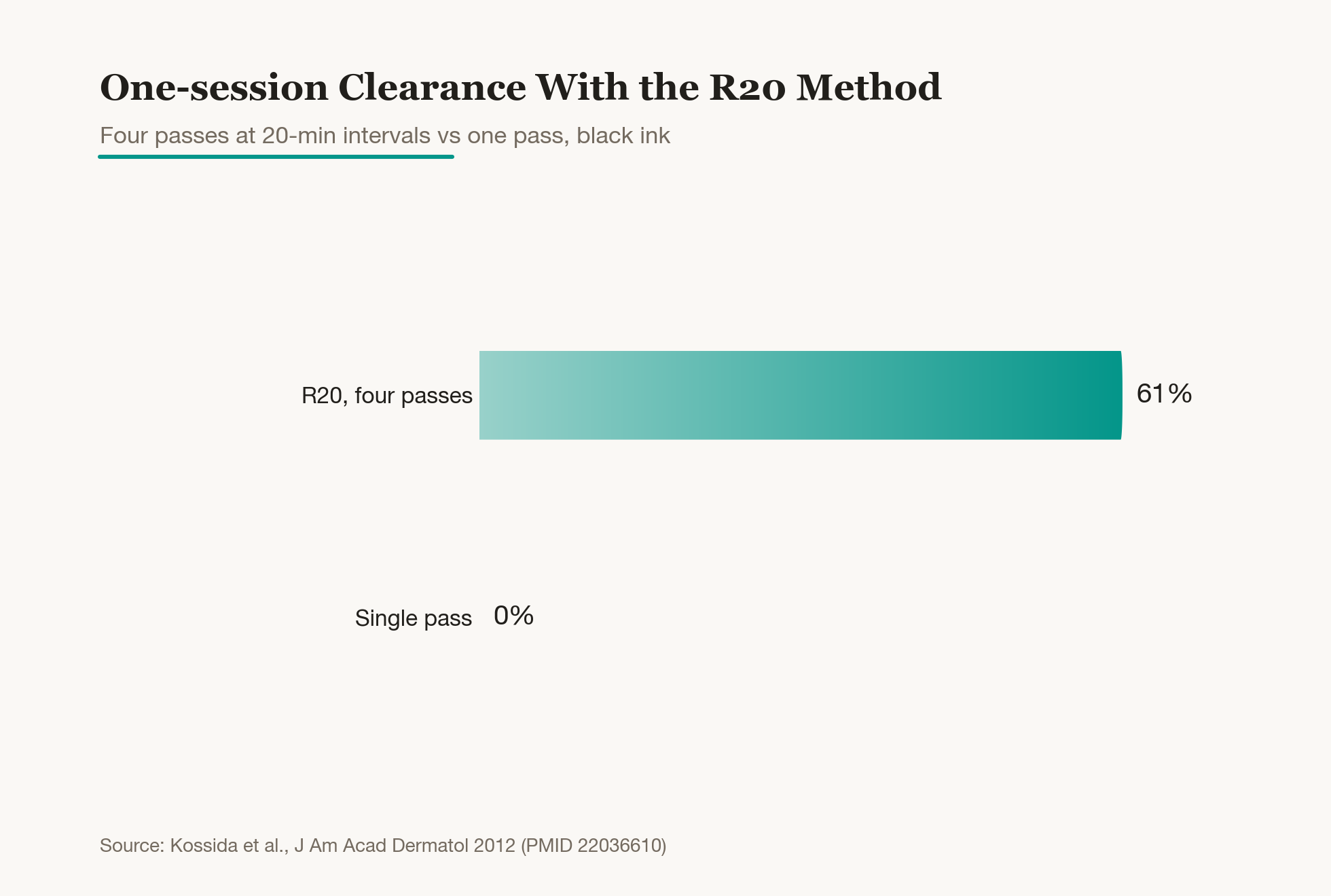
There's also a technique involving multiple passes in a single visit. In one study, the R20 method, which passes over the same area four times at 20-minute intervals, achieved a 61% complete clearance rate in just one session. Compare that to 0% with a single pass, and the difference is substantial. However, because this method delivers more energy in one sitting, reactions like blistering can also be more pronounced, so it's used carefully based on the skin's condition.
Why Does Eyebrow Permanent Makeup Sometimes Turn Darker?
Removing permanent makeup on eyebrows, eyeliner, or lips is trickier than removing a regular tattoo, because an unexpected reaction can occur. This is called paradoxical darkening, where an attempt to lighten a bright pigment instead turns it dark gray or black.
| Category | Regular tattoo | Permanent makeup |
|---|---|---|
| Ink composition | Carbon-based | Iron oxide, titanium dioxide |
| Risk of color change | Low | Paradoxical darkening possible |
| Test patch | Optional | Required |
| Response | Generally clears well | Watch for color change |
Permanent makeup inks designed to mimic skin tones, like peach, white, and pink, often contain iron oxide or titanium dioxide. When hit with a laser, these compounds can undergo a chemical reduction reaction that turns them darker or even black. This is exactly why a light eyebrow tint can suddenly darken during removal. That's why a small test patch is standard practice before treating permanent makeup, since ink brands and formulations vary widely and it's hard to know the exact composition beforehand. There are reports that newer permanent makeup inks use less iron oxide and titanium dioxide, which has lowered this risk compared to older formulations. Even if darkening does occur, continued treatment usually fades it back out over time, so as long as you don't skip the test patch, the process can proceed safely.
Skin Reactions and Precautions After Treatment
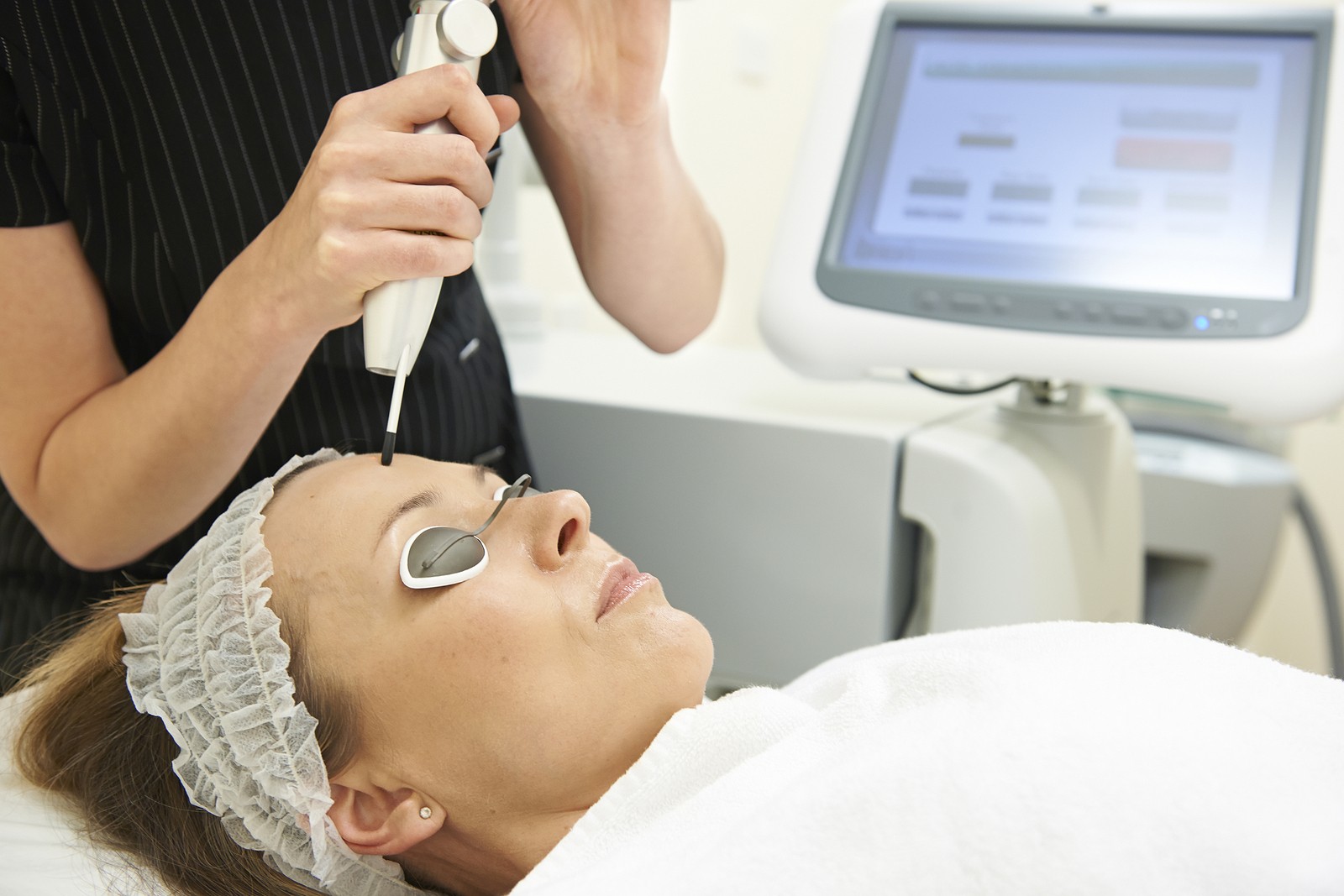
Tattoo removal lasers are generally safe, but a few reactions are worth knowing about ahead of time. Right after treatment, the area typically turns white, then red, and blistering can occur. Swelling and itching are also common, but most of this settles within a day or two, and fully resolves within 1–2 weeks at the latest.
Pigment changes can happen too. The treated area may temporarily lose pigment, appearing lighter, or it can darken instead. Darkening is more common but usually fades over time, while lightening tends to linger a bit longer. This matters especially for darker skin tones, where pigment overlap is more likely, so practitioners favor 1064nm over shorter wavelengths, keep energy settings conservative, and space sessions out more generously. This is an important consideration for Korean skin as well. Scarring or texture changes are rare when settings are properly calibrated. Afterward, consistent sun protection and resisting the urge to pick at scabs go a long way toward reducing the risk of pigment changes.
It's worth keeping expectations realistic. A tattoo doesn't always disappear 100%. Sometimes a faint shadow remains, especially with colorful or densely inked tattoos. Even so, most tattoos fade noticeably across multiple sessions, and black tattoos tend to clear quite cleanly. Choosing the right wavelength and settings for your skin tone and tattoo condition, and pacing sessions without rushing, is the safest and most satisfying way to see it through.
Was this helpful?
About this article
Written by a practising aesthetic physician and intended for general education — not a substitute for individual medical advice.
Read next

Types of Lasers for Facial Redness: Differences Between Devices and How to Choose
Why facial redness looks red, what Vbeam, Excel V, IPL, and Nd:YAG lasers each do best, which device fits which type of redness, how many sessions and downtime to expect, and what lasers cannot fix, all explained simply with real study numbers.
By Dr. Lee

Stretch Mark Treatment: Effect and Number of Sessions, Including Laser and Radiofrequency Differences
A clear look at why stretch marks form and what sets red stretch marks apart from white ones. We break down, with real study numbers, how much fractional laser, radiofrequency microneedling, and pulsed dye laser for red marks actually fade them, plus what topical tretinoin can and cannot do at home.
By Dr. Lee
Eyebrow Tattoo Laser Removal: Number of Sessions, Darkening Risk, and Precautions
Eyebrow permanent makeup fades when a laser shatters the pigment lodged in the skin so immune cells can carry it away. Here's how that process works, including the risk of iron oxide pigment turning darker instead of fading, and how color lightens session by session.
By Dr. Kim