Under-Eye Syringoma Laser Effect: Which Is Better, CO2 or Erbium YAG?
By Dr. Kim8 min read

Small, skin-colored bumps that appear in clusters under the eyes or on the lower lids can be frustrating. They are hard to hide with makeup, and many people find that even after a treatment, the bumps come back a while later. In a lot of these cases, the culprit is syringoma.
Syringoma is a benign tumor that develops from the sweat glands. Because it sits in a deeper layer of the skin, treating only the surface rarely clears it, which is why it tends to recur. The good news is that lasers like CO2 or Erbium YAG can visibly reduce it. Below, I walk through what syringoma actually is and why it is so stubborn, how to tell it apart from milia, how the lasers differ in results and recovery, and how to manage recurrence and pigmentation, drawing on real studies step by step.
Why Is Syringoma Hard to Clear?
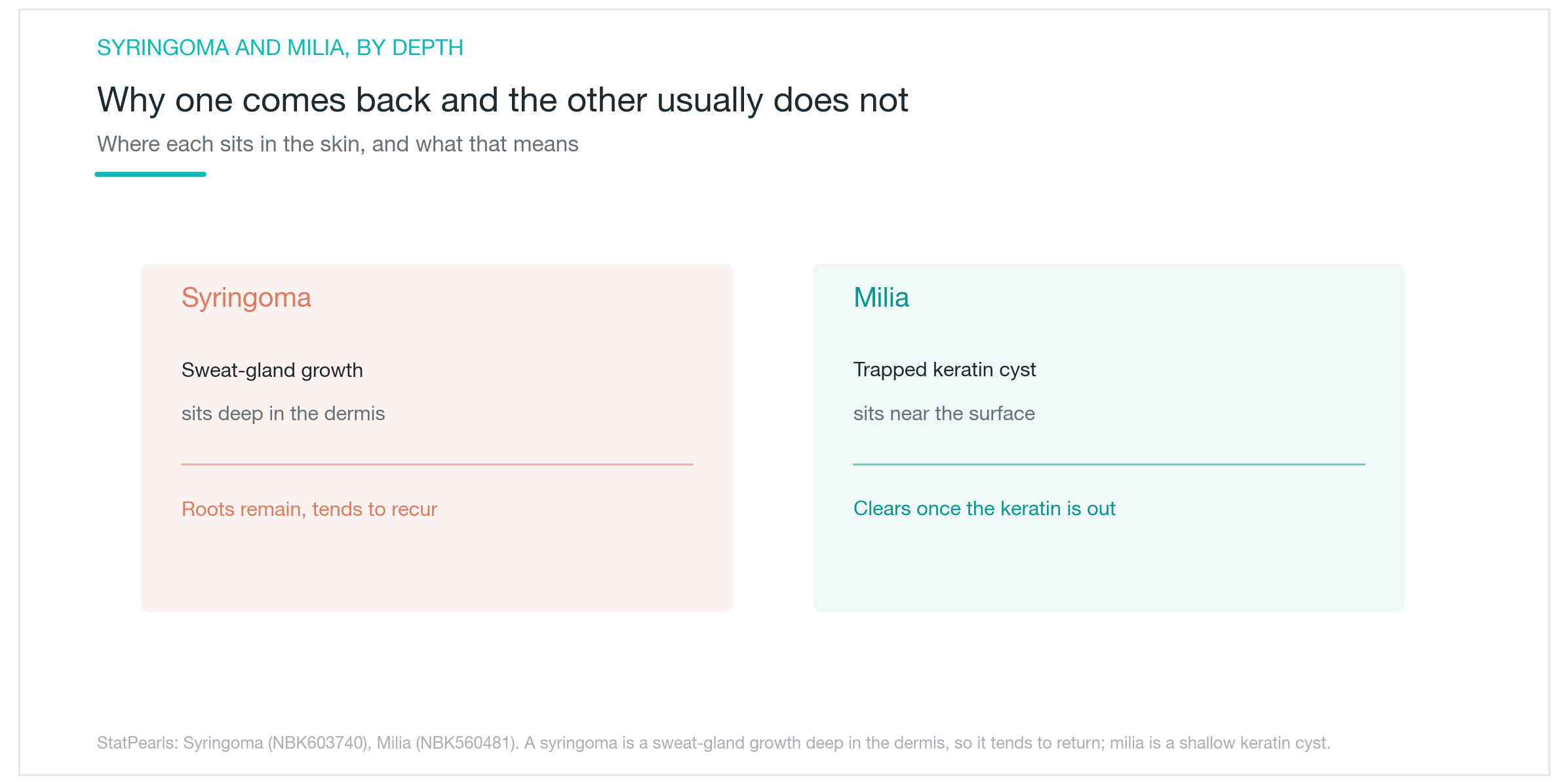
Syringoma is a benign tumor that arises from the ducts of the eccrine sweat glands. Under the microscope, it shows a characteristic tadpole or comma-shaped duct structure, and the lesion sits not on the surface but in the dermis, the layer beneath it. It usually appears as firm papules 2 to 4mm in size, showing up in symmetrical clusters under the eyes and on the lower lids.
This is exactly why it is so hard to clear. Since the roots of the lesion sit deep in the dermis, a shallow treatment that only skims the surface leaves tissue behind. That leftover tissue grows back, so recurrence is common. On the other hand, going too deep can leave scarring or pigmentation, so the trick is to treat at a moderate depth over several sessions. It comes back not because the treatment failed, but because of where the lesion lives.
Syringoma tends to appear in early adulthood and is more common in women and in people of Asian descent. It can be linked to puberty or hormonal changes, Down syndrome, and diabetes. Some people are simply genetically prone to it, so it is not unusual to have similar lesions elsewhere in the family. Reassuringly, it is benign, so it does not harm your health or turn malignant. That means the goal is cosmetic: how cleanly you can reduce it and keep it managed.
How Do You Tell It From Milia?
Among the tiny bumps that pop up around the eyes, milia are also common. The two can look similar on the surface but are completely different in nature. Milia are small cysts that form when keratin gets trapped just below the epidermis. They appear as pearly white grains, and squeezing one releases the white keratin inside. Because they sit close to the surface, gently opening one with a needle and extracting it usually clears it neatly.
Syringoma is different. The tumor forms in the sweat glands and settles deep in the dermis, so no white grain comes out. Instead, it feels like a firm, skin-colored papule. Treating only the surface leaves the root behind and makes recurrence likely. So if a white grain comes out, it is probably milia; if you have firm, skin-colored papules in symmetrical clusters under the eyes, it is more likely syringoma.
Telling them apart matters because the treatment approach and the outlook differ. Milia clear fairly simply, while syringoma is approached as something to manage with recurrence in mind. Sometimes both appear together on the same face, so sorting out which lesion is which is the starting point for any treatment plan. An accurate diagnosis comes from examining the skin directly and, if needed, confirming with a biopsy. The CO2 laser improvement figures shown in the chart above are also based on syringoma.
How Many CO2 Laser Sessions Do You Need?
The most commonly used option for syringoma is the CO2 laser. It works by finely vaporizing the lesion to reduce it, and various methods have been developed to reach deep into the dermis. Let's look at the actual clinical numbers to see how much improvement it really brings.
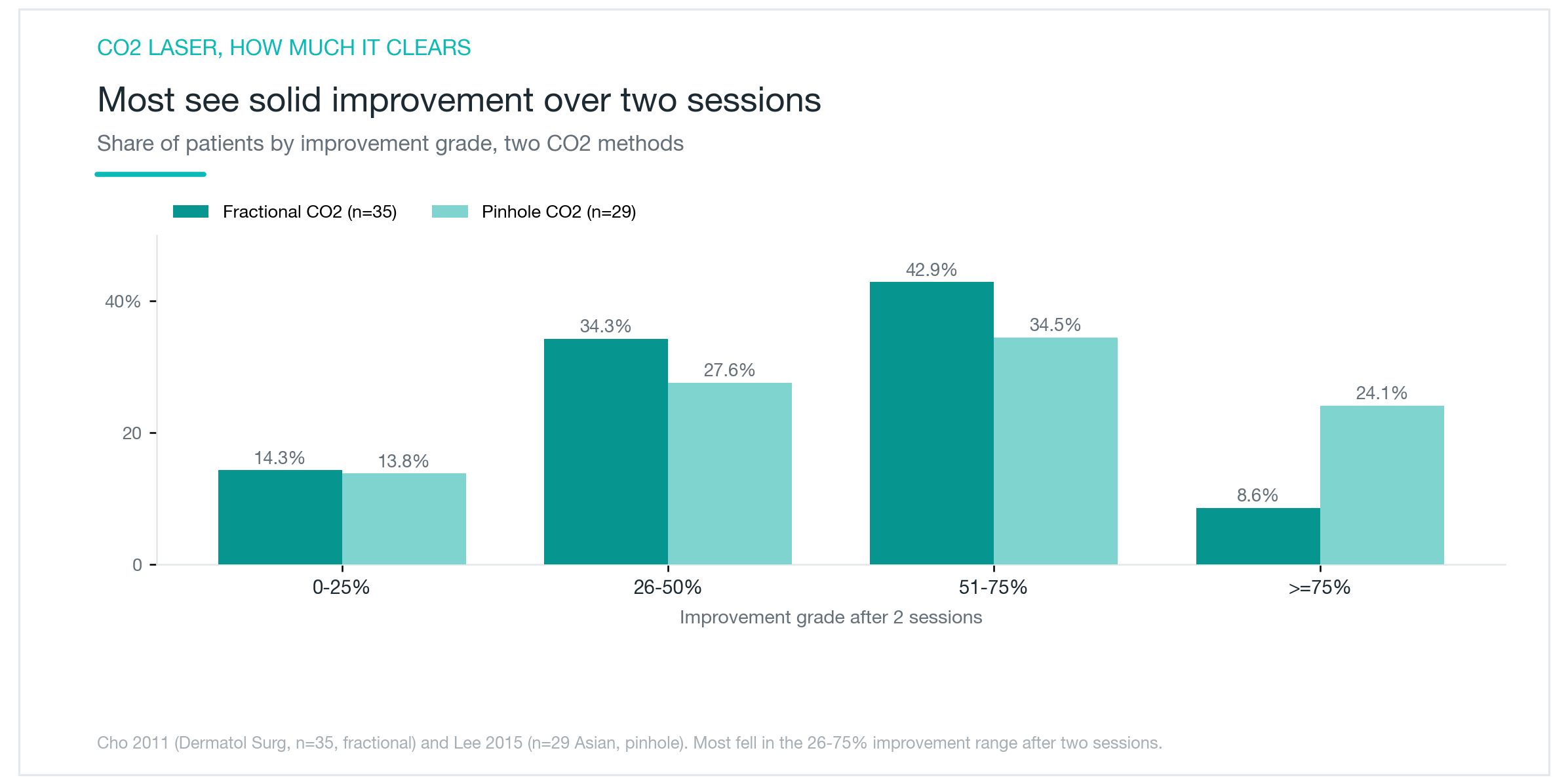
In a study using fractional CO2 for two sessions (35 patients), about half of all cases improved by more than half. Improvement of 51 to 75% accounted for 42.9%, and 26 to 50% improvement for 34.3%, so most cases fell into this range. In a study using the pinhole method, which reaches the dermis through fine channels (29 Asian patients), the rate of major improvement, defined as 75% or more, was higher at 24.1%. Results vary a bit depending on the method.
Rather than expecting it to vanish completely in one go, it is more realistic to think of it as a treatment done over two or three sessions to visibly reduce the lesion. There is also research suggesting that pairing CO2 with 50% TCA helps clear out residual tissue in the deeper layer the laser reaches, leaving less of the lesion behind. Methods like fractional and pinhole, which limit damage to surrounding tissue, keep being refined for exactly this reason: to preserve the results while lowering the risk of scarring and pigmentation. Whichever method is used, the goal is to fade the lesion and keep it managed.
Is Erbium YAG Better Around the Eyes?
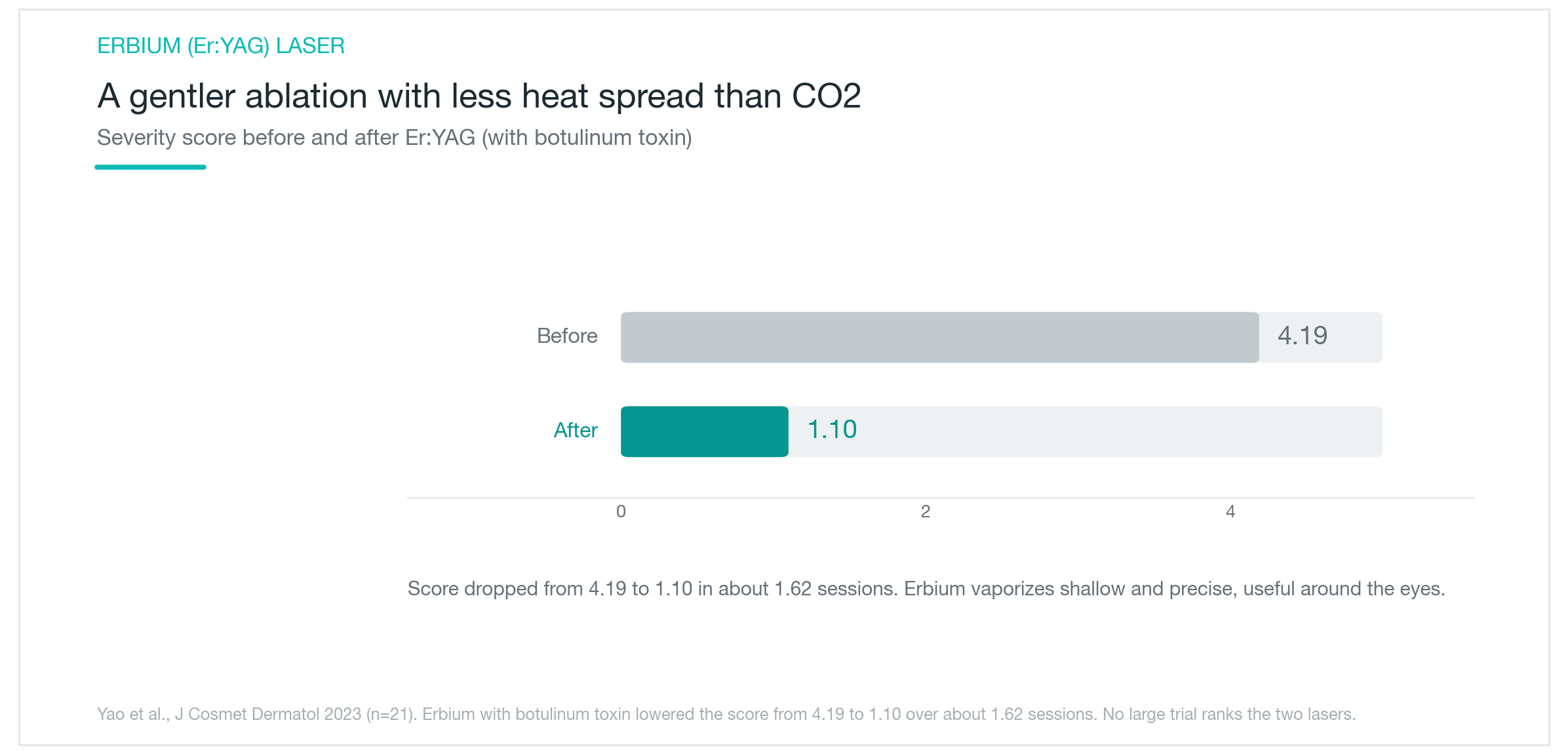
The Erbium YAG laser has a slightly different character than CO2. Because it is absorbed by water much more strongly, it vaporizes tissue shallowly and precisely, with less thermal damage spreading to the surrounding area. As a result, the risk of redness, downtime, and pigmentation tends to be lower than with CO2, which makes it a good fit for delicate areas like around the eyes.
Its effectiveness is documented too. In a study pairing Erbium YAG ablation with botulinum toxin (21 patients), the severity score for syringoma around the eyes dropped clearly, from 4.19 to 1.10. The average number of sessions was also on the low side, at about 1.62. Thanks to its shallow, precise action, it has an advantage around the eyes.
That said, because it vaporizes shallowly, very deep lesions may need to be treated over several sessions. And there is not yet a large comparative study that could declare CO2 or Erbium YAG the clear winner. Erbium YAG tends to have the edge on thermal damage and recovery, while CO2 is sometimes favored for tackling deeper lesions more aggressively. In the end, it helps to understand that the choice depends on lesion depth and skin condition. As the chart above shows, managing pigmentation alongside treatment leads to better results.
How to Care for Brown Marks After Laser
For Korean patients, pigmentation is the biggest concern with laser treatment. It refers to the brown marks left where the lesion was treated, and it can be substantially reduced with the right planning.
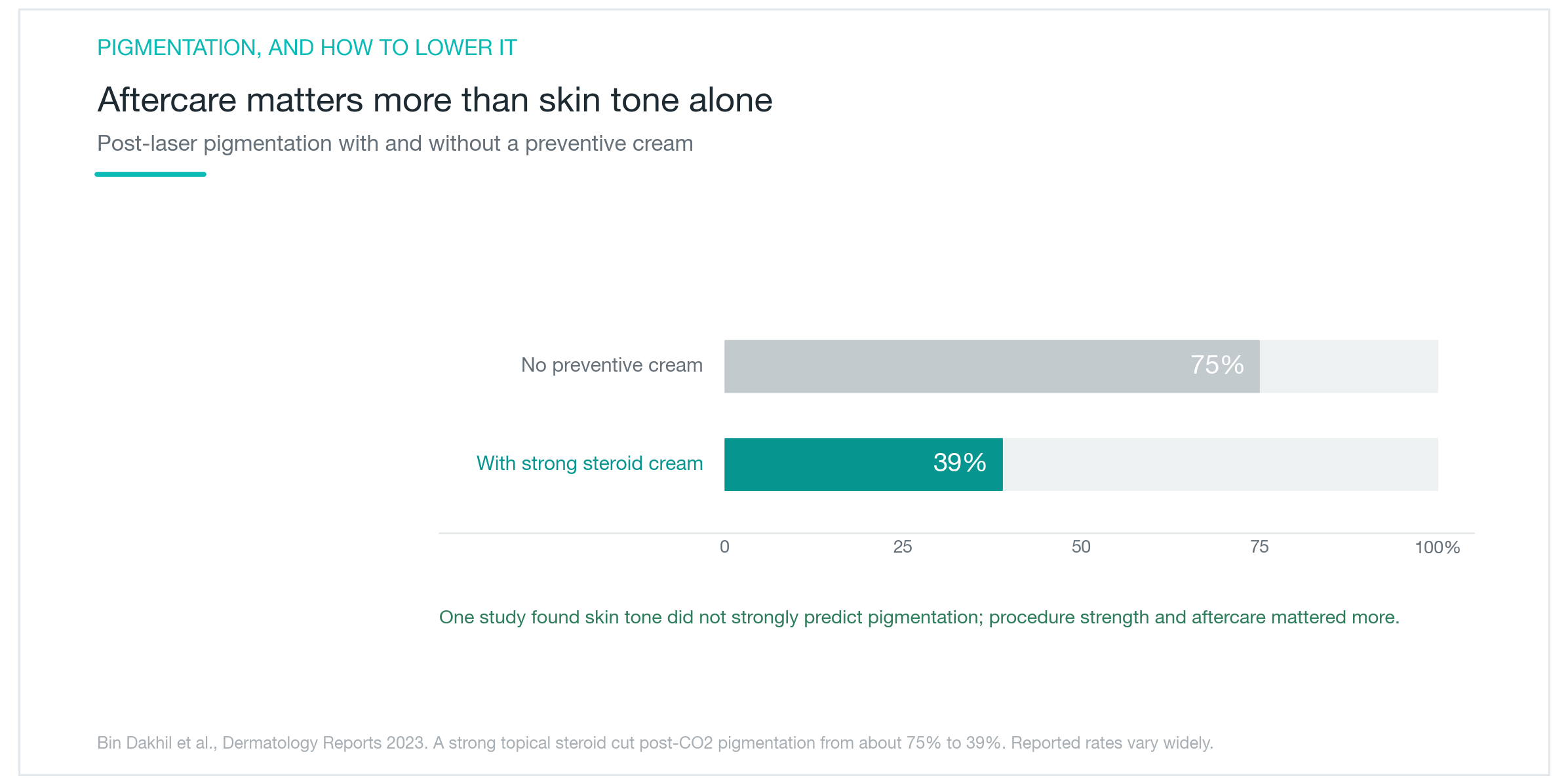
In one study, applying a potent topical steroid cream after CO2 laser cut the occurrence of pigmentation significantly, from 75% to 39%. Interestingly, in the same study, skin color itself did not have a major influence on pigmentation. In other words, rather than darker skin automatically developing more pigment, treatment intensity and aftercare were the bigger variables. That shows just how much aftercare matters.
Pigmentation usually fades over time, though the timeline varies from person to person. So the keys are keeping treatment intensity reasonable and staying consistent with soothing care and sun protection. UV exposure is the biggest cause of pigment darkening, so it is best not to skip sunscreen after treatment. Rather than trying to erase everything aggressively in one go and leaving marks behind, treating it gently over several sessions is easier on pigmentation too. This is not something to fear, and it can be managed well with proper care.

Is Recurrence a Treatment Failure?
The most frequent concern with syringoma is recurrence. When bumps you cleared come back a while later, it is natural to worry that the treatment went wrong. As we saw earlier, this happens because the roots of the lesion sit deep in the dermis, not because the treatment failed.
So with syringoma, it is more realistic to think in terms of reducing and managing it rather than curing it in one shot. The approach is to visibly fade it over several sessions and address new bumps as they come up. Because lesions are rarely confirmed with a biopsy beforehand, it is hard to pin down an exact recurrence rate. Still, you can take comfort in the fact that even if it recurs, it is a benign lesion that poses no threat to your health.
In the end, what matters is that you are treating a delicate area under the eyes, so it helps to see a clinician who can accurately assess the lesion depth and skin condition. Managing it at a reasonable intensity over several sessions, along with soothing care and sun protection afterward, can keep the skin looking clean for a long time. Even if new bumps appear, addressing them early keeps things manageable, so periodic check-ins on your skin help too. For syringoma, the phrase well managed fits better than fully cured.
Was this helpful?
About this article
Written by a practising aesthetic physician and intended for general education — not a substitute for individual medical advice.
Read next

Milia Around the Eyes: Is It Really Safe to Pick Them Out With a Needle at Home?
Why those little white bumps around the eyes show up, how milia differ from syringoma, when extraction versus CO2 or erbium YAG laser makes sense, whether you can pick them out at home with a needle, and how likely they are to return, explained simply with real studies.
By Dr. Lee
Skin Tag Removal Methods: Types of Laser and Pigmentation Care
What those small soft bumps on your neck, underarms, or eyelids actually are, how to tell them apart from milia and warts, how to choose between Er:YAG, CO2 laser, electrocautery, and cryotherapy based on size and location, how to keep pigmentation down, and what the research says about their link to diabetes and metabolic syndrome, all explained simply with real study numbers.
By Dr. Lee

Nasolabial Fold Treatment: Which Is Right for You, Filler or Thread Lift?
Whether your nasolabial folds come from sagging, lost volume, or aging skin decides whether filler, thread lifting, or a collagen stimulator is the right call. Here is what actually works for each cause, how long the results hold, and how to stay safe around the vessels beside the nose, all explained simply with real study numbers.
By Dr. Lee