Nasolabial Fold Treatment: Which Is Right for You, Filler or Thread Lift?
By Dr. Lee8 min read

One of the first things most of us notice in the mirror is the line that runs from beside the nose down toward the corner of the mouth: the nasolabial fold. It gets deeper with age, and on days when you are tired or your makeup is not sitting right, it stands out even more. So you start looking into filler, then hear that thread lifting might be better, and end up right back where you started.
Here is the thing, though. Nasolabial folds form for different reasons in different people. For some, the cheek has sagged. For others, volume has deflated. For others still, the skin itself has thinned and the crease has simply set in. And when the cause is different, the right treatment is different too. If sagging is the real problem and you only add volume, the face can end up looking heavier. If volume has deflated and you pull with threads, the face can look gaunt. So knowing what caused your fold in the first place is the whole ballgame. Below, we walk through how to tell the causes apart, which treatment fits each one and how long it lasts, and the safety points around the vessels beside the nose, one at a time with real research.
What causes nasolabial folds?
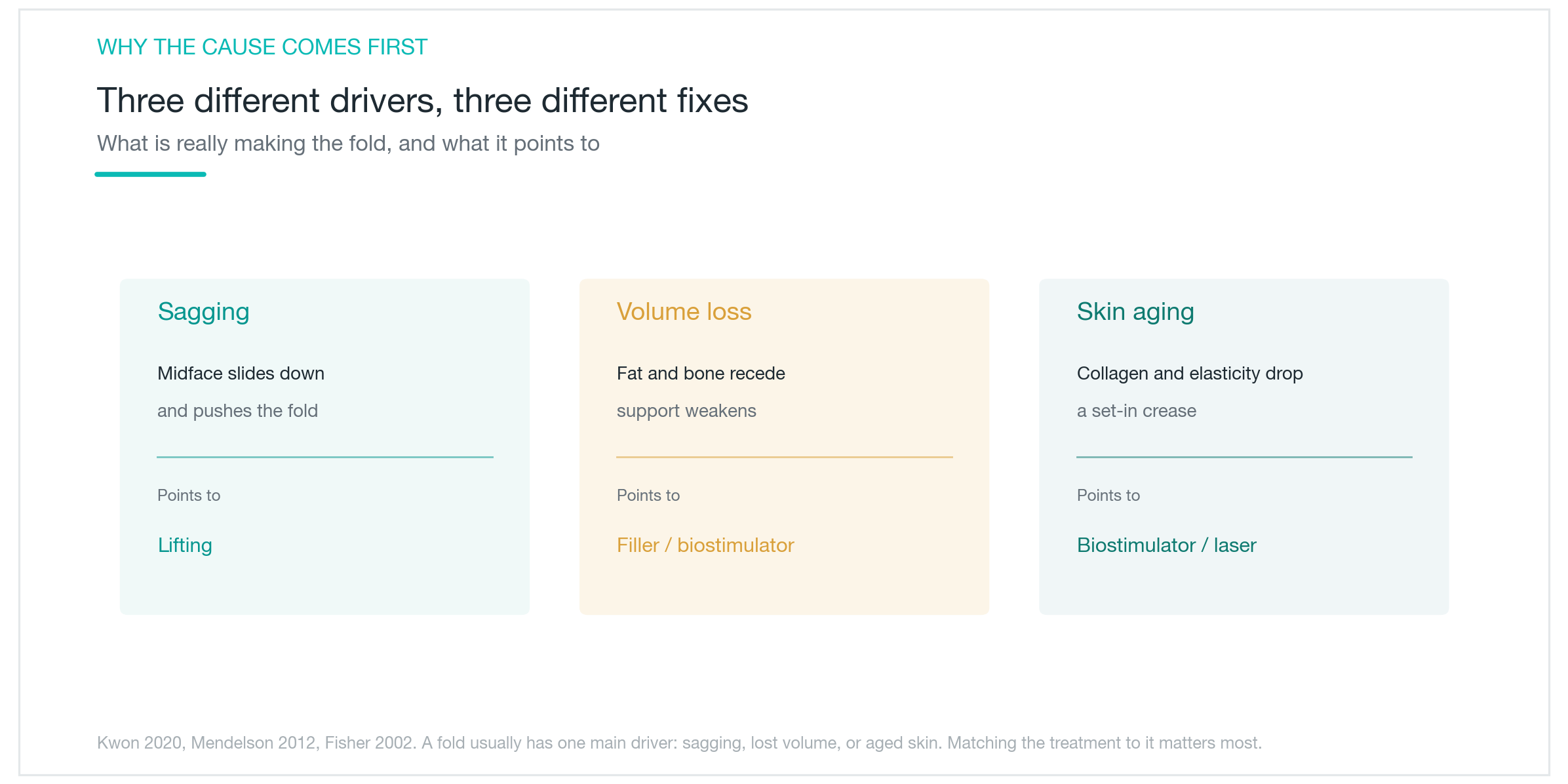
Nasolabial folds do not come from a single cause. Three things tend to overlap. The first is sagging. As we age, the fat and tissue of the cheek drift downward, pushing into the upper part of the fold and deepening it. The second is volume loss. The fat beneath the skin shrinks and the bone beside the nose is subtly resorbed, so the support that used to prop things up from the inside weakens. The third is aging of the skin itself. As collagen and elasticity drop, a folded crease simply stays put as a wrinkle.
These three call for different approaches. If sagging is the main driver, a lift that pulls the tissue upward fits best. If deflated volume is the cause, a filler or collagen stimulator that adds support suits it. If the wrinkle in the skin itself is the issue, you need an approach that builds new collagen or resurfaces the surface.
So even with the same fold, the choice depends on what is mainly behind it. In real life the three are often mixed a little, which can make it hard to name just one. When that happens, you tackle the biggest cause first and then round out the rest. Even the same filler goes to a different spot depending on the cause, and lifting is often combined with filling. Diagnosing the cause comes first, and the treatment comes second.
How long does filler last?
For nasolabial folds caused by deflated volume, HA (hyaluronic acid) filler is the most common choice. You can fill the hollow directly, or add volume to the midface so it supports the sagging cheek and softens the fold indirectly. The change is immediate and the evidence is well established, which makes it a good starting point.
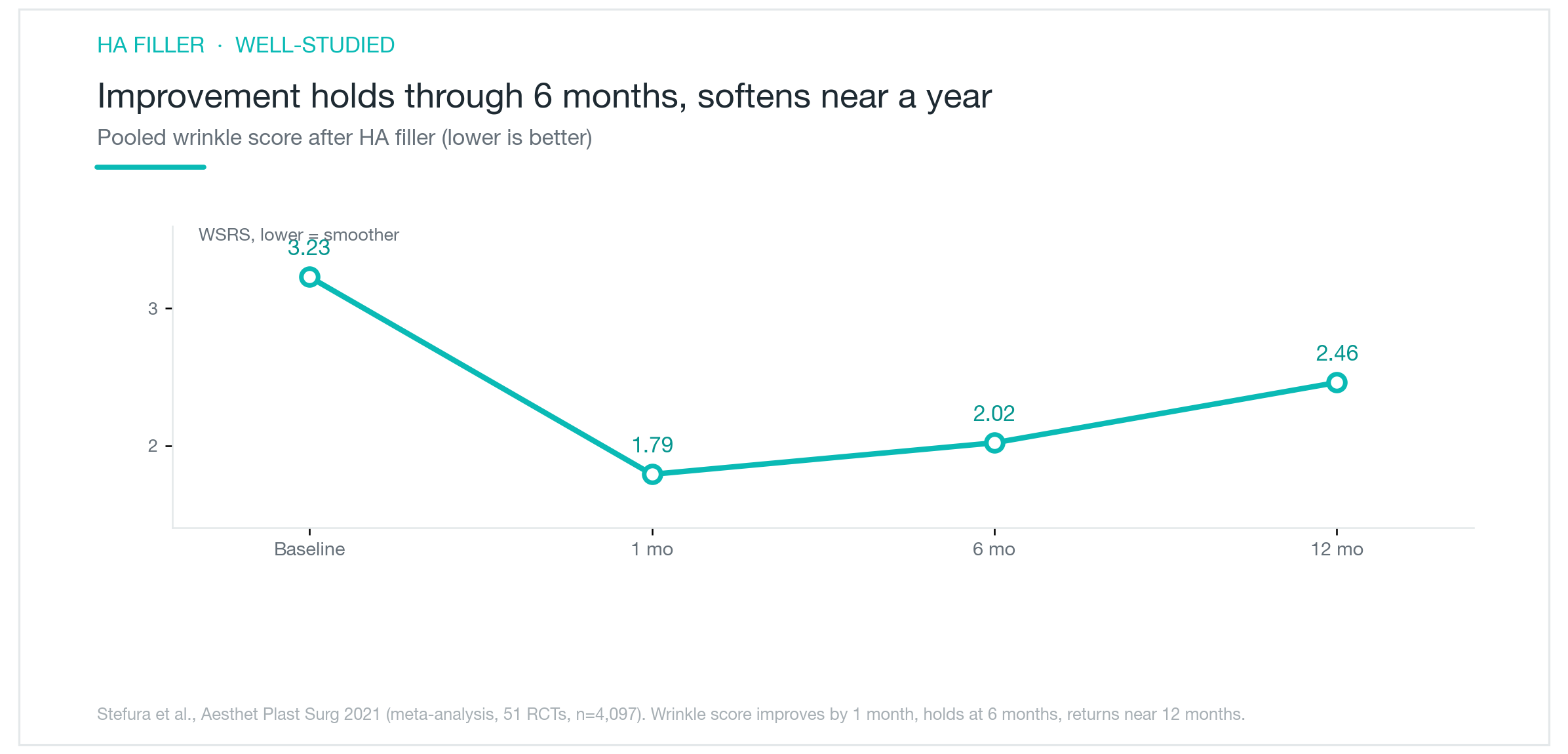
The data backs up how long it lasts. A pooled analysis of many trials (51 studies, roughly 4,000 people) found that nasolabial fold scores clearly improved one month after treatment, held well through six months, and gradually returned toward baseline around the one-year mark. Depending on the product, some midface volumizing fillers have been reported to last up to two years. Results also tend to last longer with repeat treatment.
That said, a good share of the numbers showing that midface volumizing improved the fold reflect patient satisfaction rather than an objective measurement of the fold's actual depth. Adding volume does soften the fold naturally, but when sagging is severe, filler alone may not be enough. That is why filler fits best when lost volume is the main cause.
Can threads lift a sagging fold?
For nasolabial folds caused by a sagging cheek, a lift that pulls the tissue upward is a good match. Thread lifting places dissolvable threads to physically raise the sagging tissue, and over time collagen forms around the threads and helps it settle. Because the lift feels distinct right after the procedure, satisfaction tends to run high.
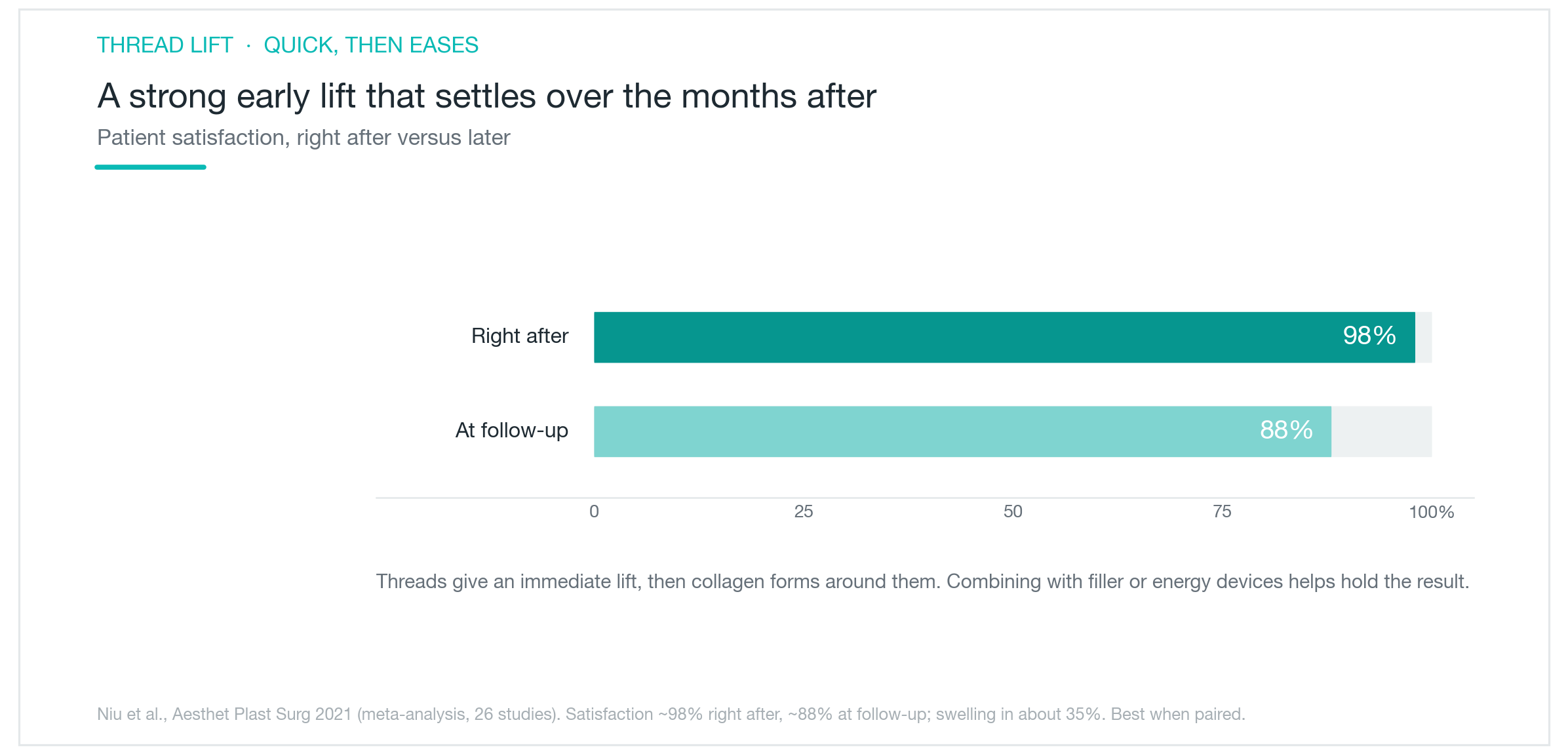
The longevity deserves an honest look. In a pooled analysis of several studies, satisfaction with thread lifting was about 98% right after the procedure and dropped to about 88% as time passed. Mild reactions like swelling are fairly common too. The immediate effect is strong, but on its own the lift tends to ease over time, so pairing it with filler or a radiofrequency treatment makes the result last longer.
If you are wondering whether to look at filler or threads first, there is a small comparison study worth noting. In a study of 20 people, filler tended to suit deflated faces better, while thread lifting suited those wanting a slimmer contour. The group was small and the follow up short, so it is hard to draw firm conclusions, but the direction, choosing based on the cause, is the same here. The more sagging there is, the more the weight shifts toward lifting; the more volume loss, the more it shifts toward filler.
How collagen stimulators work and how long they last
For nasolabial folds where the skin has thinned, elasticity has dropped, and the crease has set in, a collagen stimulator is a good fit. Products like Sculptra (PLLA) and Juvelook (PDLLA) belong here. Rather than filling the hollow right away, they prompt the skin to build new collagen and raise thickness and elasticity gradually over time.
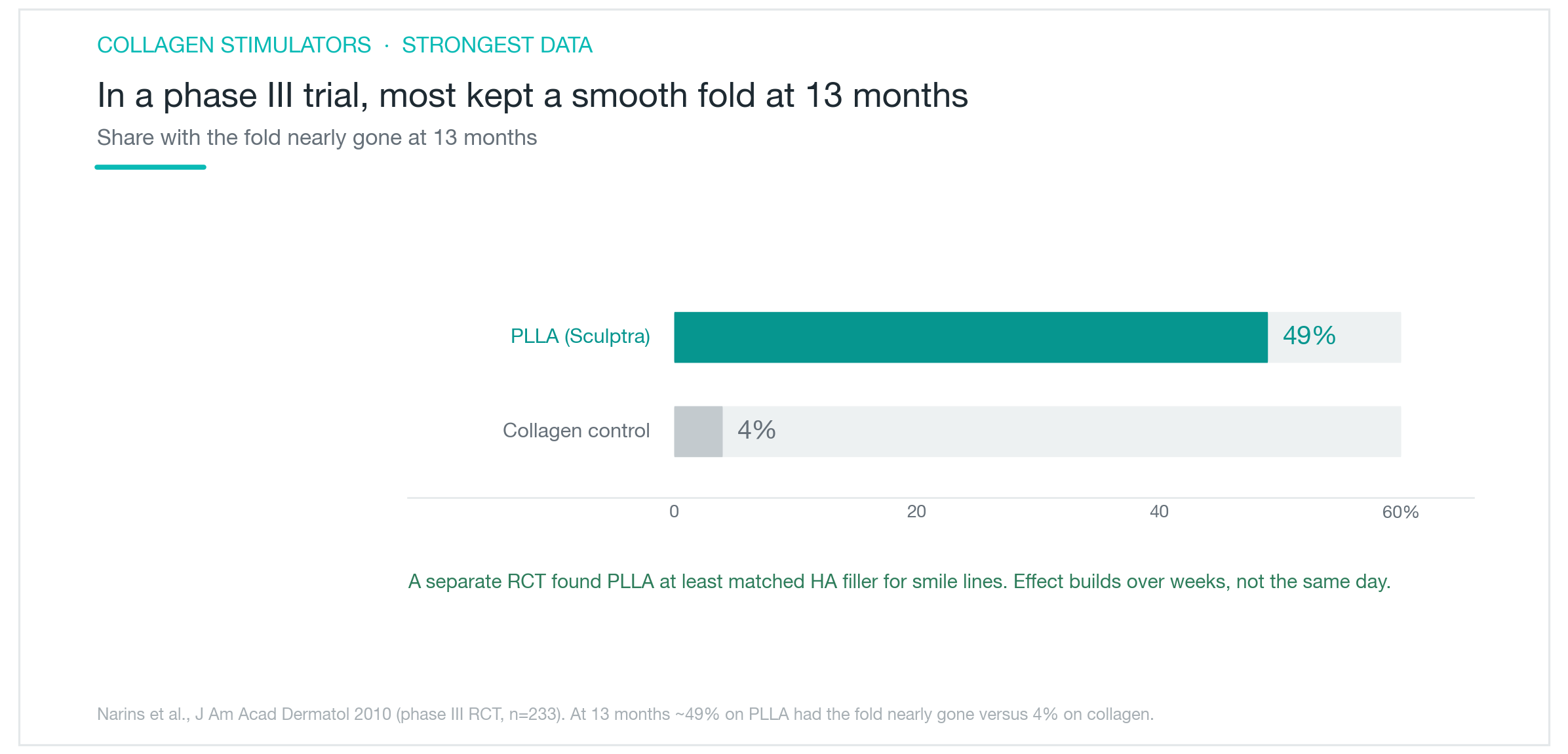
This class has solid evidence in the nasolabial fold literature. In Sculptra's phase 3 trial (233 people), about 49% had improved to the point where the fold was nearly invisible at the 13-month mark. That is a big gap from the 4% in the comparison group. Because it was a randomized comparison, the level of evidence is high too. In a study comparing PLLA head to head with HA filler, PLLA showed improvement that held its own against filler.
The trade off is that this treatment appears gradually. Building collagen takes time, so the change shows up over weeks to months, and it is usually done across several sessions. It helps to think of it as a treatment that fills in naturally over time rather than one you expect to see the same day. Skin boosters like a hydrating gloss injection or lasers, aimed at improving skin quality, are sometimes used alongside it.
Filler beside the nose: what is the risk of vascular side effects?
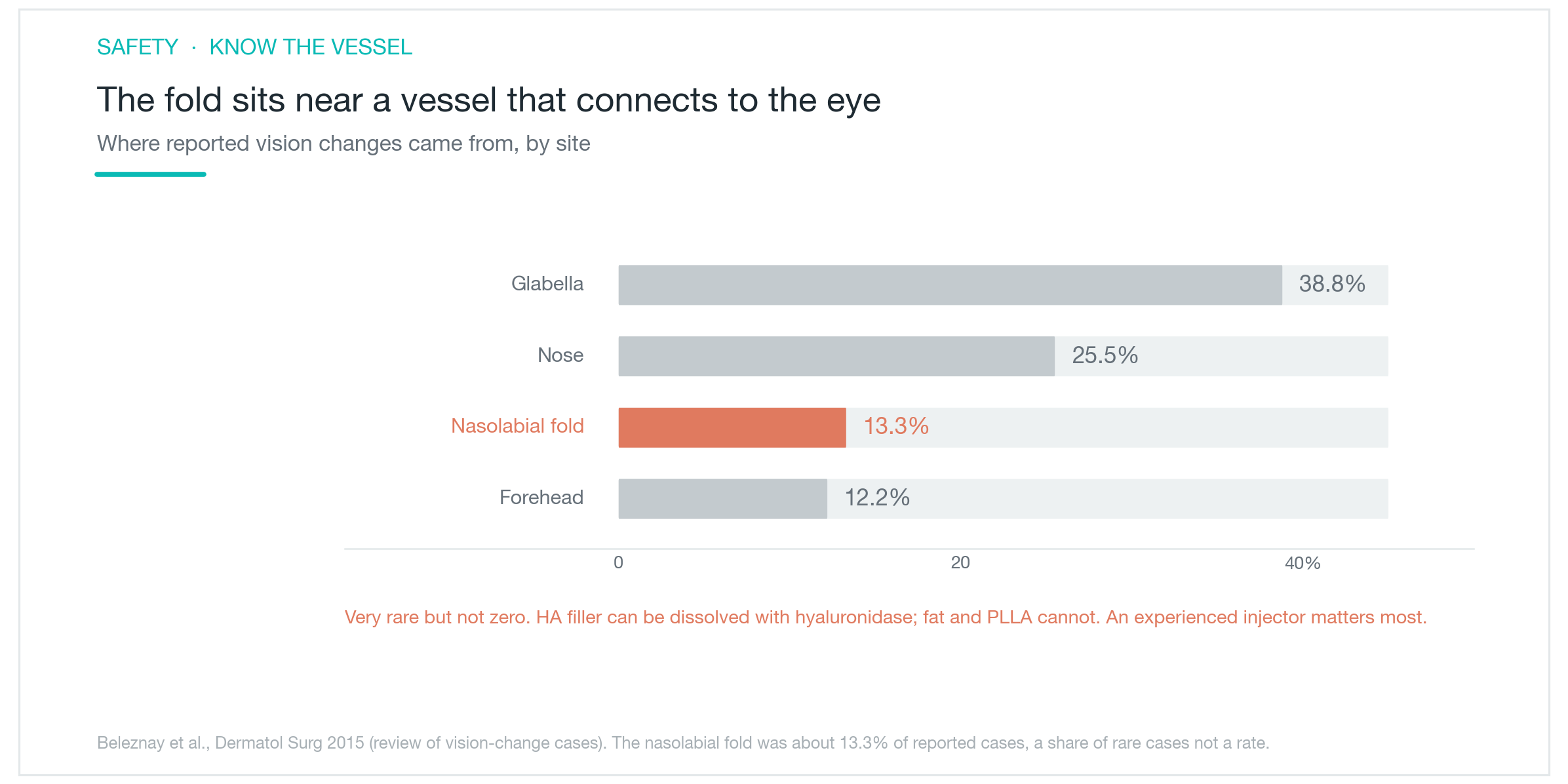
This one point deserves to be spelled out clearly. Vessels that lead to the eye pass through the area beside the nose and along the nasolabial fold. If filler is accidentally injected into this artery, in rare cases it can cause vision problems. In a review pooling the world literature, when reported cases of vision changes were broken down by site, the nasolabial fold accounted for about 13.3%, following the glabella and the nose. This number is a proportion among those rare cases, not the rate per procedure.
The takeaway is that it is very rare but not zero, which is exactly why prevention matters most. The good news is that if a problem arises, HA filler can be dissolved and reversed with an enzyme called hyaluronidase. Fat grafts or PLLA, by contrast, are hard to dissolve. This reversibility is a major advantage of HA filler.

So when choosing treatment, the injector matters as much as the product name. Getting it from a provider who knows the position of the vessels beside the nose and the right injection depth is the heart of safety. A place that injects slowly in small amounts and checks vessels with ultrasound when needed gives you more peace of mind. This is not a reason to be scared, but going in informed is different from going in blind.

Which treatment combination fits your fold?
The answer lies in the cause. If deflated volume is the main driver, an approach that fills with filler or a collagen stimulator fits. If sagging is significant, an approach that lifts fits. If the wrinkle in the skin itself is the issue, an approach that builds new collagen fits. No single treatment is the right answer for everyone.
In reality, some mix of all three is the most common situation. That is why a layered approach is so often used. You support deflated volume with filler or a collagen stimulator, lift the sagging part, and refine skin quality with skin boosters or lasers. That said, large scale studies comparing how much better such combinations are than a single treatment are still limited, so it is better to think in terms of direction than exact numbers.
If you are unsure what to do first, gently lifting your cheek upward in front of the mirror can help. If the fold softens a lot when you lift, sagging plays a big role; if it barely changes, volume or skin plays the bigger part. Of course, an accurate read comes from a consultation where a provider looks and feels in person. Once you pin down the cause together and set an order, you can get a natural result without doing everything at once.
Was this helpful?
About this article
Written by a practising aesthetic physician and intended for general education — not a substitute for individual medical advice.
Read next

Under-Eye Hollow Filler: Effect and Side Effects, and the Tyndall Effect to Watch
The dark, sunken look under the eyes often comes less from pigment than from hollowing and the shadow it casts. Here's how the tear trough ligament and lost volume under the eye create that shadow, how a soft hyaluronic acid filler placed shallowly and sparingly smooths it out, why thin skin and the bluish Tyndall effect make this area tricky, and how long results actually last, all backed by real published numbers.
By Dr. Kim

Chin Filler for the E-line: Which Product Suits a Recessed Chin?
When chin filler is used to correct a recessed chin in profile, here's why it calls for a firm filler rather than the soft kind used on cheeks or lips, which products are used, how long results last, and how safe the treatment is, laid out in plain terms with real clinical research.
By Dr. Kim

Double Chin Treatment: Which Method Fits Fat or Sagging?
Whether your double chin comes from excess fat or from sagging skin and fascia determines which treatment should come first: deoxycholic acid injections, RF devices like INMODE, thread lifting, or HIFU. We break down what real studies show and why diagnosing the cause matters most.
By Dr. Kim