Sculptra PLLA and Filler: When Results Show and How Long They Last Compared
By Dr. Lee8 min read
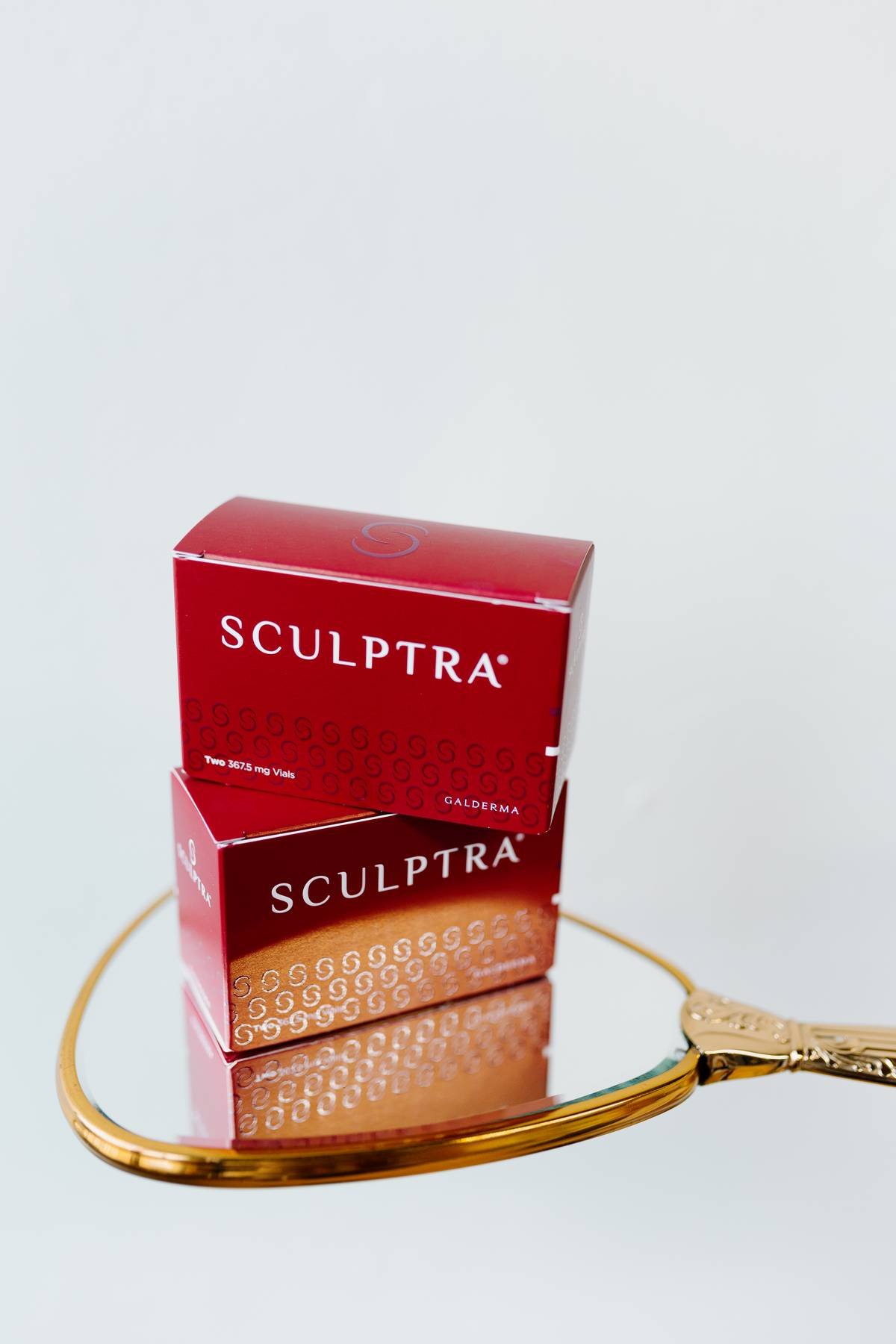
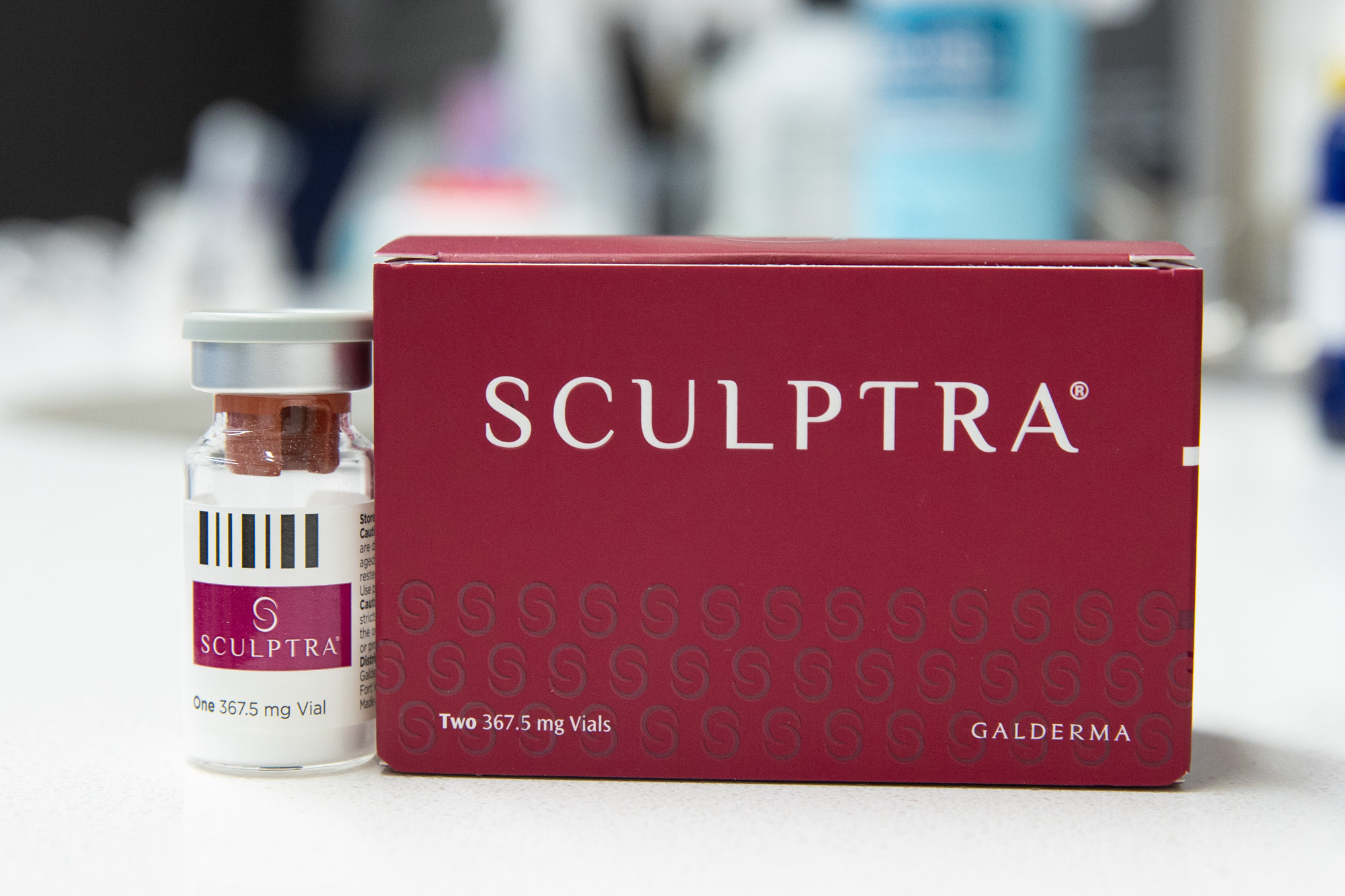
Standard fillers like Juvederm or Restylane give you results you can see the next morning. Sculptra doesn't work that way. Patients leave the treatment room looking essentially the same, sometimes a little swollen, and over the following weeks they often ask whether anything is actually happening. I hear this in nearly every consultation. The difference isn't a flaw in the product; it reflects a fundamentally different mechanism. Sculptra doesn't fill space. It recruits your skin to build its own collagen, and that process takes time. The active ingredient is poly-L-lactic acid (PLLA), a bioabsorbable synthetic polymer that's been used in dissolvable sutures and surgical materials for decades. Injected into the deep dermis, PLLA microparticles gradually break down over several months, and as they do, they trigger a wound-healing cascade that deposits new collagen in their place. Volume returns slowly and naturally. If that timeline sounds different from what you're used to in aesthetics, that's precisely the point.
How Is Sculptra Different From Filler?
Once PLLA microparticles are deposited into the deep dermis or subcutaneous tissue, the body recognizes them as foreign material and mounts a controlled inflammatory response. Macrophages migrate to the site first, followed by fibroblast recruitment and activation. Those fibroblasts, the cells responsible for collagen synthesis, begin laying down new Type I collagen around the dissolving particles. By the time the PLLA itself is fully resorbed, metabolized into lactic acid and cleared, the structural collagen it stimulated remains. The lactic acid byproduct isn't exotic; your muscles generate it during exercise. Nothing foreign is left behind.
This separates Sculptra from hyaluronic acid fillers in a fundamental way. Products like Juvederm Voluma or Restylane Lyft fill space with cross-linked gel and produce immediate lift, but when the gel resorbs, the effect goes with it. Polynucleotide (PN) skin-booster treatments target cellular regeneration, hydration, and surface texture rather than volumetric restoration. Sculptra occupies a different category: a true biostimulator that rebuilds tissue volume through native collagen, not an injected scaffold.
Sculptra's original FDA indication wasn't cosmetic at all. It was approved first for HIV-associated lipoatrophy, the hollow, aged facial appearance that comes from antiretroviral-drug-induced fat loss. The results in that population demonstrated that PLLA could restore volume through the patient's own tissue, and the technology eventually expanded into cosmetic use for age-related volume loss. When I explain this origin to new patients, it tends to reset their expectations in a useful way: Sculptra was designed to address significant, progressive volume loss, and it delivers on that in a timeframe measured in months, not days.
How Much Does Collagen Increase 3 Months After Treatment?
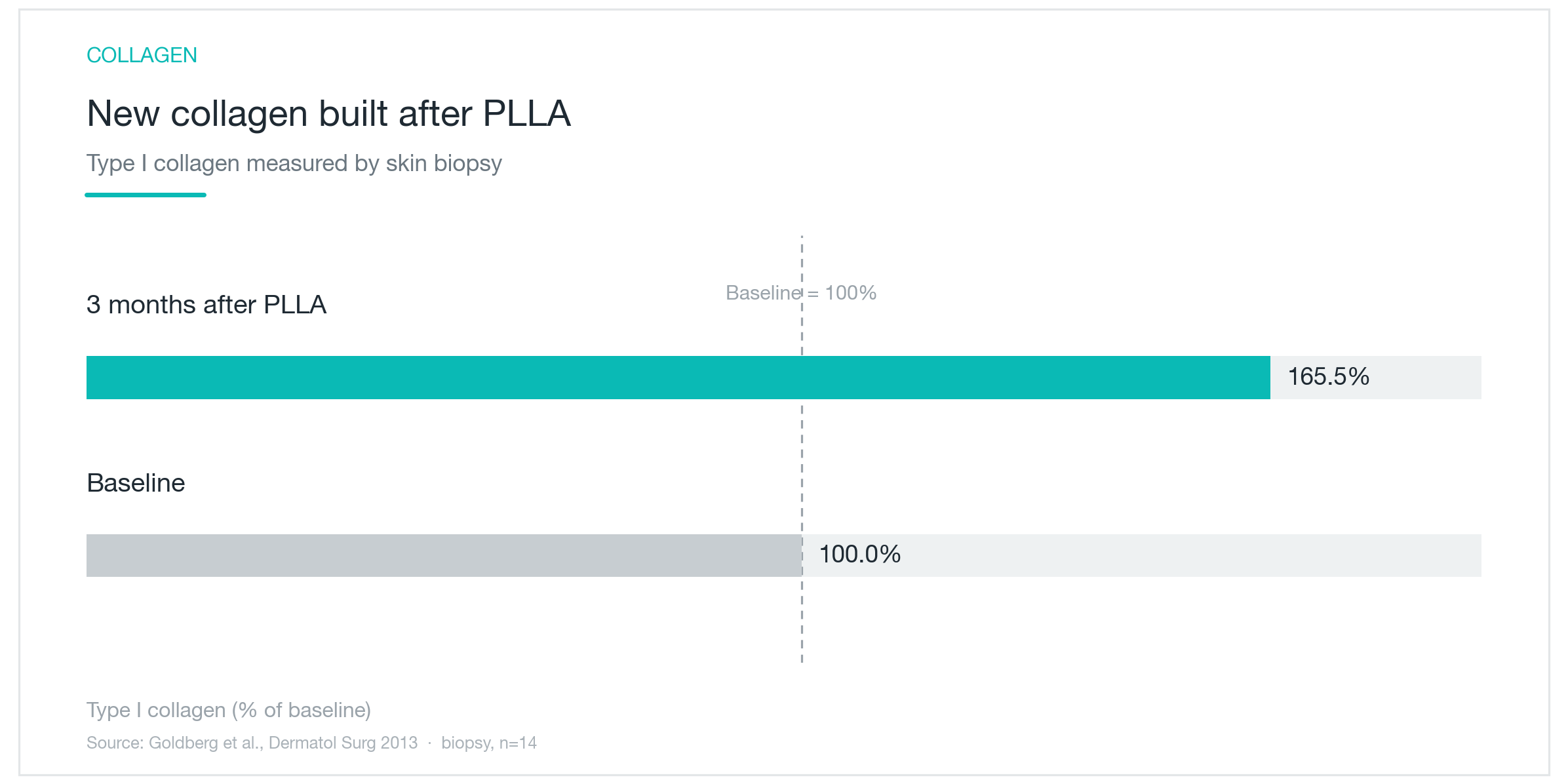
Claims about "collagen stimulation" are common in aesthetics and often mean very little. What makes the Sculptra evidence more credible is that some of it comes from direct tissue sampling: biopsy studies where skin was removed and examined before and after treatment, rather than relying on patient-reported outcomes or photography alone.
The chart above shows one such study. Three months post-treatment, biopsies from injected sites showed a 65.5% increase in Type I collagen compared to baseline. Type I collagen is the primary structural protein responsible for skin firmness, density, and mechanical resilience. It's a measurable tissue component, not a marketing abstraction.
The mechanism has been traced at the cellular level too. Research has shown that PLLA activates the p38 MAPK signaling pathway in fibroblasts, upregulating collagen synthesis gene expression. The particles aren't simply occupying space; they're actively signaling the surrounding cells to produce collagen.
That biopsy study enrolled 14 patients, a small sample worth acknowledging. But histological confirmation of collagen increase in actual human skin is harder evidence than before-and-after photographs. One nuance worth understanding: collagen levels don't plateau permanently. They tend to peak in the months after treatment, then undergo a maturation and remodeling phase around six months where the architecture stabilizes. The net volume gain is lasting, but it's your skin's own collagen that persists, which is precisely why Sculptra results tend to look and feel natural rather than filled.
Duration of Effect Compared With Filler
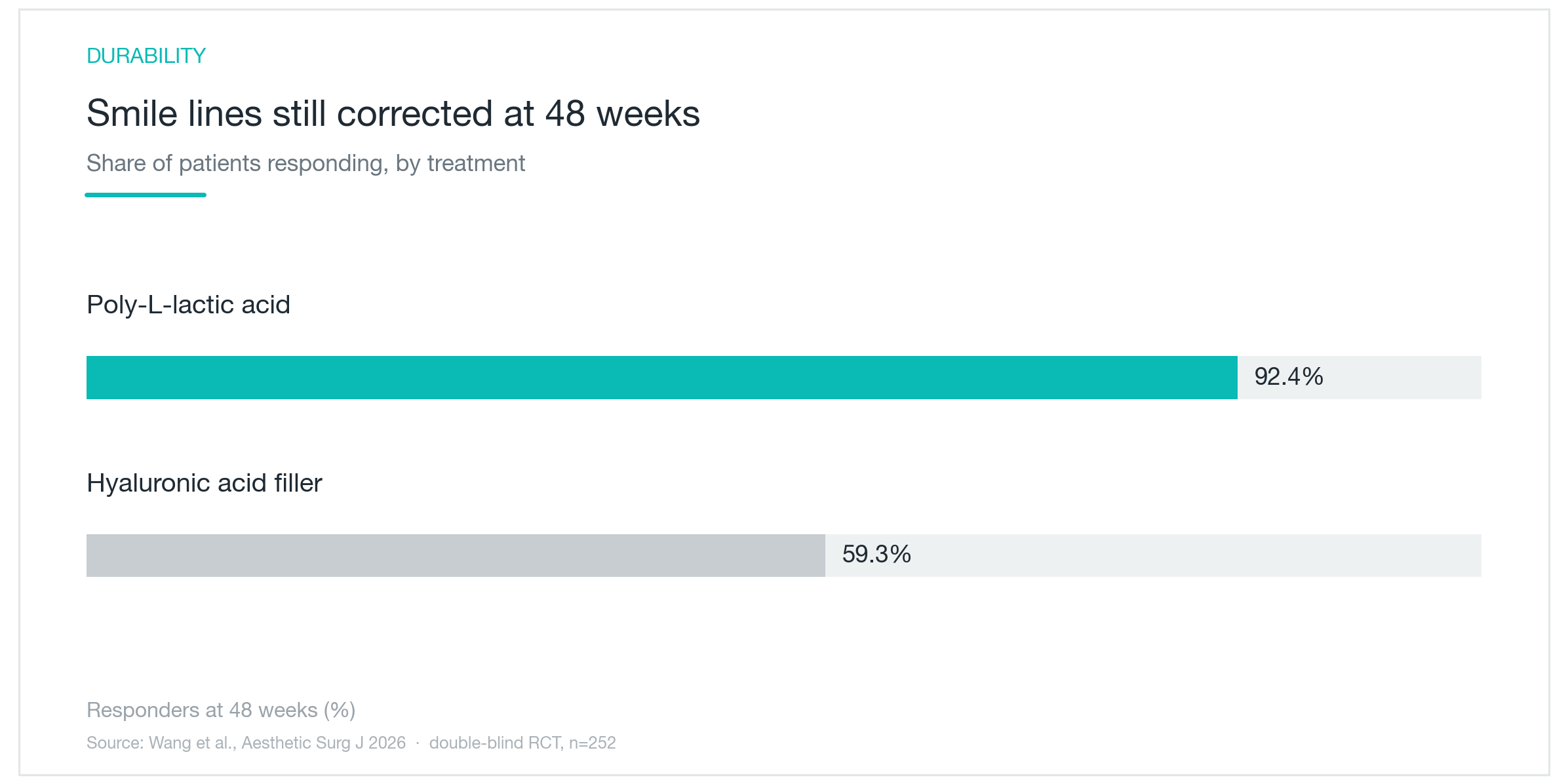
This is the question I get in every room. The clearest answer comes from the study shown above, which tracked nasolabial fold correction out to 48 weeks, roughly 11 months. At that point, 92.4% of patients in the PLLA group were still showing maintained improvement, compared to 59.3% in the HA filler group.
The crossover pattern in the data matters. At week four, the filler group actually led, with 99% still maintaining results, because HA fillers work immediately while Sculptra is still building. By week 36, the curves crossed. By week 48, the gap had widened to more than 30 percentage points in Sculptra's favor.
None of this is surprising once you understand the biology. When an HA filler resorbs, its effect goes with it. The collagen Sculptra stimulated isn't going anywhere when the PLLA particles break down; it's integrated into your tissue. The tradeoff is explicit: slower onset, longer payoff. If you need to look different in two weeks, Sculptra is the wrong choice. If you're thinking about looking meaningfully better for the next one to two years with minimal touch-ups, it's a different calculation entirely.
The study enrolled 252 patients in a double-blind randomized design, with both patients and injectors blinded to treatment allocation. Sample size is adequate, methodology is sound. These numbers are credible.
How Long Does Skin Thickness Keep Increasing?
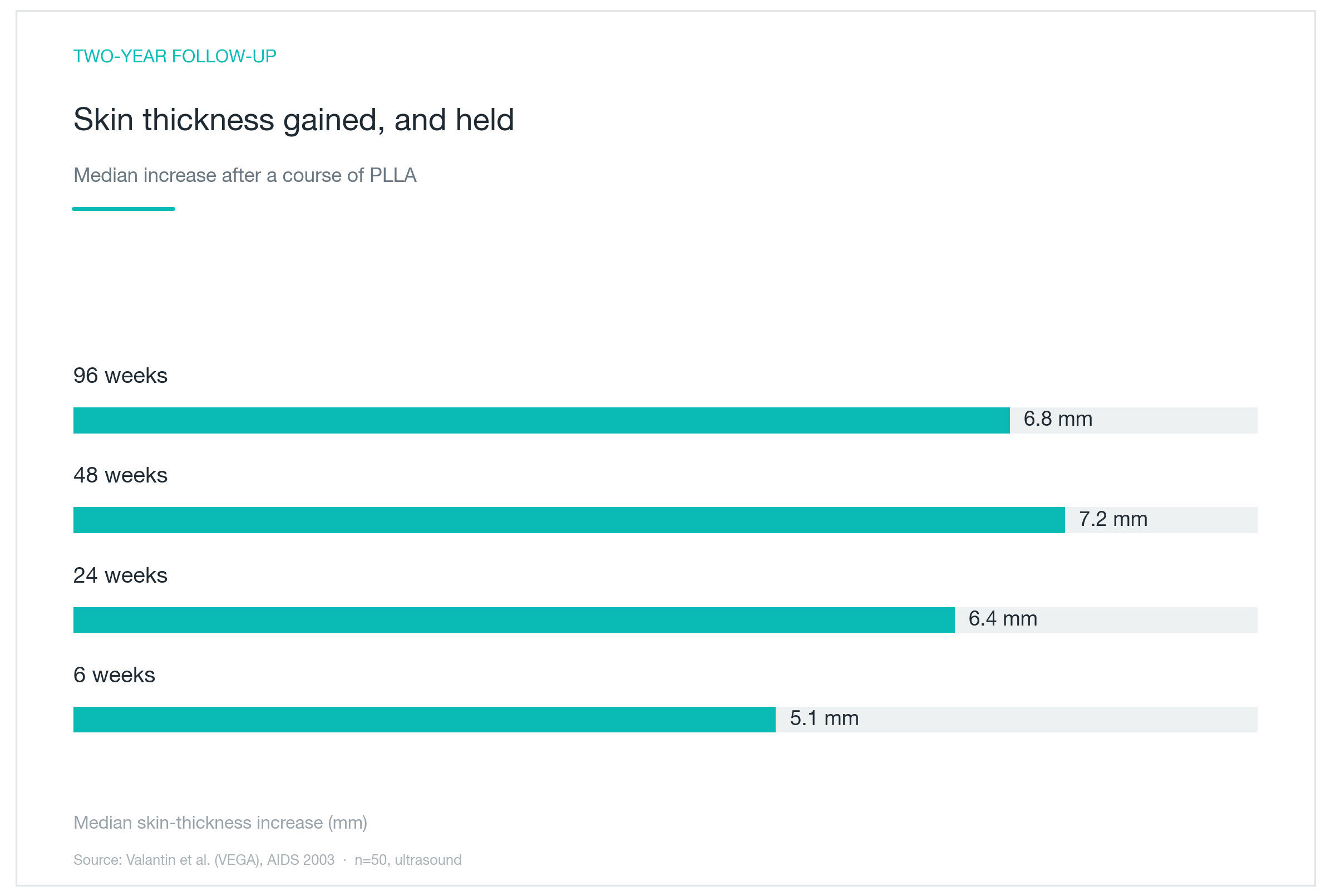
The chart above tracks something concrete: ultrasound-measured skin thickness in patients with severe facial lipoatrophy, followed for nearly two years. At six weeks, tissue thickness had increased by 5.1 mm. It peaked at 7.2 mm around 48 weeks and remained at 6.8 mm at the 96-week mark. Volume, once built, held. The attrition between peak and two-year follow-up was minimal.
Extrapolating directly to cosmetic patients requires caution. Lipoatrophy causes more dramatic baseline volume loss than typical age-related changes, so the absolute numbers won't translate directly. But the trajectory is informative: PLLA builds measurable tissue thickness, and that thickness persists over a long follow-up horizon. More recent cosmetic-population data supports the same pattern. A 2025 randomized trial examining midface volume loss (Zhang et al.) found that 90.6% of the PLLA group maintained results at 12 months versus 51% in the HA filler group, consistent with the durability story across very different patient populations.
Because collagen accumulates gradually, Sculptra is almost never a one-session treatment. A standard protocol involves two to three sessions spaced several weeks apart, building collagen cumulatively. Patients who receive a single treatment and see limited early change sometimes draw the wrong conclusion. The result worth evaluating appears several months after the final session. Once a good baseline is established, maintenance thereafter typically means one treatment every one to two years.
Who It Suits and Nodules to Watch For
Sculptra performs best in patients with diffuse facial volume loss: hollow cheeks, temporal wasting, generalized midface flattening that creates shadows and a gaunt or deflated appearance. If the concern is broad, "my whole face looks older and sunken," rather than narrow, "I want more definition in one specific spot," then Sculptra's mechanism matches that problem well. It works on a canvas, not a brushstroke.
It's the wrong choice in other scenarios, and I'm upfront about this. Need visible results in a week? HA fillers like Juvederm or Restylane. Lip augmentation or precise structural shaping? HA fillers, without question; Sculptra has no role there. Fine surface lines, skin texture, enlarged pores? Sculptra won't address those meaningfully; skin boosters, resurfacing treatments, or PRF-based protocols are more appropriate. Sculptra is an architecture treatment, not a finishing treatment.
The main risk to understand is nodule formation. When PLLA particles concentrate unevenly in one area, they can form palpable subcutaneous lumps. This was a real clinical problem in the early years, when the product was used at higher concentrations with less dilution. Current protocols, including greater dilution, blunt-tip cannula delivery for even distribution, and the standard 5-5-5 massage aftercare (five minutes, five times a day, for five days post-treatment), have reduced the incidence substantially. Recent technique reports put nodule rates below 1% with cannula-based injection. Swelling and bruising for a few days are expected and transient.
Sculptra is one of the more technique-sensitive treatments in aesthetics. Dilution ratios, injection depth, and particle distribution all affect both efficacy and safety. The underlying science is solid. The margin for poor execution is not small, which means provider selection matters more here than with many other injectables.
Was this helpful?
About this article
Written by a practising aesthetic physician and intended for general education — not a substitute for individual medical advice.
Read next

Sculptra and Juvelook Volume: Differences and Duration Compared
Sculptra and Juvelook Volume both get filed under collagen-stimulating injectables, but they differ in ingredient and mechanism, particle shape, and how much evidence has stacked up. Here is a calm, research-based look at when results appear, how long they last, and what to weigh when choosing.
By Dr. Kim
Radiesse Skin Booster: Results, How Long It Lasts, and Differences From Sculptra
Radiesse (CaHA) delivers immediate volume while triggering your body to produce new collagen in the neck, décolleté, and hands. What the biopsy data and ultrasound measurements actually show, how long results last, how it compares to Sculptra, and who makes a good candidate.
By Dr. Lee
Reepot Laser Results: Can One or Two Sessions Clear Lentigines That Toning Couldn't?
How Reepot's 532nm wavelength achieves roughly 11x higher melanin absorption than the 1064nm used in laser toning, why VSLS pre-cooling reduces the risk of post-inflammatory hyperpigmentation on Asian skin, what the clinical evidence shows for efficacy on solar lentigines, how to manage the scabbing process, and an honest look at PIH rates and who benefits most.
By Dr. Lee