Belotero Soft Neck Line Filler: How Long It Lasts and How Many Sessions
By Dr. Kim9 min read

Horizontal lines across the neck have a way of making you look older than you are. It's easy to put all your care into your face and neglect the neck, and once those horizontal creases show up deeply in photos or when you tilt your head back, they're hard to ignore. Filler is often used to fill in these horizontal neck lines, but the approach here differs quite a bit from filler used on the face.
The key here is using a soft filler placed shallow, in small amounts. A firm filler like the kind used on the chin or cheeks will bunch up and show through the skin if placed in the neck, making things look worse rather than better, because neck skin is thin and moves constantly. Here's the research on why a soft filler like Belotero Soft is the right choice, how long it lasts and how many sessions it takes, how strong the supporting evidence really is, and what to know about the Tyndall effect and overall safety.
How and why neck lines deepen
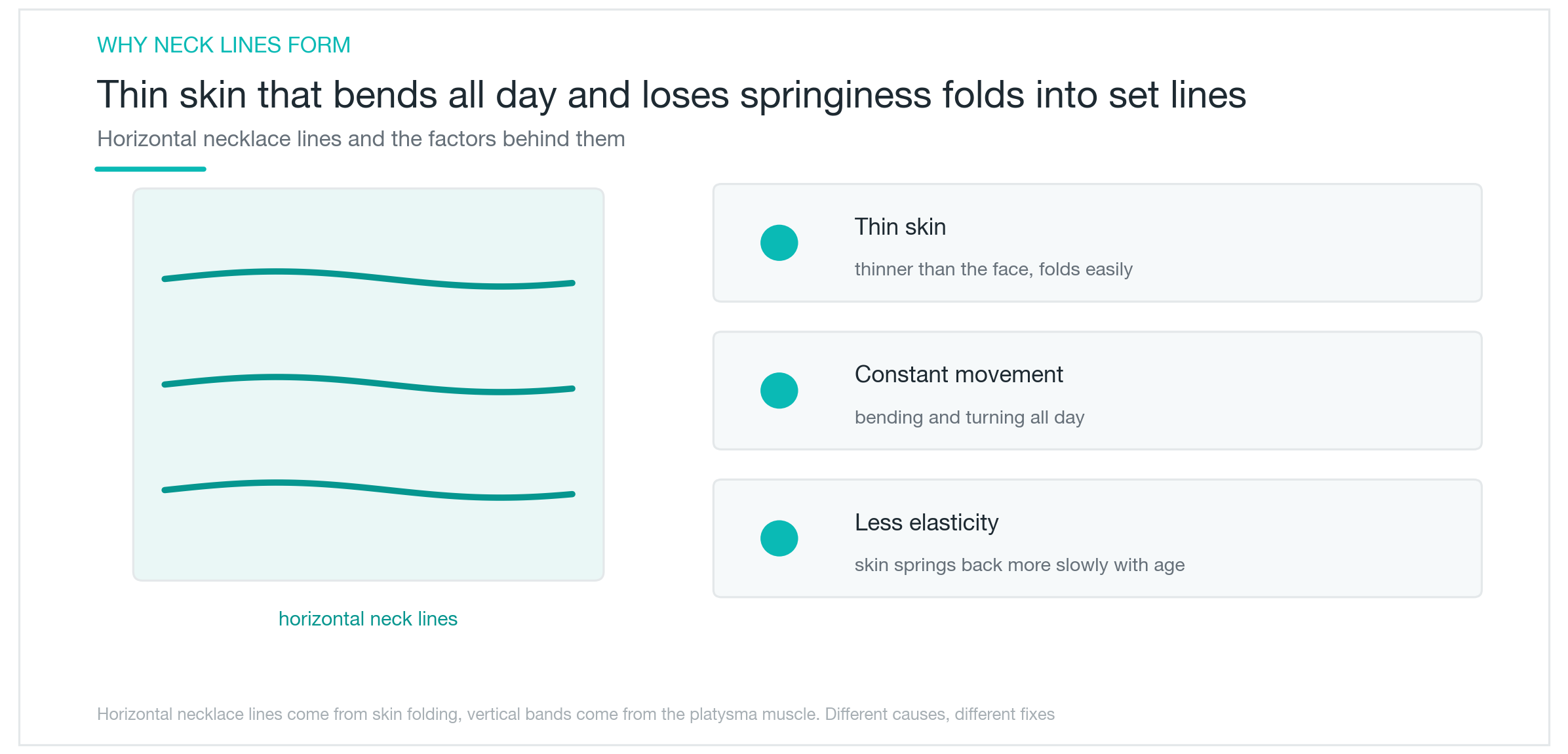
Neck lines fall into two broad categories. One is the horizontal creases running across the neck, often called necklace lines or the rings of Venus. The other is vertical bands, which form when the platysma, the broad muscle sheet across the neck, contracts or slackens. Since the causes differ, so does the treatment, and filler is used mainly to address the horizontal lines.
The reason horizontal lines form so readily comes down to the nature of neck skin. It's thinner than facial skin, isn't anchored firmly to bone underneath, and gets folded at the same spots over and over as you tilt and turn your head all day long. That repeated creasing is what sets the horizontal lines in place and lets them deepen over time.
As skin elasticity declines with age, those crease marks stop bouncing back the way they used to. The neck often gets less sun protection and moisturizing care than the face does, so signs of aging can show up there first. These days, long hours spent looking down at screens mean horizontal lines are showing up at younger ages too. In short, horizontal neck lines come from thin skin, repeated movement, and declining elasticity all layering on top of each other, and understanding that helps explain why a soft filler placed shallow is the right approach.
Why does neck filler have to be softer?
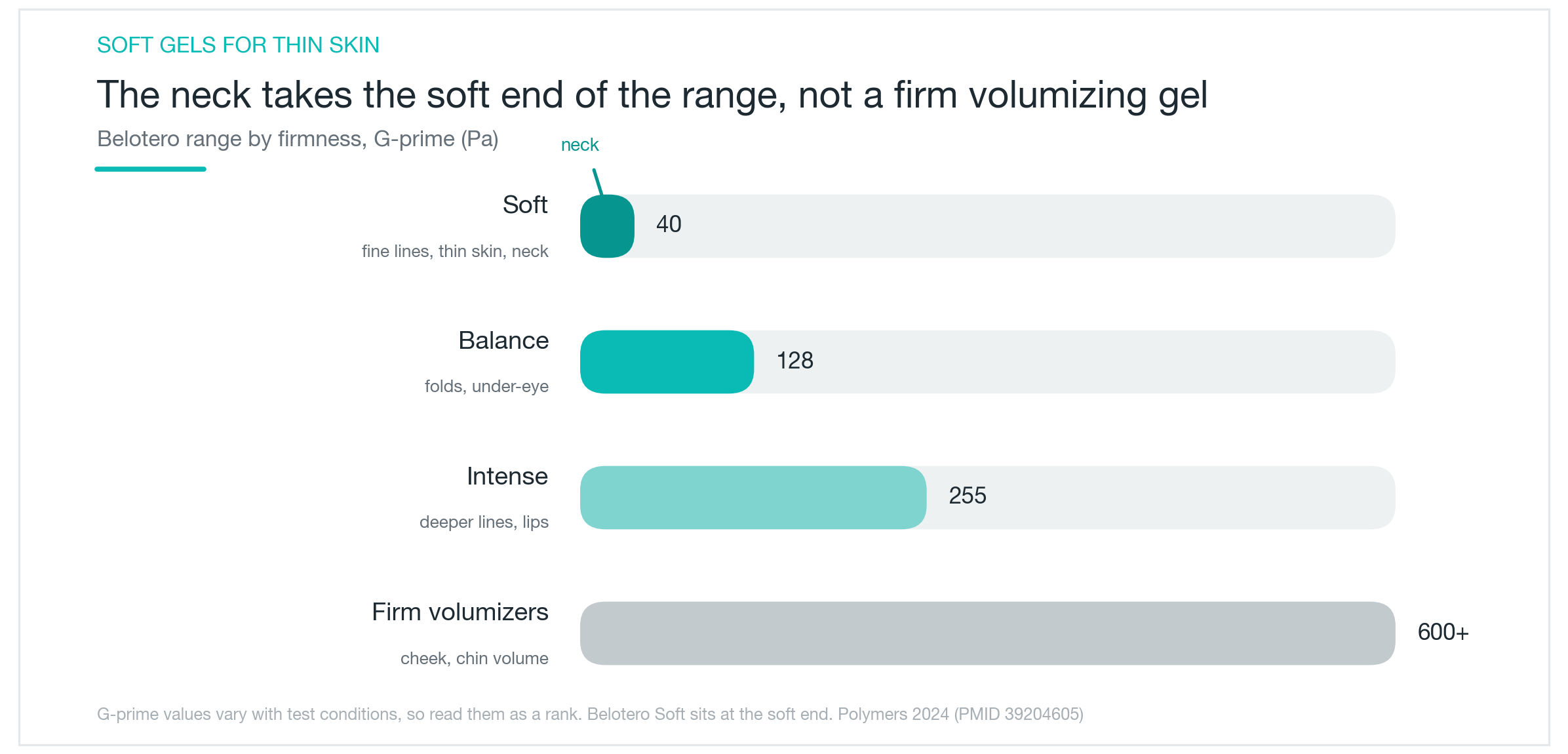
If facial filler is all about firmness, the neck flips that logic entirely. The same G-prime measure applies, but here the goal is the opposite. A high G-prime builds deep volume, while a low G-prime blends smoothly into shallow, fine lines. Horizontal neck lines call for the low end of that scale, a soft filler.
The reason comes down to how thin and mobile neck skin is. A firm filler placed shallow in thin skin will bunch up and become palpable, and in more severe cases can create the Tyndall effect, a bluish tint showing through the skin. That's why the neck calls for a soft, low-concentration HA like Belotero Soft, placed shallow and in small amounts. The goal isn't to build volume, it's to fill in the crease lines and improve overall skin texture.
There's another reason Belotero Soft suits the neck so well. It's formulated so the gel disperses evenly within the skin, letting it settle smoothly even in thin, easily swollen areas. That's why it's also used under the eyes, and the neck benefits from the same properties. Soft fillers overlap conceptually with skin boosters too, since both work by spreading a thin layer through the skin to improve hydration and texture.
How long does neck filler last?
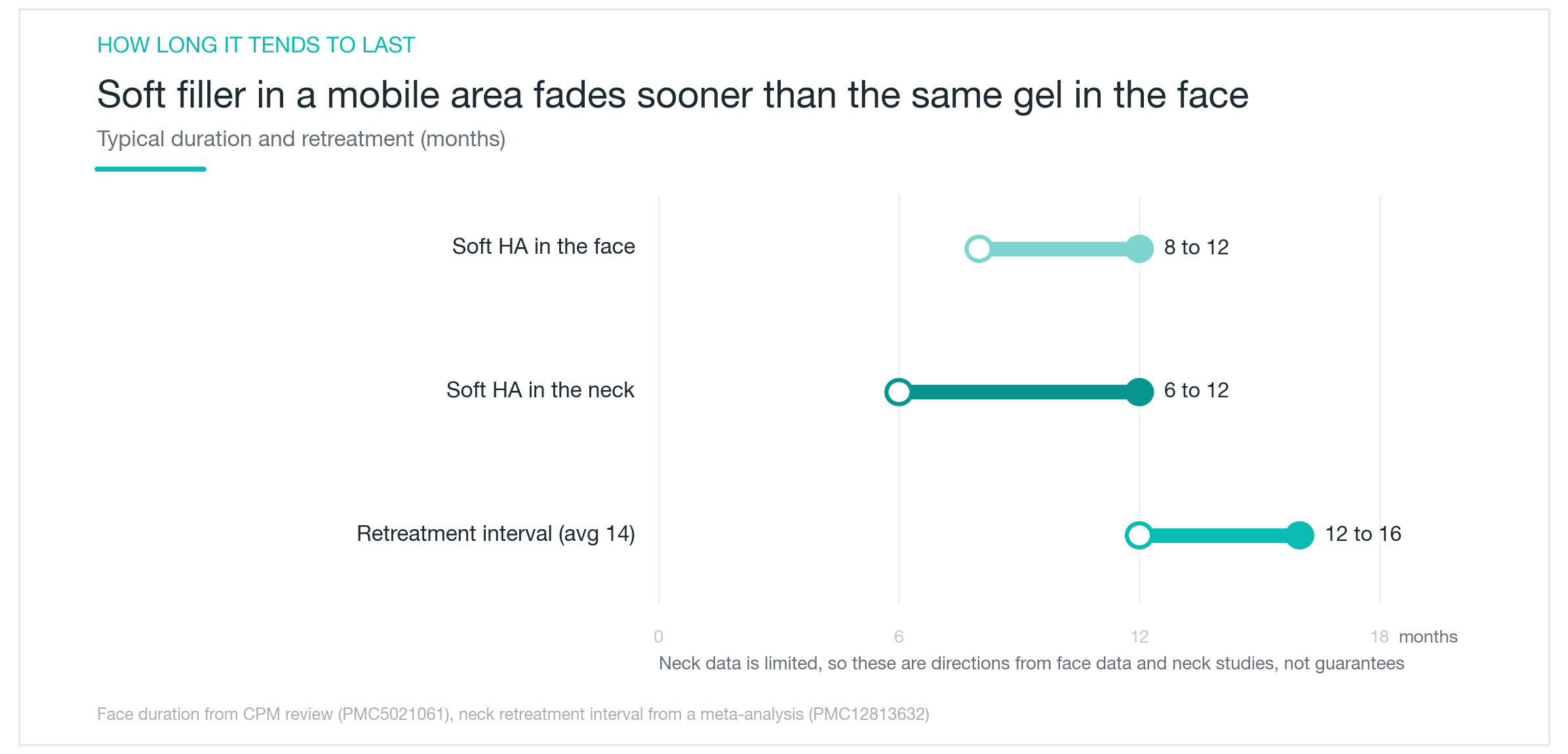
Soft neck filler is generally thought to last somewhere between 6 months and a year. Data on the Belotero line used on the face shows it lasting 8 to 12 months, but because the neck moves constantly and the product goes in shallow, it can wear off sooner there. When you pool the research on neck filler together, the general pattern is a touch-up roughly once a year.
A pooled analysis of studies using HA for horizontal neck lines found an average gap of about 14 months between the initial treatment and the next touch-up, with roughly half of patients returning within a year. A trial that followed neck filler patients for a full year found that improvement seen at the two-month mark was still statistically significant at the one-year point.
Realistically, it's fair to plan for a somewhat shorter duration than facial filler. There's a wide range depending on the product, the volume injected, and how much the neck moves day to day. People who tilt their head down frequently or have thinner skin tend to see it fade faster, so it makes more sense to time touch-ups by how the results are actually holding up rather than fixing a set number on the calendar. It's also worth noting that large studies measuring duration for Belotero Soft used exclusively on the neck are still limited, so the figures above are a rough estimate based on combining facial data with what neck filler studies do show.
How many sessions should it be split into?
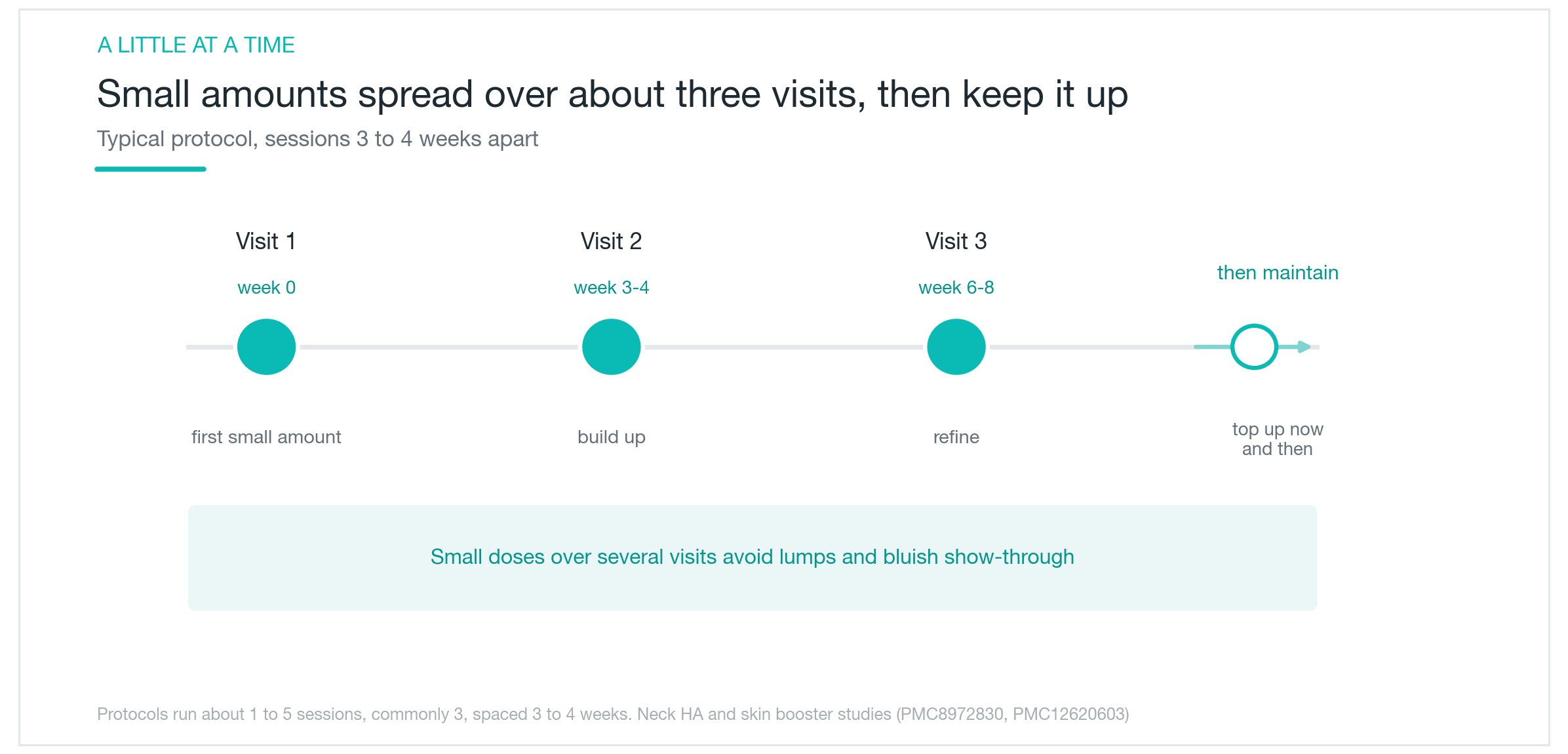
The standard for neck lines is small amounts spread across multiple sessions rather than one large treatment. Injecting a lot of product into thin skin all at once raises the risk of lumping or show-through. Building it up gradually over several sessions is both safer and more natural-looking.
The studies generally show around three sessions, spaced three to four weeks apart. A trial combining HA treatments on the neck used two to three sessions four weeks apart, while a skin-booster protocol ran three sessions three weeks apart. A pooled analysis of multiple studies also commonly found one to five sessions spaced about four weeks apart. The typical rhythm is to treat once, then check back in about a month and add more as needed.
After that initial series, ongoing maintenance similar to a skin booster or glow injection is the way to go. Because the constant movement of the neck makes lines prone to reforming, this is better approached as ongoing upkeep than a one-and-done fix. That's why small, repeated doses upfront followed by spaced-out maintenance tend to work best. Trying to push for a fast result by injecting a large amount all at once just increases the risk of lumping and show-through, so patience really is the key here.
Here's how the treatment options break down by cause.
| Method | Goal | How It Works | Sessions | Best For |
|---|---|---|---|---|
| Soft HA filler | Fill horizontal lines | Fills the crease line shallowly | About 3 sessions | Deep, well-defined horizontal lines |
| Skin boosters, glow injections | Improve skin quality | Hydration and texture across the dermis | 3 sessions, 3 to 4 weeks apart | Widespread, shallow skin decline |
| Platysma Botox | Ease vertical bands | Relaxes the muscle | As needed | Protruding vertical bands |

Neck line filler results and level of evidence
The evidence generally reads as positive. A pooled analysis of studies using HA for horizontal neck lines found clear improvement in both wrinkle severity and patient satisfaction, along with better skin hydration and texture scores. A trial combining HA treatments on the neck found wrinkle grades dropped from baseline, with greater improvement than Botox alone in the same area.
A study using skin boosters on the face, neck, and upper chest also found improvements in wrinkle depth, hydration, and roughness at multiple time points, with the effect persisting for several months. That points to soft HA doing double duty, filling the crease line while lifting overall skin quality at the same time.
That said, it's worth being upfront that the evidence base for neck filler still isn't as strong as it could be. Much of it comes from small studies or case reports, and large comparative trials are in short supply. The results are consistently favorable across the studies that do exist, but they don't carry the same weight as the evidence behind facial filler. So it's more accurate to think of this as noticeably softening the lines rather than erasing them entirely. Steady maintenance, rather than dramatic expectations, is the right mindset to bring.

What to do if the Tyndall effect appears
The side effect that draws the most attention with neck filler is the Tyndall effect. When too much filler is placed too shallow in thin skin, the HA particles scatter light and the area takes on a bluish tint. A study using HA on the neck reported this in some patients, which is exactly why a skilled, even, small-volume injection technique placed shallow matters so much here.
Fortunately, most side effects are mild and temporary. Across pooled studies, the vast majority are bruising, swelling, and tenderness on pressure, with serious problems being rare. And because HA filler is what's used on the neck, even if the Tyndall effect or lumping does occur, it can be dissolved with hyaluronidase. That reversibility is really the practical safety net that makes HA the right choice here.
Neck lines are often addressed by combining treatments rather than relying on filler alone. Vertical bands caused by the muscle respond to Botox in the platysma, while widespread, shallow skin decline responds better to skin boosters. Deep, well-defined horizontal lines are a good match for direct filling with a soft filler. The cleanest approach is to first figure out which type of neck line you're dealing with, then choose or combine treatments accordingly. Whatever you choose, since the neck is thinner and more sensitive than the face, starting with a shallow, small-volume, reversible HA filler is the safe way to go.
Was this helpful?
About this article
Written by a practising aesthetic physician and intended for general education — not a substitute for individual medical advice.
Read next

Chin Filler for the E-line: Which Product Suits a Recessed Chin?
When chin filler is used to correct a recessed chin in profile, here's why it calls for a firm filler rather than the soft kind used on cheeks or lips, which products are used, how long results last, and how safe the treatment is, laid out in plain terms with real clinical research.
By Dr. Kim

Marionette Line Filler: Results, How Long It Lasts, and Combining With Botox
Marionette lines running from the corners of the mouth down toward the jaw form when the supporting ligaments loosen, the fat pad sags, and the muscle pulling down on the mouth corners adds to the strain. HA filler works by rebuilding this collapsed structure from the inside out, restoring lost volume layer by layer. Here's a look at recovery time, how long results last, and why Botox is often paired with it.
By Dr. Kim

Body Onda: Effects, Approach by Area, Number of Sessions and How Long It Lasts
Body Onda is a non-surgical body contouring treatment that uses microwave energy to selectively heat the fat layer beneath the skin, shrinking fat cells while tightening the skin above them. Here is why the heat targets fat rather than skin, why fat reduction and tightening happen together, how the approach differs for the abdomen, arms, and flanks, and how many sessions it takes to see lasting results.
By Dr. Kim