Chin Filler for the E-line: Which Product Suits a Recessed Chin?
By Dr. Kim10 min read

When your chin sits too far back in profile, your mouth can look like it's jutting forward, and your whole face reads as softer and less defined. You don't need to touch your nose or your lips to fix that. Often, just bringing the chin forward a little is enough to straighten out the side profile. The most common way to do that is chin filler.
But not just any filler works here. A soft filler meant for cheeks or lips will spread and sag quickly if it goes into the chin, and you won't get the shape you were after. The chin has to stand in for bone, so it needs a firm filler that can hold its own. Here's what the research actually says: why a firm filler is the right call, which products get used, how long results last, how safe the treatment is, and how to tell a chin that responds well to filler from one that really needs surgery.
What is the E-line?
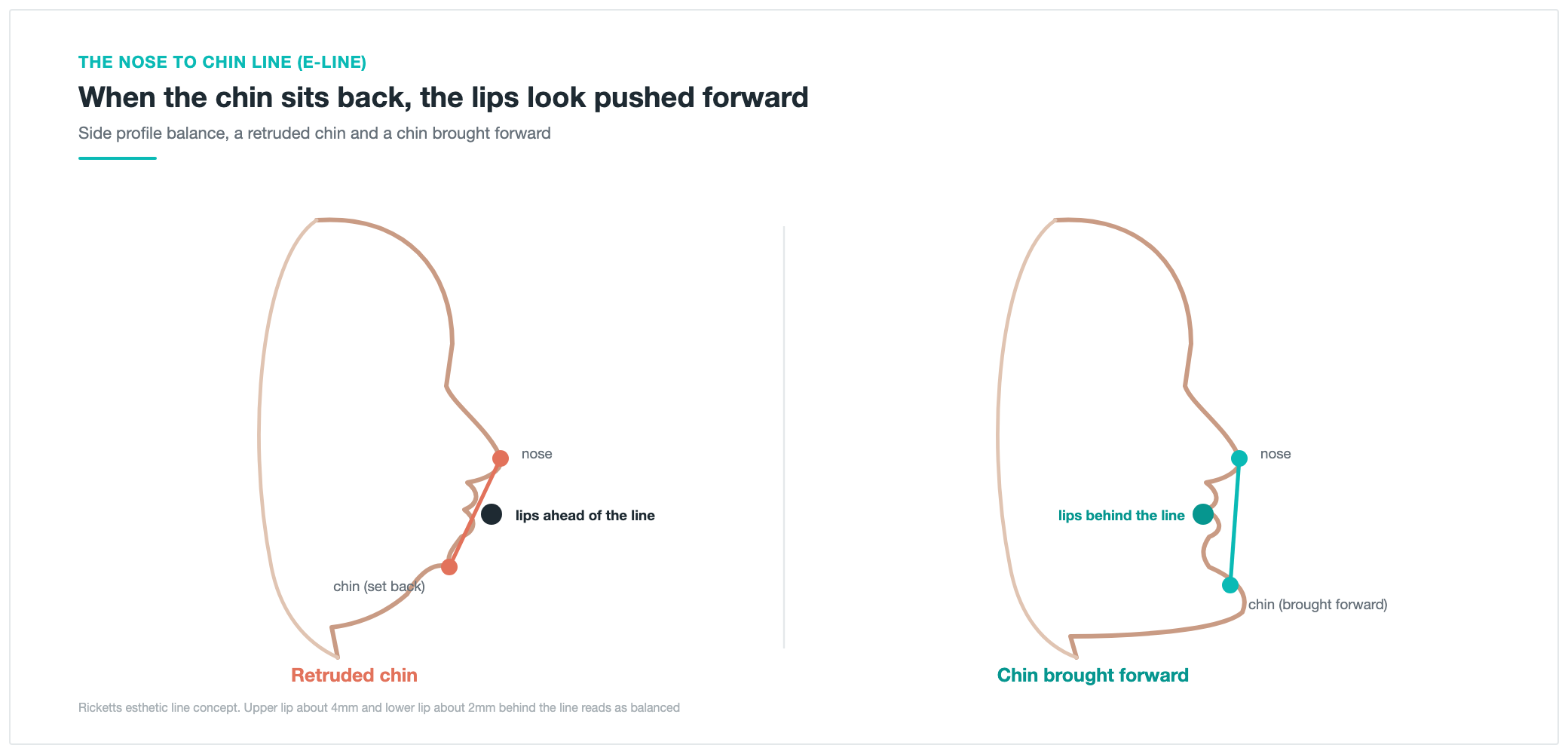
The E-line is an imaginary straight line drawn from the tip of the nose to the tip of the chin in profile. Orthodontist Robert Ricketts proposed it back in 1968 as a way to judge where the lips sit relative to that line. A balanced profile is generally described as one where the upper lip sits about 4mm behind the line and the lower lip about 2mm behind it.
When the chin sits back, in other words, when someone has a recessed chin, the lips end up looking like they protrude in front of that line, even though the mouth itself never actually changed. So the profile looks like the mouth is jutting out, when the real problem has nothing to do with the lips. Bringing the chin forward resets the proportions between nose, mouth, and chin, and the side profile smooths out.
Not every recessed chin is the same, though. Some come from a lack of soft tissue, some from a chin bone that's just slightly small, and some from a jawbone that's genuinely small or set back. Filler works well for the first two, the milder cases. When the jawbone itself is set far back, that's really surgical territory rather than a filler fix, so it's worth figuring out which category your chin falls into first. Two chins can look similar on the surface but need completely different treatments if the underlying cause differs. Rather than reaching for filler right away, it helps to take a profile photo and look at how the chin, lips, and nose line up together.
Why does chin filler need to be firm?
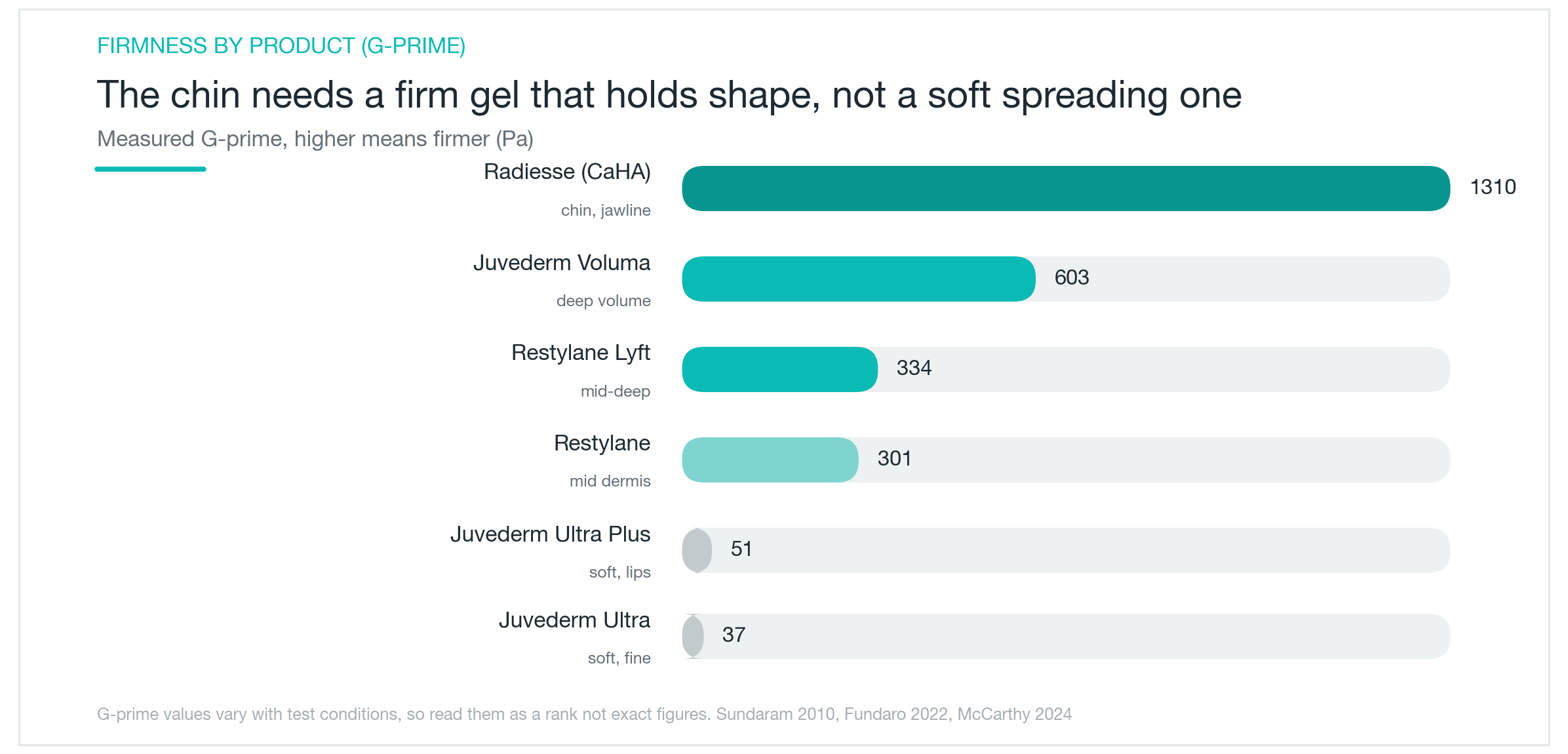
Fillers differ a lot in firmness, and the number that captures that is G-prime, essentially how strongly the gel springs back to its original shape after you press on it. A high G-prime means a firmer gel that holds its shape under pressure and has real lifting strength. A low G-prime means a softer gel that blends smoothly into tissue and looks natural, but doesn't have much structural power.
The chin has to substitute for bone in holding up the profile. So what happens if you put a soft filler there? Every time you chew, talk, or make an expression, the tissue pushes back against it, and it spreads sideways and sags downward. Instead of the sharp, defined chin point you wanted, you end up with something blunted and blurred, with the volume scattered rather than held.
That's why a firm, high G-prime filler is the standard for a spot like the chin that has to mimic bone. Papers on filler rheology make the same point: high G-prime fillers belong in deep layers or directly on bone to build volume and support, while low G-prime fillers belong in superficial skin to smooth fine lines. In plain terms, cheeks and lips look best filled softly, while the chin needs firm support to hold its shape. The same filler ingredient can be a great fit in one area and a poor one in another, depending on where it's placed. Matching firmness to location is really the whole game.
Types of chin filler and how they compare
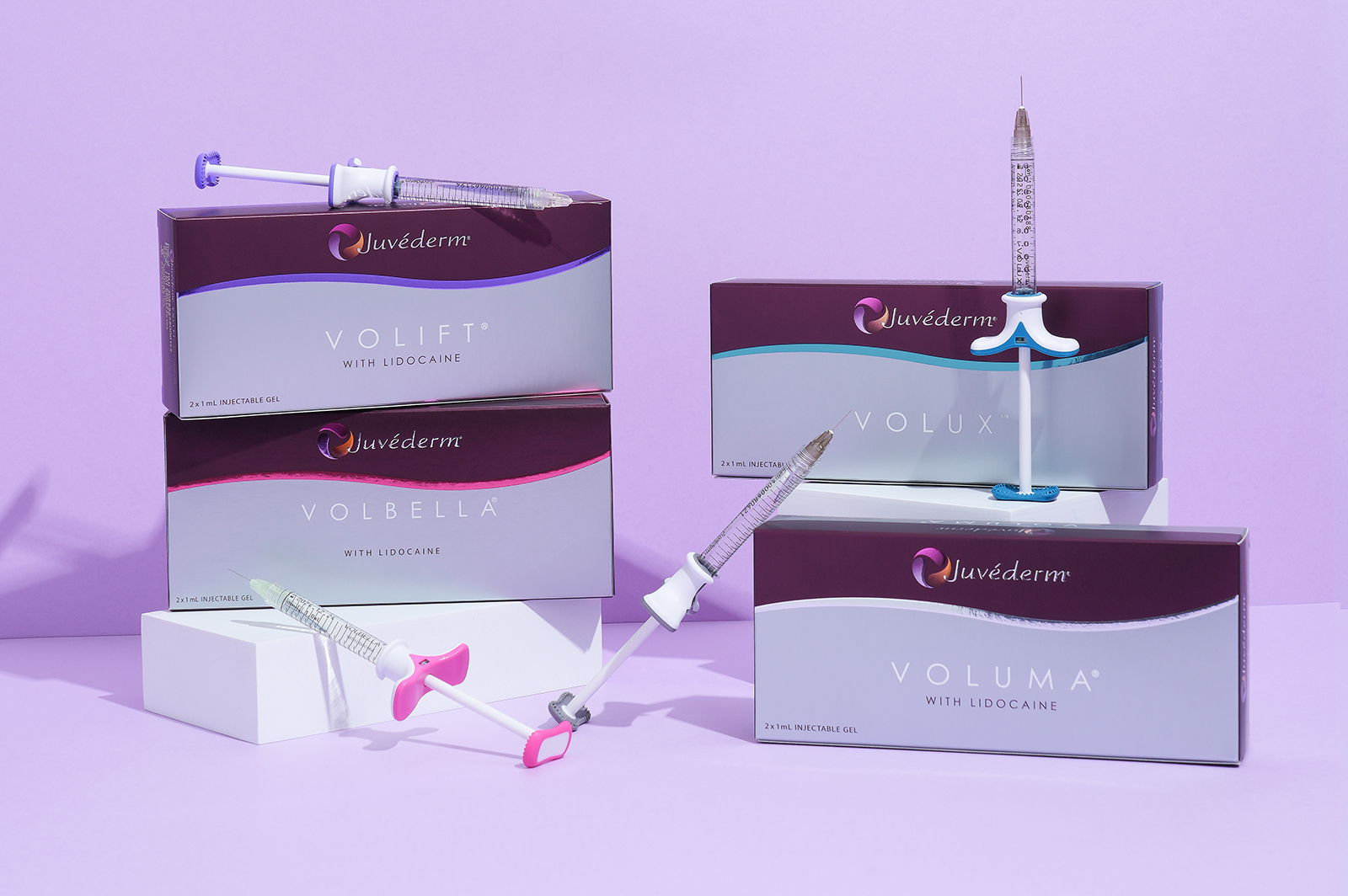
Firm fillers for the chin fall into two broad categories. One is high G-prime HA filler, and products like Volux, Voluma, and Restylane Lyft fall into this group. Volux in particular is the first HA filler the FDA approved specifically for jawline contouring, and it's used on the chin as well. The big advantage of HA fillers is that if you don't like the result or something goes wrong, they can be dissolved with an enzyme called hyaluronidase, reversing the effect.
The other option is CaHA filler, better known as Radiesse. It sits among the highest G-prime injectables available, which makes it strong for building bold chin contour, and it also stimulates collagen production over time. The catch is that no currently available agent can dissolve it, so once it's in, reversing it is difficult. That makes the injector's skill and judgment that much more important.
If you want to keep the option of reversing things, firm HA is the better fit. If you're after bold contour and the collagen-stimulating bonus, CaHA fits better. Either way, the underlying principle stays the same: use a firm product, not a soft one. The right choice comes down to your chin's starting point, how dramatic a change you want, and whether reversibility matters to you. It's safer to base the decision on firmness and reversibility suited to your own tissue rather than on price or trends. If it's your first time, HA is the more reassuring choice since it can be dissolved if anything goes wrong.
Here's a quick side-by-side of the fillers most commonly used on the chin.
| Filler | Type | Firmness | Reversible | Duration | Best For |
|---|---|---|---|---|---|
| Volux | HA | Very firm | Yes | About 24 months | Jawline and chin contour |
| Voluma | HA | Firm | Yes | 12 to 18 months | Deep volume and chin projection |
| Restylane Lyft | HA | Moderately firm | Yes | About 12 months | Mid-depth support |
| Radiesse | CaHA | Firmest | Difficult | 12 to 18 months | Bold contour and collagen stimulation |
How long does chin filler last?
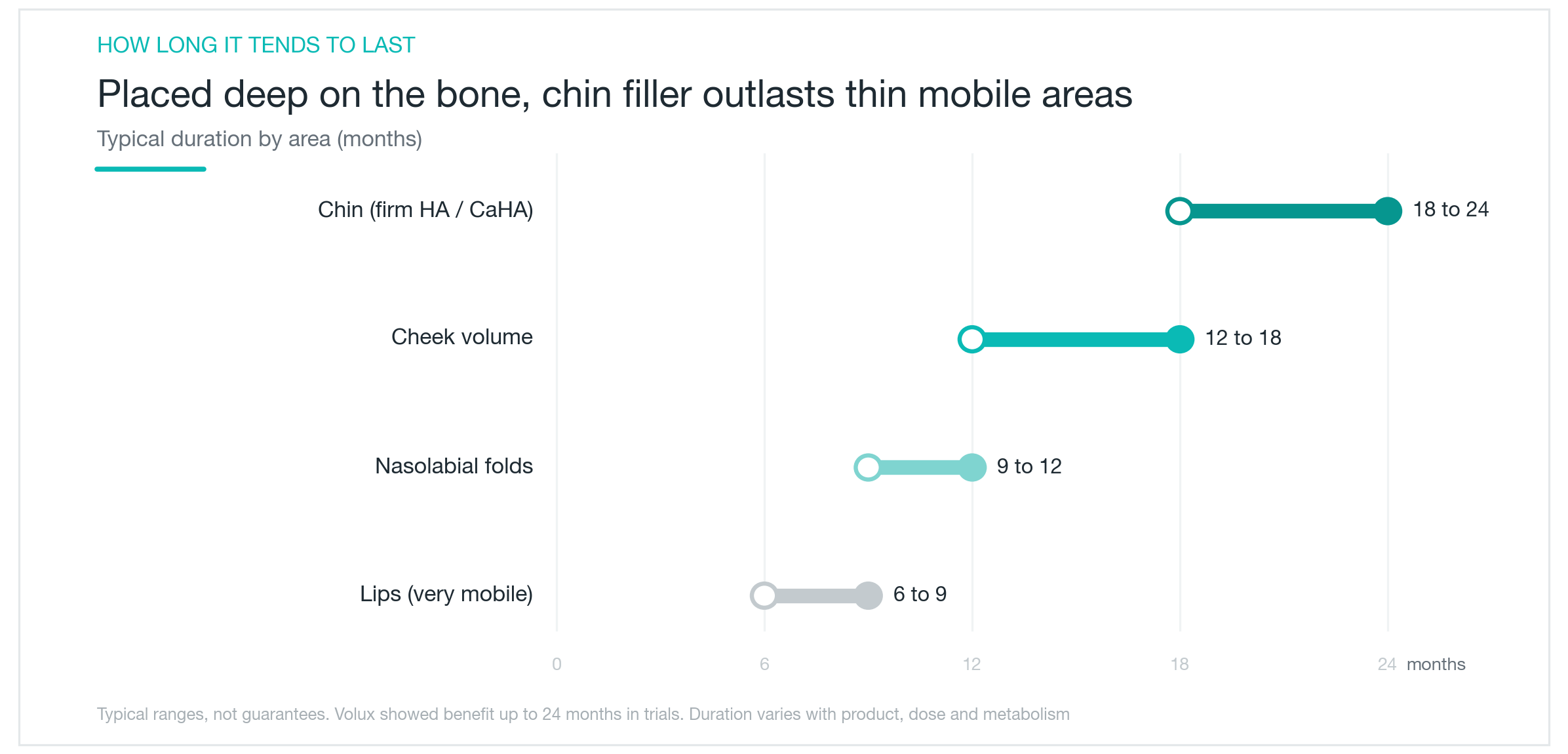
Chin filler is placed deep, specifically right on top of the periosteum covering the bone, in a compact bolus. Placing it more superficially raises the risk of spreading and also increases the risk to blood vessels. Because it settles in deep and firm, it tends to last longer than it would in thinner areas of the face.
In terms of numbers, a study using Volux on the chin found improvement held up clinically for as long as 24 months, with a substantial portion of the effect still present at the one-year mark. Radiesse used on the jawline has also been reported to last a long time while remaining safe. These are average trends, of course, and actual duration varies by product, injection volume, and each person's own metabolism.
The chin holds up better than a highly mobile area like the lips. Still, it does gradually get absorbed over time, so the usual approach is to top it off once the shape starts to fade. Rather than overfilling once to make it last, injecting a moderate amount and touching up as needed tends to look more natural and stay safer. It's also worth remembering that topping up before the filler fully disappears lets you maintain the shape with a smaller amount. Refilling a little at a time while some filler remains is both more economical and more natural-looking than starting completely from scratch after it's all gone.
Effects shown in clinical trials
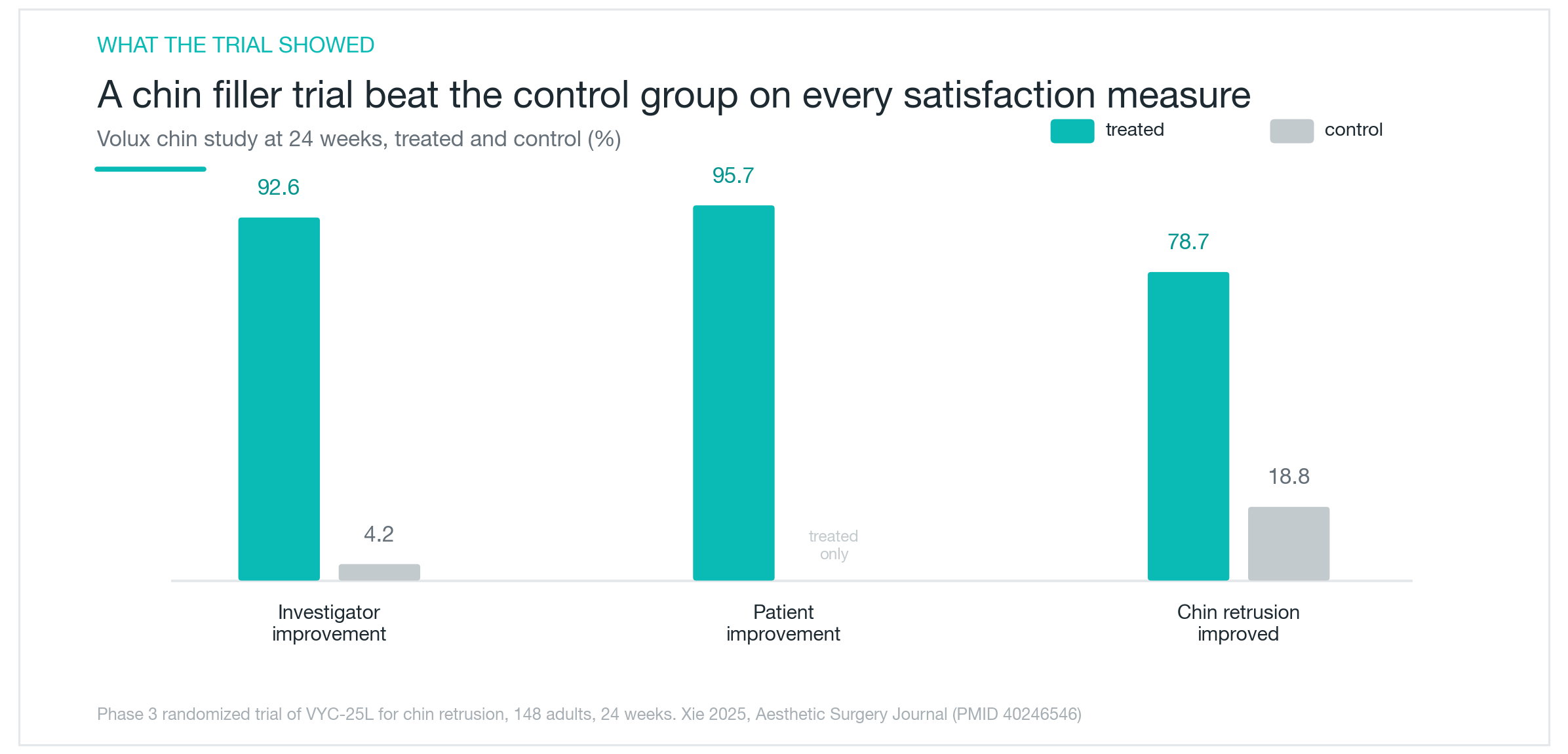
There's clinical trial evidence behind this. A phase 3 randomized trial that corrected recessed chins with Volux followed 148 people split between a treatment group and a control group for 24 weeks. The angle connecting the forehead, subnasale, and chin in profile improved markedly in the treatment group, while the control group showed almost no change.
Satisfaction numbers were just as clear. At 24 weeks, investigator-rated improvement was 92.6 percent in the treatment group versus just 4.2 percent in the control group. Patient-rated improvement came in at 95.7 percent. On a scale measuring how recessed the chin was, 78.7 percent of the treatment group showed improvement. Facial satisfaction scores were also higher in the treatment group, 70.4 versus 34.9 in the control group.
The effect held up substantially even at 52 weeks, the one-year mark. Procedural pain averaged around 2.6 on a 10-point scale, mild by any measure; injection site reactions mostly settled within two weeks; and there were no serious adverse events or dropouts. Looking at the numbers alone, it's easy to see why filler is so widely used to correct a recessed chin. That said, these figures come from a well-designed trial performed by experienced injectors, and results with the same product can still vary depending on the injector, the volume used, and each individual's own tissue.

Side effect precautions and combining with Botox
The chin and lower jaw area is dense with blood vessels, so it demands real care. If filler accidentally enters a vessel, it can cause a blockage or tissue damage, which is why the standard approach is slow, small increments injected deep against the bone. As mentioned earlier, an HA filler can be dissolved with hyaluronidase if something does go wrong, and using that reversal agent sooner rather than later gives the best recovery.
Beyond that, infection, delayed nodules, and swelling are all possible, but they're generally mild. Keeping the basics in place (proper sterilization, an authentic product, and an experienced injector) cuts the risk down considerably.
Chin filler works fine on its own, but combining it with other treatments tightens up both the profile and the front view. Chin filler builds front-to-back length for a recessed chin, while masseter Botox narrows a square jaw side to side, and together they give the lower face a slimmer, more three-dimensional shape. If the corners of the mouth have started to droop, Botox can refine that line too. It's worth looking at your whole face together to see where treatment will actually bring your E-line into balance. In the end, chin filler comes down to placing a firm product at the right depth in the right amount, and pairing it with Botox when it makes sense. Since a single profile shot can change someone's whole impression, taking the time to plan rather than rushing tends to produce the best results.
Was this helpful?
About this article
Written by a practising aesthetic physician and intended for general education — not a substitute for individual medical advice.
Read next

Belotero Soft Neck Line Filler: How Long It Lasts and How Many Sessions
When filler is used to fill in horizontal neck lines, here's why the treatment calls for a soft filler like Belotero Soft placed shallow and in small amounts, rather than the firm fillers used on the chin or cheeks, plus how long results last, how many sessions it takes, and what to know about the Tyndall effect and overall safety, based on real clinical research.
By Dr. Kim

Collarbone Filler: How Long Do Swelling and Results Last?
Clavicle filler is not a facial treatment. It fills the hollow areas around the bone to bring out a defined collarbone line. Here is why the filler goes deep instead of shallow, which collarbone shapes respond well, and what determines recovery and how long results last.
By Dr. Lee

Nostril Botox: When Does It Start Working and How Long Does It Last?
Nostril botox targets the small muscle that makes the sides of your nose flare out when you smile or take a deep breath. Rather than reshaping or narrowing the nose, it only dials down that muscle's pull, which is what sets it apart from other nose treatments. Here is a breakdown of which muscle is responsible and exactly how botox acts on it.
By Dr. Lee