Collarbone Filler: How Long Do Swelling and Results Last?
By Dr. Lee7 min read

Clavicle filler works on the same principle as facial filler, but the goal is different. Facial filler fills sunken cheeks or deep folds to soften the look of the face. Clavicle filler does almost the opposite: it brings out the natural contour of the bone so the line reads more clearly. When an off-shoulder top or a V-neck reveals a collarbone that dips unevenly or sits higher on one side than the other, hyaluronic acid filler is placed into that hollow to smooth the line into one continuous curve.
Unlike the face, the area around the collarbone has a thin fat layer, and the bone sits close to the surface. Because of that, the approach to injection depth and technique differs from facial filler. Here is why that difference exists and who tends to be a good candidate.
Why does the collarbone line look broken?
The difference between a sharply defined collarbone and a soft one usually comes down to the surrounding tissue rather than the shape of the bone itself. A thin layer of fat and fascia sits just under the skin above the collarbone, and its thickness varies from person to person and shifts gradually with age.
When fat is distributed evenly, the collarbone line reads as a smooth, gentle curve. When one section has noticeably less fat, or when the gap between a bony ridge and the area next to it is large, the line looks broken or uneven. It is a bit like the difference between a ribbon that has been pressed smooth and one with creases and fold marks left in it. The fabric itself is the same. What differs is the surface.
Natural asymmetry between the left and right collarbone is also common. If one side has a shallow groove and the other a deep one, the eye is drawn straight to that difference once clothing frames the area. Clavicle filler is used to fill in that hollow and even out the balance and flow of the line.
How are hollow spots filled?
The basic principle behind clavicle filler is the same as facial filler. Hyaluronic acid, or HA (a substance already present in skin and joints that binds water to add volume), is formulated as a gel and injected with a needle. The added volume fills the space and smooths the surface.
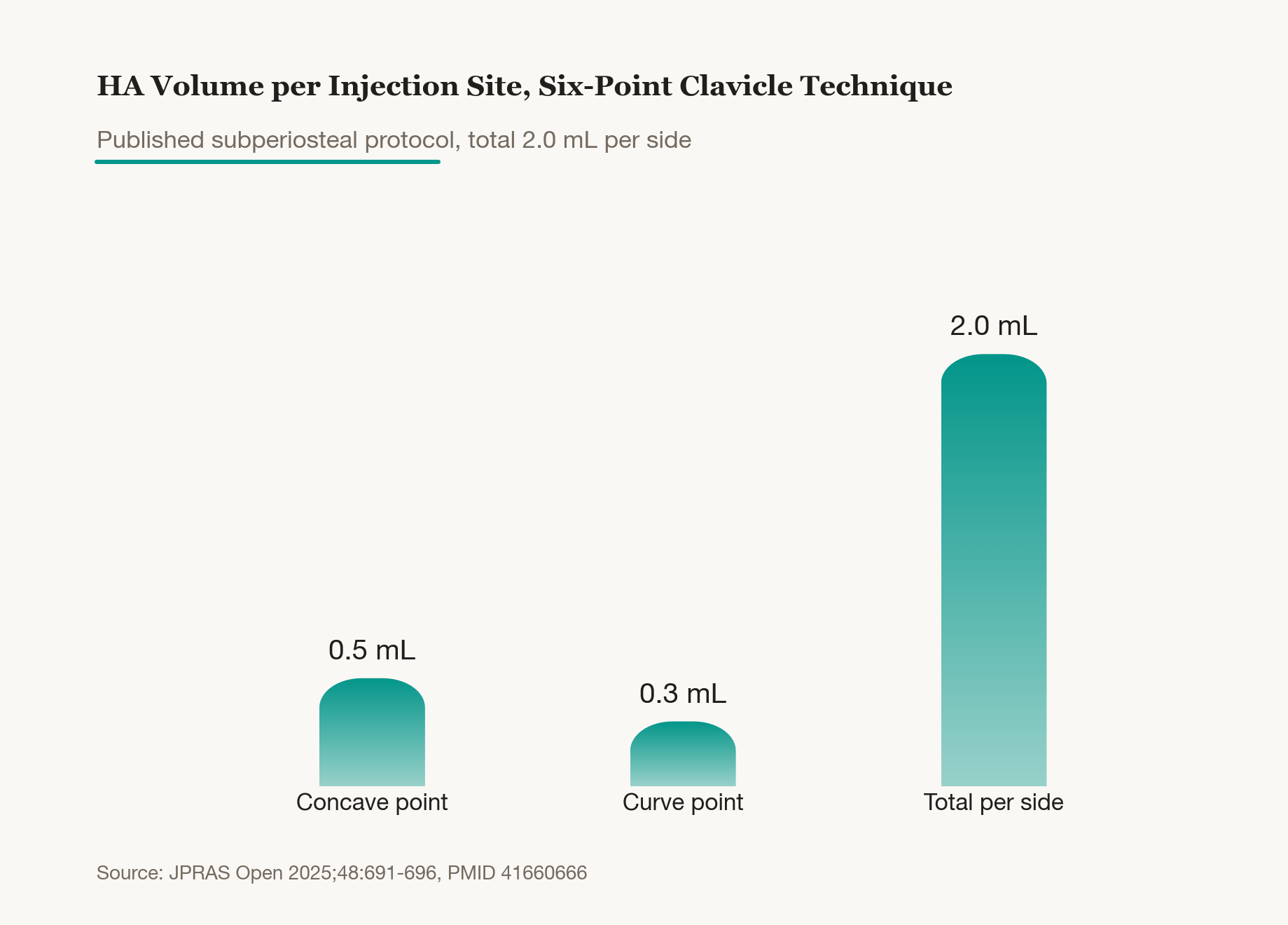
Where it goes is different from the face. Around the collarbone, the practitioner looks for the narrow hollow between bony landmarks, or just above the bone, and places small amounts there in stages. Rather than building up thickness across the whole area, the goal is to fill only the hollow parts to create one even line. That distinction makes the technique easier to picture.
It is similar to patching a pothole in a road. Instead of repaving the entire surface, only the sunken spot gets filled so the road is level again. Clavicle filler leaves the raised, bony parts alone and fills only the low spots next to them, so the overall line reads as continuous. That is also why the total volume used per session tends to be smaller than in facial filler.
Why is it placed close to the bone instead of shallow?
Facial filler is placed at different depths depending on the layer: the dermis, subcutaneous fat, or just above the fascia. Around the collarbone, as mentioned, the fat layer between skin and bone is very thin. Placed too shallow, the filler can bunch up right under the skin and become visible or palpable as a ridge.
For that reason, clavicle filler is usually described as safer and more natural when placed just above the periosteum (the thin membrane that covers the bone), a relatively deep layer. At that depth, the layer of fat and skin above it settles naturally over the filler, so the transition stays smooth. It works something like tucking a thin blanket over something: the tissue above wraps around the filler rather than sitting right on top of it.
This area also has major blood vessels and nerves running through it. That is why a cannula (a tool with a blunt tip rather than a sharp needle, which tends to push vessels aside instead of piercing them, lowering the risk of injury) is commonly used to place small amounts along a defined layer. It is also why a precise understanding of the anatomy in this area is described as essential before the procedure begins.
When is collarbone filler needed, and when not?
Not every collarbone needs filler. If the left and right sides are already balanced and the contour is already gentle, there is generally not much reason to add volume.
Here is a summary of cases where the procedure is often described as helpful, alongside cases that call for caution.
- A noticeable height difference between the two sides: filling only the lower side to even out the balance is a common approach, since a difference in groove depth is what draws the eye toward the asymmetry.
- A groove that has deepened with age as fat thins out: an area that was once smooth can hollow out gradually as fat under the skin decreases throughout the body, so the approach is to restore just that spot rather than change the overall shape.
- A bone that protrudes noticeably or causes pain: in this case, exploring other causes typically comes before considering filler, since filler is meant to fill a surface hollow, not change the structure of the bone itself.
- A history of vascular or nerve conditions, or recent surgery in the area: the underlying anatomy may have changed, so a thorough consultation beforehand is advised.
How many days do swelling and bruising last?
Mild swelling and redness right at the injection site are common right after the procedure. This is a normal response to the temporary irritation caused as the needle or cannula passes through the tissue.
Bruising can also occur, usually from small blood vessels near the injection path being disturbed, and it tends to fade over time. The underlying process is the same as the swelling and bruising seen after facial filler, but because the fat layer around the collarbone is thinner, the filler itself may be a little more noticeable at first.
As time passes and the filler settles into the surrounding tissue, the initial swelling goes down, and the treated area starts to look like a natural part of the body rather than an added volume. During this period, avoiding heavy pressure or massage over the area is recommended, since it can shift the filler out of place.
What conditions affect how long it lasts?
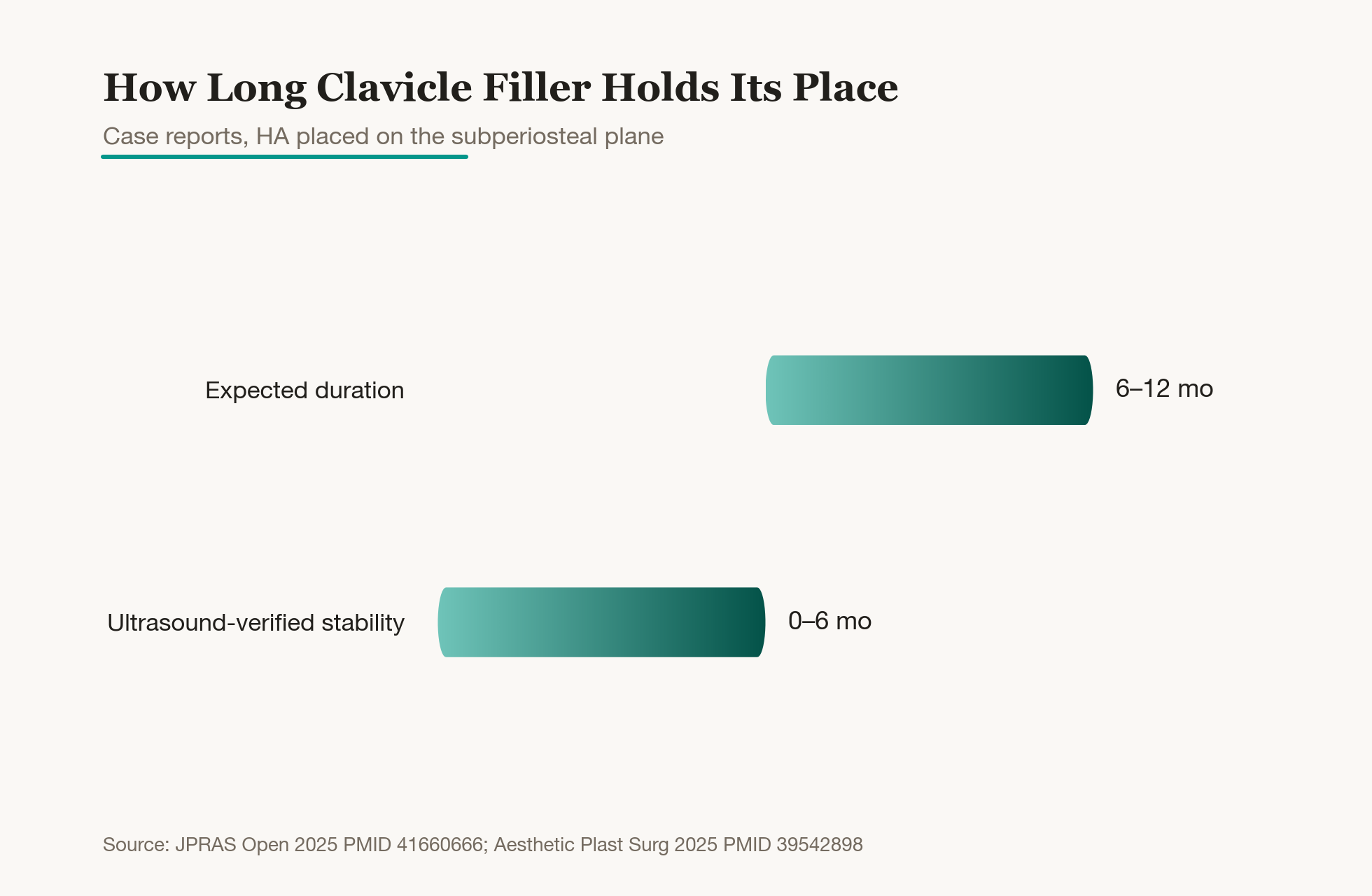
Like other hyaluronic acid fillers, clavicle filler gradually breaks down inside the body. HA holds onto water to maintain its volume, and over time, enzymes naturally present in the body break that structure down bit by bit.
That pace varies from person to person and from one filler to another. Here are the main factors that influence how long results last.
- How the filler is cross-linked and its viscosity: filler made of more tightly cross-linked molecules tends to take longer to break down, similar to how a tightly woven net takes an enzyme longer to work through than a loosely woven one.
- Movement and pressure at the injection site: the skin around the collarbone stretches and compresses constantly with shoulder and arm movement, and areas with more repetitive motion tend to absorb filler somewhat faster.
- Individual metabolism and blood flow: people with a faster metabolism tend to have more active enzyme activity that breaks down HA, which can shorten how long results last.
- Volume and depth of injection: filler placed deep, close to the bone, in the right amount and spread across multiple small injections tends to hold its position longer than filler placed shallow or all in one spot, since deeper layers are less affected by movement.
In general, how long HA filler lasts in the body varies widely depending on the area and the individual, and once results naturally fade, many people return for a small touch-up to maintain the look.
References
Korean Dermatological Association, American Academy of Dermatology (AAD), and Ministry of Food and Drug Safety (MFDS).
Was this helpful?
About this article
Written by a practising aesthetic physician and intended for general education — not a substitute for individual medical advice.
Read next

Chin Filler for the E-line: Which Product Suits a Recessed Chin?
When chin filler is used to correct a recessed chin in profile, here's why it calls for a firm filler rather than the soft kind used on cheeks or lips, which products are used, how long results last, and how safe the treatment is, laid out in plain terms with real clinical research.
By Dr. Kim

Belotero Soft Neck Line Filler: How Long It Lasts and How Many Sessions
When filler is used to fill in horizontal neck lines, here's why the treatment calls for a soft filler like Belotero Soft placed shallow and in small amounts, rather than the firm fillers used on the chin or cheeks, plus how long results last, how many sessions it takes, and what to know about the Tyndall effect and overall safety, based on real clinical research.
By Dr. Kim

Skinaura Booster: Effect, Duration and Aftercare
Skinaura Booster combines a hydrating ingredient with a cell-stimulating one to smooth out skin texture. Here is why texture roughens in the first place, which ingredients reverse it and how, plus what determines how long results last and how to care for your skin afterward.
By Dr. Kim