Marionette Line Filler: Results, How Long It Lasts, and Combining With Botox
By Dr. Kim7 min read

The lines that run from the corners of the mouth down toward the jaw, shaped like an upside down V, are known as marionette lines. The name comes from the strings on a puppet's mouth, which move the same way. These lines aren't the result of one thin layer of skin thinning out. They show up when several layers of facial structure collapse together.
The retaining ligaments (thin fibrous bands that anchor skin to bone and hold the shape of the face) loosen, the fat pad inside the cheek slides downward, and the muscle that pulls the corners of the mouth down adds its own strain on top of that. Together, they leave a deep groove behind. Filler works by supporting this collapsed structure again. Let's walk through why filling this area softens the lines, one mechanism at a time.
In what order do the corners of the mouth start to sag?
Marionette lines don't appear overnight. When you're young, the tissue below the corners of the mouth stays firmly anchored to the retaining ligaments, so it springs back into place even after the muscles move during talking or smiling. But as the years pass, these ligaments gradually stretch out, and the fat pad sitting above them slides downward with gravity.
As a result, tissue bunches up along the stretch from the inner corner of the mouth down toward the jawline, while the area right beside the mouth corner caves in. Because the hollow spot and the bunched up area sit side by side, the boundary between them stands out as a visible line. In other words, it isn't just one crease that's the problem. It's more accurate to see it as the outcome of the whole structure above and below shifting together.
Three changes behind marionette lines
Three changes are described as working together to bring about this collapse. Each has its own cause, so looking at only one doesn't give the full picture.
- Loosening of the retaining ligaments: The fibrous tissue connecting the facial bones to the skin loses its elasticity and sags with age. As the ligament stretches, the tissue resting on top of it loses its grip as well.
- Descent of the fat pad: The fat pad that once filled out the cheek loses volume and slides downward, leaving empty space where it used to sit. The spot that lost fat caves in, while the area below where that fat collects gets thicker.
- Pull from the muscle at the corner of the mouth: The muscle that lowers the corner of the mouth (depressor anguli oris) pulls downward every time you make an expression. Repeated over decades, this movement leaves the skin with a habit of folding in that direction.
Because all three overlap around the same time, marionette lines rarely fade when only one cause is corrected. They're often mentioned together with nasolabial folds, the lines running from beside the nose down to the mouth, but nasolabial folds are shaped more by sagging fat at the front of the cheek, while marionette lines owe more to weakened support along the jawline. That's why treating both the same way can leave one side filled and the other unchanged.
Why does filler go into the deeper layer first?
HA (hyaluronic acid) filler mainly refills the spot where the fat pad has been lost, out of everything that's collapsed here. HA attracts and holds onto water molecules, so it creates volume right where it's injected.
The treatment usually starts with a cannula (a thin tube with a rounded tip that pushes through tissue rather than piercing it), placing a small amount deep, close to the bone, to support the hollowed volume first. The reason for filling the deep layer first is simple. The supporting pillar needs to go up before the skin resting on it can smooth out naturally. Filling only the surface without that pillar tends to leave the pressed area sinking back in.
If needed, a small amount is added to a shallower layer as well, to reduce the depth of the line itself. Following this order is described as the key to avoiding lumpy or unnatural results.
How long does the treatment take?
The actual procedure generally breaks down into three stages.
- With the patient standing, the sagging and hollow areas are marked, and pressing on the skin helps gauge how much filler is needed for a natural result. This step matters because tissue sags in a different direction lying down versus standing up.
- After numbing the area with a topical anesthetic cream or ice, small amounts are injected into the deep layer first, in stages. Injecting everything at once would press the tissue and create an unnatural lump, which is why it's done in smaller increments.
- After the injection, the area is gently pressed and shaped by hand, then checked for left-right symmetry. Freshly injected filler hasn't settled into place yet, so there's only a short window where massage can still adjust its position.
The procedure itself is often reported to take around 30 minutes.
How long does swelling last, and how long do results stay?
Right after the procedure, some swelling and mild bruising can occur. This happens because the needle or cannula can brush against small blood vessels along the way, and it's generally described as settling within one to two weeks. Full settling is said to take about four to twelve weeks, and during that time, any minor lumpiness or awkwardness tends to smooth out on its own.
The area around the mouth moves thousands of times a day while talking, eating, and smiling. Because of that, filler here feels the effects of movement sooner than in other areas. HA filler in the marionette area is generally reported to last around six to twelve months, which is on the shorter side compared to areas that move less.
How loose the ligaments already are and how much fat has been lost differ from person to person, so the amount needed and how noticeable the result feels also vary. The more the support structure has weakened, the more volume is typically needed, and the point where the lines become noticeable again can arrive relatively sooner as well.
Why Botox is sometimes added
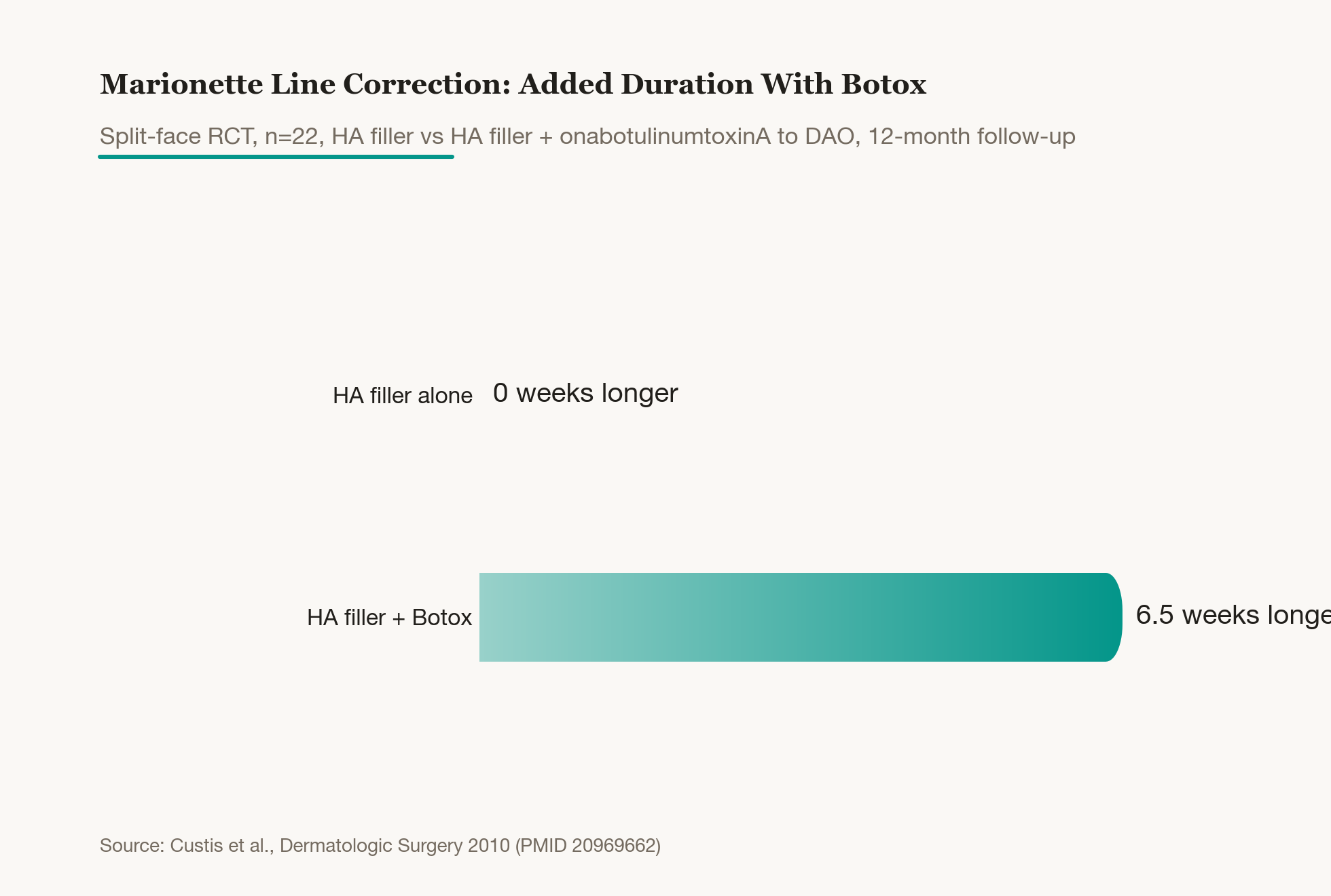
Filler alone can rebuild the structure, but the pull from the muscle lowering the corners of the mouth doesn't go away on its own. That's why a small amount of botulinum toxin (Botox) is often injected into this muscle too, to reduce how hard it pulls.
When the muscle's pull weakens, the downward force acting on the volume the filler has supported weakens along with it. In effect, raising the supporting pillar and reducing the force that shakes it happen together. Some reports describe results lasting longer when the two are combined than with filler alone. That said, injecting Botox into the muscles around the mouth can subtly affect speech or expression, so this is known as an area where the dose and placement need to be chosen carefully.
What to tell your doctor before treatment
There are a few things worth checking before and after the procedure. Each one has a reason behind it, tied to a safer recovery.
- It's best to mention any recent use of blood thinners or aspirin ahead of time. A tendency to bleed more easily can make bruising larger and longer lasting.
- Any history of herpes (cold sores) around the lips should be mentioned in advance. The stimulation from the procedure can trigger a recurrence, so a preventive medication is sometimes used first if needed.
- For a few days after the procedure, it's best to avoid opening the mouth wide or pressing firmly on the area. Applying pressure before the filler has settled can shift its position.
Once these points are checked ahead of time, recovery tends to go smoothly, within the range that's expected.
References
Korean Dermatological Association, American Academy of Dermatology (AAD), and Ministry of Food and Drug Safety (MFDS).
Was this helpful?
About this article
Written by a practising aesthetic physician and intended for general education — not a substitute for individual medical advice.
Read next

Under-Eye Hollow Filler: Effect and Side Effects, and the Tyndall Effect to Watch
The dark, sunken look under the eyes often comes less from pigment than from hollowing and the shadow it casts. Here's how the tear trough ligament and lost volume under the eye create that shadow, how a soft hyaluronic acid filler placed shallowly and sparingly smooths it out, why thin skin and the bluish Tyndall effect make this area tricky, and how long results actually last, all backed by real published numbers.
By Dr. Kim

Belotero Soft Neck Line Filler: How Long It Lasts and How Many Sessions
When filler is used to fill in horizontal neck lines, here's why the treatment calls for a soft filler like Belotero Soft placed shallow and in small amounts, rather than the firm fillers used on the chin or cheeks, plus how long results last, how many sessions it takes, and what to know about the Tyndall effect and overall safety, based on real clinical research.
By Dr. Kim

Forehead Botox: When It Starts Working, How Long It Lasts, and Aftercare
Forehead lines form when the frontalis muscle contracts over and over with everyday expressions. Botox works by blocking the nerve signal that tells this muscle to move, not by dissolving the wrinkle itself. Here is how the muscle gets quieted down and why the effect eventually wears off.
By Dr. Kim