Forehead Botox: When It Starts Working, How Long It Lasts, and Aftercare
By Dr. Kim7 min read
Forehead lines are one of the most common wrinkles that show up as we get older. Every time you raise your eyebrows or look surprised, horizontal creases appear across the forehead. At first they only show up while you are making an expression, but over time they start staying put even when your face is completely relaxed. Botox, or more precisely botulinum toxin, is the go to treatment for softening these lines.
What is less well known is why Botox actually works on forehead lines, and why the lines tend to creep back after a while. If you think of it as simply "a shot that smooths wrinkles," it is hard to understand why the effect is not permanent. Once you follow the mechanics of how the muscle moves in the first place, the answer becomes pretty intuitive.
Why do forehead lines form?
Forehead lines belong to a category called expression lines, wrinkles that form because a muscle keeps contracting in the same spot. On the forehead, the frontalis (a broad, flat muscle that spans the upper forehead) pulls the eyebrows and forehead skin upward every time it contracts, and that creates a horizontal fold.
The issue is that this movement happens hundreds of times a day. Every time you talk, look surprised, or concentrate, your eyebrows twitch upward, and the forehead skin folds and unfolds in the same place each time. It is a bit like folding a piece of paper along the same crease over and over: eventually the paper keeps that fold even when you let go.
Aging skin adds another layer to this. In younger skin, a fold like this bounces back quickly. But once collagen and elastic fibers start to decline, skin tends to hold onto the crease almost like it "remembers" the shape. That is why the same expression leaves a deeper, more visible line as we age.
This is also why a line that only shows up when you smile or look surprised eventually turns into a static line, one that stays visible even with a relaxed face. The muscle's folding force has not changed. What has changed is the skin's ability to spring back on its own.
How do nerve signals move the muscle?
For a muscle to move, a signal has to travel down from a nerve. When the brain sends a command to lift the eyebrows, the nerve ending releases a substance called acetylcholine, a neurotransmitter that tells muscle to contract.
At the junction where the nerve meets the muscle, acetylcholine attaches to receptors on the muscle cell and delivers the order to contract. It works a bit like a key fitting into a lock: the door only opens once acetylcholine locks into the right receptor on the muscle. As this signaling repeats, the frontalis keeps contracting and relaxing, and the end result shows up on the skin as a horizontal line.
Where Botox blocks the signal
Botulinum toxin interrupts one specific step in this chain. Precisely, it blocks the nerve ending from releasing acetylcholine in the first place, essentially stopping the key from ever reaching the lock.
Without acetylcholine, the muscle cell never receives the order to contract. The frontalis loses much of its pulling force, and the forehead skin is no longer being folded as forcefully. The muscle itself is not damaged or destroyed, it simply stops receiving the signal for a while, which is exactly why this effect is temporary and reverses on its own over time.
So while a treated area can look as if the muscle is paralyzed, the muscle is actually still there, fully intact. What has been interrupted is only the conversation between the nerve and the muscle, and once that conversation resumes, the muscle starts moving again.
When do results start to appear?
You will not see an effect the moment the injection is done, because it takes time for the toxin to actually stop acetylcholine release.
Most people start to notice the muscle relaxing somewhere between 2 and 5 days after treatment, with the effect typically reaching its peak between 1 and 2 weeks. During this window, the injected protein is busy settling into the nerve endings and getting to work.
So there is no need to panic if you check the mirror on treatment day and see no change at all. Give it anywhere from a few days up to about 2 weeks for the full effect to settle in.
Why does the effect fade after a few months?
Botox is not a permanent fix, because the nerve ending that was blocked eventually grows a new pathway around the blockage.
A nerve ending has a natural ability to sprout a new side branch when its original route is blocked, not unlike cars rerouting through a side street when the main road is closed for construction. Once that new branch is established, acetylcholine release starts up again and the muscle gradually regains its contracting strength.
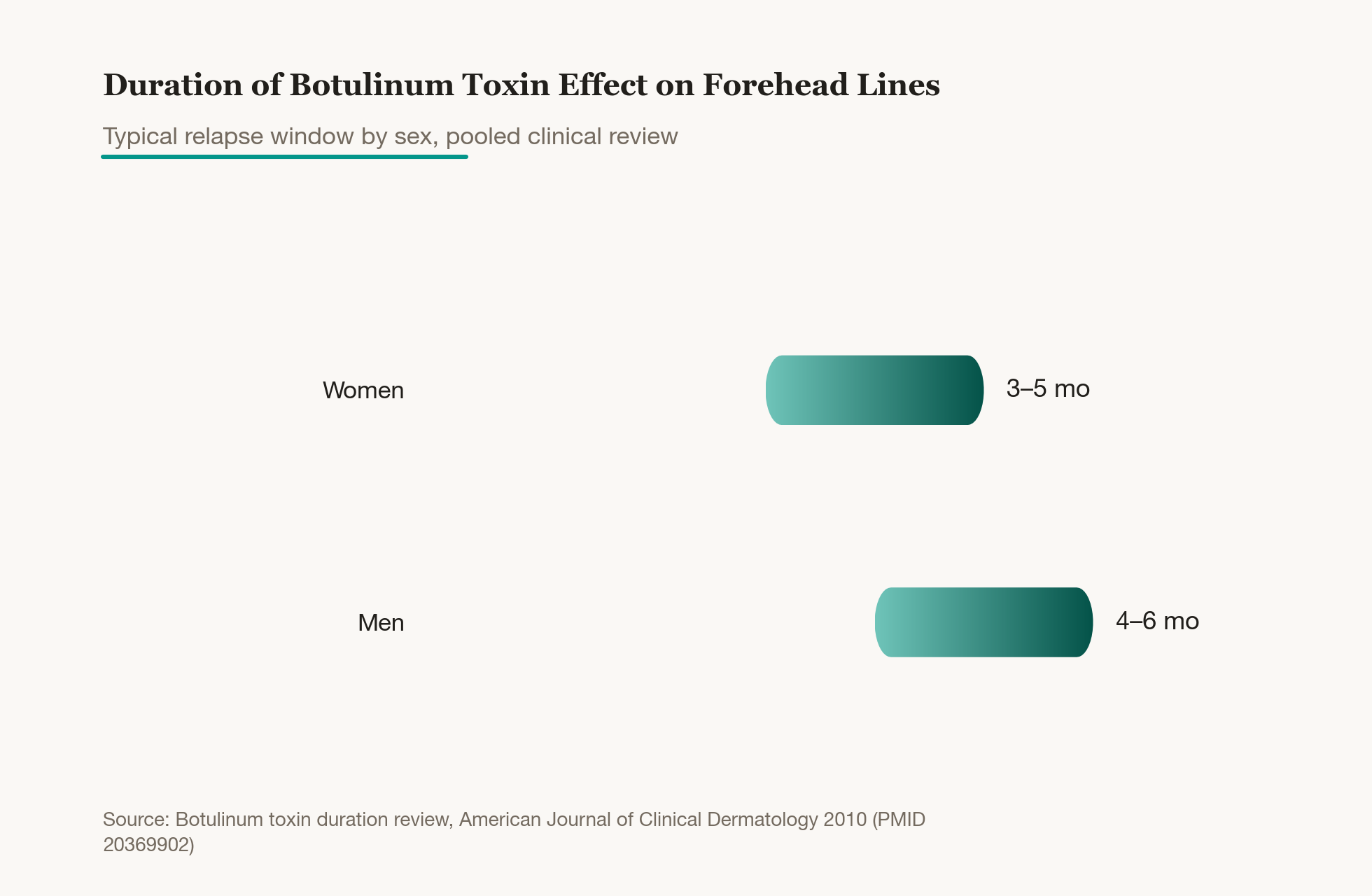
How long this takes varies from person to person, but muscle movement noticeably returns for most people somewhere between 3 and 4 months after treatment, and in some cases the effect can last close to 6 months. How often the muscle gets used and how much product was injected both play a role in that variation.
Why does duration differ between people?
Even with the same treated area, results last different lengths of time for different people. A few factors are known to play into this together.
- Dose and area treated: The dose is calibrated to the size and strength of the muscle, and a smaller dose can wear off sooner, since how much acetylcholine release gets blocked is roughly proportional to the amount injected.
- How much you use the muscle: People who make big expressions and move their eyebrows often tend to regrow those nerve side branches faster, since a more active muscle tends to push its nerve to find a new route sooner.
- Metabolism and individual differences: Everyone breaks down and processes protein at a different rate, so even the same dose can last a different length of time from one person to the next.
- Number of past treatments: With repeated treatment over a long period, the muscle itself can gradually thin out, which sometimes makes each following treatment last longer, though this varies enough between individuals that it is hard to say for certain.
Because of this, someone getting treated for the first time and someone who has had it done many times before may feel the same dose lasts differently, since how sensitive the muscle is to the signal shifts gradually with repeated treatment.
What to do right after treatment
Right after treatment, the main goal of aftercare is helping the injected product settle exactly where it was placed.
- Staying upright rather than lying down for about 4 to 6 hours after treatment is generally recommended, since a change in gravity can let product that has not fully settled migrate to areas it was not meant for.
- Avoiding massage or firm rubbing of the face on treatment day is recommended, since pressure can shift the injected product and cause an uneven result.
- Avoiding saunas or hot compresses for about a day afterward is generally advised, since heat speeds up blood flow and can make the product spread or absorb faster than intended.
- Holding back on big eyebrow movements for about a week, while the effect is settling in, is generally recommended as well.
References
Korean Dermatological Association, American Academy of Dermatology (AAD), and Ministry of Food and Drug Safety (MFDS).
Was this helpful?
About this article
Written by a practising aesthetic physician and intended for general education — not a substitute for individual medical advice.
Read next

How Long Botox Lasts and Why It Varies: Dose and Antibodies Included
Botox works by blocking the signal pathway between nerves and muscles, temporarily stopping muscle movement. How long the effect lasts depends on the dose, the size of the muscle, and how quickly the nerve recovers, so results vary from person to person. Here is how repeat treatments, antibody formation, and aftercare all affect how long Botox lasts.
By Dr. Kim

Masseter Botox: When It Starts Working, How Long It Lasts, and Changes in Chewing Strength
Jaw slimming Botox blocks the nerve signal that tells your chewing muscle to contract, weakening its grip. As the muscle loses strength, it slowly shrinks, softening a square-looking jawline into a slimmer contour. Here's the science behind when results appear and why duration varies from person to person.
By Dr. Lee

Marionette Line Filler: Results, How Long It Lasts, and Combining With Botox
Marionette lines running from the corners of the mouth down toward the jaw form when the supporting ligaments loosen, the fat pad sags, and the muscle pulling down on the mouth corners adds to the strain. HA filler works by rebuilding this collapsed structure from the inside out, restoring lost volume layer by layer. Here's a look at recovery time, how long results last, and why Botox is often paired with it.
By Dr. Kim