Masseter Botox: When It Starts Working, How Long It Lasts, and Changes in Chewing Strength
By Dr. Lee7 min read

Jaw slimming Botox is often described as "shaving down a square jaw," but it doesn't actually reshape any bone. The jawbone stays exactly as it is. What changes is the size of a single muscle sitting on top of it.
In many cases, a square-looking jawline has less to do with bone shape and more to do with an overdeveloped chewing muscle. Weaken that muscle's activity, and it naturally shrinks, softening the jawline along with it. So how does simply reducing a muscle's strength end up shrinking its size too? Let's walk through the mechanism step by step.
The masseter muscle that shapes a square jaw
Place your fingers on both corners of your lower jaw and bite down hard on your back teeth. You'll feel a firm bulge under your fingers. That's the masseter, the muscle that pulls your lower jaw upward every time you chew. Jaw slimming Botox targets exactly this muscle.
The masseter moves thousands of times a day. Every bite of food, every time you clench your jaw, every night you grind your teeth in your sleep, this muscle gets worked. It's the same logic as training your biceps at the gym: the more often and the harder a muscle is used, the thicker it gets. If you grind your teeth at night, your masseter is essentially getting a workout while you sleep, which makes it especially prone to bulking up.
This is why some square-looking jaws aren't a bone shape issue at all, they're the result of an overworked, thickened muscle. And that's exactly why a jawline can slim down without ever touching the bone.
How does Botox block muscle signals?
Muscles don't move on their own. They only contract once a signal from the brain travels down a nerve and reaches them. The spot where this handoff happens, where nerve meets muscle and information passes between them, is called the neuromuscular junction.
At that junction, a chemical messenger called acetylcholine (the signal a nerve releases to tell a muscle to move) gets released, carrying the order to contract. Botulinum toxin, the active ingredient in Botox, cuts a protein called SNAP-25 that's involved in releasing acetylcholine, which stops the signal from getting out at all.
Think of it like a postal strike. The person writing the letter (the nerve) and the person meant to receive it (the muscle) are both still there, but if the delivery in between stops, no message gets through. When Botox is injected into the masseter this way, the "chew" signal never arrives, so the muscle can't contract as forcefully as it used to.
Why does an unused muscle shrink?
Blocking the signal doesn't make the muscle disappear overnight. But over time, its actual volume decreases. This process is called disuse atrophy, the shrinking that happens simply because a muscle stops being used.
You've probably seen this before: after a broken arm spends weeks in a cast, it looks visibly thinner than the other one once the cast comes off. Muscle is tissue that needs continuous use to hold on to its size. Once movement drops, the body sends fewer resources to that muscle and the fibers themselves get thinner. The masseter works the same way. Once Botox weakens its contracting power, it no longer needs its usual workload, and its volume gradually shrinks along with that.
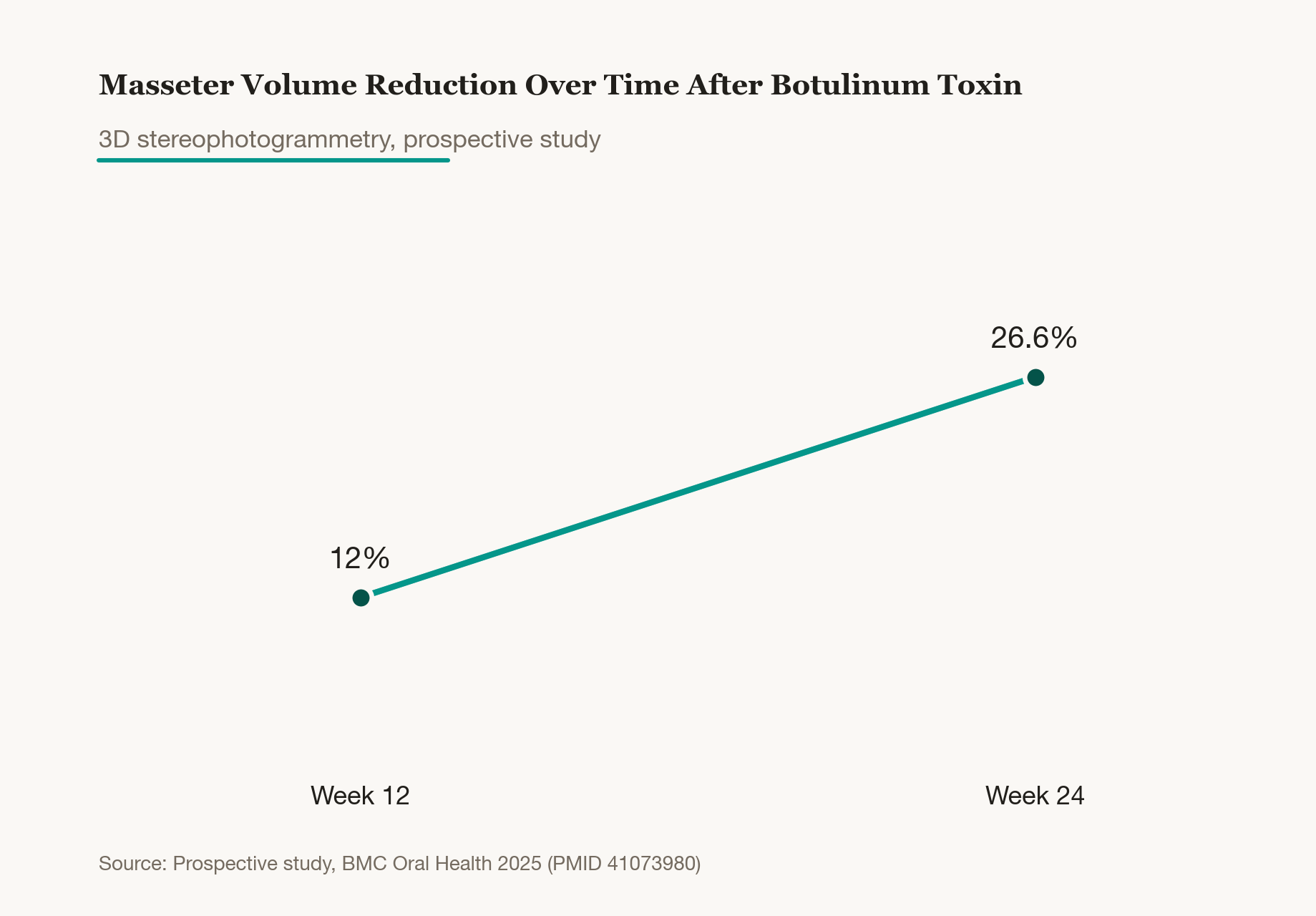
Studies using ultrasound or MRI to measure masseter thickness before and after Botox have reported a clear decrease. Some studies note the muscle's cross-sectional area shrinking by roughly 20 to 30 percent. How much a given person's muscle shrinks can vary depending on the original thickness, the injected dose, and whether teeth grinding continues afterward.
When does the face line become slimmer?
Jaw slimming results unfold in two separate stages. In the first one to two weeks after treatment, you'll notice your bite feel weaker. If you have a history of grinding or clenching, this is also when that tight, achy jaw feeling tends to ease up.
A visibly slimmer jawline, though, takes longer to appear. Most people start noticing a change around four to six weeks in, and the muscle typically reaches its most fully atrophied, slimmest point around the three to four month mark. Blocking the signal happens fast, but shrinking muscle volume is a slow process the body works through gradually, on its own timeline.
So if you check the mirror right after treatment and see no change, it's too early to be disappointed. Blocking the nerve signal and shrinking the muscle are two separate processes that move at different speeds, and it takes a few months to see the full result.
Is eating still fine when chewing strength decreases?
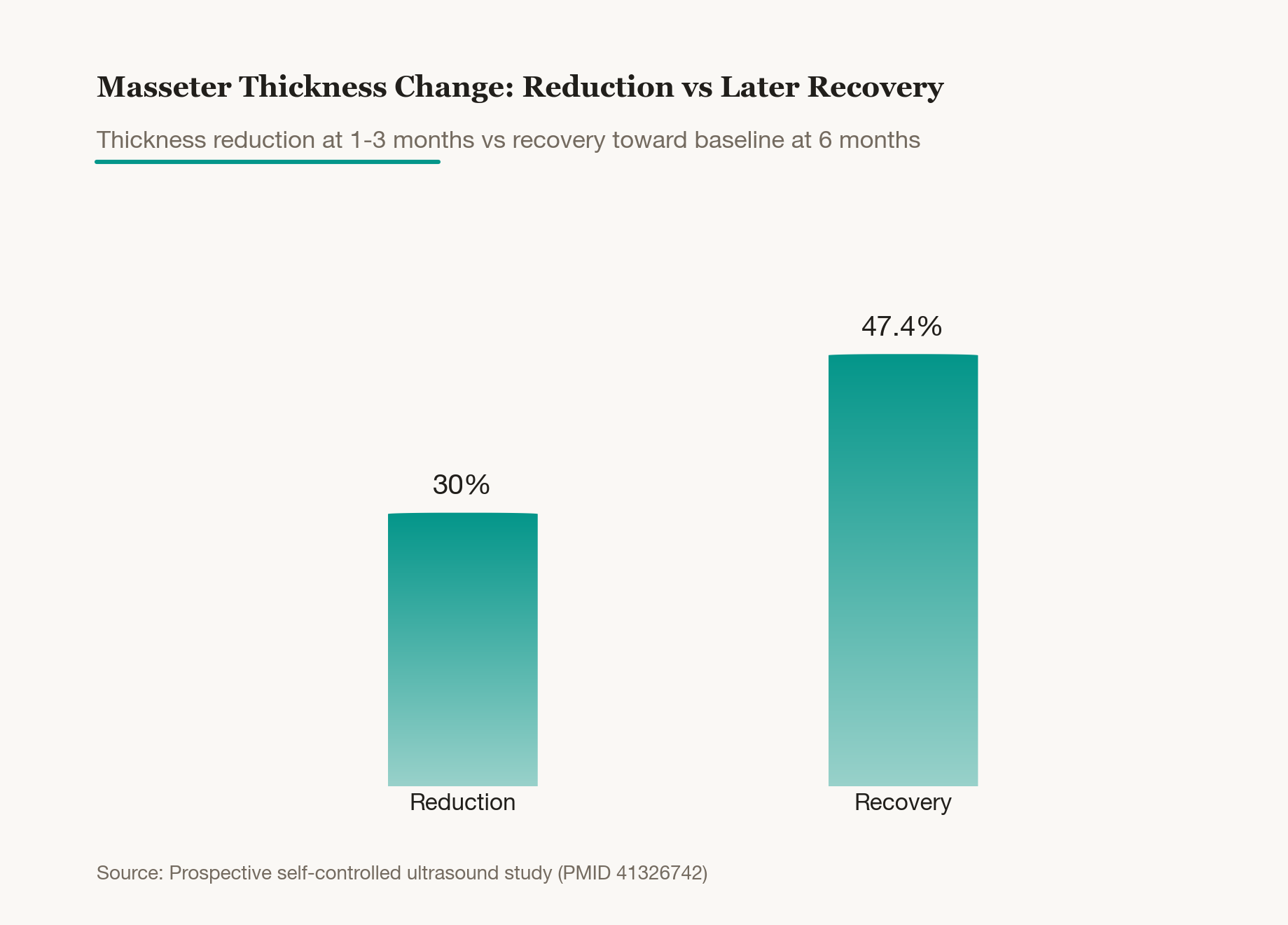
As the masseter weakens, your bite force weakens along with it. Clinical studies have tracked this directly, showing maximum bite force dropping after treatment and then gradually recovering over time. Even so, the drop isn't reported to be severe enough to interfere with everyday eating or speaking.
That's because the masseter isn't the only muscle doing the chewing. The temporalis at your temple and the medial pterygoid deeper inside your jaw share the workload too. When the masseter's strength drops, these other muscles pick up some of the slack. You might notice a bit less power behind biting into something hard, but eating itself never becomes impossible.
In short, your jawline slims down in proportion to how much the masseter weakens, but your overall chewing function holds up because the other muscles step in to balance things out.
Factors that decide how long the effect lasts
Jaw slimming results are generally reported to last around 6 to 12 months. That window varies from person to person depending on a few factors:
- Injected dose: A higher dose tends to suppress muscle activity for longer, which keeps the muscle in its atrophied state longer too. That's simply because blocking the nerve signal lasts longer at higher doses.
- Whether grinding or clenching continues: If these habits persist after treatment, the muscle gets re-stimulated and can recover its size faster, since muscle is tissue that grows back once it's put to work again.
- Original muscle thickness and individual metabolism: Someone who started with a thicker, more developed masseter will generally take longer to reach full atrophy, and how quickly the nerve regenerates varies from person to person too, which affects when the effect wears off.
- Treatment intervals and repetition: Repeating injections at regular intervals is known to leave less time for the muscle to bulk back up, helping the slimmer result last longer.
Once enough time passes for nerve signaling to return to normal, the muscle gradually regains its workload and can start thickening again. That's why maintaining the result long-term calls for repeat treatments at regular intervals.
Precautions for the first few days after treatment
The core of aftercare is simple: don't interfere with the muscle's atrophy process while it's settling in.
- For the first few days after treatment, it's recommended to avoid biting down hard on tough or chewy foods. Working the muscle hard can slow down the atrophy process.
- It's also best to avoid pressing or massaging the treated area firmly early on, since this can cause the injected solution to spread and affect nearby muscles.
- If you have a teeth grinding habit, it's often recommended to consider addressing it too, for example with a nightguard, since cutting back on the habit while the muscle is atrophied slows down how quickly it thickens back up.
- You may feel some weakness when chewing for the first few days, but this is reported to resolve on its own, with most people finding no real disruption to daily life shortly after.
References
Korean Dermatological Association, American Academy of Dermatology (AAD), and Ministry of Food and Drug Safety (MFDS).
Was this helpful?
About this article
Written by a practising aesthetic physician and intended for general education — not a substitute for individual medical advice.
Read next

Masseter Botox: When Results Appear, How Long They Last, and Precautions
Masseter Botox is injected into the masseter, the muscle you use to chew, to reduce its strength. Here is an easy breakdown of why the muscle atrophies, why the slimmer jawline appears gradually, how long the effect lasts, and when a touch-up is needed.
By Dr. Lee
Masseter Botox for a Square Jaw: When Does It Start Working and How Long Does It Last?
Masseter Botox uses botulinum toxin to shrink the chewing muscle and slim a square jawline. Here is what the evidence says about how it works, when results appear, how long they last, side effects, and its effect on teeth clenching.
By Dr. Kim

Marionette Line Filler: Results, How Long It Lasts, and Combining With Botox
Marionette lines running from the corners of the mouth down toward the jaw form when the supporting ligaments loosen, the fat pad sags, and the muscle pulling down on the mouth corners adds to the strain. HA filler works by rebuilding this collapsed structure from the inside out, restoring lost volume layer by layer. Here's a look at recovery time, how long results last, and why Botox is often paired with it.
By Dr. Kim