Masseter Botox for a Square Jaw: When Does It Start Working and How Long Does It Last?
By Dr. Kim9 min read
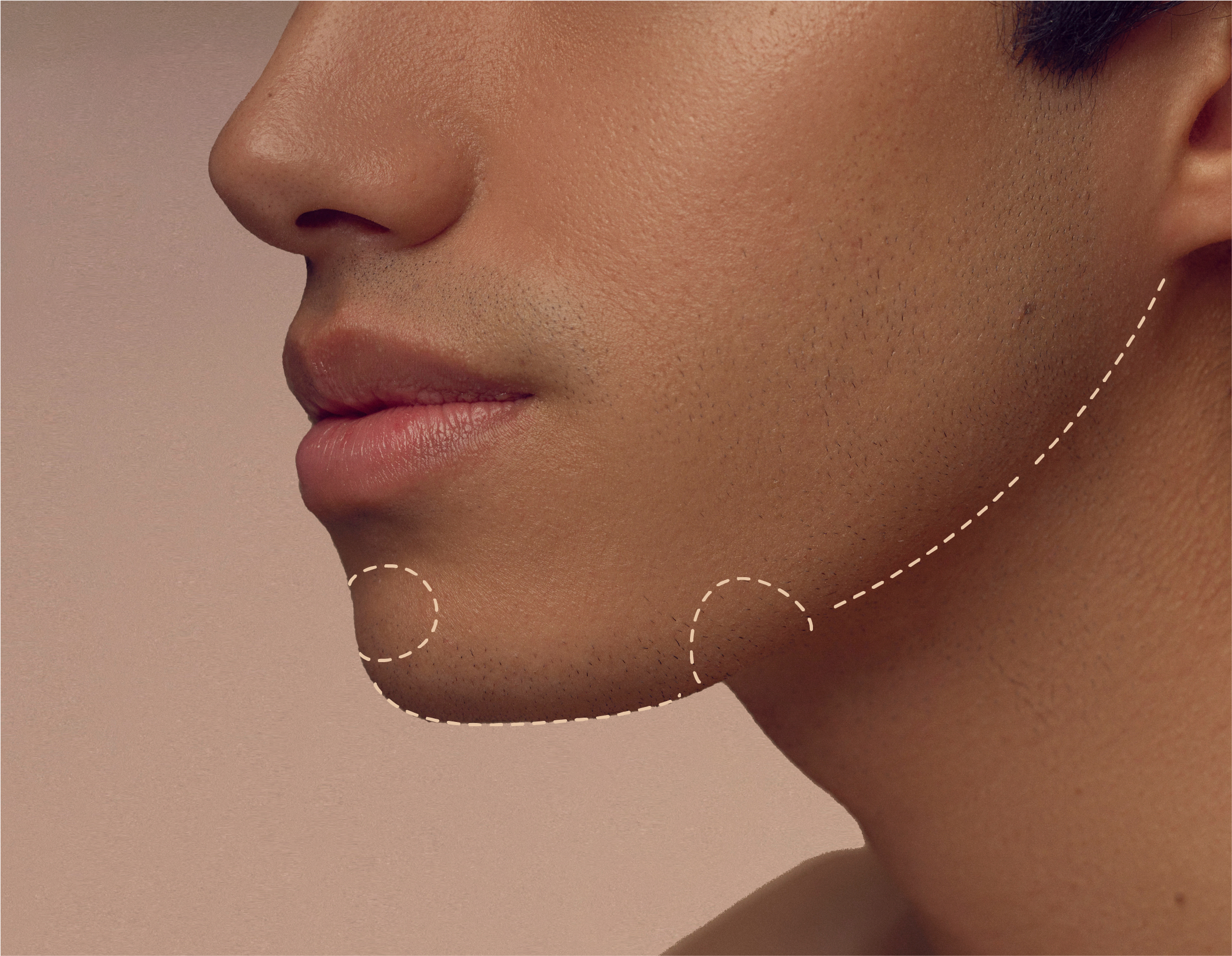
When a prominent jaw makes the face look wider, many people start looking for ways to create a slimmer jawline. Masseter Botox is one of the treatments people turn to for this. The masseter is the jaw muscle used for chewing. Botulinum toxin is injected into the masseter to gradually shrink the muscle, so the jawline softens over time. This is not a treatment that carves anything away but one that works by thinning the muscle for a natural slimming effect, so it helps to know beforehand when results appear, how long they last, and what side effects to expect. Here is a look at how masseter Botox works, how well its slimming effect is backed by evidence, and what it can do for teeth clenching, all based on verified data.
| Item | Key point |
|---|---|
| How it works | Masseter atrophy slims the jawline |
| Timeline | Bite strength drops in days, slimming in 6–12 weeks |
| Duration | 3–6 months, about 248 days for responders |
| Thickness reduction | Varies widely, from about 6% at 1 month |
| Watch for | Muscle bulging, asymmetry, weaker bite |
How does masseter Botox work?
The masseter is a thick, square chewing muscle that runs from the cheekbone to the angle of the jaw. When both masseters thicken, whether from habitual clenching or naturally larger muscle mass, the lower face looks wider, creating what is commonly called a square jawline.
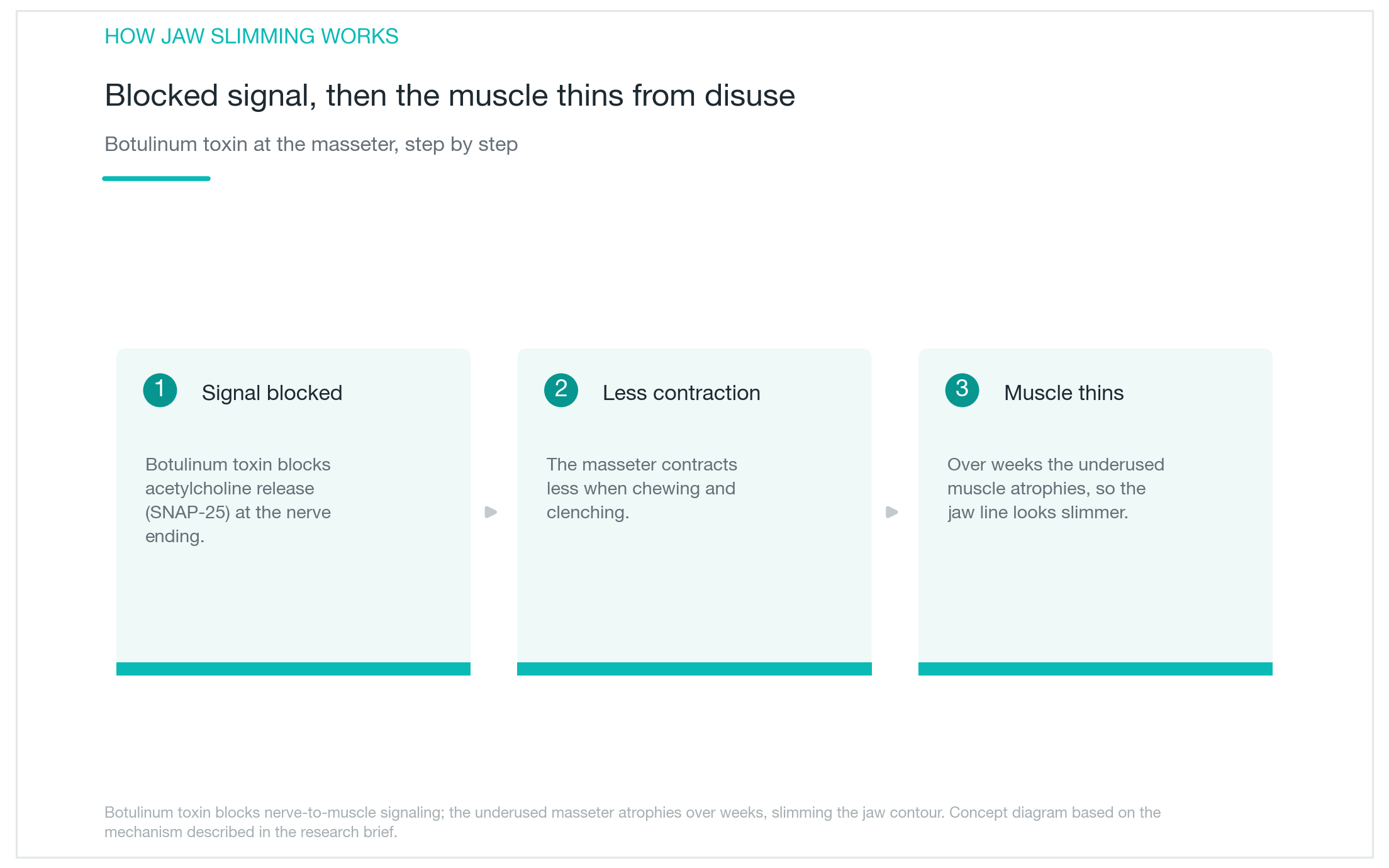
Botulinum toxin type A cleaves a protein called SNAP-25 at the nerve ending, blocking the release of the signaling molecule acetylcholine. This reduces the contraction signal the nerve sends to the muscle, so some muscle fibers lose their strength.
A muscle that works less gradually thins over several weeks, the same way any unused muscle atrophies. This atrophy is the real reason the jawline slims, so the face does not shrink on the day of the injection. The change appears gradually over time.
By the same mechanism, bite force itself also weakens. This is why the treatment is also used to reduce teeth clenching, nighttime grinding, and the muscle soreness that comes with them. The effect is not permanent, though. Once the nerve endings regrow and start signaling the muscle again, muscle volume and strength return, and both the jaw contour and symptoms gradually come back over several months.
Units per side and how units differ by brand
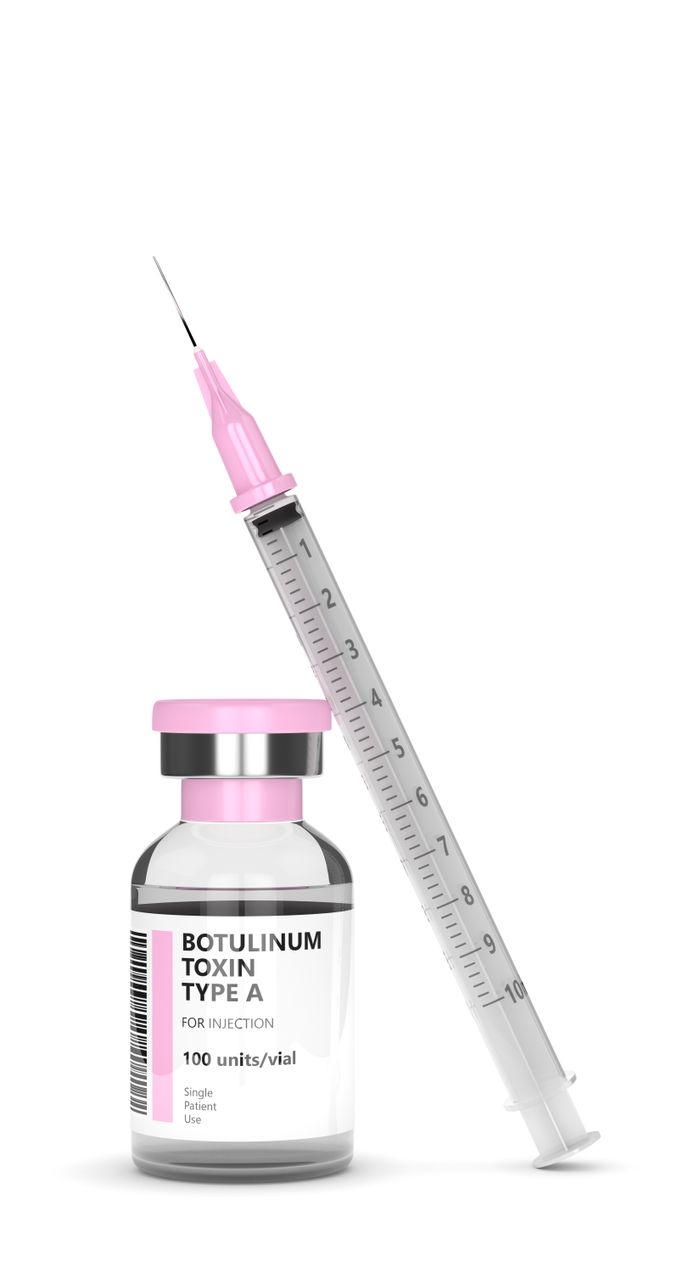
The dose for masseter Botox varies by product and muscle size. For cosmetic slimming, 20–30 U of onabotulinumtoxinA per side is commonly used. Thicker muscles call for a higher dose.
| Product | Dose per side | Note |
|---|---|---|
| onabotulinumtoxinA | 20–30 U | Standard cosmetic dose |
| ona, high dose | Up to 72 U | Very thick muscles |
| abobotulinumtoxinA | About 75 U | Equal to ona 30 U |
One thing worth knowing is that the units differ from product to product. AbobotulinumtoxinA 75 U is roughly equal to onabotulinumtoxinA 30 U. Comparing unit numbers heard at different clinics without checking the product can therefore be misleading, so it helps to confirm which product is being used.
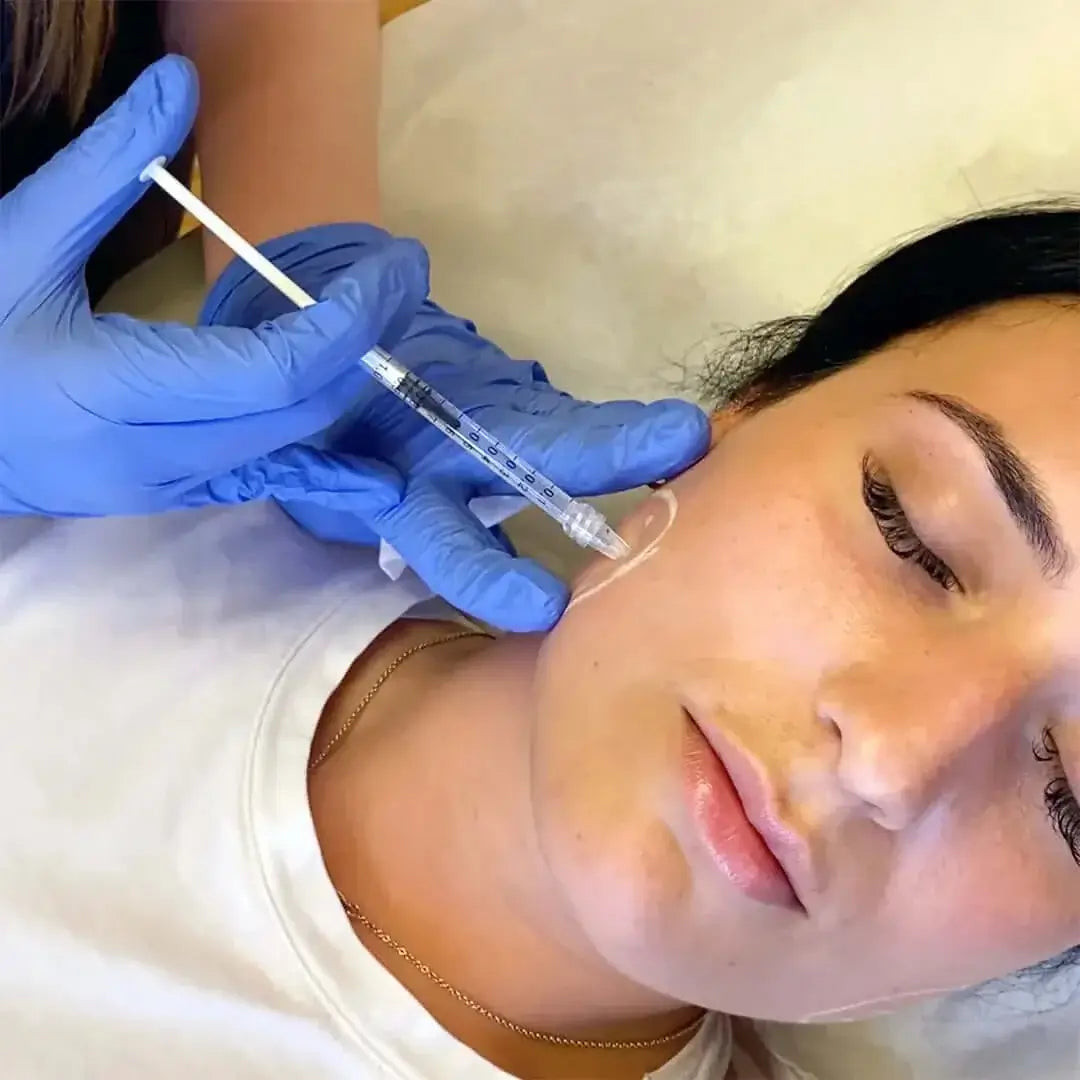
Injection site matters too. The safe zone sits at least 1cm above the border of the jawbone, below the line connecting the front of the ear to the corner of the mouth. If the toxin spreads forward or downward past this boundary, it can affect the muscles that control facial expression, such as pulling the corner of the mouth off center when smiling. The needle is placed at muscle depth and the dose is split across several points, and checking the muscle layer with ultrasound helps limit spread into nearby muscles.
When does it start working and how long does it last?
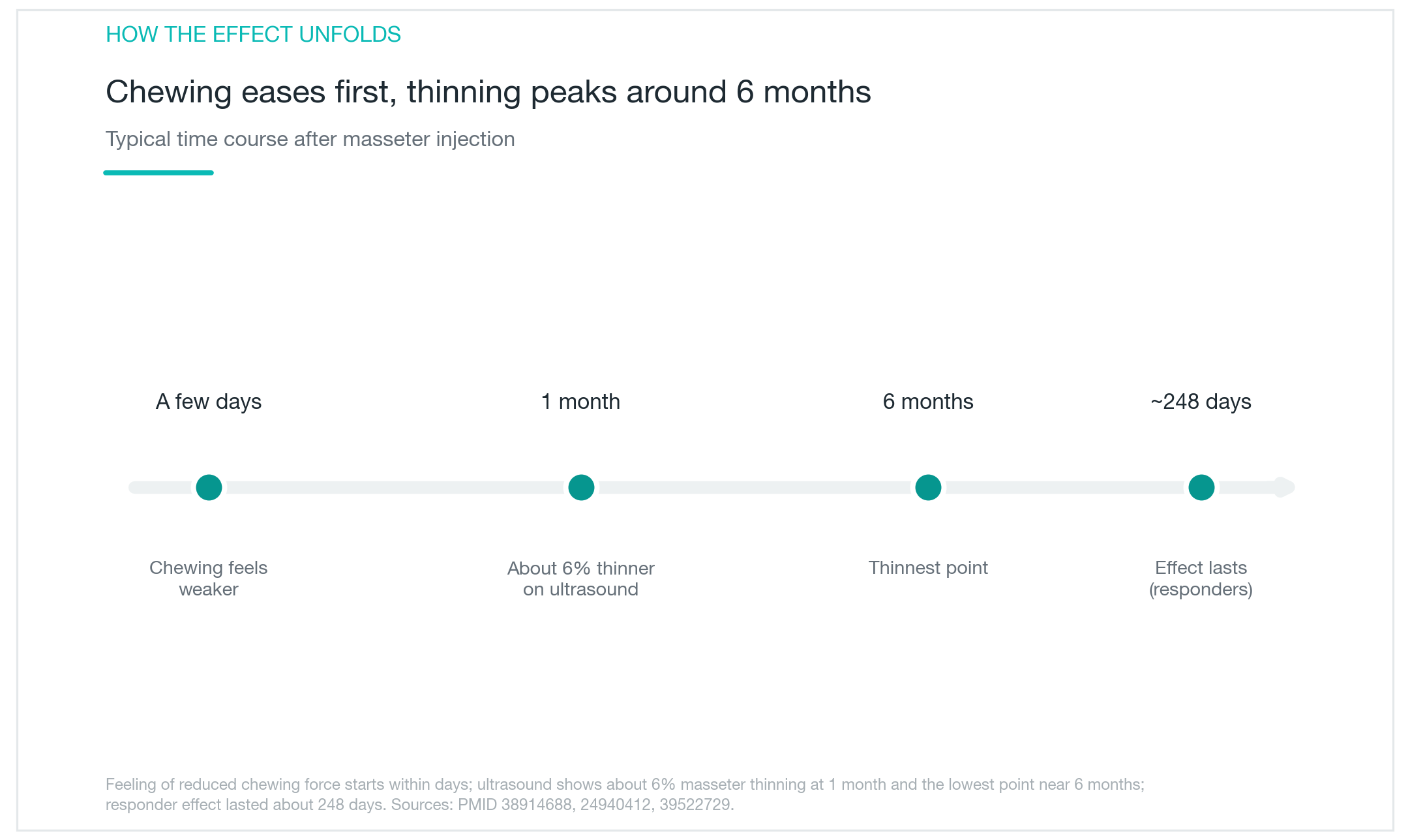
Masseter Botox is not a treatment with instant visible results. The feeling of weaker bite force comes within days, but visible slimming requires time for the muscle to atrophy.
Muscle thickness is measured by ultrasound in both the clenched and relaxed states, comparing before and after treatment. Studies that measured thickness this way found the muscle was already about 6% thinner at 1 month after injection. The visible change in jawline appears over roughly 6–12 weeks, and one study found muscle thickness reached its thinnest point at 6 months before starting to recover.
A single treatment typically lasts about 3–6 months. In one trial, people who received 72 U per side and reached a clear improvement saw the effect last about 248 days. How quickly muscle volume recovers varies widely from person to person, depending on dose, original muscle size, and clenching habits.
Repeat treatments help extend the effect. One study found that muscles re-injected at 3 months stayed thinner at the 6-month mark, while muscles that received only a single injection had mostly recovered their thickness by then. In other words, repeat treatments make the atrophy deeper and longer-lasting. This study had a small sample size, though, so it should be taken as a reference rather than a firm conclusion.
How much slimmer does the jaw actually get?
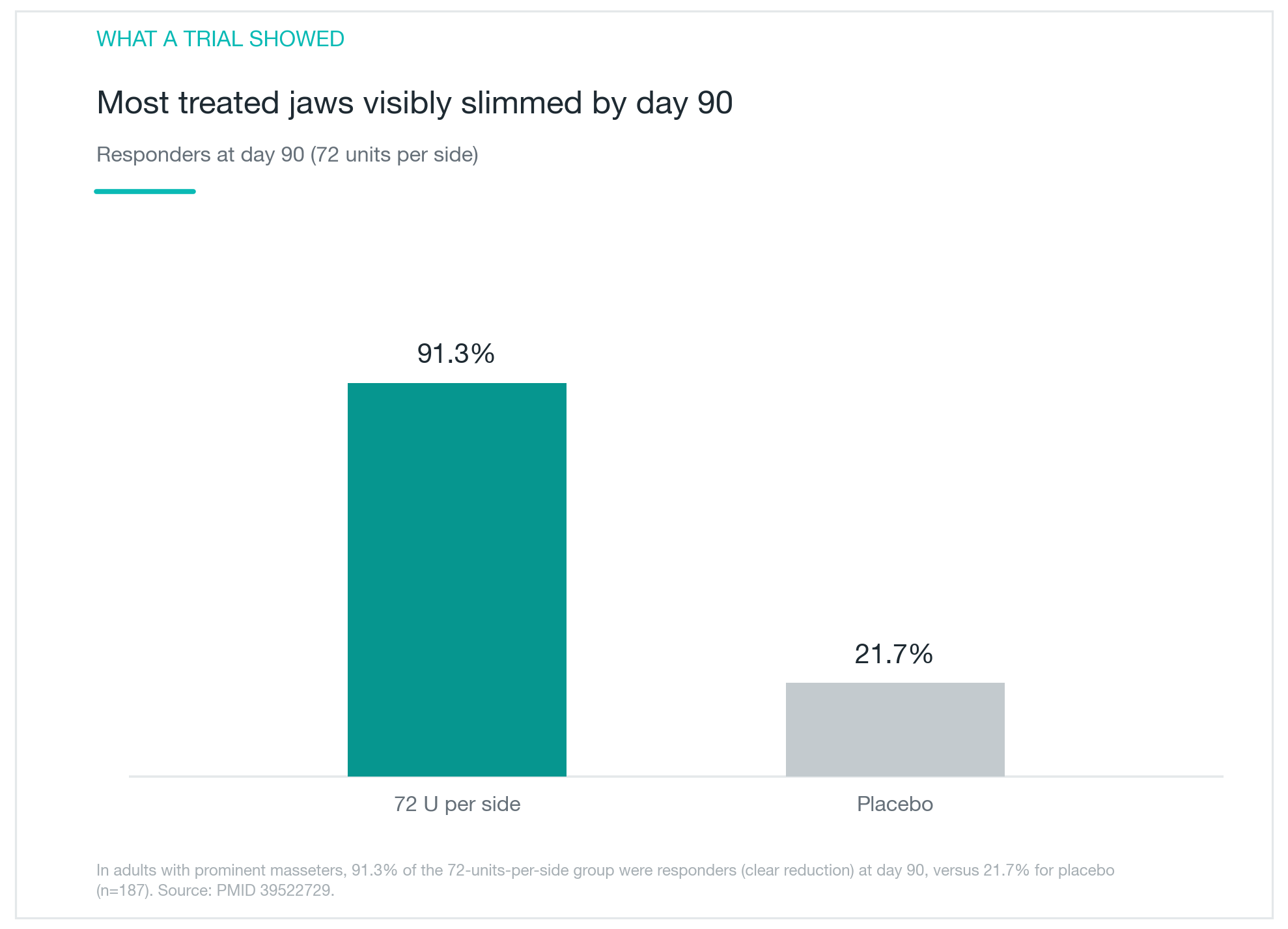
The slimming effect of masseter Botox has been confirmed across several clinical trials. In a trial of 187 adults with a pronounced square jaw, 91.3% of those who received 72 U per side showed a clear reduction in muscle bulging by day 90, compared with 21.7% in the placebo group at the same point. Lower face volume also decreased significantly more than with placebo, and since 72 U and 96 U showed almost no difference in effect, around 72 U is generally seen as a practical upper limit even for very thick muscles.
How much thickness decreases varies widely between studies. As measured by ultrasound, a single treatment reduces thickness by about 6% at 1 month, but figures as high as 30–50% have been reported for repeat treatments, at the thinnest point around 6 months, or in observational studies without a control group. In one comparative study, the two sides differed sharply, at about 49% and 19%.
Because the range is this wide, it is hard to pin down a single percentage for how much thinner the muscle gets. It is more accurate to think of it as a trend: thicker muscles and repeat treatments tend to produce a larger change. Still, the overall slimming effect itself has been confirmed in well-designed trials, making it a reasonable option for softening a square jawline.
Possible side effects and how to handle them
The main side effect to know about with masseter Botox is compensatory muscle bulging. When the toxin mainly reaches the deep muscle and leaves the superficial layer untouched, that remaining layer can bulge out instead during chewing. It usually appears within a day of the injection and fades within about ten days; if it persists, a small touch-up dose in the superficial layer corrects it.
| Side effect | Feature | Management |
|---|---|---|
| Muscle bulging | Superficial muscle bulges instead, usually fades in 10 days | Small touch-up in superficial layer |
| Asymmetry | From uneven dose or depth side to side | Symmetric injection |
| Weaker bite | Mild and temporary | Caution with tough foods |
| Sunken cheeks | Hollow look after repeated overdosing | Dose adjustment |
Asymmetry can be reduced by matching the dose and depth on both sides and marking injection points in advance. A weaker bite is an expected part of how the treatment works, so tough foods may feel harder to chew, but this is usually mild and resolves with time.
If the dose is too high or repeated too aggressively, the muscle and surrounding tissue can atrophy excessively, making the face look hollow. Bruising, pain at the injection site, and temporary headaches can also occur, though serious problems are rare at cosmetic doses. Large-scale data on the exact frequency of these side effects is still limited, so it is better to think of them as general tendencies rather than fixed numbers.
Does it help with clenching and teeth grinding?
Masseter Botox is used not only for cosmetic purposes but also to reduce teeth clenching, nighttime grinding, and the muscle soreness that comes with them. This is because a weaker bite reduces the intensity of grinding and clenching.
| Item | Finding |
|---|---|
| Pain relief | Significant over placebo at 2 weeks to 3 months |
| Durability | Pain returns at 4–6 months, effect temporary |
| Bite force | Maximum bite force drops within 1 month |
| Evidence grade | Mostly Class II, symptom management level |
In a trial of 22 people who grind their teeth at night, pain was markedly lower than with placebo at 2 weeks, 1 month, and 3 months. By 4–6 months, though, pain had returned, which fits with the fact that the effect is temporary. A pooled analysis of multiple studies also confirmed reductions in both maximum bite force and pain.
Overall, the evidence is fairly solid for reducing pain and bite force. Neurology literature generally rates this as Class II evidence. That said, it functions more as symptom management for as long as the toxin's effect lasts, rather than eliminating grinding altogether, so repeat treatment is needed once the effect fades. Being able to expect this kind of symptom relief alongside cosmetic slimming is a practical advantage of masseter Botox.
Was this helpful?
About this article
Written by a practising aesthetic physician and intended for general education — not a substitute for individual medical advice.
Read next

Parotid Botox and Masseter Botox: Differences and Effect Compared
Parotid gland Botox injects botulinum toxin into the parotid salivary gland to shrink its volume and slim the jawline. It targets a different tissue and location than masseter Botox, which works on muscle. Here is what the evidence says about dosing, how long it lasts, and side effects like dry mouth.
By Dr. Kim

Masseter Botox: When It Starts Working, How Long It Lasts, and Changes in Chewing Strength
Jaw slimming Botox blocks the nerve signal that tells your chewing muscle to contract, weakening its grip. As the muscle loses strength, it slowly shrinks, softening a square-looking jawline into a slimmer contour. Here's the science behind when results appear and why duration varies from person to person.
By Dr. Lee

Marionette Line Filler: Results, How Long It Lasts, and Combining With Botox
Marionette lines running from the corners of the mouth down toward the jaw form when the supporting ligaments loosen, the fat pad sags, and the muscle pulling down on the mouth corners adds to the strain. HA filler works by rebuilding this collapsed structure from the inside out, restoring lost volume layer by layer. Here's a look at recovery time, how long results last, and why Botox is often paired with it.
By Dr. Kim