How Long Botox Lasts and Why It Varies: Dose and Antibodies Included
By Dr. Kim7 min read

Most people assume Botox lasts about six months. In practice, though, some patients notice the effect fading after just three months, while others still have smooth skin five months later. Same product, same area, so why the difference?
The answer comes down to how Botox acts on muscle and, just as importantly, how that action wears off, a process that plays out differently in every person. Dose, muscle size and strength, how fast the nerve recovers, and even the body's immune response all combine to decide how long results hold.
How does Botox stop a muscle?
For a muscle to move, a nerve has to send it a signal. That signal travels through acetylcholine (a chemical messenger that carries signals between nerve and muscle), released from the nerve ending. The active ingredient in Botox, botulinum toxin, blocks the point where acetylcholine is released.
More specifically, it cuts a protein called SNAP-25 (a protein required for releasing neurotransmitters), which normally carries the acetylcholine-filled packets to the cell membrane. Think of it like removing the handle from a door. With no handle, the acetylcholine inside can't get out, so the muscle never receives the signal and stays still.
So Botox doesn't destroy or damage the muscle itself. It simply blocks the channel the nerve uses to talk to the muscle, for a while. Once that channel reopens, the muscle moves normally again.
How many months does Botox usually last?
Clinically reported duration for Botox generally falls between three and four months, sometimes as short as two months, and in higher-dose areas it can stretch close to five or six months. That wide range exists because the speed at which the blocked channel reopens simply differs from person to person.
Even at the same dose, people who use a muscle heavily tend to see that channel reopen faster. Making big expressions or repeatedly flexing a muscle hard means the nerve keeps trying more often to push a signal back through.
Age and skin condition are also thought to play some role, though this effect isn't nearly as clear-cut as the muscle's own characteristics, and individual variation is wide enough that it's hard to pin down with numbers. That's why even patients treated at the same clinic by the same provider often see results last a few days differently each time.
Duration by dose and muscle size
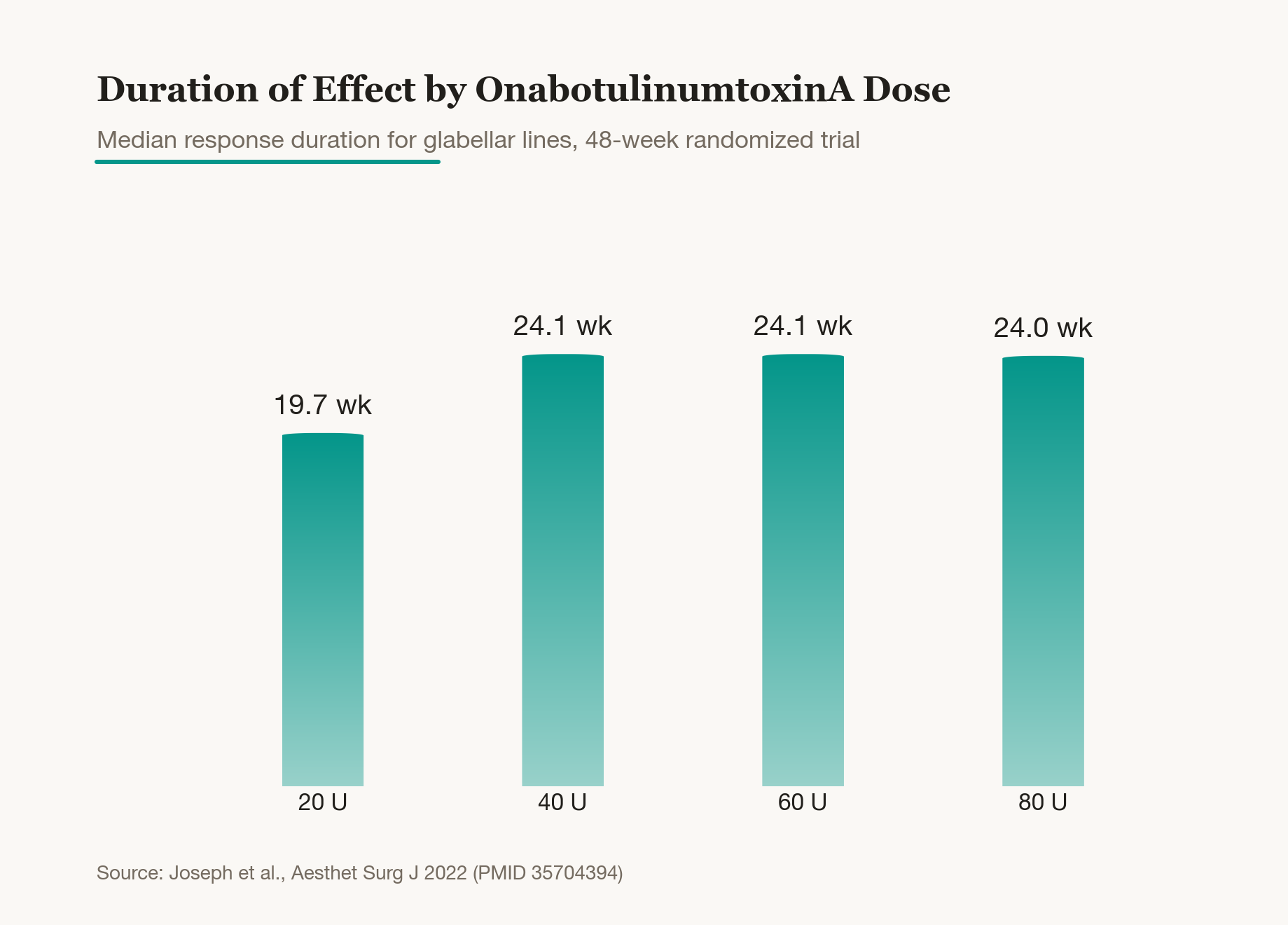
Within the same area, higher doses tend to be reported as lasting longer. One study found that the time until the effect wore off was several weeks longer with a higher dose compared with a lower one. More toxin molecules simply means more channels get blocked at once, so it takes the nerve longer to reopen all of them.
The muscle's own size and strength matter too. Large, powerful muscles like the masseter (the jaw muscle used for chewing) or the calf muscle tend to see the effect wear off faster than smaller muscles, like those around the forehead or eyes, even at the same dose. The simplest way to picture it: a stronger muscle pushes back harder to reopen that channel.
That's why the right dose differs by treatment area. Give a small muscle a dose meant for a large one, and the risk of it spreading to nearby muscles goes up. Give a large muscle a dose meant for a small one, and strength returns quickly. Matching the dose to the muscle's volume and strength is itself what determines how long the result lasts.
How the effect wears off gradually
A nerve ending with a blocked channel doesn't just sit idle. Right next to the blockage, it sprouts new side branches, trying to get a signal through to the muscle another way. It's similar to a temporary detour opening up next to a blocked road.
Thanks to these side branches, the muscle gradually starts moving again as time passes after treatment. Once the original blocked channel fully recovers, though, those temporary branches are no longer needed and get cleared away, the same way a detour closes once it's not needed anymore. This whole process is why Botox seems to wear off gradually rather than all at once.
That's also why it's hard to pinpoint the exact day the effect ends. Wrinkles don't suddenly reappear overnight. Instead, expression slowly comes back over several weeks as branches sprout and then get cleared in overlapping waves. Early on the muscle barely moves at all, in the middle stage it starts moving just a little, and by the later stage it's back to its original strength, and this pattern is exactly why.
Does repeat treatment make it last longer?
Among people who get Botox regularly over time, there's a reported tendency for results to hold up just as well even as the interval between sessions gets longer. This is generally explained by disuse atrophy (a muscle thinning out because it isn't being used), a natural shrinking that happens when a muscle goes underused for a long stretch.
Once a muscle thins out, there's simply less force for the nerve to carry in the first place. So even after the channel reopens, the muscle can't move as strongly as before, which makes the visible effect appear to last longer. That said, this varies a lot by treatment area and by person, so it doesn't show up to the same degree for everyone.
If Botox antibodies form, does it stop working?
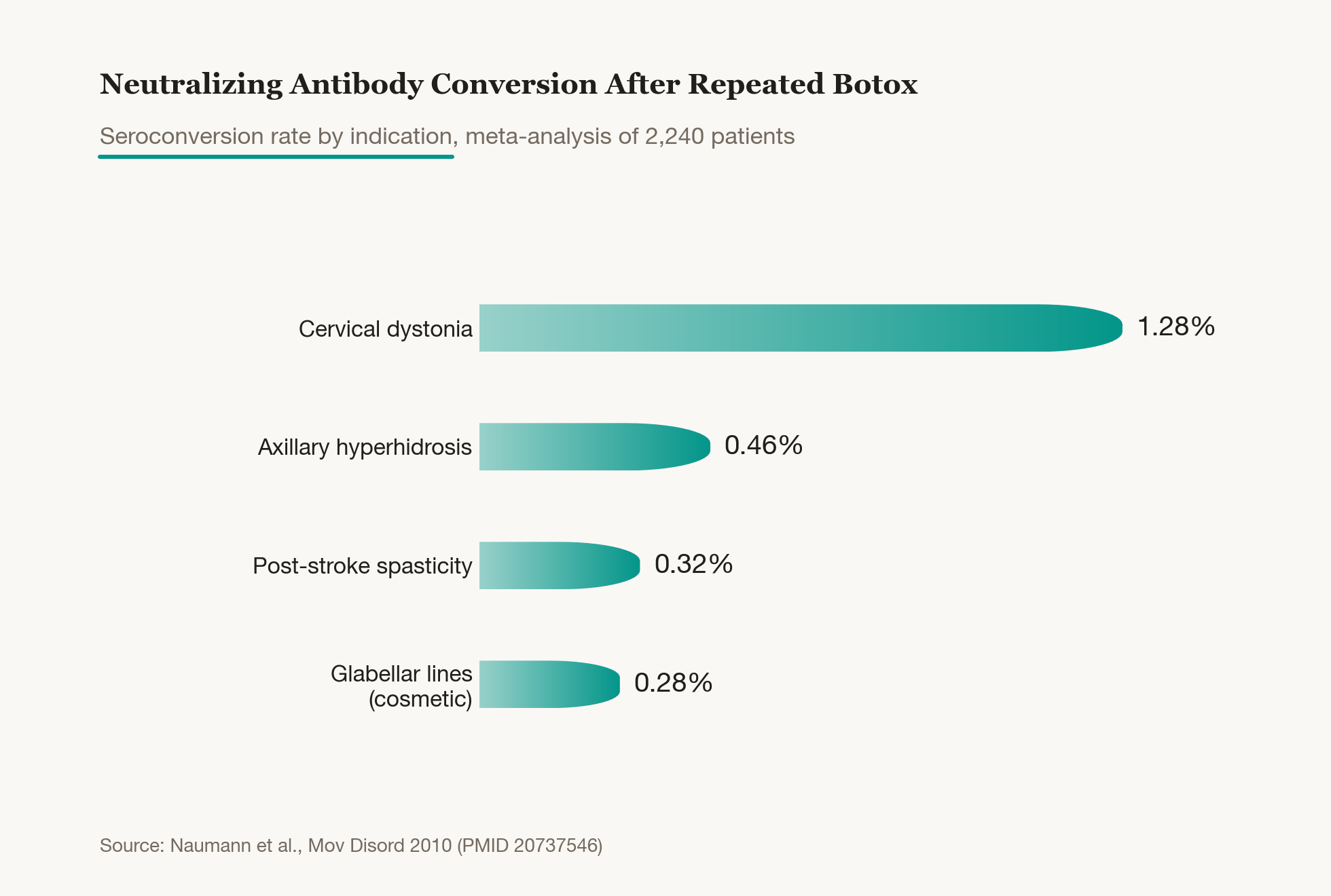
In rare cases, repeated treatment can lead the body to recognize the botulinum toxin protein as foreign and produce neutralizing antibodies against it. Once that happens, future treatments may be weaker or may not work at all, because the toxin gets intercepted by antibodies before it ever reaches the nerve ending.
Antibodies are more likely to form with frequent, short-interval sessions at high doses. So, somewhat counterintuitively, the way to keep results lasting long term is to use only what's needed and to space treatments out with adequate intervals.
Fortunately, cases where antibodies form and the treatment stops working entirely are reported to be uncommon. Newer products tend to be formulated with fewer unnecessary proteins than older ones, which is thought to reduce the chances of the body flagging it as foreign in the first place. Even so, it's best to avoid a habit of frequent, closely spaced treatments.
Aftercare that helps it last longer
Some of the factors that affect duration can be influenced, at least to some degree, by aftercare.
- Avoid rubbing or pressing firmly on the area right after treatment: If toxin that hasn't settled yet spreads to nearby muscles, the effect in the target area can end up shallower than expected.
- Wait until the effect has fully worn off before your next session: Adding more while some effect is still active raises the cumulative dose, which is understood to increase the risk of antibody formation.
- Check your expression habits: Frequently frowning or squinting hard essentially means using the muscle more often and more forcefully, which can make the effect wear off relatively faster.
- Get treated with an accurate dose and injection site: Matching the dose to the muscle's size and strength is guided to help keep the duration within a predictable range.
None of this is a dramatic trick for stretching results out. It's more about helping the mechanisms described above play out the way they're meant to.
References
Korean Dermatological Association, American Academy of Dermatology (AAD), and Ministry of Food and Drug Safety (MFDS).
Was this helpful?
About this article
Written by a practising aesthetic physician and intended for general education — not a substitute for individual medical advice.
Read next
Forehead Botox: When It Starts Working, How Long It Lasts, and Aftercare
Forehead lines form when the frontalis muscle contracts over and over with everyday expressions. Botox works by blocking the nerve signal that tells this muscle to move, not by dissolving the wrinkle itself. Here is how the muscle gets quieted down and why the effect eventually wears off.
By Dr. Kim
Botox for Sweaty Palms: How Many Months Does It Last?
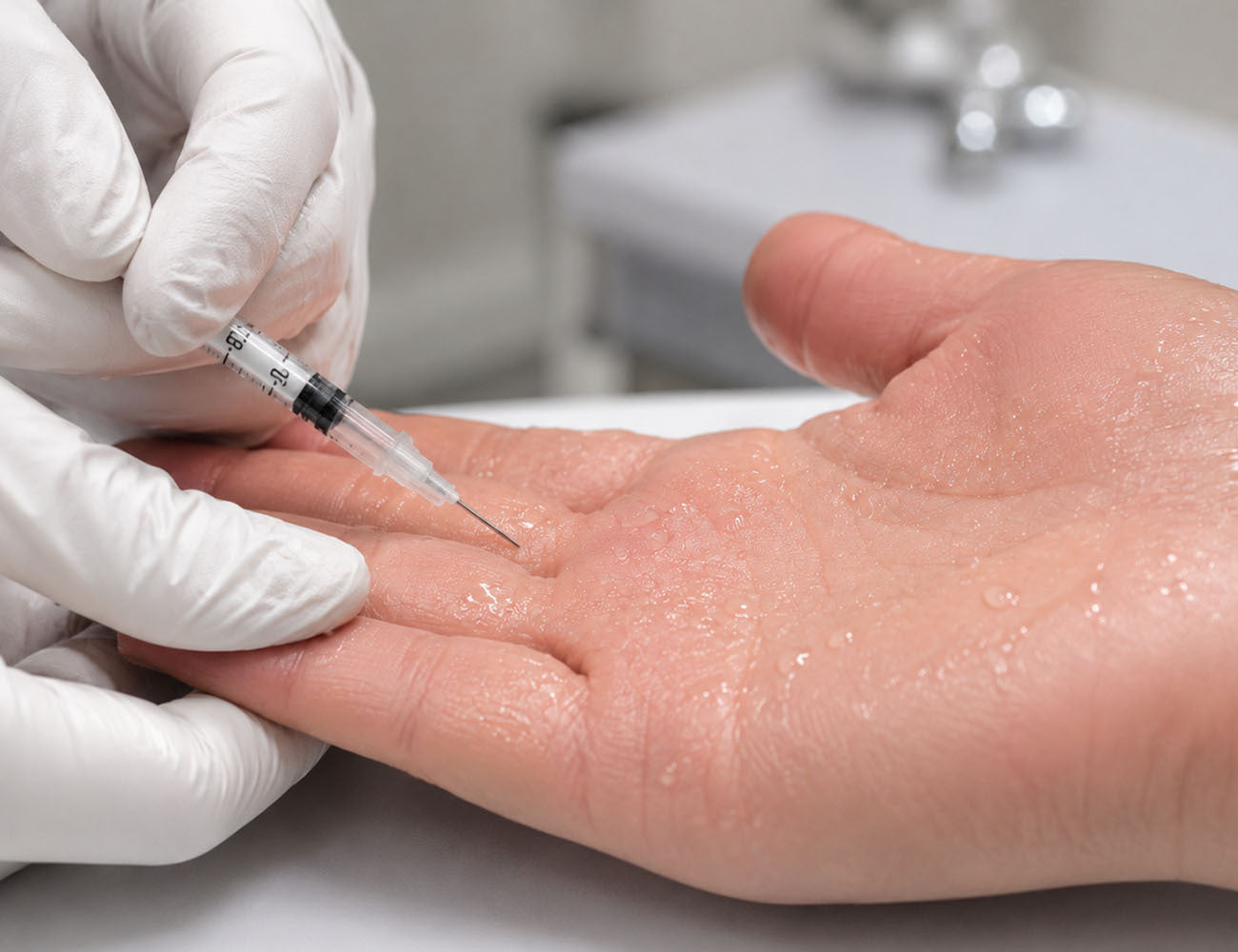
Botox for sweaty palms works by blocking the nerve endings that signal the sweat glands, cutting sweat production at the source. Here is why the effect fades after a few months, how much it hurts, and what decides how long results last.
By Dr. Lee

Marionette Line Filler: Results, How Long It Lasts, and Combining With Botox
Marionette lines running from the corners of the mouth down toward the jaw form when the supporting ligaments loosen, the fat pad sags, and the muscle pulling down on the mouth corners adds to the strain. HA filler works by rebuilding this collapsed structure from the inside out, restoring lost volume layer by layer. Here's a look at recovery time, how long results last, and why Botox is often paired with it.
By Dr. Kim