Mineral and Chemical Sunscreen Differences, Including White Cast and Reapplication
By Dr. Kim8 min read
Everyone knows you're supposed to wear sunscreen every day, not just in summer. But once you actually read the ingredient list, terms like mineral (physical) and chemical filters show up, and explaining exactly how they differ isn't so easy.
The truth is, these two work in completely different ways. One bounces light off the skin's surface, the other absorbs it and gets rid of it entirely. Once you understand the mechanism, it makes sense why some products leave a white cast and others cause irritation.
What Do UVA and UVB Do to Skin?
Sunlight's UV rays are classified by wavelength. UVA has a longer wavelength (320 to 400nm), which lets it penetrate all the way down to the dermis, the deep layer of skin. The dermis is where collagen lives, the protein that works like structural pillars holding up skin's firmness, and UVA reaches those pillars and damages them gradually.
That's why UVA damage doesn't show up right away like a sunburn does, but it's considered the main culprit behind wrinkles and sagging that build up over decades. It's also strong enough to pass straight through window glass, so you're still exposed indoors. If you've ever sat by a window for long stretches and noticed your skin gradually looking duller, even without any burn, that's UVA damage quietly accumulating.
UVB, on the other hand, has a shorter wavelength (290 to 320nm), so it can't reach the dermis and gets absorbed mostly by the epidermis, skin's outer layer. But it carries more energy, which is why it can cause sunburn in a short amount of time. If your skin turns red after just an hour or two at the beach in summer, UVB is the reason.
The epidermis itself actually has no blood vessels. When UVB-damaged epidermal cells release inflammatory signals, the blood vessels in the dermis right below dilate, and that's what makes the skin flush red. The redness and stinging that define sunburn come from those dermal vessels reacting, not from the epidermis itself. UVA, meanwhile, just piles up collagen damage slowly without triggering this kind of acute inflammation, which is why it doesn't hurt or turn red in the moment. It happens quietly.
How Does Mineral Sunscreen Block UV?
Mineral sunscreens are made with fine metal particles like zinc oxide and titanium dioxide. These particles settle on the skin's surface as a thin film.
When UV rays hit the skin, these metal particles act like tiny mirrors, bouncing the light back or scattering it in every direction. The rays get redirected right at the surface, before they ever have a chance to enter the skin. Think of the foil emergency blankets hikers wrap around themselves in winter. Just as the foil reflects body heat back instead of letting it escape, the metal particles in a mineral sunscreen bounce UV rays away before they touch the skin.
Because mineral filters keep UV rays from ever reaching skin cells in the first place, they deliver protection without any chemical reaction. That's part of why they're considered relatively safe for sensitive skin and babies. A chemical reaction requires the ingredient to bind with skin, and since mineral sunscreens skip that step entirely, the odds of irritation or allergic reaction drop naturally.
There's another key feature worth knowing. Since reflection is a purely physical process, protection kicks in the moment you apply it. There's no need to wait for the ingredient to sink in and react. That's exactly why mineral sunscreen is a good option when you're rushing out the door.
How Chemical Sunscreen Blocks UV
Chemical sunscreens rely on carbon-based compounds like avobenzone and octinoxate. Instead of reflecting UV rays, these ingredients absorb the energy directly into themselves.
Once a molecule absorbs UV energy, it briefly enters an excited state, meaning its energy level spikes and it becomes unstable. Like a compressed spring snapping back, the molecule immediately returns to its original shape, converting the absorbed energy into heat and releasing it. It's similar to brushing your hand against a hot pot and pulling away instantly. You take in a burst of heat for a split second, but you don't hold onto it. You release it right away and go back to normal.
In the end, the dangerous light energy of UV rays gets converted into a tiny amount of heat and disappears before it can harm the skin. But this process repeats itself over and over, and the ingredient gradually breaks down as a result, which is why chemical sunscreens are known to lose their protective power over time. Just as a spring loses its bounce after being compressed and released too many times, chemical sunscreen molecules absorb UV rays and release heat hundreds of times a day, and their structure gradually wears down in the process.
Unlike mineral sunscreen, chemical sunscreen doesn't work the instant you put it on. The ingredients need to settle into a stable film on the skin's surface before the absorption reaction can properly start, which is why it's best applied 20 to 30 minutes before heading outside. Skip that window and step straight into the sun, and you're exposing skin to UV rays before the ingredients are even ready.
Why Is White Cast More Noticeable With Mineral Sunscreen?
White cast refers to that chalky, whitish look sunscreen can leave on skin. It's mostly a mineral sunscreen issue.
The reason comes down to particle size. Zinc oxide and titanium dioxide particles also reflect some of the visible light we can actually see, so even a thin layer on skin shows up as a noticeable white film. It's the same reason a single thin coat of white paint on a wall still covers the color underneath instead of letting it show through. When the particles reflect light away, the skin tone underneath can't come through, and what you see instead looks like a white layer sitting on top.
More recent formulas grind these particles down to nano size, which has cut white cast down considerably, though it's difficult to eliminate entirely. Chemical sunscreens, in contrast, only absorb light rather than reflecting it, so they generally sit clear and invisible on skin.
What Do SPF and PA Protect Against?
Check any sunscreen label and you'll find two numbers listed together, SPF and PA. They're measured against two different types of UV rays.
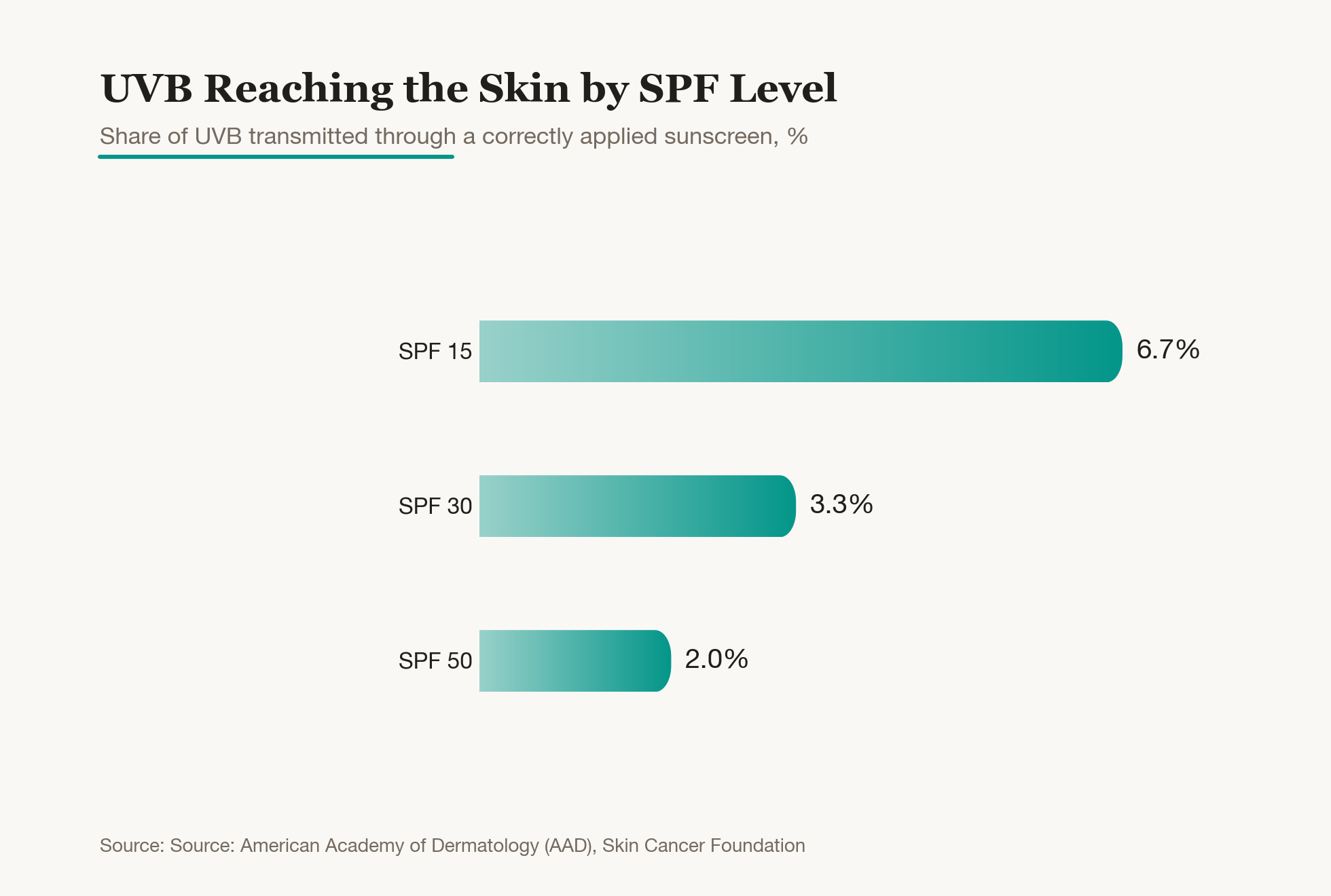
SPF, or Sun Protection Factor, measures how well a product blocks UVB. The higher the number, the longer it delays skin from turning red. Say your bare skin normally turns red after 10 minutes in the sun. SPF15 would, in theory, extend that to 15 times longer, or 150 minutes. In practice, sweat and friction wear it off faster than that, so don't skip reapplication just because the number looks high. PA, or Protection Grade of UVA, measures UVA protection, and more plus signs, as in PA+++, means stronger protection.
Having just one of the two high isn't enough. To protect against both UVA, which damages the dermis, and UVB, which causes sunburn, it's best to check both SPF and PA together.
How Much Sunscreen to Apply and How Often to Reapply
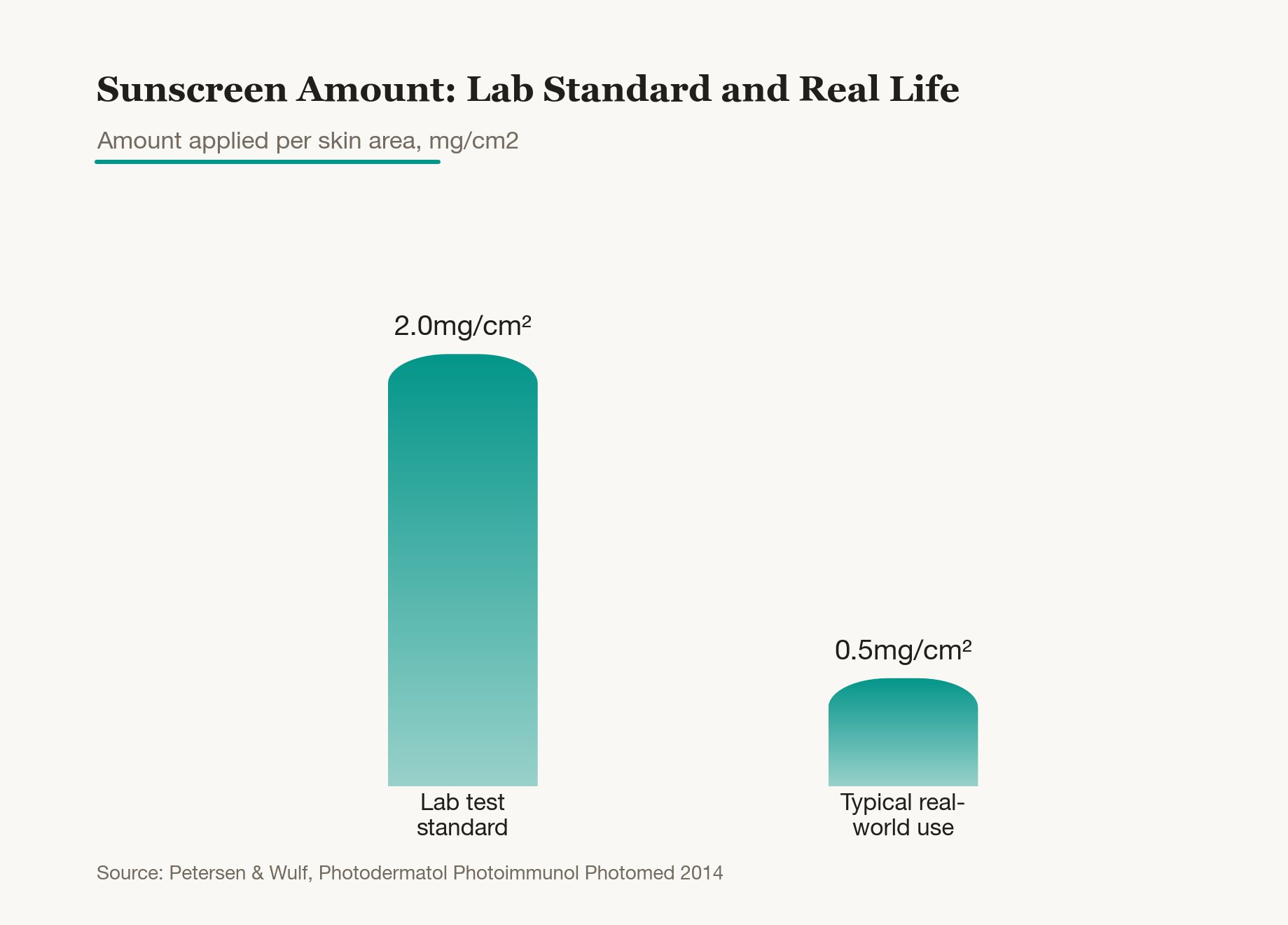
Sunscreen only delivers the protection listed on the label if you apply the right amount and reapply on schedule. Here's what to check.
- Use at least a coin-sized amount for your whole face: the SPF and PA figures on the label are tested at roughly this thickness, so applying less means the real-world protection falls well short of what's printed.
- Reapply every 2 hours once you're out: chemical filters gradually break down as they absorb UV rays, and mineral filters wash away with sweat and oil, so the protective film thins out over time either way.
- Apply it even on cloudy days: clouds block a good amount of visible light but let much of the UV through, so skin keeps getting exposed even when the sun looks weak.
In the end, how thick and how often you apply sunscreen makes a bigger difference than which type you choose. If reapplying with your fingers over makeup feels like a hassle, layering on a cushion or spray sunscreen is a practical workaround.
How to Choose a Sunscreen for Your Skin
It's hard to say mineral or chemical sunscreen is flatly better. Which one suits you depends on your skin.
If your skin is sensitive or flushes easily, mineral sunscreen tends to feel more comfortable. Since it works physically instead of chemically reacting with skin, it carries a lower risk of triggering a breakout.
If you have oily skin and white cast bothers you, chemical sunscreen's light, clear finish tends to be the more popular pick. That said, some chemical filter ingredients have been reported to cause contact dermatitis, so if you notice repeated stinging or redness, switching to a different ingredient is worth trying.
There are also plenty of hybrid formulas now that combine both approaches, using reflection and absorption together to cut down white cast while keeping protection strong. Splitting sunscreen by body area is another option many people use, mineral filter on the face where irritation is more of a concern, and a light chemical filter on arms and legs that get heavy sun exposure. There's no single fixed answer here. It's more about reading the signals your own skin gives you and finding what works.
References
Korean Dermatological Association, Ministry of Food and Drug Safety (MFDS), American Academy of Dermatology (AAD), and U.S. Food and Drug Administration (FDA).
Was this helpful?
About this article
Written by a practising aesthetic physician and intended for general education — not a substitute for individual medical advice.
Read next
Filorga NCTF 135 Ingredients and the Difference From Water-Glow Injections, Including Sessions and Interval
Filorga NCTF 135 is a mesotherapy treatment that delivers vitamins, amino acids, minerals, and hyaluronic acid, dozens of ingredients in a single syringe, straight into the dermis. Here's a principle-first look at why so many ingredients are mixed together, what each one actually does in the skin, and how this differs from a classic skin booster.
By Dr. Kim

Lara Peel Effects and Irritation, Including Treatment Interval and Suitable Skin
Lara Peel was developed for sensitive skin that finds stinging, peeling treatments too harsh. It combines LHA with an alkaline ingredient to gently smooth away dead skin cells. Using real research on LHA and other gentle peel ingredients, here is a look at how it works on texture and pores.
By Dr. Lee
IPL Effects on Dark Spots and Redness, Including Sessions and Differences From Laser
Unlike a laser, which fires a single wavelength, IPL releases a broad spread of light all at once. That's what lets it reach two very different targets, melanin and hemoglobin, in the same pass, and understanding that mechanism explains why it's said to treat multiple concerns in one session.
By Dr. Kim