Filorga NCTF 135 Ingredients and the Difference From Water-Glow Injections, Including Sessions and Interval
By Dr. Kim8 min read
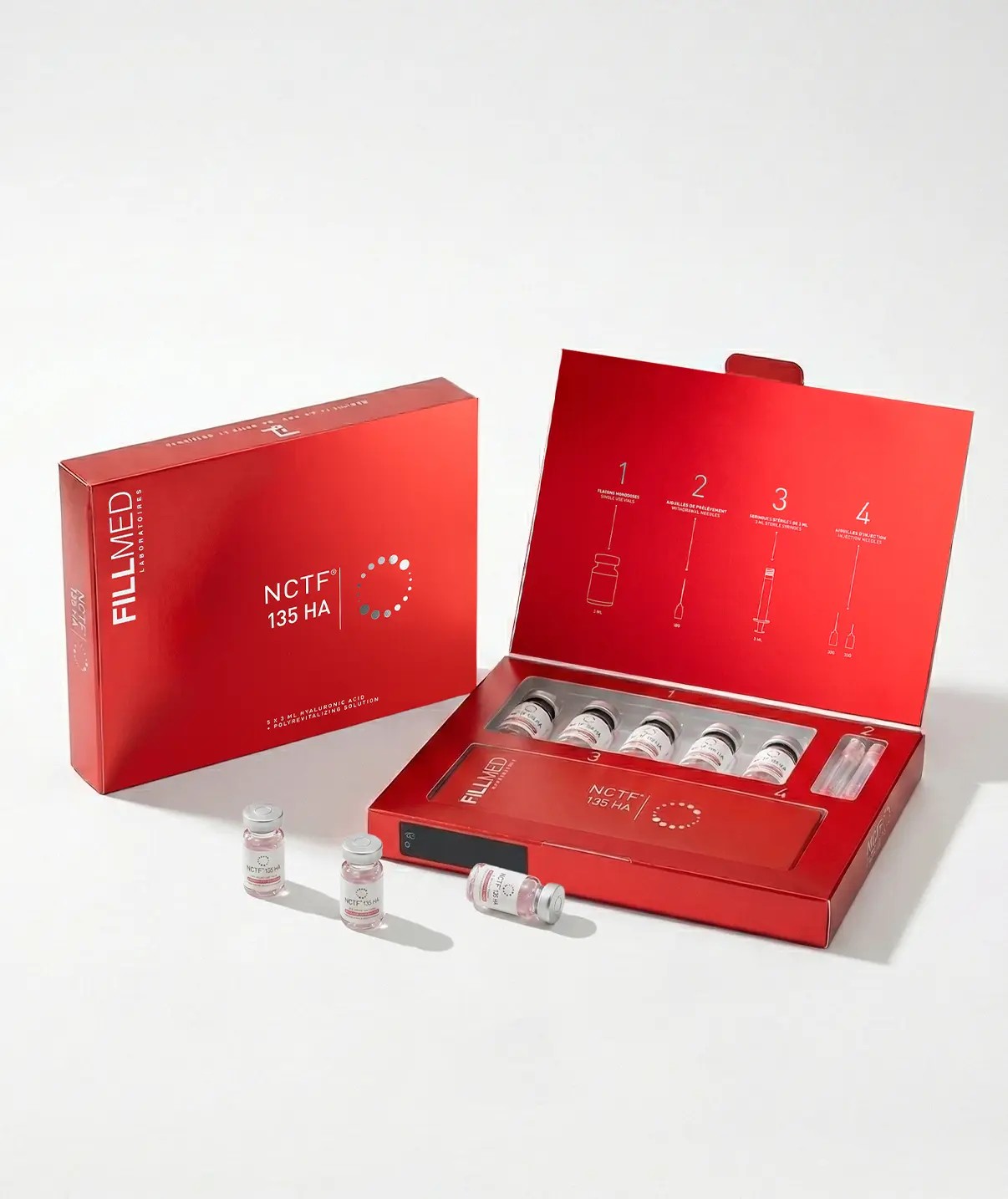
Chances are you've heard the name Filorga NCTF 135 somewhere, at a mom group chat or in a dermatology clinic waiting room. It's known for delivering vitamins, amino acids, minerals, and hyaluronic acid into the dermis, all in one syringe. And it's not just one ingredient doing the work. More than 53 ingredients are blended together, which naturally raises the question of what's actually going on.
Can loading up on that many nutrients at once really bring skin back to life? Below, we break down why this particular combination is used, what each ingredient is actually doing under the skin, and how it differs from a skin booster like the popular "glass skin" injections, all with a focus on the underlying mechanisms.
Why mix several ingredients together?
Sagging, dull skin rarely comes down to a single cause. Collagen, the structural pillar that holds skin up, declines. Cellular metabolism slows. Free radical damage builds up over time. These problems overlap and compound each other. Inject just one ingredient, and you're only addressing one of those pathways.
A garden makes the logic easier to picture. A wilting plant doesn't spring back to life just because you give it water. It needs water, fertilizer, and sunlight together to actually thrive. Filorga NCTF 135 works on the same principle: it packs in a range of ingredients to support several pathways at once, rather than betting everything on one.
- Vitamins (B-complex, C, E, and others): they support cellular metabolism and antioxidant defense, which ties directly into how fast skin regenerates.
- Amino acids: these are the literal building blocks of collagen and elastin, so they're non-negotiable.
- Minerals and coenzymes (helper molecules that assist chemical reactions inside cells): they help regulate how fast those internal reactions run.
- Hyaluronic acid: it holds onto water molecules, keeping hydration levels in the skin topped up.
What's interesting is that these ingredients don't work in isolation. For vitamin C to help the enzyme that builds collagen do its job, the raw material, amino acids, needs to be sitting right there alongside it. Tools without materials, or materials without tools, and the work grinds to a halt. When both are present in the same place at the same time, the process is understood to speed up noticeably, and that's the biggest difference from a single-ingredient injection.
What do vitamin C and B vitamins do?
Vitamin C acts as a coenzyme, helping the enzyme responsible for building collagen do its job properly. If you picture collagen production as a factory floor, vitamin C is closer to the lubricant that keeps the machinery from grinding to a halt. It also pulls double duty as an antioxidant, neutralizing the free radicals that damage cells.
Free radicals are a problem because they activate MMPs (matrix metalloproteinases, enzymes that act like scissors, slicing through collagen fibers). When that pillar of collagen keeps getting cut, skin loses its ability to hold firm and stay elastic. Antioxidants working alongside vitamin E are reported to dial down that scissor action.
The B vitamins work along a different track. They're essential materials for the entire process of cells generating energy and turning over into new cells, so a shortage can slow down the regeneration process itself. Think of it as the electricity supply on a construction site: cut that off, and the building work stalls.
The role of amino acids and hyaluronic acid
Amino acids are the smallest building blocks of protein. Collagen and elastin, the pillars and elastic fibers of skin, are ultimately just amino acids linked together in chains. Just as you can't build a pillar without bricks, when amino acid supply runs short, fibroblasts (the cells that actually spin out collagen) hit a wall no matter how hard they're working.
Hyaluronic acid plays a different role. It has the ability to hold onto water molecules hundreds of times its own weight, essentially creating a hydration reservoir inside the skin. When that reservoir is full, skin looks plumper, and fine lines tend to stand out less.
The two ingredients take on separate jobs, but the end results overlap. If amino acids are the work of erecting the pillar itself, hyaluronic acid is the work of filling the space between those pillars with water to keep everything firm and supported.
Among the amino acids, glycine, proline, and lysine are considered especially important for twisting together the rope-like structure of collagen. Collagen protein is made of three strands twisted together like a braided cord, and glycine needs to appear at regular intervals along each of those three strands for the structure to stay tight and intact. If even one of these building blocks runs short, the braid loosens, and the collagen structure can weaken right along with it.
Why inject into the dermis instead of using cream?
The name mesotherapy (a treatment that injects active ingredients directly into the dermis, the middle layer of skin) already tells you where it's headed. The epidermis, the outermost layer of skin, is woven tightly to act as a barrier against outside substances. That's exactly why slathering on cream or ampoules, no matter how much, mostly stops at the epidermis. Most active ingredients never make it down to the dermis at all.
The fibroblasts that produce collagen, along with blood vessels, sit in the dermis, below the epidermis. So for an ingredient to actually reach where it's needed, it has to get around that barrier. Injecting directly into the dermis with a fine needle is exactly that: a way of bypassing the barrier and delivering the ingredients straight to where they're needed.
In practice, a very fine needle taps in anywhere from dozens to hundreds of tiny injection points across the skin. Rather than pushing a large volume in deep at once, the approach spreads small amounts across many shallow points. That way, the ingredients don't pool in one spot in the dermis; they spread evenly across the whole treated area.
How is it different from water-glow injections?
What's commonly known as a "glass skin" injection is typically a skin booster built mainly around hyaluronic acid, with a relatively simple ingredient list. The goal leans heavily toward boosting hydration and radiance.
Filorga NCTF 135 takes a different approach by layering in vitamins, amino acids, minerals, and coenzymes on top of the hyaluronic acid. Rather than chasing a single goal like hydration, it's designed to support several pathways at once, cellular metabolism, antioxidant defense, and the raw materials for collagen production. Think of it as the difference between simply topping up water and actually reconditioning the environment cells need to do their work.
How many sessions build up results?
The nutrients injected get metabolized by the body and gradually used up over time. And the process by which cells absorb these ingredients and translate that into actual collagen synthesis or improved metabolism doesn't complete in a single stimulus either. It tends to build gradually across 3 to 5 sessions.
It's similar to how a plant doesn't keep growing just because you soaked it in water once. Repeated sessions spaced at regular intervals give cells the conditions they need to keep up regeneration activity consistently. That's why treatment is generally recommended across 3 to 5 sessions, spaced 2 to 3 weeks apart.
Duration of effect and maintenance interval
The turnover cycle of skin cells runs about 4 weeks, and the cycle of collagen synthesis and breakdown runs on a 4 to 12 week basis. The regeneration activity triggered by the injected nutrients doesn't escape that same cycle. Over time, the stimulated effect naturally fades, and metabolism gradually settles back to its baseline pace.
On top of that, as we age, or with continued exposure to outside factors like UV light and stress, the forces that break down collagen tend to regain the upper hand. That's why, rather than trying to hold onto the results of a single session indefinitely, maintenance sessions every 4 to 8 weeks are commonly recommended. The point of maintenance isn't to restart from scratch after the effect disappears. It's to smooth out that fading curve itself.
Precautions and aftercare
Because the treatment involves repeated fine needle stimulation across the dermis, some redness, minor bruising, or slight swelling can show up right after the session. This is a natural reaction from the needle lightly nicking shallow capillaries as it passes through, and it typically settles within 2 to 5 days.
It's best to avoid touching or rubbing the treated area firmly for about 2 to 3 days, since that can add extra strain to already-stimulated skin. UV exposure is also worth watching closely, since it can ramp up free radical activity during the skin's regeneration process and intensify inflammation, so keeping up sun protection more diligently than usual for about a week after treatment is a good idea.
This treatment is known to suit dry, less elastic skin, and dull skin tone particularly well. That said, if there's active inflammation or a wound at the treatment site, needle stimulation could aggravate that area further, so it's safer to wait until it has settled before going ahead.
References
Korean Dermatological Association, Ministry of Food and Drug Safety (MFDS), American Academy of Dermatology (AAD), and U.S. Food and Drug Administration (FDA).
Was this helpful?
About this article
Written by a practising aesthetic physician and intended for general education — not a substitute for individual medical advice.
Read next
Lilied Sinmulgwang Effects and Duration, Including Aftercare
Lilied Sinmulgwang is a skin booster that injects purified hyaluronic acid straight into the dermis to hold onto water. Here is a principle-first look at how hyaluronic acid grips moisture and what actually happens beneath the skin after treatment.
By Dr. Lee

Water Glow Injection and Skin Booster: Differences and Purpose by Ingredient
A water glow injection is one type of skin booster that uses hyaluronic acid to add hydration, while skin boosters are a broader category that also includes ingredients supporting tissue regeneration. Here is a look at what each treatment actually contains and what it is designed to achieve.
By Dr. Lee
Ulfit Body HIFU Fat Reduction Effect: How Many Sessions Do You Need?
Ulfit Body HIFU is a non-surgical body contouring treatment that focuses ultrasound energy on the fat layer beneath the skin, gradually shrinking fat cells with heat. Here is a principle-first look at why the ultrasound heats only fat and nothing else, how that destroyed fat actually leaves your body, why the settings differ from facial HIFU, and roughly how many sessions and how much maintenance you can expect.
By Dr. Kim