Sunscreen SPF and PA Differences, and How Much to Apply
By Dr. Lee7 min read
Sunscreen is the one skincare step with the most solid evidence behind it. And yet most people are fuzzy on what SPF actually measures, what PA means, or how much to put on for the label to be accurate. Get it wrong and you can apply religiously every morning and still get a fraction of the protection you're expecting.
The short version: sunscreen is one of the very few things proven in well-designed trials to slow skin aging and reduce the risk of skin cancer. No expensive procedure matches what a consistent daily habit can do over a decade. But you only get the labeled protection if you apply enough and reapply on time. Below is a breakdown of the numbers, the two filter types, the evidence, the common myths, and how to actually make it work day to day.
How Are SPF and PA Different?
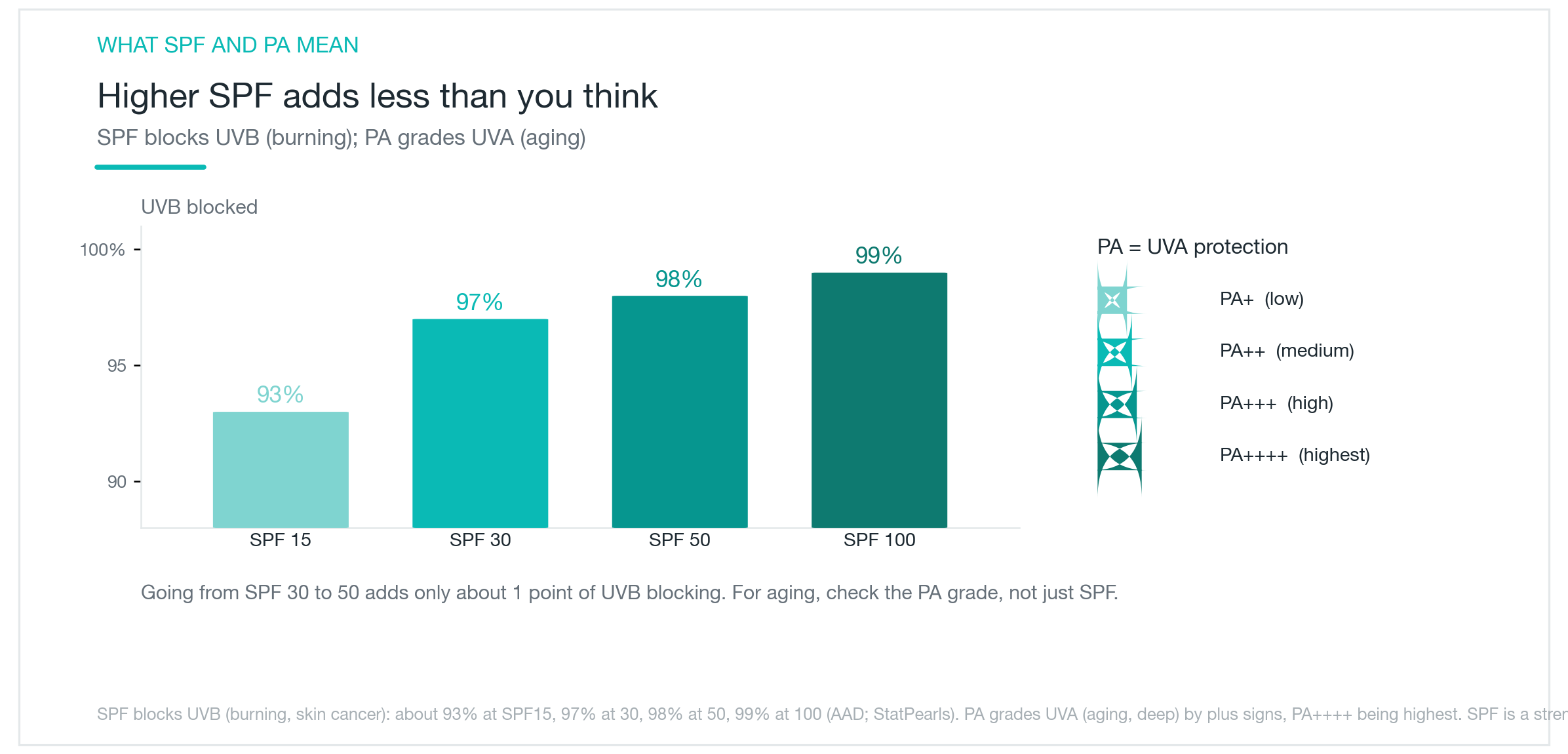
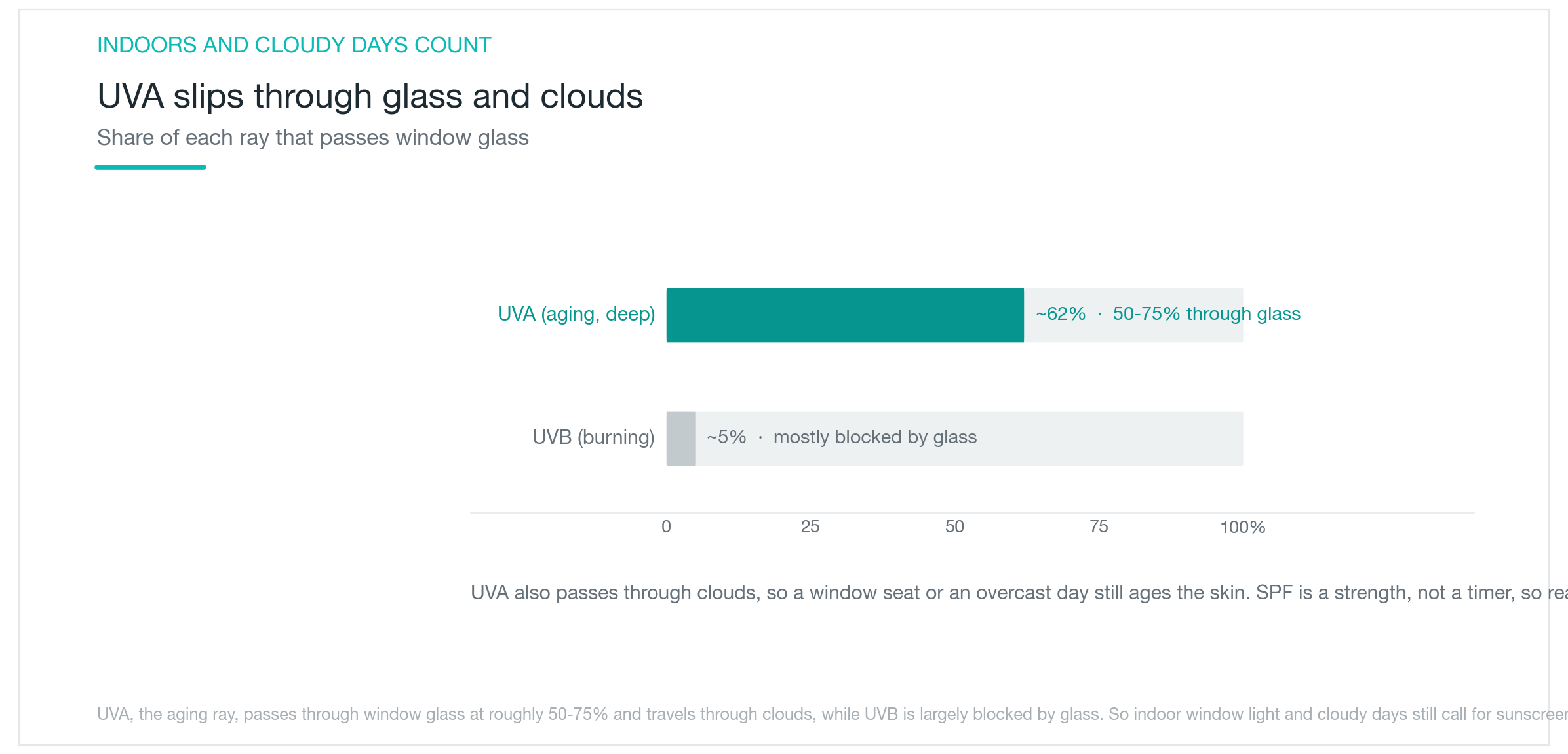
The two labels cover two different types of UV radiation. UVB hits the surface of the skin, causes burning and redness, and is closely linked to skin cancer. UVA penetrates deeper, driving wrinkles and pigmentation over time. UVA also passes through window glass at more than half its full intensity.
SPF tells you how well a product blocks UVB. The numbers can be misleading because the jumps look bigger than they are. SPF 15 blocks about 93% of UVB; SPF 30 blocks about 97%; SPF 50 gets to about 98%. Going from SPF 30 to SPF 50 adds only about 1 percentage point of real-world protection. Also worth noting: SPF is a measure of intensity, not time. A higher number doesn't mean you can go longer between applications.
PA is the UVA rating, expressed in plus signs. More plusses mean stronger UVA protection, with PA++++ being the highest tier. If aging is your main concern, PA is just as important as SPF. A simple way to think about it: SPF covers burning and skin cancer risk; PA covers long-term aging.
Why Amount Matters More Than the SPF Number
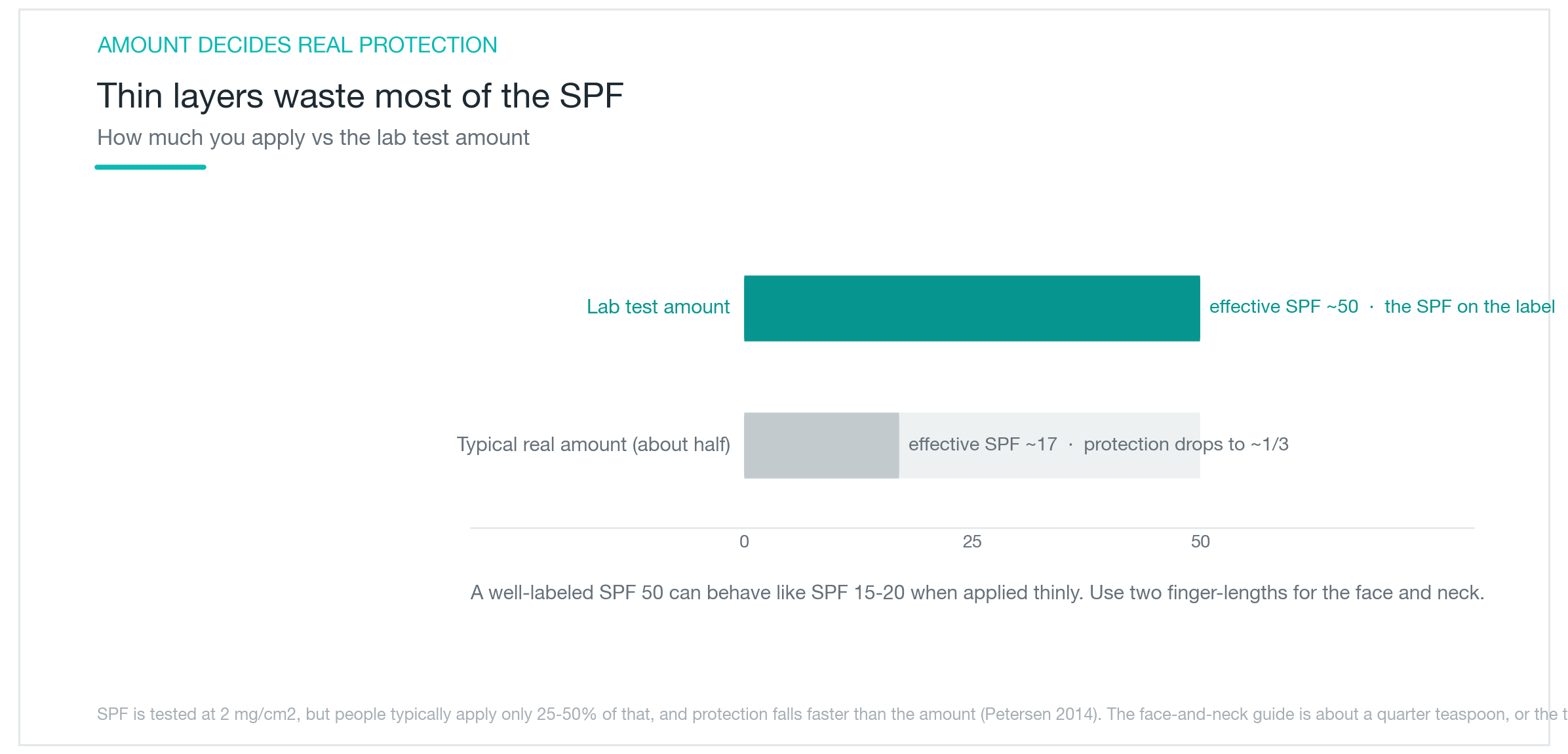
This is where most sunscreen routines quietly fall apart. SPF is tested in labs using 2 milligrams per square centimeter of skin, which is a generous layer. In practice, studies find people typically apply between a quarter and half that amount.
The problem is that the drop in protection isn't linear. Applying too little means an SPF 50 product may only deliver protection closer to SPF 15. You could be careful about SPF selection and still come up short.
The recommended amount for the face and neck is about a quarter of a teaspoon, roughly what fills two fingers from knuckle to tip. It feels like more than you'd expect, but that's the standard worth building toward. Reapplication matters too: every two hours outdoors, and right after sweating heavily or getting in the water. Relying on a single morning application to carry you through the day is where protection quietly slips.
The practical takeaway: applying enough, consistently, does more than chasing a higher SPF number with a thin layer.
Can You Trust Chemical Sunscreens?
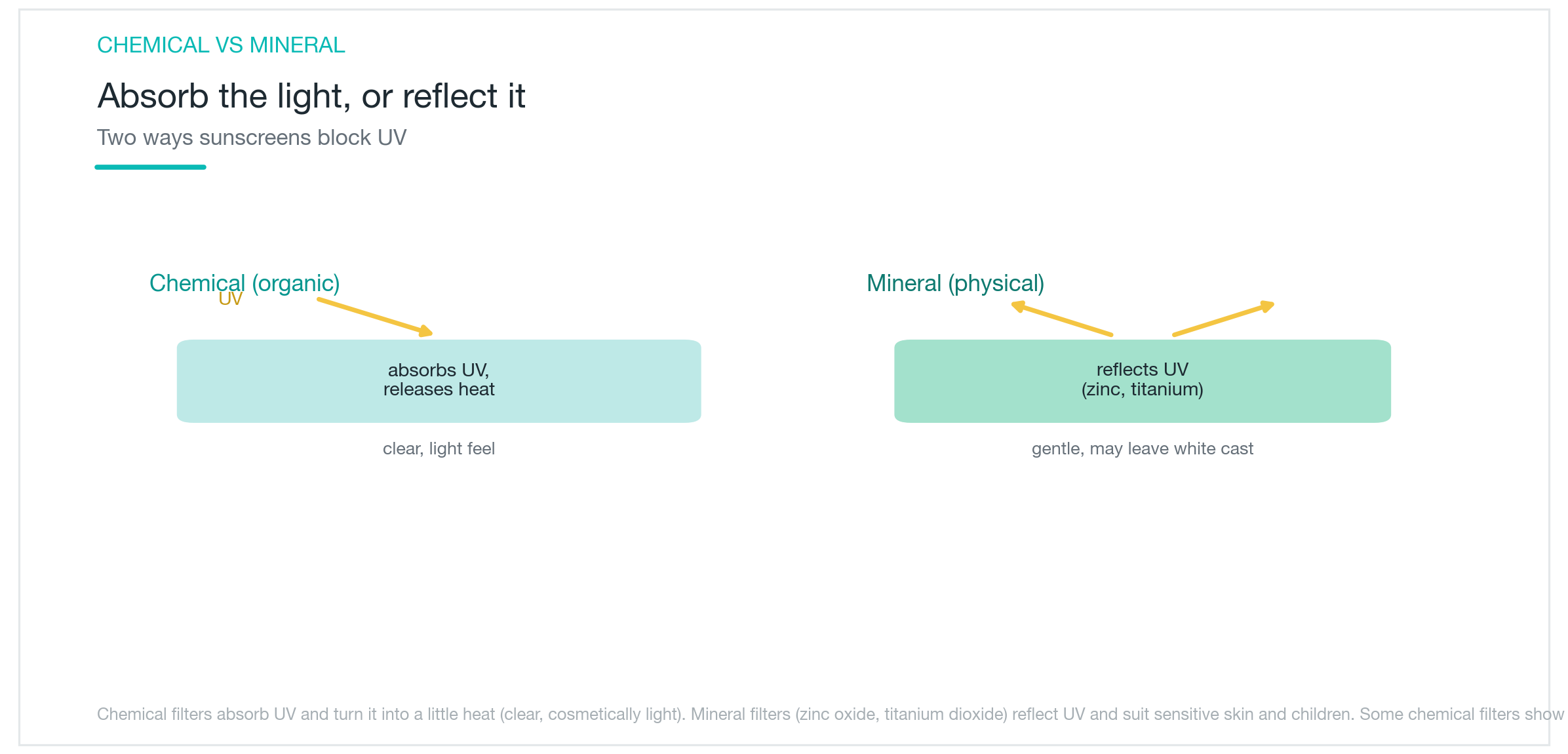
Chemical (organic) sunscreens absorb UV radiation and release it as heat. They tend to blend in smoothly and go transparent on the skin, which makes them popular as a makeup base. Physical (mineral) sunscreens use zinc oxide or titanium dioxide to reflect UV at the surface. They're generally gentler and well-suited for sensitive skin or children, though some formulations leave a mild white cast.
A few years ago, studies reported that ingredients from chemical sunscreens can be detected in blood after full-body application. In one study, certain ingredients showed up at concentrations above the threshold that would normally trigger further safety review. Both the researchers and the FDA were clear on the response: detection does not mean harm, and they explicitly recommended against stopping sunscreen use.
Chemical sunscreens have a long track record of safe use, and no actual harm has been established from the blood-absorption finding. If that still feels uncertain or you have reactive skin, zinc oxide-based physical formulas are a solid alternative. What matters most is staying consistent with whichever type you'll actually use every day.
Effect on Aging and Skin Cancer Prevention
This is where sunscreen's reputation is fully earned, backed by actual trials rather than marketing.
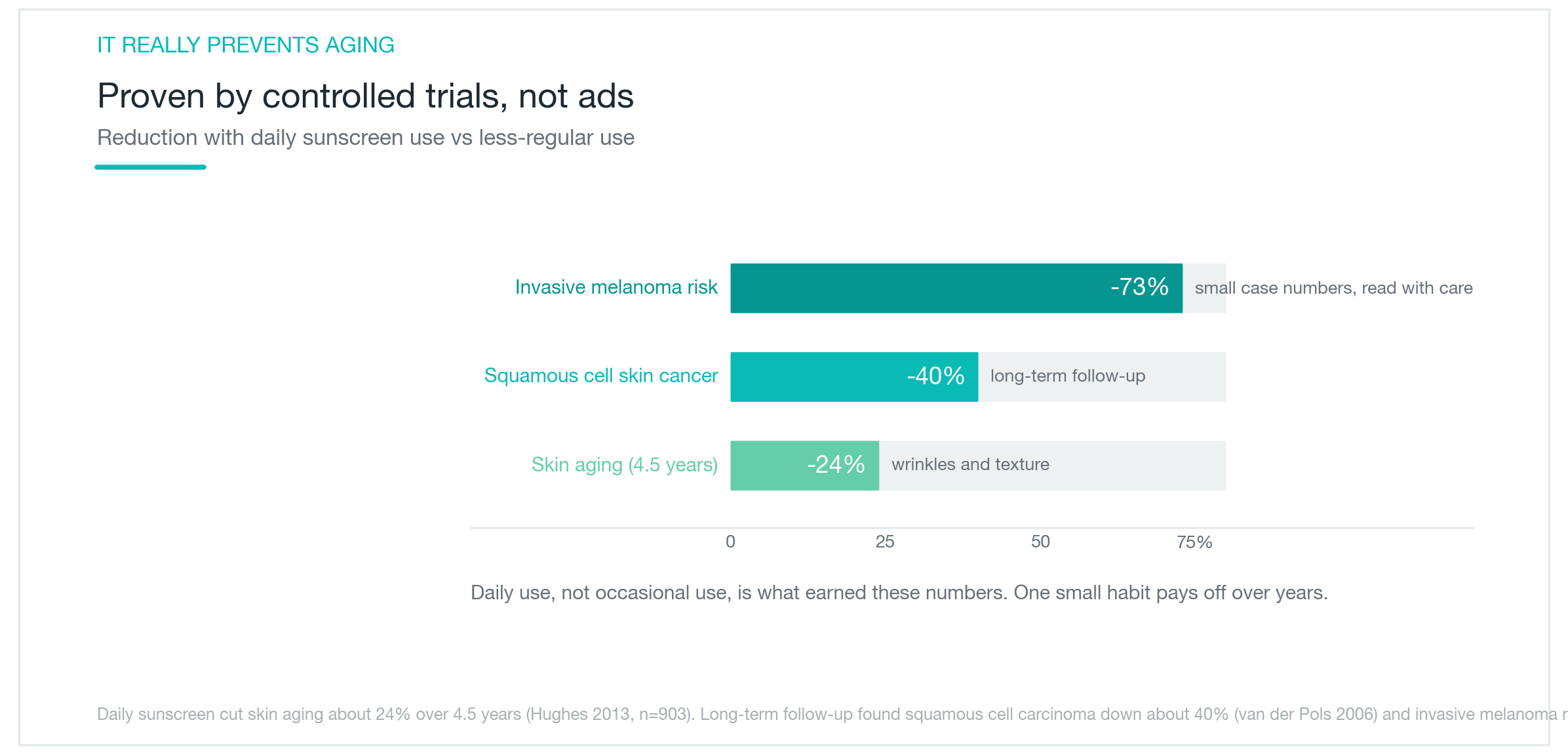
On aging: a study followed around 900 adults split into two groups, one applying sunscreen daily and the other using it as needed, over four and a half years. The daily-use group showed 24% less skin aging, measured by real changes in wrinkling and texture. Four and a half years is a short window in skin terms; over 10 to 20 years, the difference compounds considerably.
On skin cancer: in a long-term follow-up study from the same population, the daily-use group had roughly 40% fewer squamous cell carcinomas. There was also a meaningful reduction in invasive melanoma risk, though the case numbers are smaller and interpretation requires some caution. The key detail in both findings is that the protection came from the daily-use group specifically. These weren't comparisons against no sunscreen; they were against occasional use. Consistent daily application, not just applying when it feels necessary, is what produced the results.
Do You Need Sunscreen on Cloudy Days and Indoors?
A few widespread misconceptions are genuinely worth addressing because they reduce real-world protection.
First, the idea that a high SPF removes the need to reapply. SPF measures intensity, not duration. Even SPF 100 needs to go back on every two hours, sooner after heavy sweating or water exposure.
Second, thinking sunscreen isn't necessary indoors or on cloudy days. UVA, the main driver of long-term aging, passes through window glass at more than half its full strength and cuts through cloud cover effectively. If you spend significant time near windows or are regularly out on overcast days, daily application is still worthwhile for skin aging prevention.
Third, the difficulty of reapplying over makeup. It's not seamless, but powder, cushion, and stick formats can be pressed on without disrupting a full face. Imperfect reapplication still outperforms skipping it entirely.
Fourth, expectations around oral supplements marketed as "drinkable sunscreen." Antioxidant supplements may offer some complementary support at the cellular level, but they don't block UV in any way comparable to a topical product. They're a possible add-on, not a substitute for what you apply to the skin.

Recommended Amount and Reapplication Interval
The principle is straightforward: daily, enough, and often. For everyday use, SPF 30 or higher with a strong PA rating (PA+++ or PA++++) and broad-spectrum coverage covers all situations well. On days with extended outdoor time, SPF 50 with water resistance is a sensible step up. Sensitive skin or younger children generally do better with zinc oxide-based mineral formulas.
Amount and timing are the real levers. Two fingers' worth across the face and neck, reapplied every two hours outdoors, and promptly after water or sweat. The best SPF product used sparingly doesn't perform like a moderate product used properly. Since you're applying this daily, finding a texture you actually like makes consistency far easier to maintain.
Sunscreen also works best as part of a broader approach: a wide-brimmed hat, sunglasses, shade when possible, and avoiding peak UV hours around midday. None of these replace topical application, but layering them meaningfully reduces total UV exposure. The daily habit, built into the morning routine, is what compounds over time into a measurable difference for your skin.
Was this helpful?
About this article
Written by a practising aesthetic physician and intended for general education — not a substitute for individual medical advice.
Read next

Sunscreen SPF and PA Differences: How Much Should You Apply?
Summer sunlight splits into UVB, which burns the skin red, and UVA, which quietly breaks down collagen deep inside. Here is what SPF and PA actually block, how to apply sunscreen the right way, and how antioxidants round out summer skin care.
By Dr. Kim
Keratosis Pilaris Causes, Keratolytics, and Laser Effects
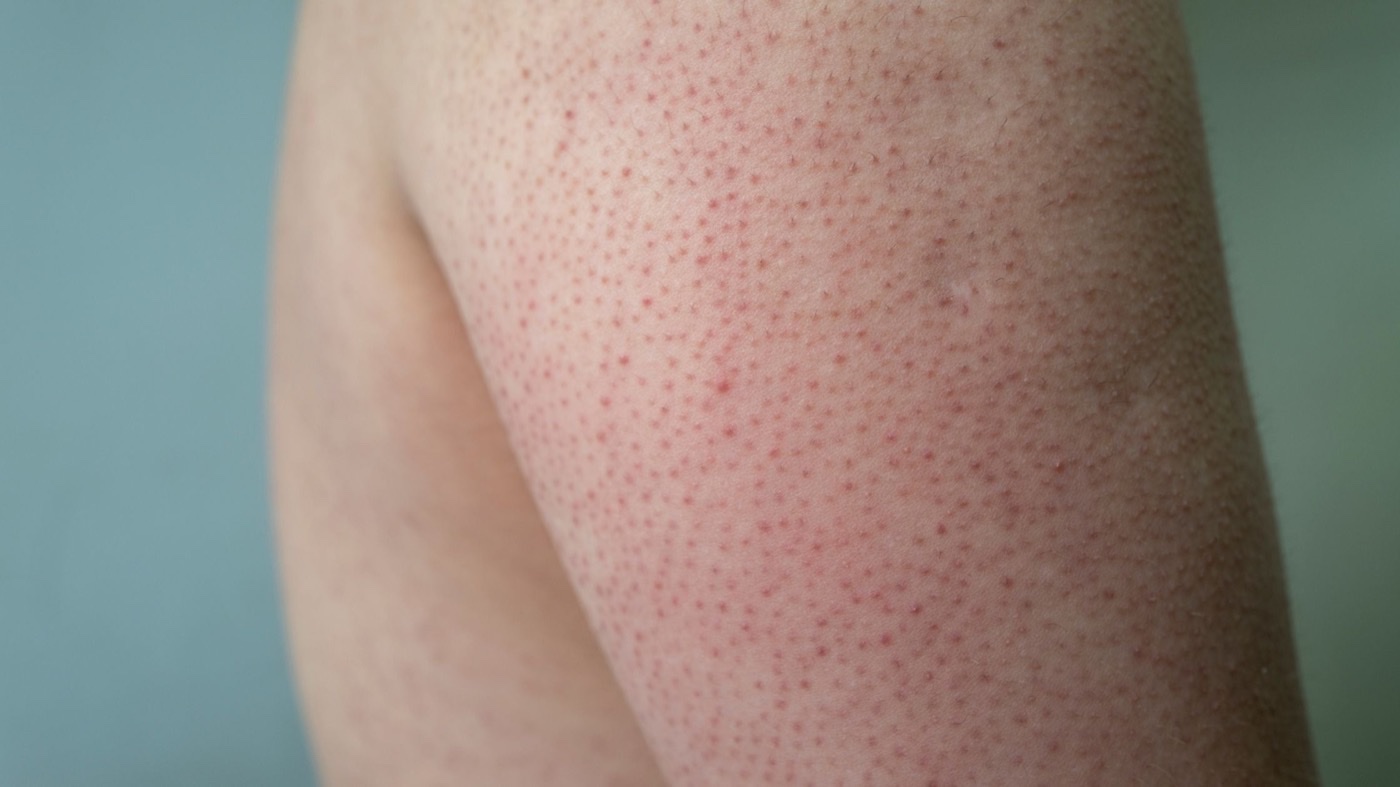
Keratosis pilaris, the bumpy skin on the arms and thighs often called chicken skin, is extremely common. We'll cover why it happens, how to choose a keratolytic like urea, salicylic acid, or a retinoid, and how much lasers can actually help. It's not a condition that clears up in one treatment, it's one you manage over time, and understanding that changes how you approach it.
By Dr. Kim

Fraxel for Acne Scars: Effects, Pigmentation, and Side Effects
How fractional lasers like Fraxel work on acne scars, why results differ so much by scar type, how real the PIH risk is on Asian skin, and what the research actually shows about how much improvement to expect: scars soften, they don't vanish.
By Dr. Kim