Photoaged Skin: Effect of Retinoids and Vitamin C, and Care
By Dr. Kim7 min read
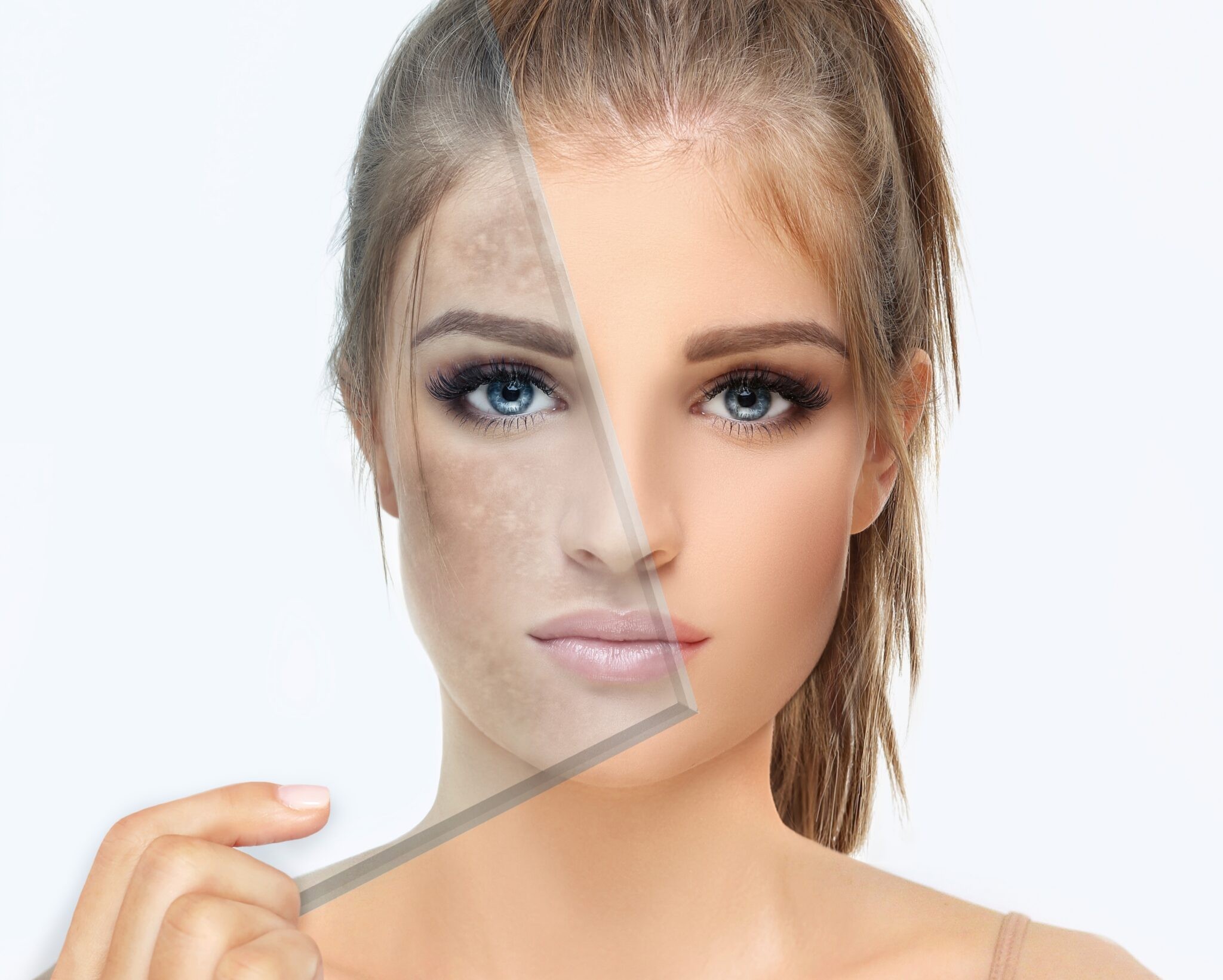
Skin that has spent years under the sun ages differently than skin that simply gets older. Both develop wrinkles, but photoaged skin also picks up pigmentation, like melasma or dark spots, along with a rougher texture. That combination is exactly why sun damage has a reputation for being permanent. But once you break down what's actually happening at the cellular level, a surprising amount of it turns out to be reversible. Let's walk through what breaks down and what can bring it back.
How Is Photoaging Different From Natural Aging?
Natural aging is a slow, steady process. Cell turnover gradually slows and collagen production tapers off little by little, evenly across the whole face. Photoaging is different because it concentrates wherever the sun hits hardest, mainly the forehead, cheekbones, and around the nose.
When UV rays reach the deeper layers of skin, they trigger the formation of free radicals (unstable, highly reactive oxygen fragments) inside skin cells. These free radicals attack collagen fibers and cellular DNA directly. That's why two people the same age can look so different depending on whether they've been consistent about sun protection. At its core, photoaging is really this chain reaction that free radicals set off.
How Does UV Destroy Collagen?
When skin cells are hit by UV light, a transcription factor called AP-1 (a protein that switches genes on and off) gets activated. Once AP-1 turns on, it sends signals throughout the cell to produce MMPs, matrix metalloproteinases, enzymes whose job is to chop up collagen.
As MMP levels rise, existing collagen fibers keep getting cut apart. At the same time, AP-1 suppresses the signal that tells cells to make new collagen (the TGF-beta pathway), so more collagen ends up being destroyed than replaced. Repeat this cycle for years and the dermis, the deeper layer where collagen lives, gradually thins out. Elastic fibers lose their organized structure and clump together like tangled thread. That clumping of elastic fibers is considered one of the hallmark signs of photoaging.
Why Does Pigmentation Form Unevenly?
UV light doesn't just target collagen, it also signals pigment producing cells. Melanocytes respond to UV exposure by ramping up melanin production, which is actually a normal protective response, the skin trying to shield itself.
The problem is that after decades of this cycle repeating, melanocytes across the face start responding unevenly. Tyrosinase, the enzyme that kicks off melanin production, becomes inconsistent from one area to the next. Pigment builds up unevenly in spots that get the most sun, like the cheekbones and forehead. That's how you end up with the sharply defined patches we call melasma or age spots. So pigmentation isn't really about melanin increasing overall, it's more about that increase happening unevenly, leaving behind visible blotches.
How Do Retinoids Act on Photoaging?
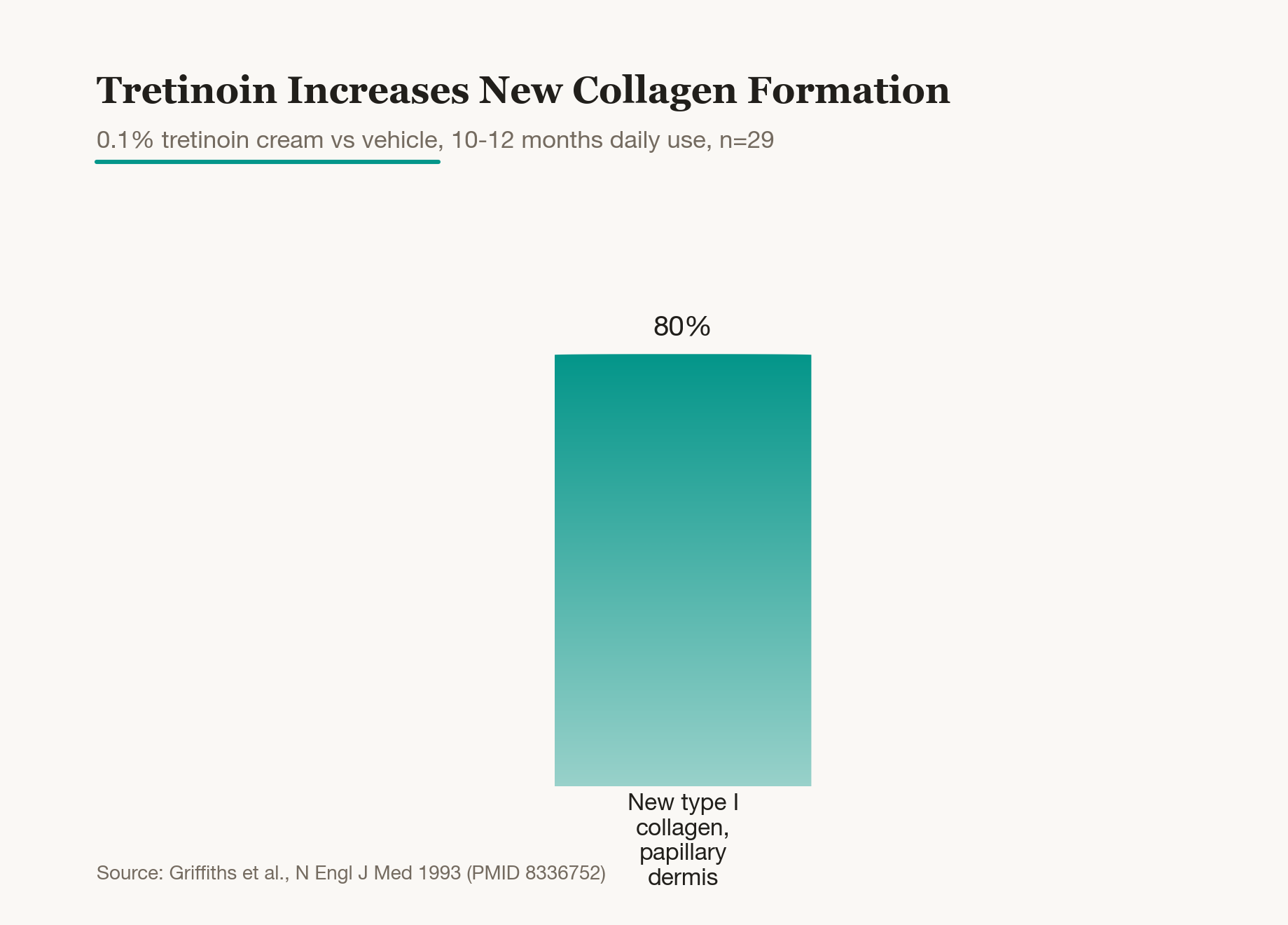
Retinoids (a family of vitamin A derivatives) are the go-to ingredient for reversing photoaging. Tretinoin works by suppressing that AP-1 activity we just talked about, which keeps MMP production from spiraling out of control. At the same time, it stimulates the procollagen gene (the blueprint for collagen before it's fully formed) to be read more actively, prompting fibroblasts to produce new collagen.
In other words, it dials down the destructive signal while dialing up the constructive one, working both sides at once. Retinol is a different molecule from tretinoin, it needs to pass through two enzymatic conversion steps inside the skin before it becomes active in the same way tretinoin is. That makes it slower and gentler, but the direction is the same. In studies where tretinoin was applied to photoaged skin over several months, new collagen production actually increased, while untreated skin showed a decline instead.
What Roles Do Vitamin C and Niacinamide Play?
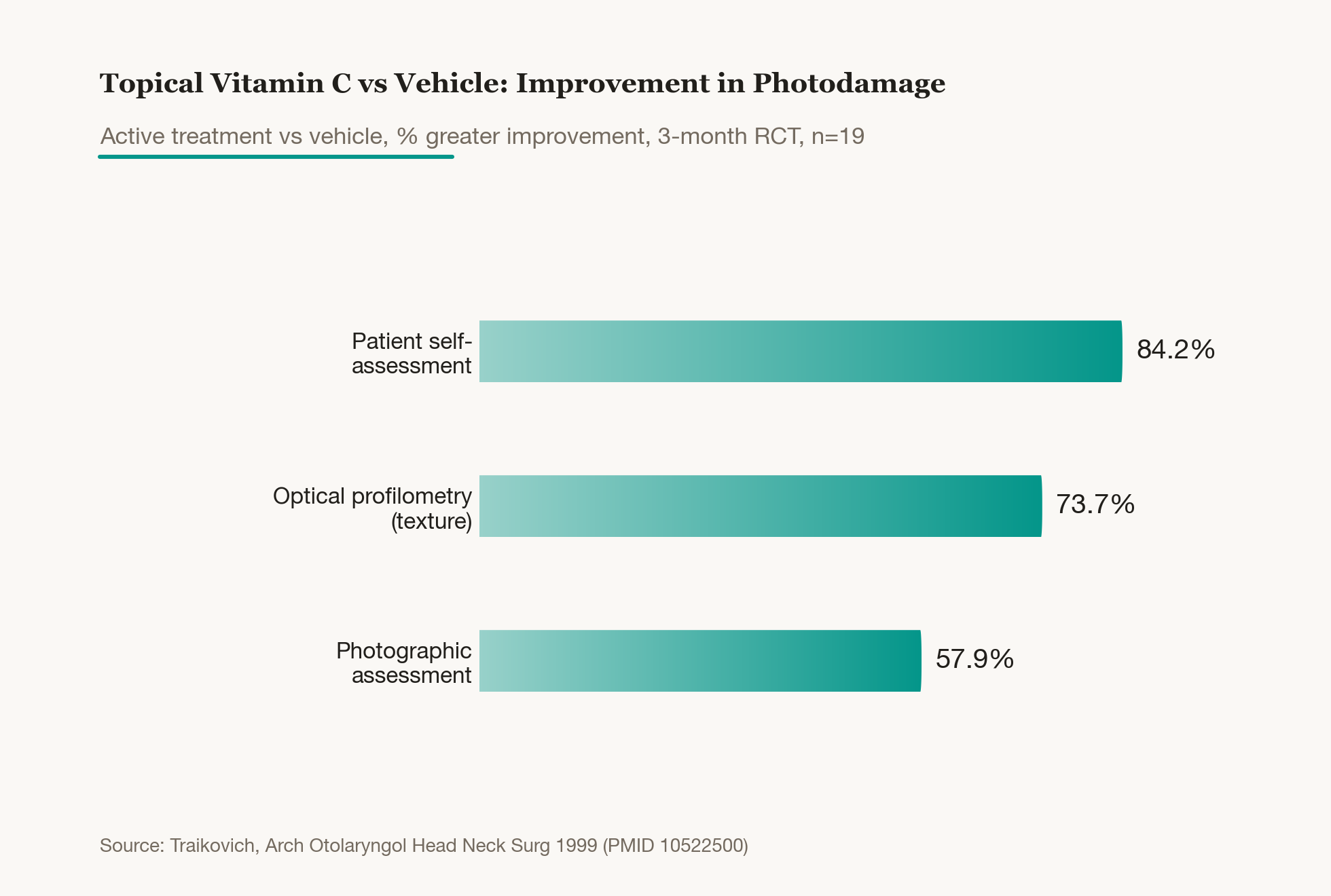
Vitamin C is a cofactor, meaning the enzyme responsible for weaving collagen strands into a stable structure (prolyl hydroxylase) simply cannot function without it. Without vitamin C, collagen strands can't twist together properly, so they never become sturdy fibers. So vitamin C doesn't build collagen directly, but it makes sure the collagen that does get made actually holds its shape.
Vitamin C also acts as an antioxidant, neutralizing the free radicals that UV exposure generates. Applied topically, it reaches the upper dermis, where most photoaging happens, at fairly high concentrations, which is another point in its favor.
Niacinamide (a vitamin B3 derivative) works through a completely different mechanism. It slows the transfer of pigment granules from melanocytes to keratinocytes, which reduces how much pigment actually accumulates near the surface. On top of that, it's also been shown to strengthen the skin barrier and calm inflammation.
When Do Results Start, and How Long Do They Last?
Different layers of skin change on different timelines. Surface texture, the smoothness and reduction in roughness, usually starts becoming noticeable within about four weeks. That's because it mainly involves clearing out dead skin cells and rebalancing hydration, which happens relatively fast.
Rebuilding actual collagen deep in the dermis takes longer. New collagen has to be produced, positioned, and cross linked into a stable structure, and that multi step process typically takes three to six months before changes become visible. Longer term studies tracking use over ten to twelve months have shown clearly measurable increases in collagen with continued, consistent use.
That said, these gains only last as long as you keep up the routine. Stop, and the UV damage cycle picks right back up, meaning the newly built collagen gradually erodes again. How long the improvement sticks around varies from person to person, but with consistent care, people typically see the benefits hold for somewhere between six months and a year. The exact range depends a lot on how much damage was there to begin with and how consistent someone's sun protection habits are.
Four Rules for Photoaging Care
No matter how strongly you activate collagen production signals, if damage signals keep coming in at the same time, the two cancel each other out. That's why a few ground rules matter for how you actually build a routine.
- Wear sunscreen every single day. Skip it, and AP-1 and MMP activity fires right back up, breaking down the very collagen that retinoids and vitamin C just helped build.
- Start retinoids at a low concentration and build up slowly. Jumping straight to a high concentration accelerates cell turnover too fast, causing irritation and redness that make it hard to stick with the routine long term.
- Never skip moisturizer. Applying active ingredients on top of a compromised barrier just piles on irritation, and the ingredients don't get the chance to work properly.
- Consistency is what actually determines the outcome. Visible collagen buildup takes months, so stopping partway through halts the process right there, and things drift back toward baseline.
Keep all four of these in place, and you give retinoids, vitamin C, and niacinamide the time they need for their effects to actually accumulate. Relying on a single ingredient rarely gets you there. Pairing sun protection, active ingredients, and moisture together is a far more reliable path to real results.
References
Korean Dermatological Association, American Academy of Dermatology (AAD), and Ministry of Food and Drug Safety (MFDS).
Was this helpful?
About this article
Written by a practising aesthetic physician and intended for general education — not a substitute for individual medical advice.
Read next

Vbeam Laser Effect on Tiny Vessels and Redness, and Downtime
Vbeam is a vascular laser that uses a specific wavelength tuned to hemoglobin, the pigment in blood, to coagulate dilated capillaries without harming the surrounding skin. This column breaks down why that wavelength zeroes in on blood vessels, along with the bruising, downtime, and sessions it takes to see results.
By Dr. Lee
Cafe-au-Lait Spots Returning After Laser: Causes, Number of Sessions and Expectations
A café au lait spot forms because the pigment-making cells in that one patch of skin are locally overactive. Laser treatment breaks up the pigment that has already built up, but it doesn't switch off those cells, which is why the color so often returns. Here's the biology behind it, why results differ so much from person to person, and what a realistic treatment timeline actually looks like.
By Dr. Kim
Ultracol PDO Effect and Duration, Including Differences From Lifting Threads
Ultracol isn't a thread lift. It's a skin booster made by grinding PDO into microscopic particles, suspending them in liquid, and injecting them to trigger new collagen. Here's how the particles work as they break down, where they're placed, what determines how long results last, and how to care for your skin afterward.
By Dr. Lee