Stretch Mark Laser Treatment: Are Red and White Stretch Marks Treated Differently?
By Dr. Kim7 min read
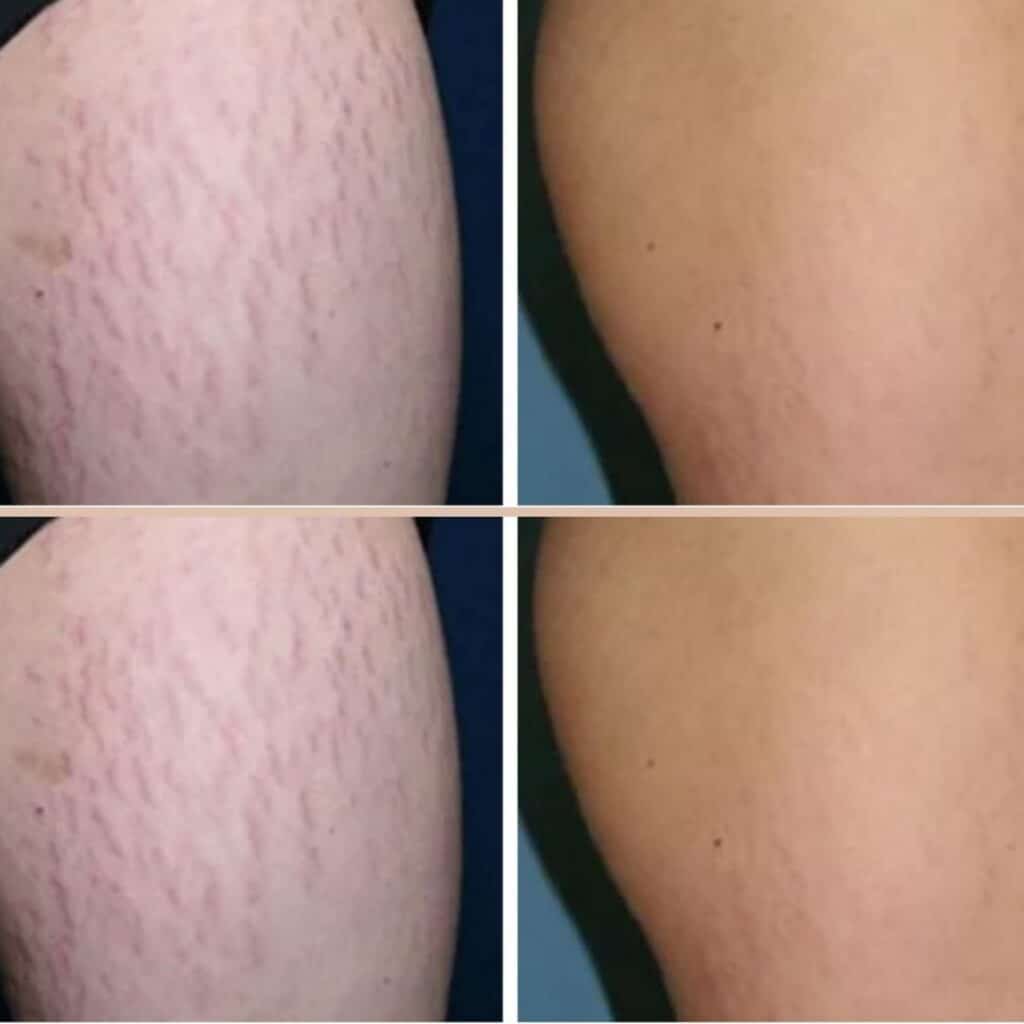
Stretch marks form when skin stretches faster than it can keep up. They're common during puberty growth spurts, pregnancy, and periods of rapid weight change, and once they set in, they don't fade away on their own. That's why so many people turn to laser treatment, but the laser and the mechanism behind it actually depend on what kind of stretch mark you're dealing with.
Fresh red or purple marks and old, faded white or silvery ones are two different things happening under the skin. Using the same laser on both doesn't give the same result. Let's break down what a stretch mark laser is actually doing beneath the surface.
How Do Stretch Marks Form?
Skin is built in layers: the epidermis on top, the thicker dermis underneath, and a fat layer below that. Inside the dermis, collagen and elastin (the stretchy fibers that let skin snap back into shape) form a mesh that holds everything together.
When skin stretches quickly during a growth spurt or sudden weight change, that mesh can't keep pace and starts to tear in places. Think of a rubber band: stretch it slowly and it just stretches, but yank it hard and fast and it snaps.
Where the mesh tears, thin, weak scar tissue fills in instead of normal dermis. That's why stretch marks feel thinner than the surrounding skin and often sit slightly sunken when you press on them.
Why Do Red Stretch Marks Turn White?
A brand new stretch mark is usually red or purple. Dermatologists call this early stage striae rubra, or "red stretch marks." As the dermis tears, blood vessels nearby dilate and multiply, and it's those vessels showing through the skin that give the mark its color.
Over time, those vessels gradually shrink back down, and the torn area settles into scar-like tissue that's still short on collagen. This later stage is called striae alba, or "white stretch marks." With less blood flow, the redness fades, and because collagen density is genuinely lower there, the area looks paler or silvery compared to the skin around it.
Different color means a different target inside the skin. So the very first thing to figure out before choosing a laser is which stage the mark is actually in.
Which Lasers Are Used for Red Stretch Marks?
Red stretch marks are usually treated with a pulsed dye laser, which fires light at a wavelength of 585 to 595 nanometers. This particular light is absorbed especially well by hemoglobin, the red pigment that carries oxygen in blood.
When that light hits a dilated blood vessel under the skin, the vessel wall heats up and slowly contracts. As the vessel narrows, less redness shows through, and the mark gradually blends closer to the surrounding skin tone over the following weeks. It's a bit like squeezing a swollen garden hose until it's thin again.
That same heat also stimulates fibroblasts, the cells responsible for producing collagen, in the dermis below. So the treatment doesn't just fade redness, it's also reported to trigger some fresh collagen production. That said, this collagen effect tends to be milder than what a fractional laser produces.
Which Lasers Are Used for White Stretch Marks?
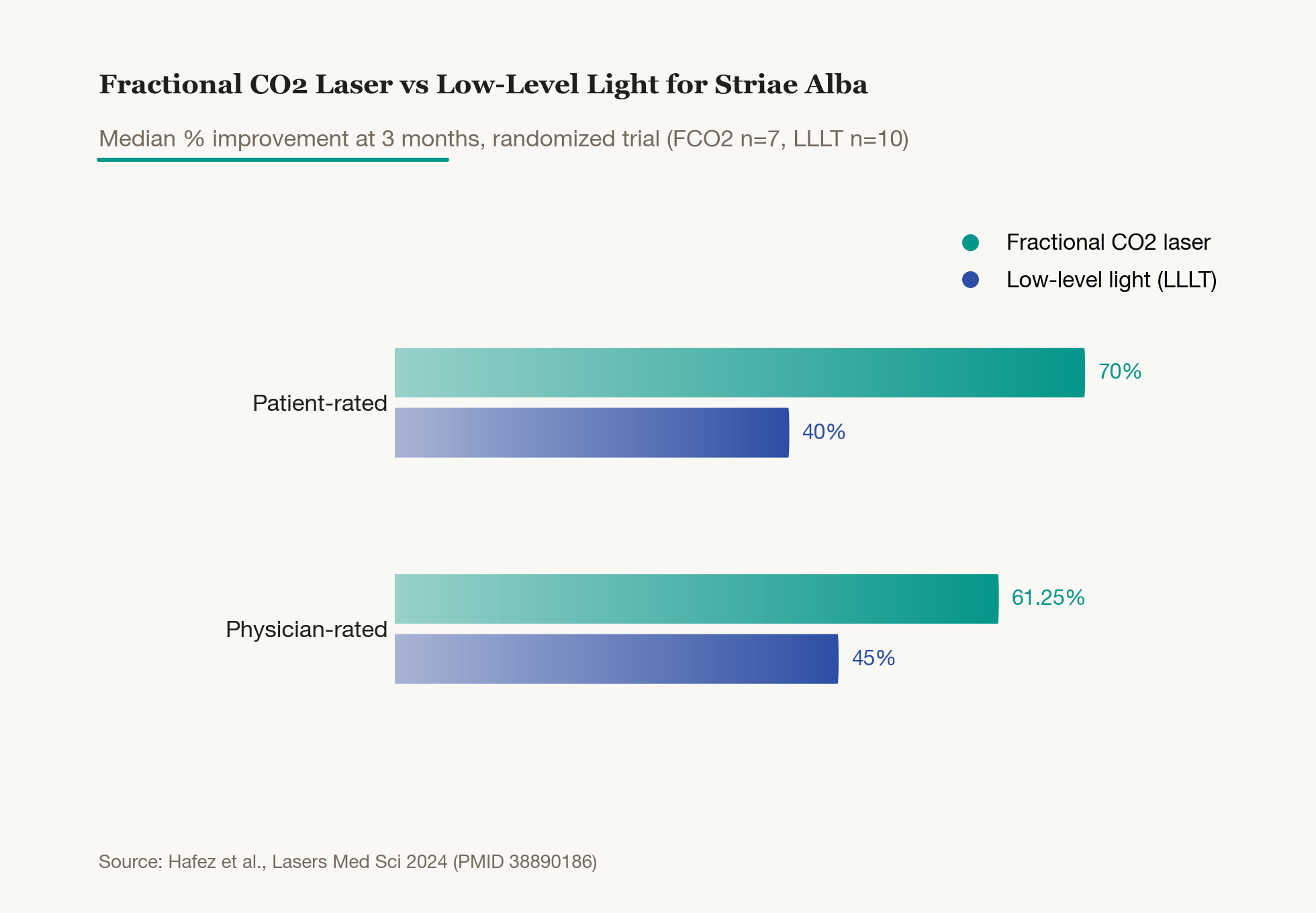
For white stretch marks, the core problem isn't blood vessels, it's a lack of collagen. That means a pulsed dye laser targeting vessels alone has limited effect at this stage. This is where fractional lasers come in, whether CO2 or Erbium:YAG, which deliver energy through thousands of tiny pinpoint columns rather than treating the whole surface at once.
Instead of burning the entire skin surface, a fractional laser creates a dense grid of microscopic channels, each finer than a strand of hair. It's similar to poking many tiny holes in a piece of fabric instead of scorching the whole thing. Because the damage at each point is so small, skin heals quickly, but the body's wound repair response still kicks in fully.
Fibroblasts gather around these tiny channels and start producing fresh collagen and elastin. As new collagen fills in where thin, weak scar tissue used to be, the treated area gradually takes on a thickness and texture closer to the surrounding skin. Since the white, faded color came from a collagen shortage in the first place, rebuilding that collagen improves both color and texture together.
How Many Stretch Mark Laser Sessions Do You Need?
Building new collagen isn't a matter of days. When skin is injured, it doesn't just fill back in instantly, it goes through inflammation, new tissue formation, and finally remodeling, in that order. The whole cycle usually takes about 4 to 12 weeks.
There's also a limit to how many microchannels and how much stimulation a single session can deliver. A single round of treatment simply can't rebuild an entire area of thinned, scar-like tissue, which is why sessions are typically spaced 4 to 6 weeks apart, letting collagen build up gradually with each pass. It's a bit like painting a wall: several thin coats give you an even color, not one thick one.
If sessions are scheduled too close together, skin gets re-stimulated before it has finished recovering, which can lead to a buildup of inflammation instead of steady improvement. Sticking to the recommended recovery interval matters for building collagen in a stable, lasting way.
How Long Do Results Last, and Can They Come Back?
The new collagen from laser treatment continues settling in over the following 6 to 12 months, with the thickness and color of the treated area gradually stabilizing during that window. That said, collagen is a protein that's constantly being broken down and rebuilt over time, so an improved result isn't necessarily permanent.
It's also worth knowing that laser treatment improves marks that already exist, it doesn't prevent new ones from forming. If skin stretches rapidly again, say from pregnancy or a sudden change in weight, new stretch marks can appear in places that were never affected before. Since the root cause is simply skin stretching faster than the dermis can keep up, that same mismatch will produce a similar result if the conditions repeat.
That's why clinics typically talk through future plans before treatment. If pregnancy is on the horizon, for example, it's common to wait until after delivery, since the belly's rapid expansion during pregnancy would likely damage the collagen that was just rebuilt. Timing treatment for after a period of rapid body change tends to give results that hold up longer.
Precautions and Care After Treatment
The main goal during recovery is simply not to interfere with collagen settling into place.
- Some redness or mild swelling in the days right after treatment is normal. It's a sign that the skin's natural healing response has kicked in at the microscopic injury sites the laser created.
- Sun protection deserves extra attention after treatment. Skin that's actively healing has pigment-producing cells that are more reactive than usual, so UV exposure during this window can leave the treated area looking darker than before.
- Retinoid-family exfoliants like tretinoin can be irritating right after treatment, so it's best to check with your dermatologist before resuming them. Skin that's still healing and thinner than usual can react more strongly to the same level of irritation.
- Avoid scrubbing or exfoliating too aggressively. Physical friction on tissue that hasn't fully settled yet can slow down recovery.
References
Korean Dermatological Association, American Academy of Dermatology (AAD), and Ministry of Food and Drug Safety (MFDS).
Was this helpful?
About this article
Written by a practising aesthetic physician and intended for general education — not a substitute for individual medical advice.
Read next
Stretch Mark Treatment: Does Starting While They're Red Work Better?
Stretch marks form when skin stretches too fast for the collagen pillars in the dermis to keep up, and they tear. Here is why red marks fade into white ones over time, and why treatment response changes depending on when you start.
By Dr. Kim

Stretch Mark Treatment: Effect and Number of Sessions, Including Laser and Radiofrequency Differences
A clear look at why stretch marks form and what sets red stretch marks apart from white ones. We break down, with real study numbers, how much fractional laser, radiofrequency microneedling, and pulsed dye laser for red marks actually fade them, plus what topical tretinoin can and cannot do at home.
By Dr. Lee
Emface Results and Duration: How Radiofrequency and Muscle Stimulation Work
Emface is a non-invasive lifting treatment that stimulates collagen in the skin with radiofrequency while an electrical signal directly moves the expression muscles underneath. Here is an easy, principle-focused rundown of why skin and muscle need to be treated together for real firmness, why sessions are spaced out, and how long results actually last.
By Dr. Kim