Square Jaw Botox: Effect, Duration, Side Effects and Limits
By Dr. Lee7 min read

If you've been bothered by a wide, angular jawline, chances are you've heard about jaw botox, the idea that a few injections, no surgery required, can soften a square jaw into something more tapered. It sounds almost too easy, so naturally the questions follow: does it actually work, and would it work for me?
The short answer is this: jaw botox reduces muscle, not bone. When the jaw looks wide because the chewing muscle has built up, the results can be genuinely good. When the jaw is wide because the bone itself is large, botox won't move the needle much at all. That distinction is the most important thing to understand before booking anything, and everything that follows flows from it.

Which Muscle Is Square Jaw Botox Injected Into?
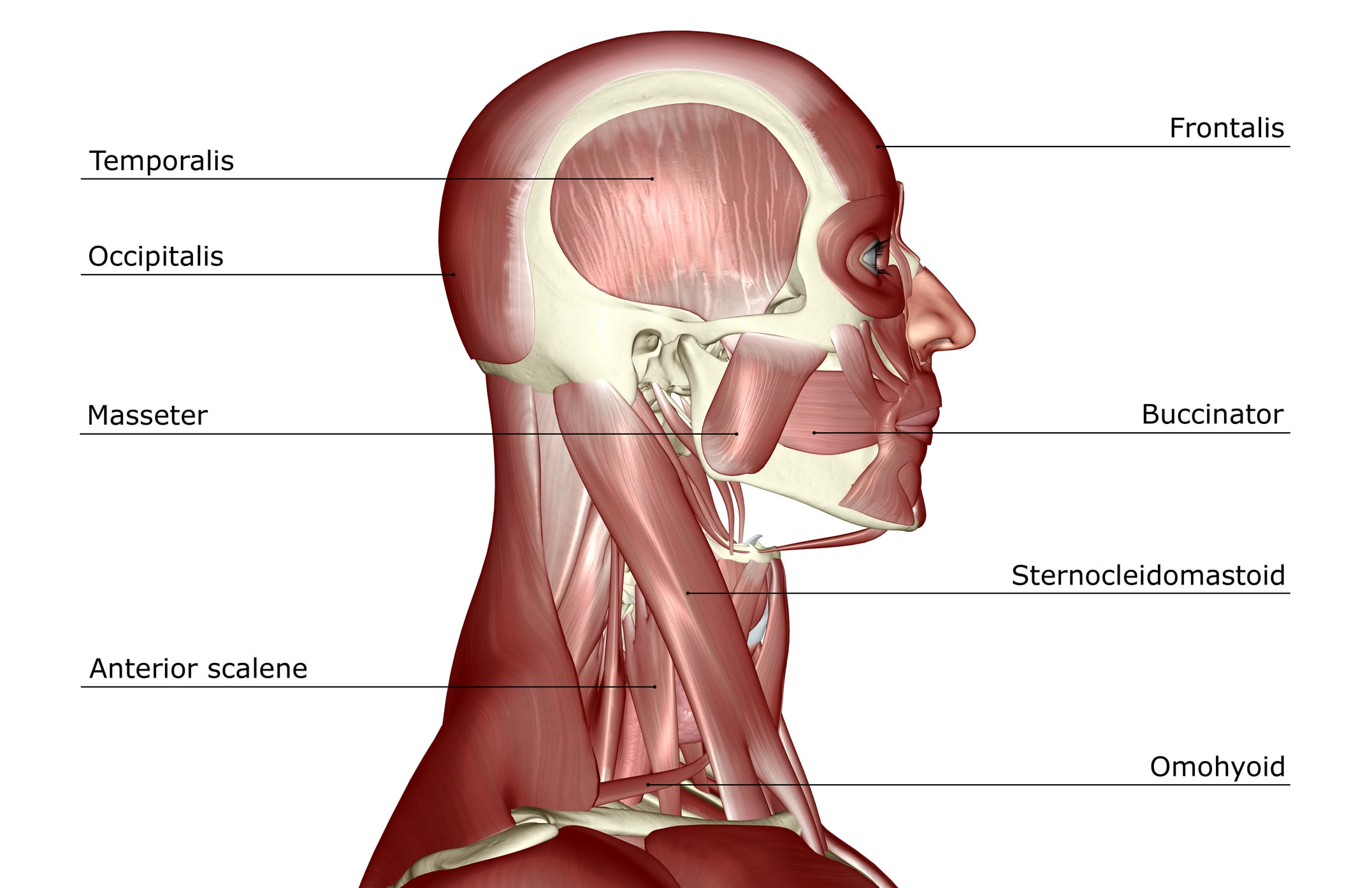
On either side of your jaw sits the masseter muscle, the workhorse behind every bite and chew. Clench your teeth hard right now, and you'll feel it bulge just below your ears. When that muscle is overdeveloped, it adds width to the lower face and creates the squared-off look people want to soften.
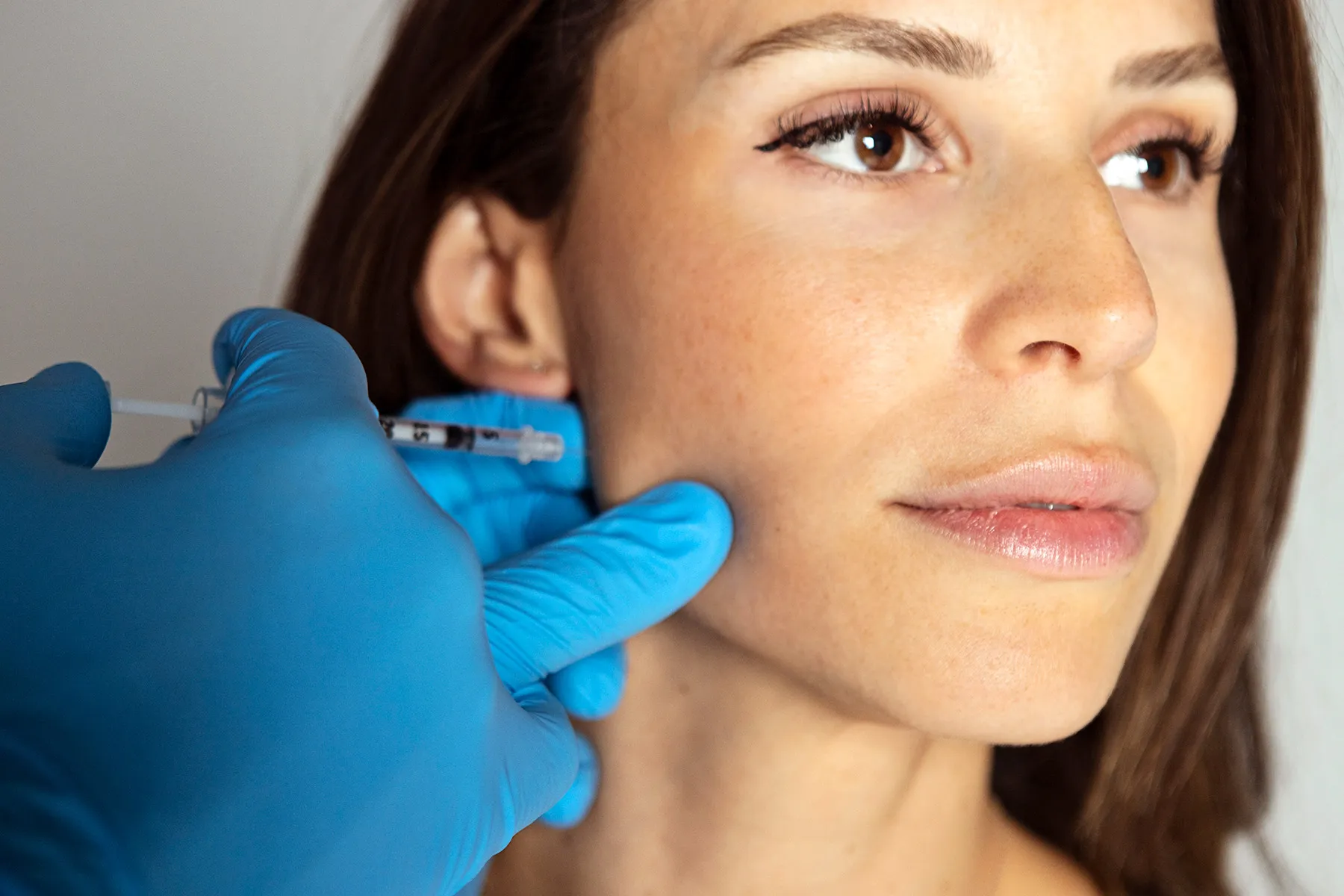
Jaw botox works by injecting botulinum toxin directly into the masseter. The muscle becomes less active, and over time an underused muscle gradually shrinks, the same way an arm in a cast loses bulk. As the masseter thins out, the widest point of the lower face narrows, and the jawline starts to follow a gentler curve.
The important qualifier: the bone stays exactly where it is. Botox has no effect on skeletal structure. In Korea, this treatment often goes by "V-line shot" or "jaw slimming injection", same thing, different names. The procedure itself takes under ten minutes, requires no anesthesia worth mentioning, and leaves no recovery period. But it is purely a muscle treatment, which means it only helps when muscle is the actual problem. Clenching your back teeth in front of a mirror and feeling whether the area below your ear puffs out noticeably is a reasonable first self-check.
How Does Botox Make a Muscle Smaller?
The mechanism is simpler than most people expect. Muscles only move when the nerve tells them to. Botulinum toxin blocks that nerve signal temporarily, leaving the masseter unable to contract with its normal force.
An inactive muscle atrophies, gradually losing bulk the way any muscle does when it goes unused. Since the masseter runs from the corner of the jawbone up to the cheekbone, as it shrinks the lower face narrows from the side and the jaw takes on a softer shape.
The timeline matters here: change doesn't arrive overnight. The first thing most people notice, two to four weeks in, is that chewing feels slightly weaker, tough foods take a little more effort. The visible slimming of the jawline comes later, typically peaking somewhere between six and twelve weeks. From there, the effect generally holds for three to six months before the nerve signal recovers and the muscle gradually returns.
That slow onset is actually part of what makes this treatment feel natural. There's no sudden overnight transformation, the change is subtle enough that most people around you won't be able to put their finger on it, and if you don't love the result, the muscle comes back on its own. For a first-time patient, that reversibility is a meaningful reassurance.
How Much Does the Muscle Actually Shrink?
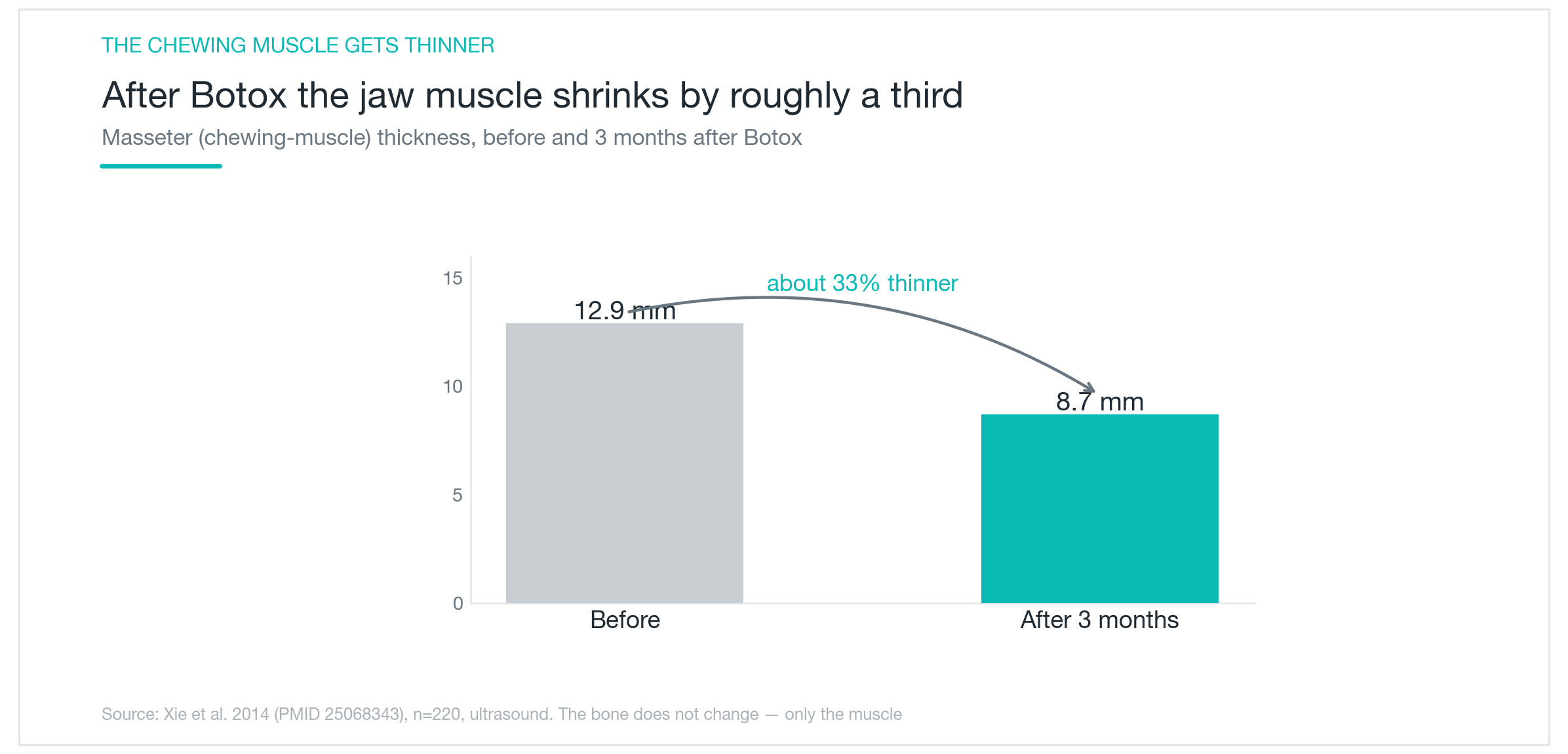
Yes, reliably so. Ultrasound studies that measure masseter thickness directly have confirmed it repeatedly. One study tracked a reduction from approximately 12.9mm to 8.7mm, about 33% thinner at three months. Across the broader literature, most studies report reductions in the 20 to 30% range.
Placebo-controlled trials have also been done, comparing real botox against sham injections in the same muscle. The treated side consistently outperforms the sham side by a significant margin. The individual response varies, though: people who start with a larger masseter see a larger absolute reduction, simply because there's more muscle to lose.
More dose is not automatically better. One study found that a moderate dose and a high dose produced similar slimming results, while the higher dose carried greater side-effect risk. A well-calibrated injection is more important than volume. If your jaw width comes from the masseter rather than the bone, a standard dose is generally enough to produce a meaningful change. Progress is often easier to track from a three-quarter or side angle than straight-on, taking a photo from the same angle every few weeks makes it easier to see what's actually happening.
Does the Effect Build With Repeat Treatments?
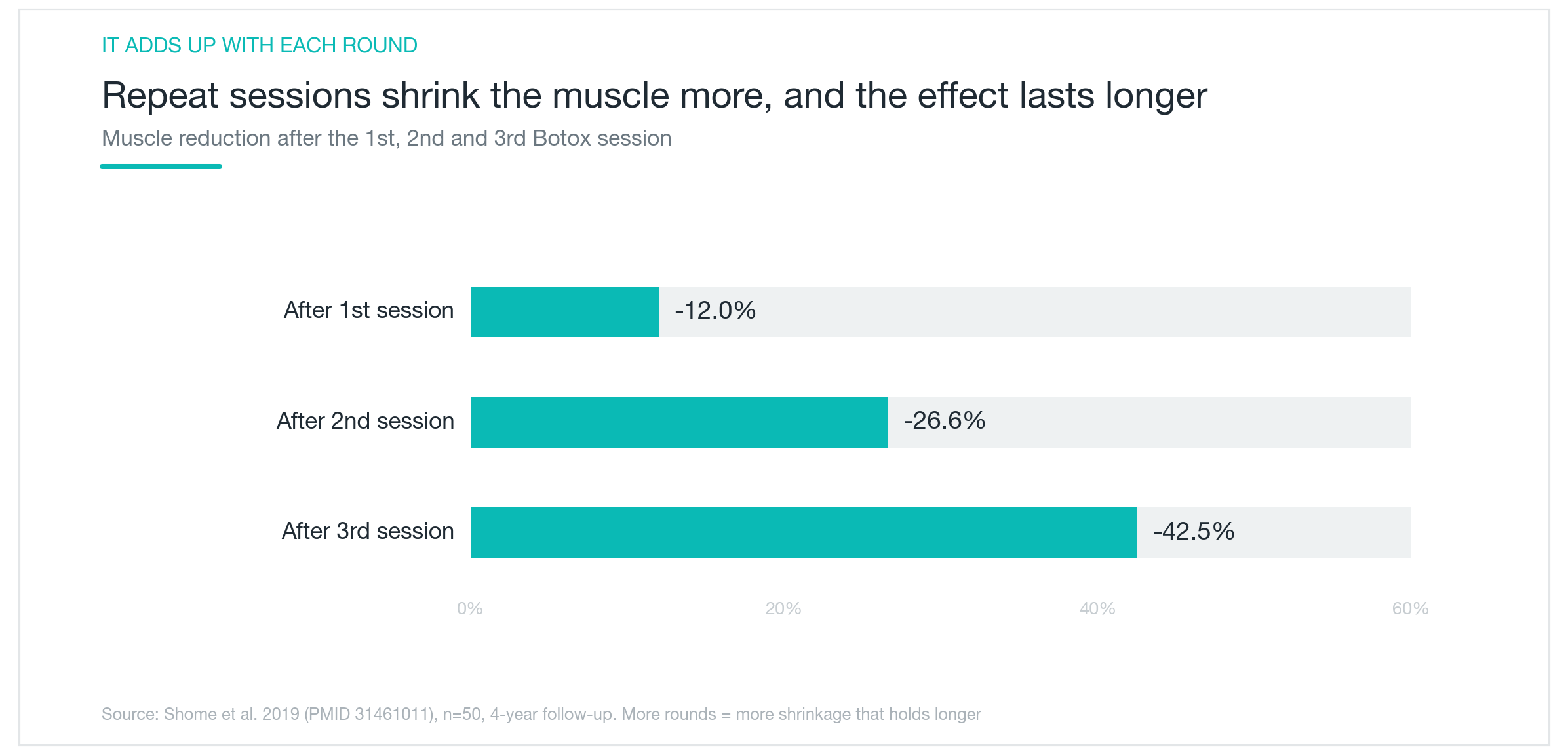
Jaw botox isn't a one-and-done treatment. When the effect fades, the muscle recovers and another session is needed. The upside is that the benefits compound over time.
The chart above comes from a study tracking muscle volume across multiple sessions. The reduction at round one was modest. By rounds two and three, the cumulative loss was substantially larger, and the duration of effect between sessions also extended. In practice, patients who start on a three-to-six-month schedule often find they can stretch the interval as the sessions accumulate, some end up maintaining results with treatments just once or twice a year rather than every few months.
If you stop entirely, the muscle does return, usually over the course of several months, sometimes longer. That said, patients who've kept up a consistent schedule for a year or more tend to hold onto some of the reduction even after stopping, at least for a while.
The most practical implication: the first year matters most. Getting sessions in at the recommended interval during that initial period gives the muscle the sustained downtime it needs to shrink meaningfully. Spacing treatments too far apart early on slows the compounding effect. Once the baseline is established, maintenance becomes considerably easier.
Limits and Side Effects for a Bony Jaw
The most important limitation to say plainly: if your jaw is wide because the bone is large, botox will not slim it. The shape comes from the skeleton, and botox doesn't touch bone. In that case, a consultation about jaw reduction surgery is the relevant path, not injections. Before committing to treatment, confirming whether your jaw width is muscular or skeletal is essential, a provider can assess this directly.
The side-effect profile is generally mild. The most common experience is reduced chewing strength in the first few weeks, sometimes accompanied by jaw fatigue or tenderness, both tend to resolve on their own. Less frequently, uneven reduction can leave one side looking slightly more prominent than the other, or partial atrophy in the wrong part of the muscle can create an irregular contour. Injection placement matters considerably: if the toxin spreads too high or too shallow, it can affect the muscles involved in smiling and briefly distort facial expression. This is why technique and the provider's experience with facial anatomy are not minor details. Pregnancy and certain neuromuscular conditions are contraindications.
One additional population worth mentioning: people who clench or grind their teeth. Weakening the masseter can reduce jaw tension and the aching that comes with it, and some bruxers find real relief from that alone, though the botox doesn't stop the grinding behavior itself, and the evidence for jaw joint pain specifically is still thin.
To put it simply: jaw botox is a good fit when overdeveloped chewing muscles are genuinely the source of a wide jaw. When the jaw is wide from bone, a mirror test and a frank clinical assessment will point toward a more appropriate solution. Getting that part right first saves time, money, and disappointment.
Was this helpful?
About this article
Written by a practising aesthetic physician and intended for general education — not a substitute for individual medical advice.
Read next
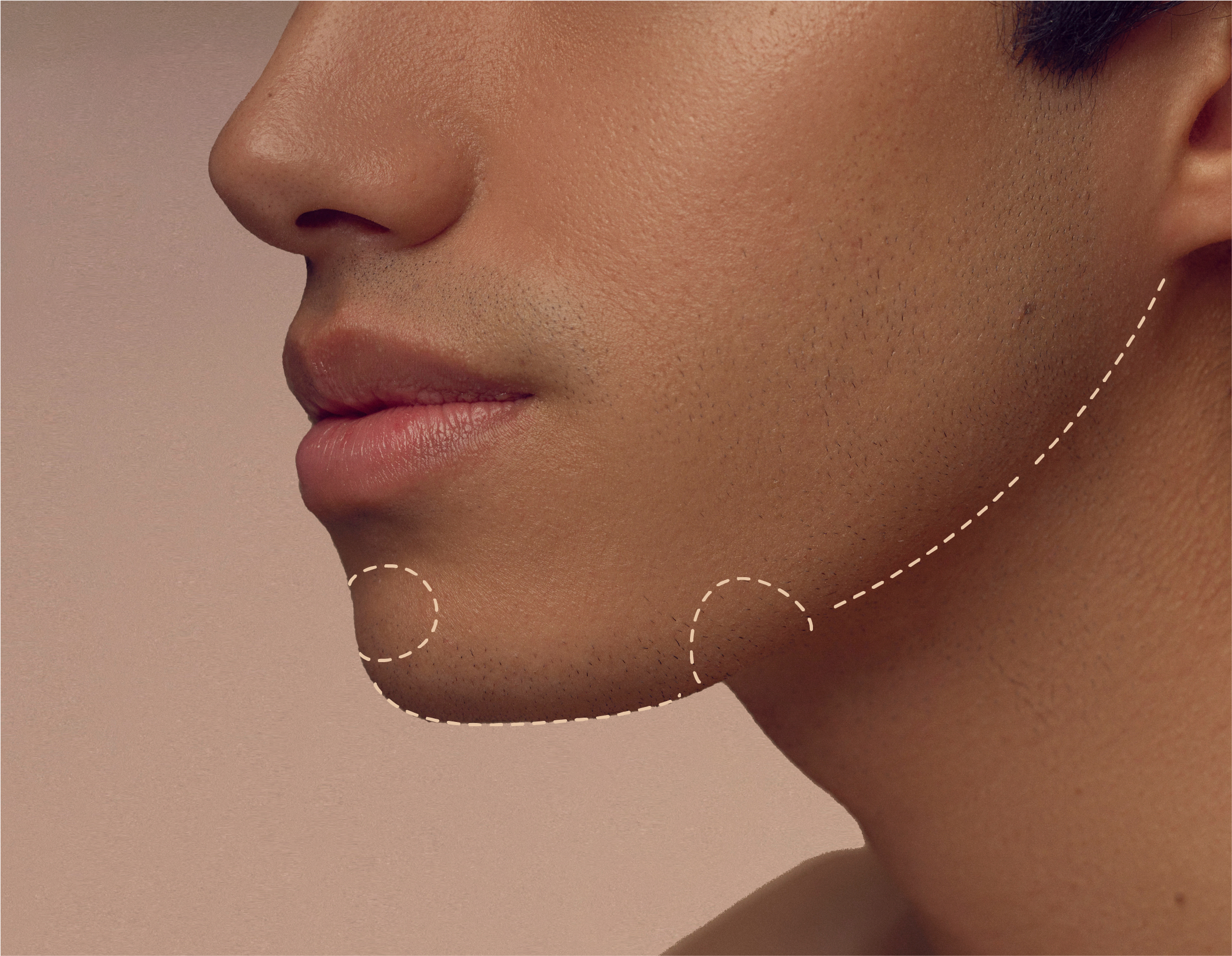
Masseter Botox for a Square Jaw: When Does It Start Working and How Long Does It Last?
Masseter Botox uses botulinum toxin to shrink the chewing muscle and slim a square jawline. Here is what the evidence says about how it works, when results appear, how long they last, side effects, and its effect on teeth clenching.
By Dr. Kim
Crow's Feet Botox: Effects, Duration and Dose
A clear look at how crow's feet Botox works. It eases the orbicularis oculi muscle that creases the outer eye corner when you smile, softening the lines it leaves behind. This guide covers the standard 24-unit dose split across both sides, where the injections go, when results show up, the roughly four-month duration, the limits for deep static wrinkles, and side effects, all backed by real clinical study numbers.
By Dr. Kim
LDM Ultrasound Effects: Soothing Post-Procedure Swelling and Red, Hot Skin
A plain-language look at how LDM ultrasound vibrates millions of times per second to stir up cell metabolism and circulation, why that helps swelling and inflammation settle down, and why it's used even on sensitive skin. Also covers how results build up over repeated sessions and where this treatment fits in practice.
By Dr. Kim