SkinVive: Effect and Duration, and How It Differs From Revive
By Dr. Kim12 min read
"I don't think I need more volume, my face looks fine structurally. My skin just feels rough and tired." That's one of the most common things I hear in the clinic, and it deserves to be taken seriously. These patients look in the mirror and recognize the same face they've always had, but foundation won't sit right, fine lines look sharper in certain light, and the cheeks have that papery, deflated quality that no moisturizer seems to fix. Cheek filler isn't the answer here. Adding volume where volume isn't the problem just makes a face look heavier, not fresher. What they want isn't bigger cheeks. They want skin that holds moisture and catches light the way it used to.
That's exactly what SkinVive by Juvéderm (Allergan Aesthetics, an AbbVie company) was designed to do. It uses the same core ingredient as a regular filler, hyaluronic acid, but the goals, the formulation, and the injection technique are completely different. Instead of sitting deep and pushing volume upward, SkinVive is placed in tiny droplets throughout the superficial dermis, changing the moisture environment inside the skin itself. Below, I'll cover what separates it from a standard filler, what's actually in the syringe, how long results hold based on the trial data, what patients say about it at six months, and how it compares to Belotero Revive, another skin booster that comes up in nearly every SkinVive conversation.
How Is SkinVive Different From Filler?
If both products contain HA, why is one called a filler and the other a skin booster? It's the question patients ask most often, and the confusion is understandable. The answer isn't in the ingredient, it's in the purpose, the depth, and the physical properties of the gel.
A traditional dermal filler is a structural tool. It restores volume where tissue has thinned: deep nasolabial folds, hollowed cheeks, a flat nasal bridge, a receding chin. Product goes into the deep dermis, subdermis, or even the supraperiosteal plane, depending on what's being corrected. The gel is firm and cohesive, designed to hold shape and provide lift. Projection is the goal.
A skin booster has a fundamentally different objective. The aim isn't structural support, it's improving how the skin itself looks and feels. Product goes into the superficial dermis in small amounts, distributed across many points spread evenly over the treatment zone. The face doesn't change shape. Done well, a patient doesn't look "worked on." They just look like their skin is in good condition.
SkinVive falls squarely in the skin booster category. It's for patients who are satisfied with their facial structure but frustrated with skin quality: chronic dryness, dullness, that way fine lines look rougher in photographs than they feel in person. Same HA molecule as a filler, completely different application.
The biology behind it: HA is a molecule skin already produces naturally, and it binds hundreds of times its own weight in water. As skin ages and accumulates UV damage, endogenous HA declines, and the dermis loses its capacity to hold moisture. A skin booster replenishes that reservoir from the outside. Results tend to develop gradually over days to weeks rather than appearing immediately, because you're not inflating a space, you're re-hydrating tissue that has slowly dried out. The difference in timing compared to volumizing filler is worth setting expectations around.
A useful mental model: dermal filler is construction, rebuilding structure. A skin booster is closer to finishing work, improving the quality of the material itself. These aren't competing treatments; they solve different problems. Volume loss calls for a filler. Skin quality is a job for a skin booster. Many patients benefit from both, sequenced appropriately.
SkinVive Injection Method and Ingredients
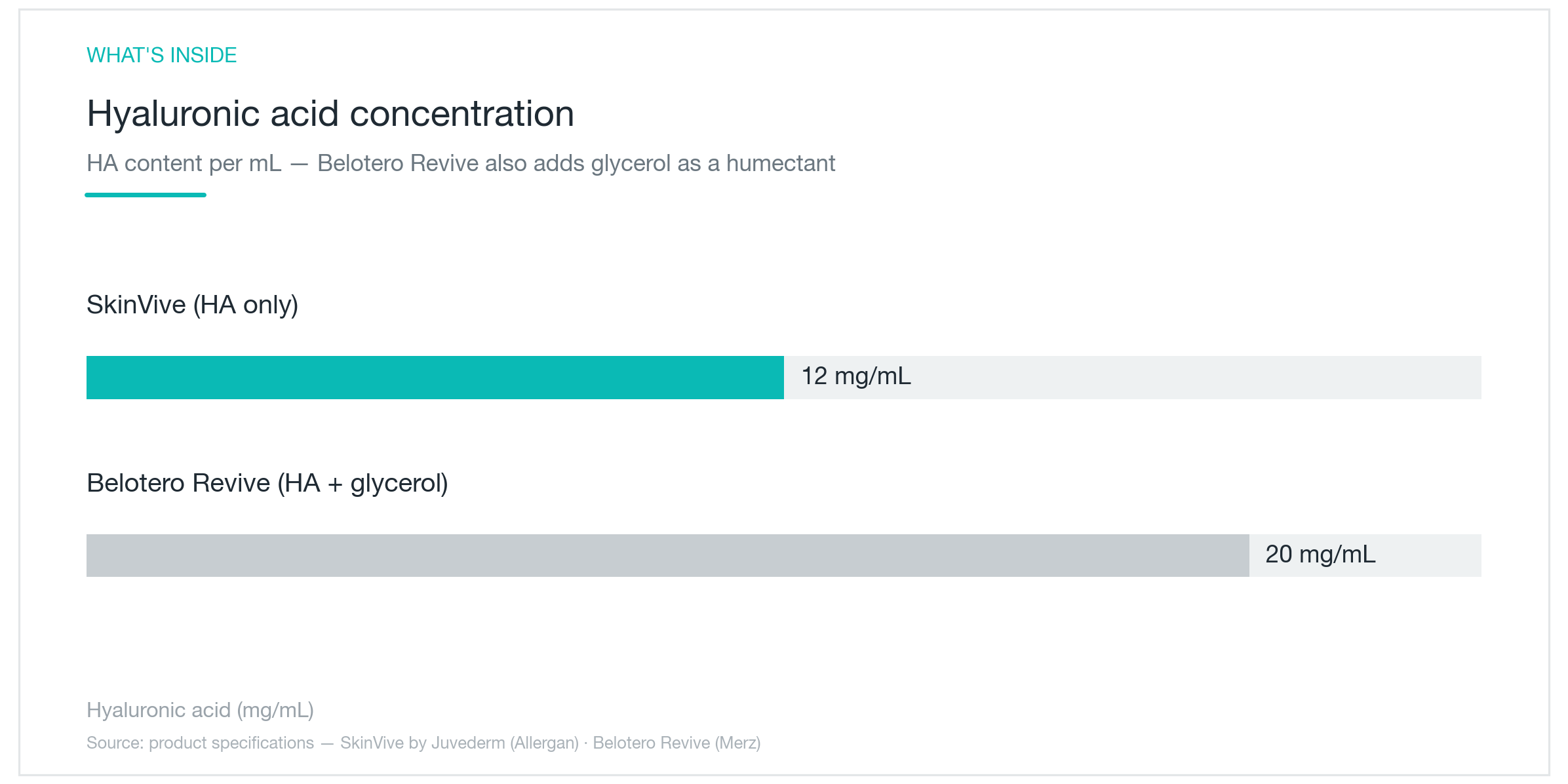
SkinVive contains HA at 12 mg/mL plus lidocaine for comfort, manufactured using Allergan's modified VYCROSS technology. VYCROSS cross-links HA chains of different molecular weights, the same platform behind Juvederm Voluma, Vollure, and Volbella, but the formulation is tuned differently here. Rather than maximizing lift capacity and firmness, SkinVive is engineered for softness and even distribution in superficial tissue. Same cross-linking chemistry, very different physical result.
The chart compares SkinVive to Belotero Revive, two products that appear side by side in almost every skin booster discussion. SkinVive: 12 mg/mL HA, modified VYCROSS, no added humectant. Belotero Revive (Merz Aesthetics): 20 mg/mL HA manufactured using CPM (Cohesive Polydensified Matrix) technology, with glycerol added as a secondary humectant. On paper, the higher HA concentration in Belotero Revive might look like more product, but the two technologies produce gels with genuinely different rheological properties. Comparing them by concentration alone is like comparing wines by alcohol percentage. The number is real, but it doesn't tell you what the product does in tissue.
What makes SkinVive's delivery distinctive is the microdroplet technique. Rather than placing product in a single deposit, the injector distributes very small aliquots, roughly 0.5 to 1 cm apart, across the entire treatment area. These micro-deposits spread through the superficial dermis, improving hydration evenly without creating visible fullness at any single point. The low-cohesivity, soft formulation is specifically suited to this distributed approach. A firm, high-G-prime filler injected in the same plane with the same technique would produce palpable nodules. SkinVive is engineered from the start to sit comfortably in superficial tissue.
That said, technique determines a lot of the outcome. Too superficial and injection marks persist longer than they should. Too deep and you lose the skin quality benefit you're aiming for. Keeping depth and spacing consistent across an entire cheek takes real experience. The product is one variable; injector skill is another, and arguably the more consequential one. Find someone who does this regularly.
Does the Effect Last Through 6 Months?
Six months is the number most commonly quoted, and it's well-supported, but understanding where that number comes from makes it more useful.
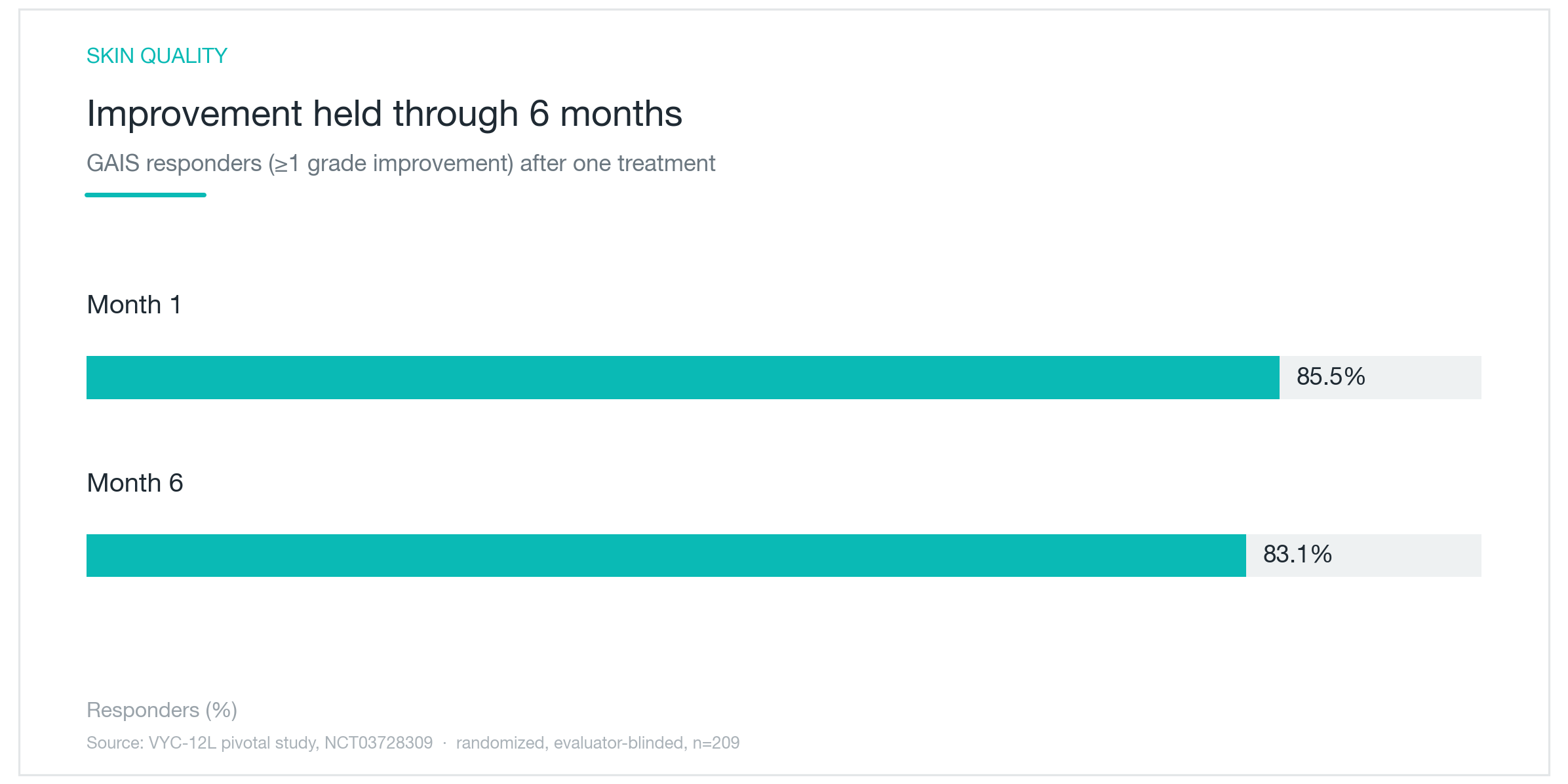
The chart tracks GAIS (Global Aesthetic Improvement Scale) responder rates from SkinVive's pivotal trial. At one month: 85.5% of treated subjects were rated as improved. At six months: 83.1%. The drop is minimal. That's not a treatment that peaks and fades, it's one that holds its improvement across the entire follow-up period.
This data comes from NCT03728309, a randomized, evaluator-blinded trial with 209 subjects. The blinding matters: physicians scoring improvement didn't know which side received treatment and which was control. That design removes the most common source of bias in aesthetic outcome studies, the tendency for both evaluators and patients to perceive results more favorably when they know treatment occurred. A maintained 83% responder rate at six months, measured under blinded conditions, is a strong result.
Individual variation is real. Skin thickness, baseline hydration, age, cumulative sun exposure, and post-treatment skincare habits all affect how long improvements hold. GAIS also reflects a physician's global rating of improvement, not a direct readout of how the patient feels day to day. The two correlate well, but they're not the same number.
In practice, I use six months as a planning benchmark, not a promise. Most patients start to notice things shifting back at some point in that window, and that's usually when we discuss a touch-up. SkinVive is best understood as maintenance, something you return to at appropriate intervals, rather than a single corrective event. Patients who approach it that way tend to get the most consistent results over time.
Patient Satisfaction at 6 Months
Physician-rated scores tell one story; patient-reported outcomes tell another. Both matter. A treatment that looks good to the injector but that patients don't feel good about in daily life is, practically speaking, not a success.
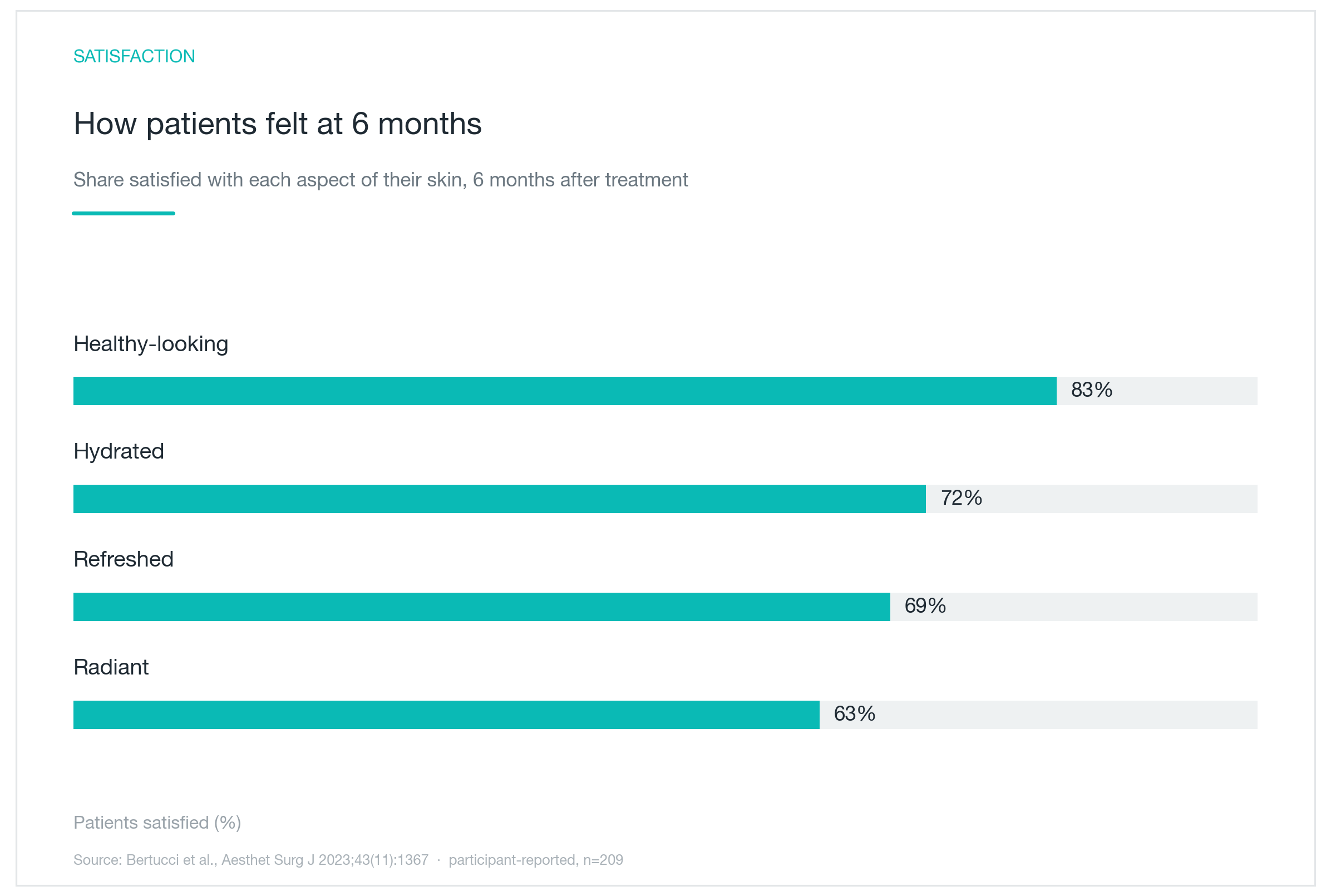
SkinVive's clinical program included self-reported patient satisfaction at six months, tracking four dimensions: whether skin looked healthier, felt more hydrated, felt refreshed, and appeared more radiant. At the six-month mark: 83% said their skin looked healthier. 72% reported improved hydration. 69% described their skin as refreshed. 63% noted more radiance.
These figures come from Bertucci et al. (Aesthet Surg J 2023;43(11):1367). The hierarchy across the four items is worth noting. "Healthier-looking" scores highest; radiance scores lowest. SkinVive's most consistent perceptible effect is an improvement in overall skin quality and moisture. It isn't primarily a glow or luminosity treatment. Patients whose main concern is achieving a visible lit-from-within radiance may want to combine it with something that specifically targets that, a resurfacing laser, a well-formulated peel, or a sustained brightening routine.
That satisfaction levels hold through six months also says something about how natural the treatment feels over time. Treatments that visibly add bulk or change shape can create a kind of aesthetic drift, where patients feel good immediately but become self-conscious as months pass. Something that works quietly on skin quality, without altering architecture, tends not to produce that reaction. Patients just feel like their skin is in good shape.

How Is It Different From Revive?
Anyone researching SkinVive will inevitably come across Belotero Revive. Both are HA skin boosters targeting skin quality rather than volume. The comparison is natural, and it comes up in clinic constantly.
Here's where they differ in formulation. SkinVive: 12 mg/mL HA, modified VYCROSS, no added humectant, delivered via microdroplet technique. It holds FDA approval for improving cheek skin smoothness, the first injectable in the US cleared specifically for that indication. Expected duration based on clinical data: approximately six months.
Belotero Revive (Merz Aesthetics): 20 mg/mL HA plus glycerol, manufactured using CPM technology. Glycerol is itself a humectant, so Belotero Revive adds a second mechanism for drawing moisture into the dermis alongside the HA. The published research around Belotero Revive has emphasized hydration and elasticity metrics tracked over somewhat longer intervals. It's more widely used in international markets and does not currently carry the same FDA-cleared indication in the United States.
No head-to-head trial has compared these two products directly. Each was validated against its own control in its own study population, with its own endpoints. There is no data showing that one outperforms the other. Claims in marketing materials or online forums that one is definitively stronger or longer-lasting are not supported by comparative evidence.
My clinical approach: I don't lead with product name. I ask what the patient's skin is actually doing. For US patients with primary concerns around cheek skin texture and dullness, who want a treatment backed by FDA-reviewed data with a clear six-month durability profile, SkinVive is the more straightforward recommendation today. For patients with a secondary emphasis on skin elasticity and longer hydration tracking, or for international patients where Belotero Revive is clinically available, that product's profile is worth discussing seriously.
Choose based on the problem, not the product name. The underlying direction, improving skin quality rather than volume, is the same with either approach.
Who It Suits and What to Know First
The right patient for SkinVive is relatively straightforward to identify. You're a good fit if your cheeks look fine structurally but the skin itself is rough, dry, or lacking luster; if your foundation emphasizes texture rather than smoothing it; if fine lines read as more prominent than they feel because of dehydration rather than deep tissue loss. You want your skin to look and feel more like its best version of itself. You're not trying to look different.
If deep static wrinkles or visible volume loss are the primary complaint, SkinVive alone won't address it. A skin booster works on the dermis; it doesn't lift, tighten, or replace lost structural support. Those patients need a volumizing approach, with a skin booster potentially added as a complement, not a substitute.
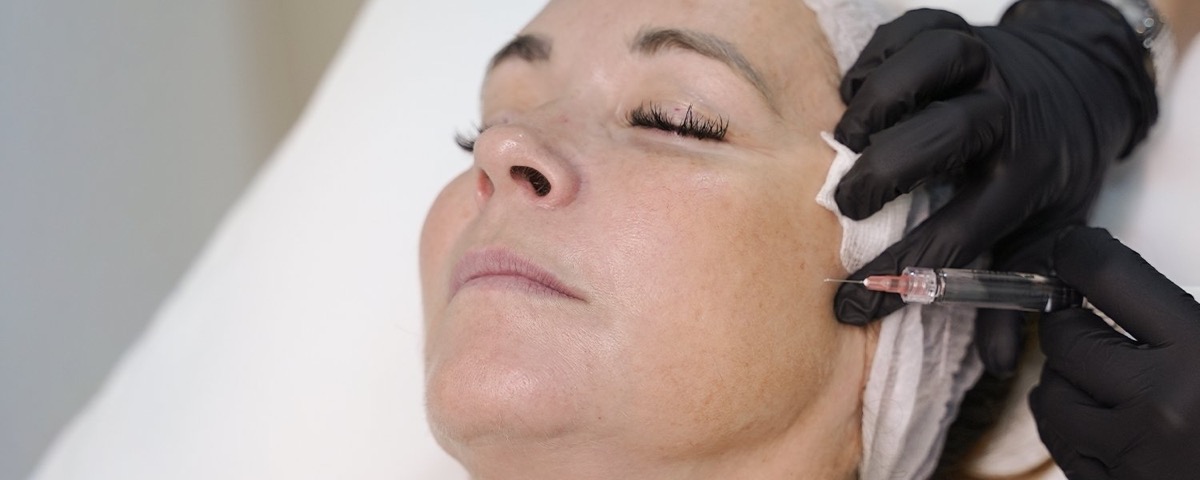
The treatment itself is low intensity. Microdroplet technique, superficial dermis, multiple small injection points across both cheeks. Lidocaine in the formulation meaningfully reduces discomfort, and topical anesthetic cream beforehand makes the session comfortable for most people. Total appointment time typically runs 20 to 30 minutes.
Realistic expectations for the first week or so: some swelling and bruising at injection sites is normal and resolves within a few days. Occasionally a patient notices small firm bumps at injection points, usually palpable before they're visible, and they settle on their own within one to two weeks without intervention.
The more serious risk, even though it's uncommon with superficial placement: vascular occlusion. If product reaches a blood vessel, the area it supplies can blanch, develop mottled discoloration, or become acutely painful within minutes of injection. Because SkinVive is placed in the superficial dermis rather than adjacent to major facial vessels, the risk profile is lower than with deep structural filler, but it's not zero. If you notice unusual one-sided pain, skin turning white or developing a dusky mottled pattern, or sensory changes after your appointment, contact your injector immediately. This is the one scenario where speed genuinely matters.
One thing that makes HA products easier to manage: hyaluronidase. If a complication arises, or a result simply doesn't look right, the enzyme dissolves the HA. That reversibility is real and worth factoring into your comfort with the procedure.
Practical scheduling note: injection marks can be visible for a short time after treatment. Don't plan SkinVive within 10 to 14 days of an event where your appearance will be closely scrutinized, a wedding, a shoot, an important presentation. On treatment day, skip intense exercise, saunas, and alcohol; elevated circulation worsens bruising.
Long-term, protecting your results comes down to basic skin hygiene: consistent broad-spectrum SPF and regular moisturizing. HA breaks down faster in UV-exposed and chronically dry skin. What you do between sessions genuinely affects how long the improvement lasts.
One honest note to close: SkinVive improves skin texture, hydration, and overall skin health. It isn't Botox, it isn't a laser, and it isn't a facelift. It won't erase deep lines, tighten lax skin, or correct pigmentation. Patients who come in understanding that, and who want their skin to feel more like its best version of itself, tend to be the most satisfied. The ones who are disappointed usually wanted a more dramatic transformation than any skin booster can deliver.
Before your appointment, be honest with yourself about what actually bothers you when you look in the mirror. That clarity makes it much easier to determine whether this is the right treatment, or whether something else, or something in combination, is what you're really looking for. Half the work of a good consultation happens before you walk in the door.
Was this helpful?
About this article
Written by a practising aesthetic physician and intended for general education — not a substitute for individual medical advice.
Read next
SkinVive and Revive: Differences, Effect and Duration Compared
SkinVive and Belotero Revive are both HA skin boosters aimed at hydration and texture, but their formulas, glycerol content, clinical data, and approval status differ in ways that matter. Here's what the research actually shows and how to choose.
By Dr. Kim
Profhilo Versus Filler and Rejuran: Differences and Results Compared
What Profhilo is, how it differs from fillers and Rejuran, and what the clinical data actually shows about skin texture, elasticity, and hydration. Effects timeline, safety record, and who it genuinely suits.
By Dr. Lee
Titanium Lifting Effect and Limits, and How It Differs From Ultherapy and Thermage
What Soprano Titanium's triple-wavelength diode laser actually does for skin laxity, texture, and tone, with a clear-eyed look at the clinical evidence and its real limitations.
By Dr. Lee