Scalp Mesotherapy: Effect, Number of Sessions and Reactions After Treatment
By Dr. Kim10 min read
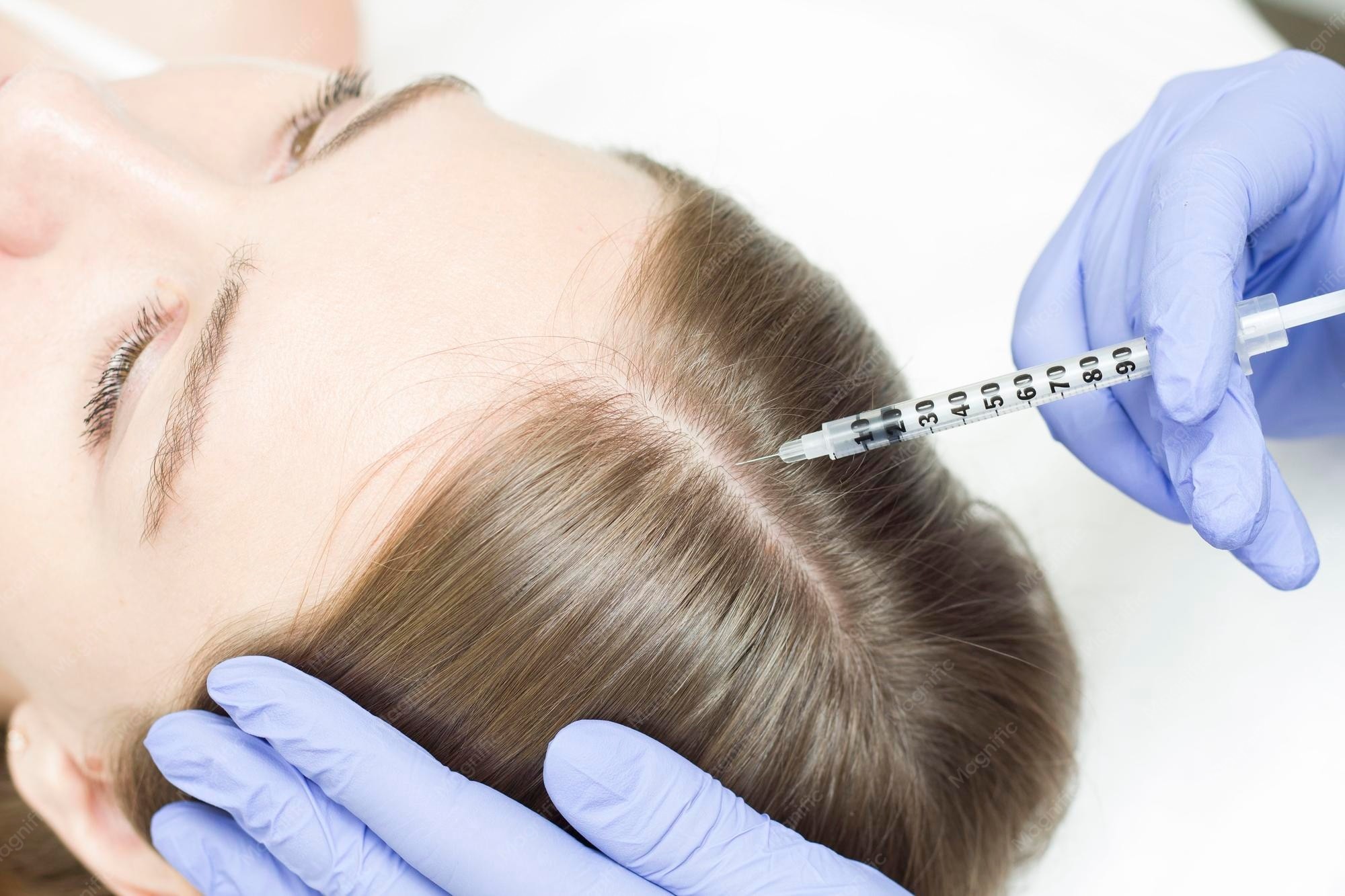
Every time you shower and see a clump of hair sitting in the drain, or notice your scalp starting to show through at the crown, it puts you on edge. So you try one thing after another, hair loss shampoos, ampoules, leave-on treatments, and still the mirror doesn't seem to agree that anything changed.
Hair thinning never happens overnight. Each strand grows a little finer over months until one day the crown looks noticeably more open, which is exactly why most people only notice once things have already progressed quite a bit. By the time you're ready to actually do something visible about it, the urgency has usually built up for a while.
One option doctors often bring up at this point is scalp mesotherapy. Instead of spreading nutrients thinly across the scalp surface, it delivers them with a very fine needle placed right next to the follicle. Why go to the trouble of injecting instead of just applying, and through what pathway is this supposed to actually help your hair. Let's walk through it.
What Is Scalp Mesotherapy?
Mesotherapy started in France, and the name comes from meso, Greek for middle, referring to the technique of injecting small amounts of active ingredients across many points in the skin's middle layer. Apply that to the scalp and you get scalp mesotherapy.
Rather than pushing a large volume in deep at one spot, a very fine needle taps shallowly across many points on the scalp, splitting the dose into small increments. The reason for spreading it out this way is that hair follicles sit just beneath the scalp surface in a broad, spread-out pattern. Spacing the injections closely gets the active ingredients near a much larger number of follicles than concentrating everything in one spot ever could.
The depth is calibrated too. The needle isn't driven down to the muscle layer, it's controlled to reach only the shallow dermis where the follicles cluster. Think of watering a plant by pushing the spout of the can right down beside the roots and soaking that spot thoroughly, instead of just wetting the surface of the soil and calling it done.
Why Don't Topical Products Soak Into the Scalp?
The reason topical products struggle to sink in comes down to the stratum corneum, the outermost layer of skin. Picture it as a brick wall with the mortar packed in tight, built specifically to keep outside substances from wandering in.
So most of what you apply topically never gets past that wall, it sits on the surface and eventually washes away. Mesotherapy, by contrast, uses a needle to hop right over that wall and drop the ingredients directly into the dermis, the depth where the follicle actually lives. It's like bypassing the hallway entirely and setting the delivery down right at the door. That's why the amount that actually reaches the area around the follicle is reported to be far greater than what a topical version of the same ingredient could ever manage.
Large protein molecules like growth factors have an even bigger problem, they were never small enough to pass through the stratum corneum in the first place. It's a bit like trying to push a package bigger than the gap under the door, no matter how much you crank up the concentration in the cream, it won't fit through. For ingredients like that, injecting them directly is really the only practical way to get them down to the dermis at all.
How Needle Stimulation Widens Capillaries
Hair grows off nutrients and oxygen supplied by a small structure at the base of the follicle called the dermal papilla. Think of the papilla as the root factory that actually manufactures the hair, and like any factory, it needs a working supply chain, in this case a network of capillaries, to keep receiving materials.
As we age, or when the scalp is under stress, that capillary network narrows and circulation slows down. Materials stop arriving on schedule, the factory's output drops, and the hair that grows comes out thinner or with a shortened growth phase.
The tiny needle pricks used in mesotherapy create microscopic injuries in that area. And whenever there's an injury, the body responds by rushing more blood to the site and releasing signals that trigger new blood vessel growth. In effect, it's construction crews widening existing roads and laying down new ones. Add the nutrients being injected at the same time, and the environment around the follicle is thought to shift toward one that's actually favorable for growth.
One of the signaling molecules released in this process is vascular endothelial growth factor, commonly known as VEGF. As the name suggests, it instructs the cells lining the inside of blood vessels to grow, and it's a substance the body naturally produces to pull more blood flow toward an injury site whenever something gets hurt. The microscopic stimulation from mesotherapy is understood to encourage more active release of VEGF around the follicle.
What's in the Injection, and What Each Ingredient Does
The exact blend used in scalp mesotherapy varies from clinic to clinic, but the ingredients generally divide up the following roles.
- Vitamins and minerals such as biotin, zinc, and panthenol: these are the basic building blocks needed to manufacture keratin, the main protein hair is made of, so if they're in short supply, even a healthy blood flow won't have enough raw material to work with.
- Growth factors: signaling proteins that instruct cells to grow. They're reported to send division signals to dermal papilla cells and hair follicle stem cells, helping keep the follicle in its growth phase.
- Copper peptide (GHK-Cu): known to help repair damaged tissue and support new blood vessel formation, backing up the circulation benefits described above.
- Low-dose minoxidil solution: injecting the active ingredient found in topical minoxidil directly is sometimes used specifically to sidestep the absorption problem topical versions run into.
The reason these different-role ingredients are combined is that stimulating material supply, signal transmission, and vessel expansion all at once is what raises the odds the follicle actually responds.
More recently, it's become common to combine this with platelet-rich plasma, or PRP, drawn from the patient's own blood. Platelets already carry a concentrated mix of growth factors, so they deliver signals to the follicle in a different way than externally synthesized ingredients do. And since the material comes from the patient's own blood, the risk of a foreign-body reaction is also considered lower.
How Is It Different From Oral Hair Loss Medication?
One of the major drivers behind male pattern hair loss is a hormone called DHT, or dihydrotestosterone. When testosterone meets a particular enzyme in the body, it converts into DHT, which then binds to the follicle, shortens the growth phase, and leaves the strand thinner. Think of it as scissors slowly nibbling away at the follicle over time.
Oral medications like finasteride block DHT from forming in the first place, throughout the whole body. In other words, they shut down the factory that makes the scissors. Scalp mesotherapy, by contrast, focuses on improving the environment already surrounding the existing follicles, the nutrition and circulation side of things.
Because the two approaches target different points in the process, they're reported to work better together than as substitutes for one another. The oral medication suppresses the hormone causing the problem, while mesotherapy tunes up the environment so the follicles that remain can actually do their job.
That said, oral medications like finasteride act throughout the entire body, and some people report systemic side effects such as reduced libido. Scalp mesotherapy, delivered locally to the scalp, is considered to keep its effects confined to that area, which is one reason it's viewed as a way to pair with oral treatment while limiting the broader systemic impact.
How Many Sessions, and How Far Apart?
Hair cycles through growth, transition, and resting phases, and that cycle turns over slowly across 3 to 6 months. So a single round of stimulation won't change the scalp environment overnight.
The typical approach is 4 to 6 sessions spaced 2 to 4 weeks apart as an initial set, followed by maintenance sessions roughly once every month or two afterward. The reasoning for repeating it is that the follicle needs the stimulation and nutrient supply to build up across those 4 to 6 sessions before it settles into holding the growth phase as a habit.
That said, effects tend to fade gradually over time if the sessions stop. So it's more accurate to think of mesotherapy as an ongoing routine you maintain, rather than a one-time procedure that finishes the job.
A single session, including the time it takes for topical numbing cream to work, usually wraps up within about 30 to 40 minutes. The needle is fine enough that the discomfort is generally described as a mild sting rather than real pain, though sensitivity varies from person to person, which is why numbing cream is commonly applied beforehand.
Reactions You May See for a Day or Two After Treatment
Right after the needle stimulates the scalp, it's common to see some redness or mild swelling at the treated area. This is simply the body sending extra blood flow to repair the microscopic injuries, and it typically settles within a day or two.
People with more sensitive scalps occasionally develop small scabs at the injection sites, or feel a slight ache when pressing on the area for 2 to 3 days. None of this tends to interfere with daily life, and washing your hair or going out is usually fine starting the same day.
Rarely, infection or an allergic reaction can develop at the injection sites, so it's worth having any existing scalp wounds or inflammation checked beforehand. And anyone who is pregnant or has a blood clotting disorder should discuss whether the treatment is appropriate with their doctor first.
Does It Work Where Follicles Are Gone?
Scalp mesotherapy has been reported to improve hair density and thickness, but how much any individual notices varies quite a bit. Scalp condition, how far the hair loss has progressed, and the specific ingredient combination all factor into what changes are felt.
It's also worth knowing that areas where the follicle is already completely gone, scarred over the way old injuries scar, have nothing left to stimulate, so meaningful improvement there is unlikely. That's why mesotherapy is considered more relevant in the early to mid stages, while follicles are still present but thinning.
It tends to respond particularly well in early to mid stage male or female pattern hair loss, and in cases where hair has thinned temporarily due to stress, dieting, or after childbirth, situations where the scalp environment has taken a hit but the underlying follicles are largely intact. Alopecia areata, where the cause is an autoimmune reaction, calls for a different approach altogether, so getting an accurate diagnosis of the underlying cause matters most before anything else.
Before starting treatment, it's worth having your scalp condition properly assessed and, if needed, building a plan that combines mesotherapy with oral medication or other treatments. In the end, mesotherapy is best understood as supportive care that steadily tunes the environment so the follicles can do their job, rather than a standalone procedure that produces a dramatic turnaround on its own.
References
Korean Dermatological Association, Ministry of Food and Drug Safety (MFDS), American Academy of Dermatology (AAD), and U.S. Food and Drug Administration (FDA).
Was this helpful?
About this article
Written by a practising aesthetic physician and intended for general education — not a substitute for individual medical advice.
Read next
Pigmentation After Laser Hair Removal: Why It Happens and How to Prevent It
Laser hair removal works by using heat to destroy melanin inside the follicle, but when that heat spreads into the epidermis, it can leave a burn that later turns into hyperpigmentation. Here is why burn risk changes with skin tone, wavelength choice, and cooling method, along with ways to reduce it beforehand.
By Dr. Lee
Skin Booster Frequency and Number of Sessions: From Loading to Maintenance Intervals
A skin booster is not a one-and-done treatment. It is designed around how quickly the injected ingredient settles into the skin and then breaks down again. Here is why the loading phase and the maintenance phase use different intervals, and why sticking to that schedule actually matters.
By Dr. Kim
Why Sculptra Takes 4 Weeks to Show, and How Long It Lasts
Sculptra volume does not appear right after injection. It builds gradually over 4 to 12 weeks because the ingredient itself does not fill space instantly, it works by stimulating collagen production in the skin. Here is a close look at how PLLA triggers that collagen response and why treatment is spread across 2 to 4 sessions.
By Dr. Lee