Rejuran PN and PDRN Salmon Injections: Differences and Results Compared
By Dr. Kim7 min read

Walk into any Korean dermatology clinic and you will hear "salmon injection" and Rejuran used almost interchangeably. Add PN and PDRN to the mix and most people zone out. Same thing? Different things? Where does Rejuran even land? Fewer people have a clear answer than you would expect.
Start with the big picture. Both PN and PDRN come from the DNA of salmon or trout, so they share the same origin. That is why both travel under the salmon injection umbrella. The meaningful difference comes down to how long those DNA fragments are, and that length gap changes everything from texture to what each ingredient actually does inside your skin. Once you understand that one distinction, the choice between them becomes surprisingly straightforward. What separates them, where Rejuran fits, and which one matches your concerns is worth breaking down with real data.
What is the difference between PN and PDRN?
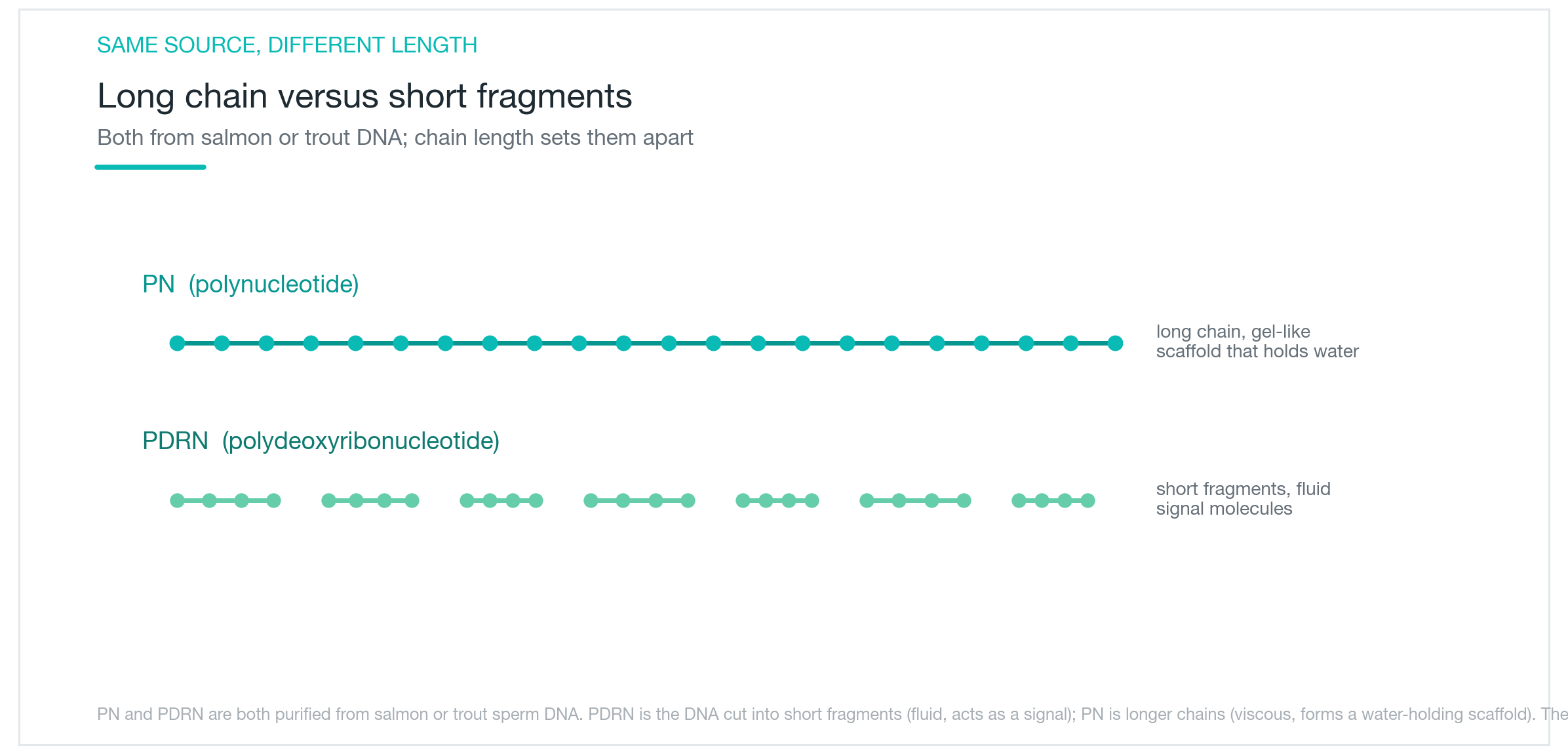
The key is chain length. Both are made from purified salmon or trout DNA, but PDRN is a short fragment of that DNA while PN is a much longer, continuous strand. That physical difference changes how each one behaves.
Short-chain PDRN is closer to a liquid in consistency and moves through tissue like a messenger molecule, working directly on cell receptors. Long-chain PN absorbs water and forms a gel, viscous and cohesive. Inside the skin that gel builds a mesh-like scaffold, holding moisture in place and giving cells a surface to anchor to. The viscosity difference also means the two are delivered with slightly different needle gauges and feel different during treatment.
So even though both come from the same salmon DNA source, their roles diverge. PDRN is more of a signaling molecule, nudging cells toward regeneration. PN is more structural, physically filling and supporting the dermis. A useful analogy: PDRN is the instruction slip sent to the workers, while PN is the scaffolding they climb. One note: the exact length cutoff that separates PN from PDRN varies by country and manufacturer, so it is cleaner to think in terms of function rather than a precise number.
Is Rejuran a PN or a PDRN?
This is the question that trips up almost everyone. Short answer: Rejuran is PN. The company uses a proprietary process to keep the salmon DNA in long-chain form, which puts it squarely in the PN category, not PDRN, even though many clinics refer to it as a PDRN injection.
The regulatory classification is different too. In Korea, PN products like Rejuran are registered as medical devices, while PDRN-based products are registered as pharmaceuticals. Different categories mean different approval pathways and different standards of evidence. The original PDRN-based product is Italy's Placentex, while the PN side includes Rejuran and Italy's Plinest.
So why the confusion? The term "salmon injection" started out attached to PDRN products, then Rejuran's popularity as a PN product pulled the whole phrase into its orbit. Both terms now sit under the same umbrella in marketing copy and patient reviews, which makes name-based comparisons unreliable. If a clinic mentions "salmon injection," it is worth asking whether they mean PN or PDRN. Knowing the ingredient matters more than knowing the brand.
How PDRN and PN work
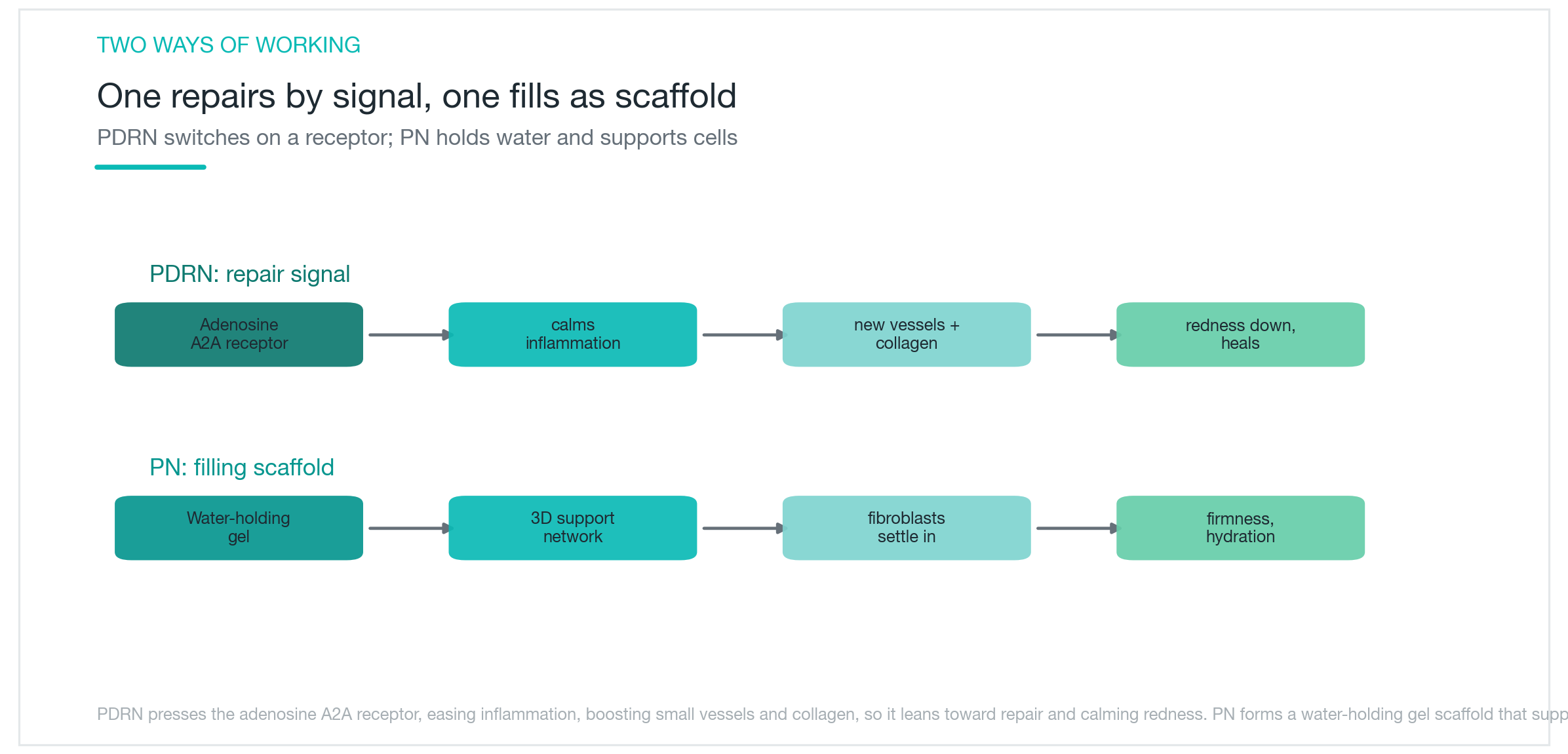
The two ingredients operate through different pathways. PDRN works by activating adenosine receptors, a switch that when flipped dials down inflammation, promotes new blood vessel formation, and ramps up collagen-producing fibroblast activity. That pathway makes PDRN especially effective for wound healing and reducing redness.
PN takes a different route. The long hydrated chain forms a gel scaffold that delivers immediate moisture retention, then acts as a substrate for cells to migrate into and build on. Collagen and elastin fibers grow around it, which is why PN is consistently associated with improved skin texture, firmness, and glow. Enlarged pores that have lost structural support can also benefit from that scaffolding effect.
The two mechanisms are not completely siloed. PN breaks down partially inside the body and some fragments activate the same adenosine receptors as PDRN, so there is overlap. Directionally, though, PDRN signals cells to regenerate while PN fills and supports. Neither is universally superior; they are better thought of as tools optimized for different goals.
How much of the salmon injection's effect has been confirmed?
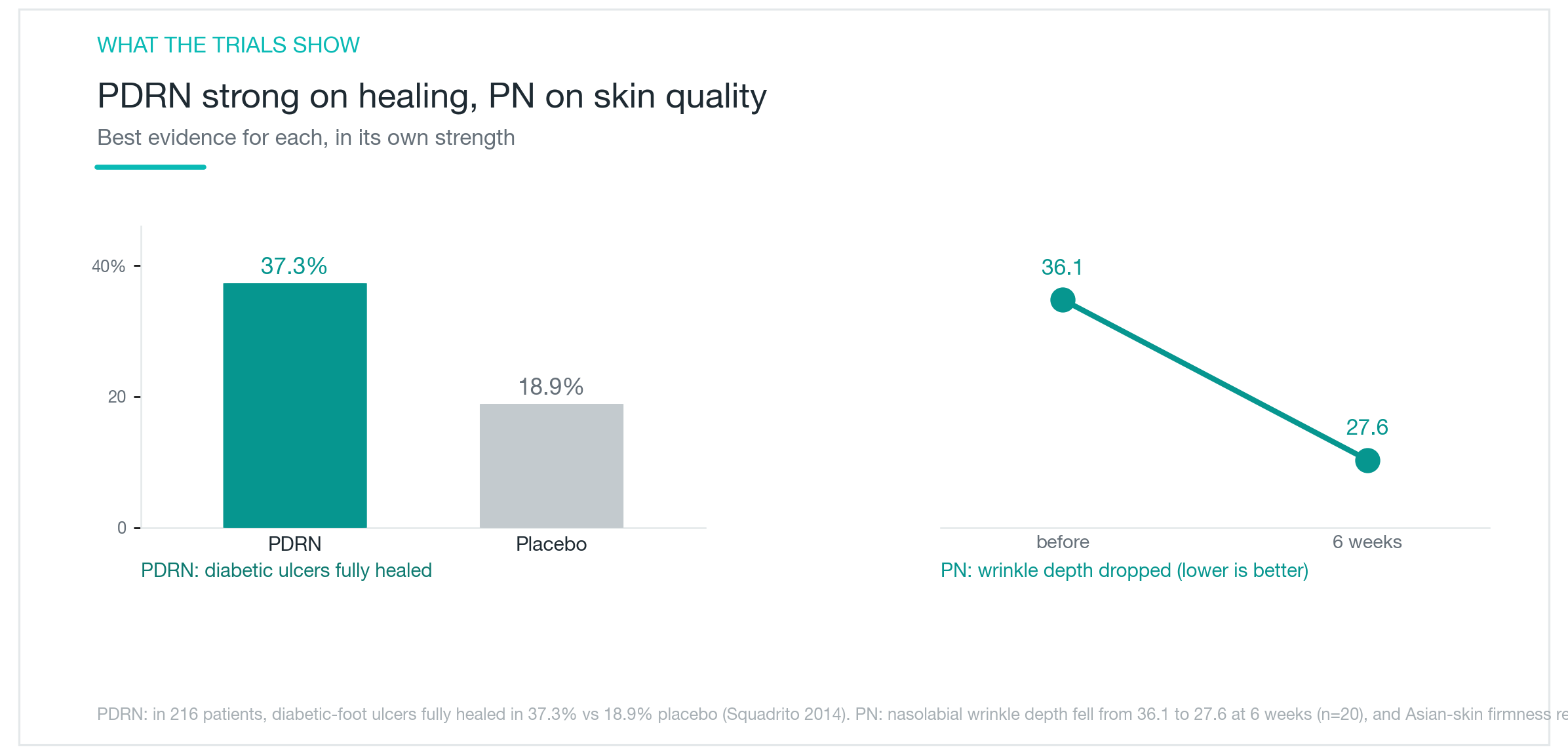
The evidence base varies by indication. PDRN has solid data on the wound healing side. In a well-designed study of 216 patients with diabetic foot ulcers, the PDRN group achieved a complete healing rate of roughly 37%, compared to roughly 19% for placebo, nearly double. That confirms the regenerative mechanism in a real clinical setting.
Cosmetic evidence is building too. In a PN nasolabial fold study, wrinkle depth measurements dropped from around 36 before treatment to around 28 at six weeks. A separate study of 30 Asian participants showed skin firmness, radiance, and texture scores improving from around 3.4 to 3.6 on a 5-point scale. The direction is consistent across multiple smaller trials: better hydration, elasticity, and texture.
An honest note: cosmetic-use studies are generally small and often lack a control group. Results tend to be gradual, building across a series of sessions rather than transforming skin overnight. One early Rejuran study that used to be widely cited was later retracted and is no longer considered valid evidence. That said, both ingredients have years of real-world use behind them and a track record of patient satisfaction, so with realistic expectations the outcomes tend to land well.
Side effects and precautions after treatment
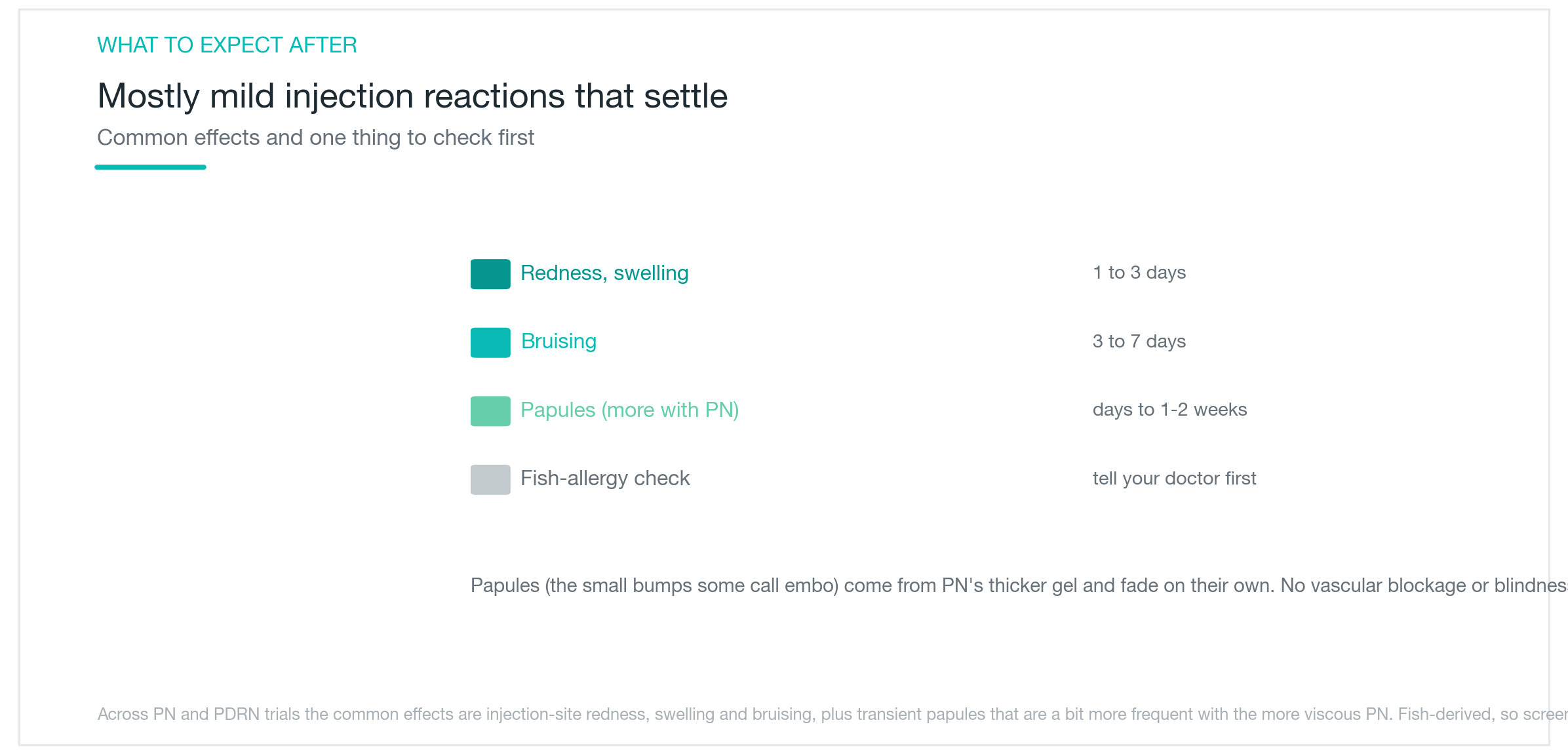
Both ingredients have a long safety record. The most common reactions, redness, swelling, and bruising, come from the injection itself rather than the ingredient and typically clear within one to seven days.
Because PN is a thicker gel, small firm papules (sometimes called embos) can occasionally be felt at injection sites. These settle on their own within a few days to a couple of weeks and are not a cause for concern. Some temporary flushing right after the session is normal, so keeping a few days' buffer before an important event is sensible. If bruising is a concern, avoiding blood thinners and alcohol around the time of treatment helps.
One thing worth mentioning: both PN and PDRN are derived from fish DNA, so if you have a significant fish allergy, let your provider know beforehand. The purification process removes most protein, making true allergic reactions uncommon, but disclosure is still good practice. Unlike filler, there are no reported cases of serious vascular complications from these ingredients. Precise placement technique still matters, though, so choosing an experienced provider is important. Treatment is generally deferred during pregnancy or when there is active inflammation at the injection site.

Which one fits your skin concern?
Breaking it down by goal makes the choice clear. If you are primarily after glow, firmness, pore refinement, or overall skin texture, PN is the stronger match. Rejuran sits in this category and is widely used as a skin booster to lift skin quality across the board.
If redness is your main concern, you are dealing with post-acne marks, or you want to speed recovery after a laser or resurfacing procedure, PDRN is more in its element. Its anti-inflammatory and repair-focused mechanism makes it well-suited for calming sensitized or post-procedure skin.
Both options are typically scheduled every two to four weeks for three to four sessions, with results building gradually over four to eight weeks and lasting roughly four to six months. Think of it less as a one-time fix and more as a maintenance protocol. Downtime is minimal for both, which makes them easy to fit into a normal schedule. Identify your primary concern first, hydration and structure, or calm and repair, then work with a provider who can match the right ingredient and product to it. Using both together, timed by goal, is common practice, so there is no need to commit to just one.
Was this helpful?
About this article
Written by a practising aesthetic physician and intended for general education — not a substitute for individual medical advice.
Read next
PDRN and PN Skin Boosters: Differences and Results Compared
PDRN and PN both come from the polynucleotide family extracted from salmon or trout DNA, but chain length and molecular weight decide what each one actually does in the skin. PDRN's short, light chains slip into the epidermis quickly to speed up recovery, while PN's long, heavy chains settle into the dermis and act as a scaffold that holds its ground much longer.
By Dr. Kim
Rejuran, Water-Glow Shots and Salmon Injections: Differences, Effect and Duration
Rejuran, Juvelook, and Re2o all fall under the skin booster label, but their active ingredients, mechanisms, and accumulated clinical evidence are entirely different. An evidence-based breakdown of what each one actually does and how to decide which fits your skin concern.
By Dr. Lee
Arm Fat Injection and CoolSculpting: Differences and Effects Compared
Lipolysis injections and CoolSculpting come up together as the go-to answers for stubborn arm fat. They break down fat cells through different mechanisms and on different timelines, and understanding that difference helps you match the right choice to your own arms.
By Dr. Kim