Pico Laser Types Compared: Wavelengths and Handpieces
By Dr. Kim8 min read

If you look into pico lasers, you will quickly run into names like PicoSure, PicoWay, enlighten, and PicoPlus, all listed side by side. When you read that these devices can fade tattoos, lighten melasma, and even improve pores, it is natural to wonder which one is actually the best.
The truth is, what determines your results is not the brand name but the wavelength and handpiece. Even within the same pico laser category, how well a device reaches tattoo pigment, melasma, or scar tissue depends entirely on the wavelength used. No study so far has directly compared one brand against another, and nearly all the evidence has been gathered by wavelength instead. So rather than asking which device is best overall, this article focuses on how to choose the right wavelength and handpiece for your particular concern.
What kind of laser is a pico laser?
As the name suggests, a pico laser is a general term for lasers that fire light in picosecond pulses. A picosecond is one trillionth of a second, a moment far too short for anyone to feel. The basic principle is to deliver a strong burst of energy in that instant, breaking apart pigment or tattoo ink beneath the skin.
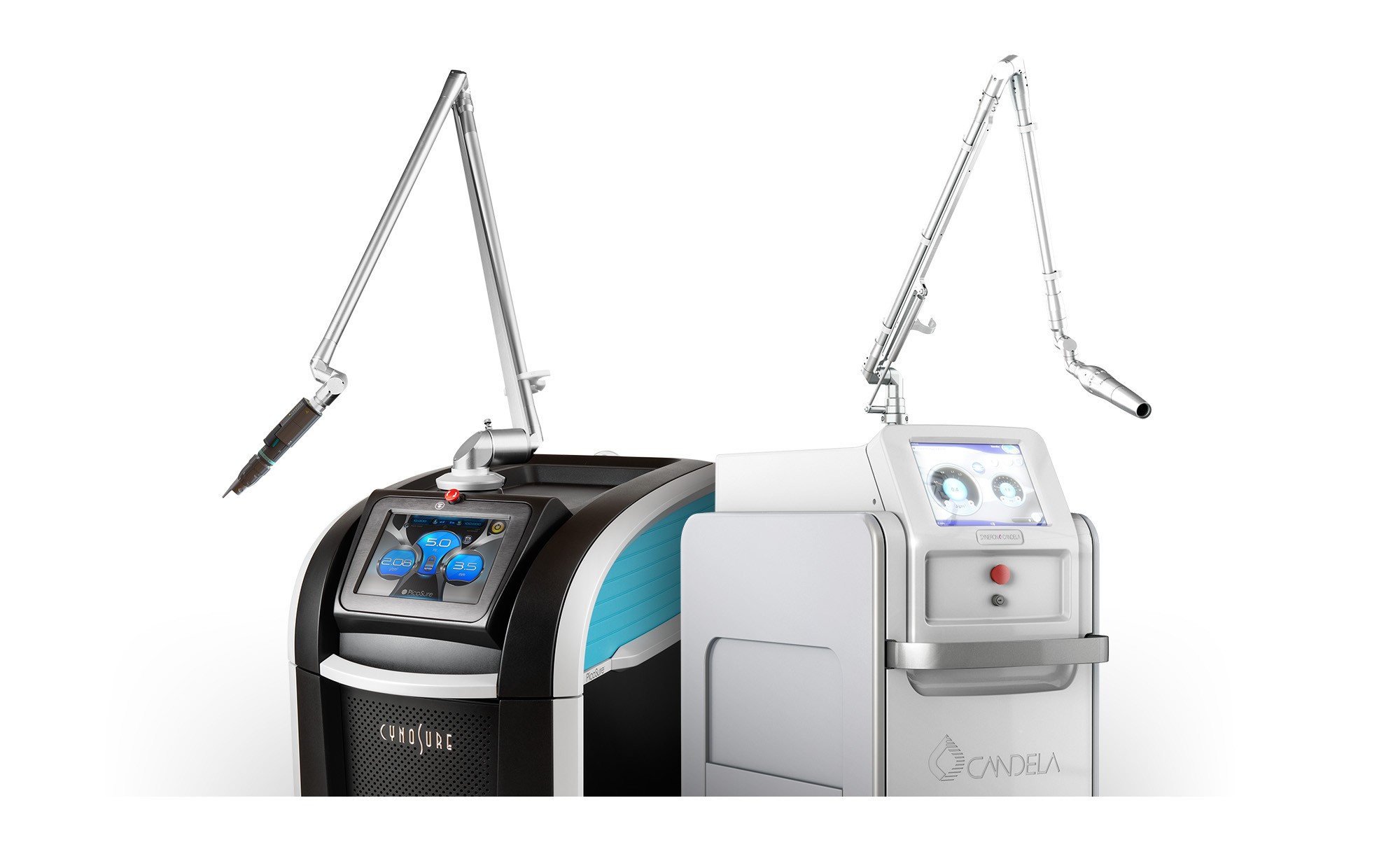
PicoSure, PicoWay, enlighten, and PicoPlus all belong to this picosecond laser category, though each comes from a different manufacturer. PicoSure is made by Cynosure, PicoWay by Candela, enlighten by Cutera, and PicoPlus by Lutronic. The core principle is the same across all four, but each company builds in a slightly different set of wavelengths and handpieces.
The main concerns these devices address are tattoo removal, pigment issues like melasma and age spots, congenital pigmentation such as Ota nevus, and scars and pores. No single device handles all of these equally well. How well it suits each area depends on its wavelength and handpiece. So when choosing a device, it makes more sense to check its wavelengths and handpieces first, rather than going by name alone. If you sort out beforehand whether your concern is pigment-related or more about scars and pores, your consultation will go much more smoothly.
How is it different from a nanosecond laser?
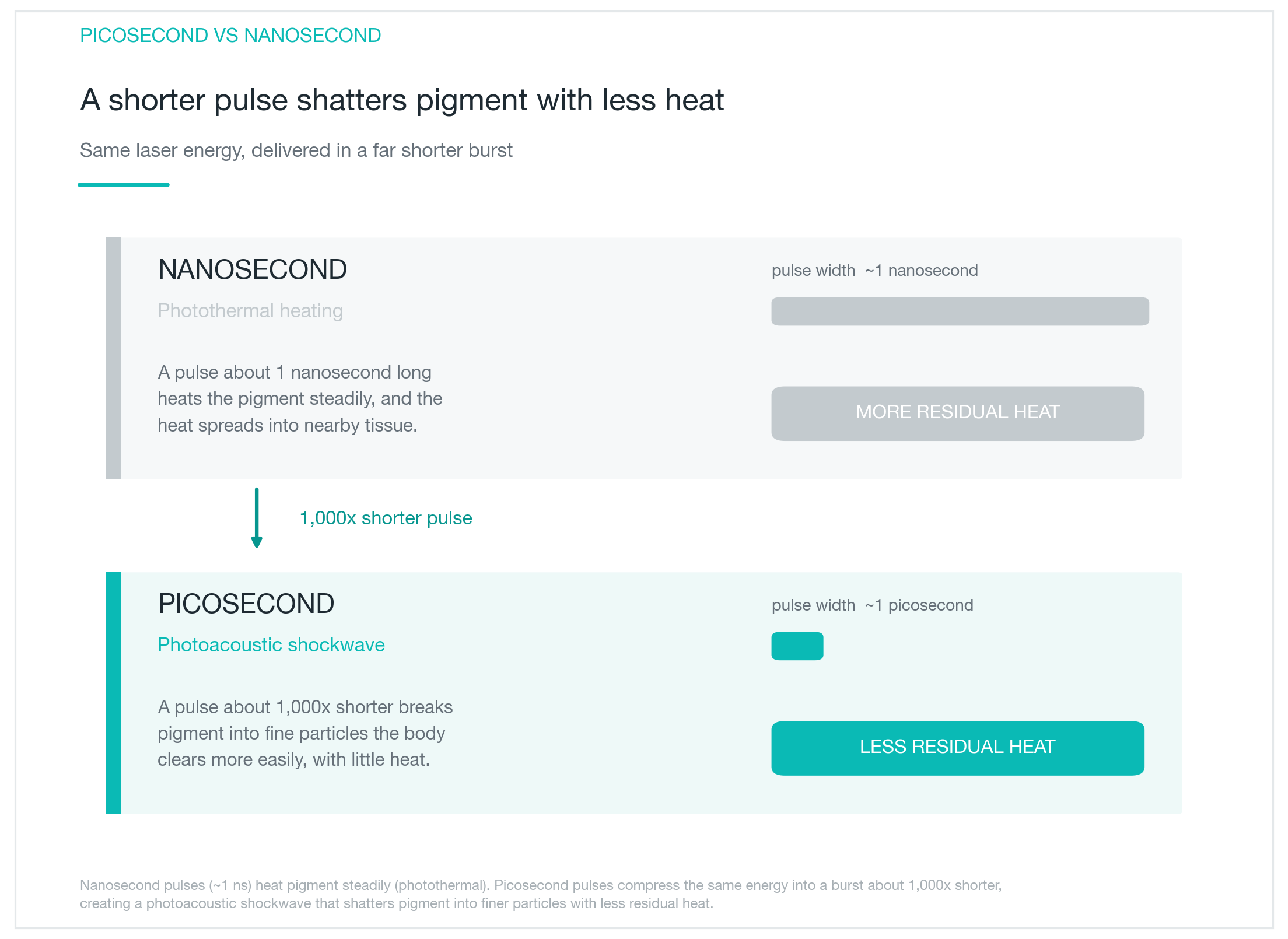
Before pico lasers arrived, nanosecond lasers were the standard for treating pigment. A nanosecond pulse fires light for roughly 1000 times longer than a picosecond pulse. During that window, heat spreads into the surrounding tissue, breaking up pigment while also leaving behind some thermal irritation.
Picosecond lasers work differently. They deliver a burst of intense energy so briefly that heat has no time to spread, shattering pigment into powder-like fragments through a photoacoustic shockwave. Think of it as breaking pigment apart with pressure rather than heat. Because less thermal irritation is left behind, side effects such as redness or post-inflammatory pigmentation are theoretically expected to be milder than with nanosecond lasers.
In tattoo removal, this difference has actually been confirmed by research. Picosecond laser treatment cleared more tattoo ink than nanosecond laser treatment. Still, it is too early to say picosecond is clearly better than nanosecond for every concern. For melasma, where pigment sits shallow and spread out, some studies found little difference between the two approaches, so the theoretical advantage and the actual clinical outcome need to be considered separately. Many clinics still use nanosecond lasers today, so it is worth checking which type is available before you go in.
Wavelength and handpiece comparison of four devices
The four devices each have a slightly different set of wavelengths. The table below sums it up.
| Device | Manufacturer | Wavelength | Signature Handpiece |
|---|---|---|---|
| PicoSure | Cynosure | 755nm (532/1064nm optional on Pro) | Focus lens |
| PicoWay | Candela | 532/730/785/1064nm | Resolve |
| enlighten | Cutera | 532/670/1064nm | Dual pico and nano |
| PicoPlus | Lutronic | 532/595/660/1064nm | MLA fractional |
PicoSure runs on 755nm as its base wavelength, with 532nm and 1064nm added as options on the Pro version. PicoWay covers four wavelengths from 532nm to 1064nm, and PicoPlus adds 595/660nm on top of that, giving it the widest wavelength range of the four. enlighten stands out for letting you switch between picosecond and nanosecond pulse modes on a single device.
The handpiece names also differ by device. PicoSure's Focus, PicoWay's Resolve, and PicoPlus's MLA are all fractional handpieces that split the laser into a dense grid of tiny dots. They are used separately from pigment removal, to refine scars, pores, and overall skin texture. All four devices share 1064nm, a shorter wavelength, and a fractional handpiece, so their basic setup is not all that different. The real differences come down to how wide a range of wavelengths each one covers and the finer details of how each one works.
Which wavelength is used for which pigment?
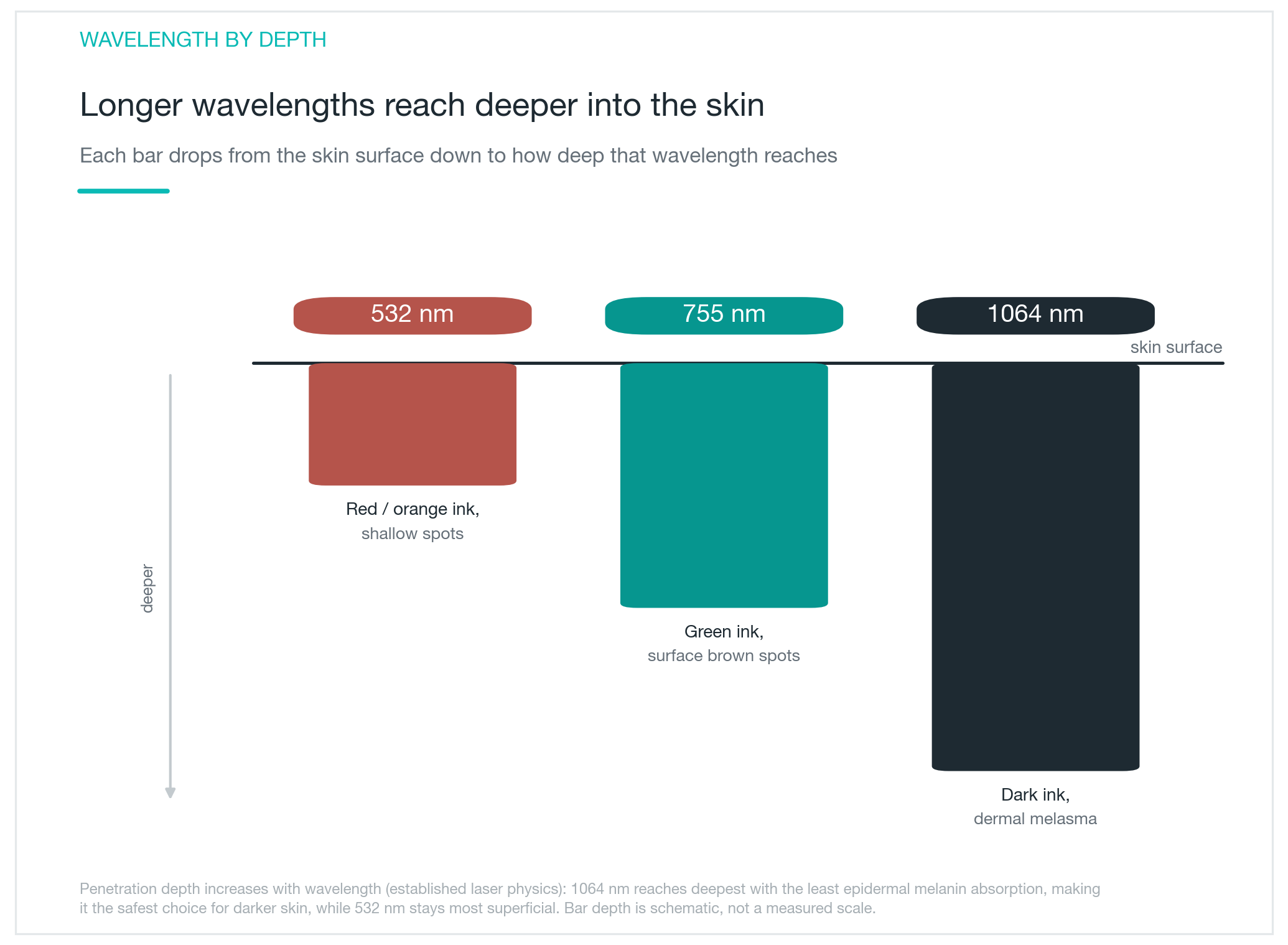
The wavelength you need depends on the color of the pigment and how deep it sits. Because 1064nm is a longer wavelength that reaches deep into the skin, it is mainly used for black or blue pigment and for melasma, which sits closer to the dermis. It can also be used relatively safely on darker skin.
755nm works well on green-toned tattoo ink and on surface-level brown pigment like age spots. 532nm, the shortest of the three, targets red tattoo ink or shallow pigment such as freckles. That said, the shorter the wavelength, the greater the risk of pigmentation on darker skin, so skin tone needs to be factored in as well.
If your concern is scars, pores, or skin texture, you should look at the fractional handpiece rather than a pigment-targeting wavelength. Fractional handpieces like Focus, Resolve, and MLA take a fundamentally different approach, stimulating skin regeneration rather than targeting pigment. So the wavelength and handpiece you need change depending on what your concern actually is, whether it is the color of a tattoo, melasma versus age spots, or scarring. If a tattoo has multiple colors mixed together, a single wavelength may not be enough, and a device with several wavelengths built in can be an advantage.
Effects confirmed in studies
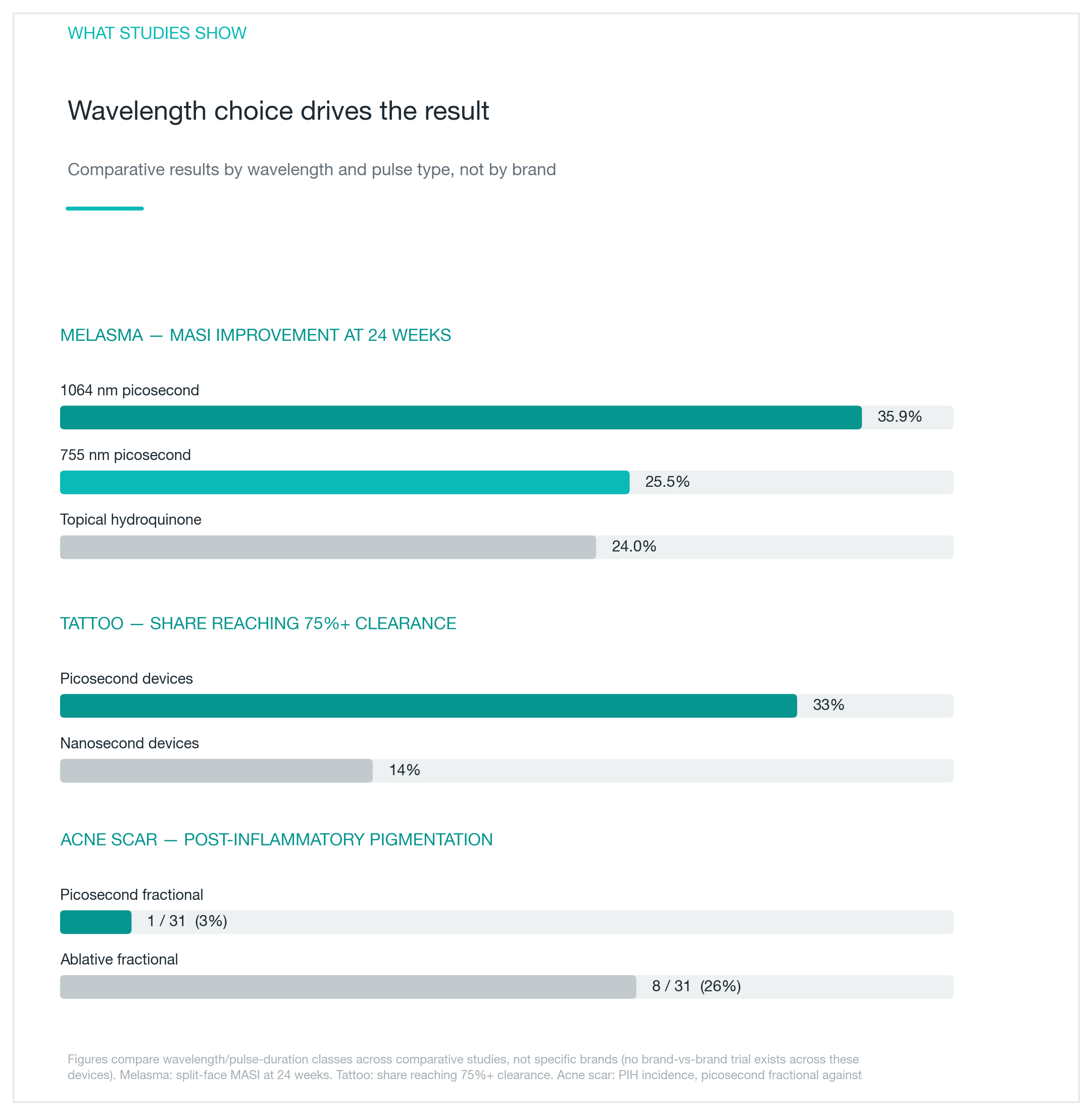
Several studies have found 1064nm outperforms other wavelengths for melasma. In one trial that followed 59 patients over 24 weeks, the melasma index dropped by about 35.9% with 1064nm, ahead of 25.5% for 755nm and 24% for a topical whitening agent. A pooled analysis of multiple studies also confirmed a clear benefit for 1064nm, while finding that 755nm was not meaningfully better than topical treatment and mainly added pigmentation risk instead. A large comparative analysis covering 1182 patients likewise showed the best results with 1064nm.
For surface-level brown pigment like age spots, on the other hand, some studies found 755nm produced faster, more pronounced improvement. That same research also found 1064nm showed almost no effect on very dark skin tones. For tattoo removal, picosecond lasers outperformed nanosecond lasers. In one study, the share of patients with over 75% ink clearance was 33% with picosecond versus 14% with nanosecond. For Ota nevus, 755nm produced meaningful improvement as well, with no permanent side effects.
For acne scars, fractional pico laser showed improvement comparable to the established erbium YAG laser, while causing pigmentation in only 1 of 31 patients compared with 8 of 31 for erbium YAG. That said, minor pinpoint bleeding right after treatment appeared more often with the pico laser. Pore improvement was found to be about on par with existing non-ablative fractional lasers.

How can you reduce the risk of hyperpigmentation?
Redness and mild swelling right after a pico laser treatment are common but usually settle within a few days. The side effect to watch for most is pigmentation. Using shorter wavelengths like 532nm or 755nm on darker skin actually raises the risk of the skin darkening instead. 1064nm, by contrast, is considered a relatively safe wavelength for melasma and darker skin alike. Fractional handpieces do not target pigment directly, so their pigmentation risk tends to be lower.
There is no single wavelength that is safest for every treatment. Since the safest choice depends on what concern you are treating, the standard practice is to do a test spot beforehand and start with a conservative setting.
What matters most when choosing a device is not the brand name. No clinical study has yet directly compared one brand against another. All the evidence gathered so far is organized by wavelength, and PicoSure, PicoWay, enlighten, and PicoPlus all come equipped with 1064nm, a shorter wavelength, and a fractional handpiece. So the practical approach is to first sort out the color of your tattoo, whether it is melasma or age spots, or whether scarring is your concern, and then check whether the device you are considering has the wavelengths and handpiece suited to that concern.
Was this helpful?
About this article
Written by a practising aesthetic physician and intended for general education — not a substitute for individual medical advice.
Read next

AHA and BHA Differences: Choosing by Skin Type and Comparing Effects
AHA and BHA are both acids that clear away dead skin cells, but where they actually work depends on one simple thing, whether they dissolve in water or in oil. AHA breaks down the bonds holding surface buildup together, while BHA rides through oil to reach the sebum sitting deep inside your pores. Here is how each one works, and which fits which skin type.
By Dr. Kim
GentleMax Pro Hair Removal: Alexandrite or Nd:YAG, Which One Is Right?
The GentleMax Pro packs two wavelengths, an Alexandrite laser and an Nd:YAG laser, into a single device, letting practitioners switch between them based on skin color and hair thickness. Here is how each wavelength works and why cooling is always built in alongside them.
By Dr. Lee
Gummy Smile Botox Effects, Duration, and Side Effects
A gummy smile happens when your gums show more than usual as you smile, and an overactive lip-lifting muscle is one of the most common causes. Botox works by slightly reducing the strength of that muscle so your lip doesn't rise as high when you laugh. Here's how to tell whether muscle is really the cause, plus how long the results tend to last.
By Dr. Lee