PDT for Acne: Results, Number of Sessions, and Downtime
By Dr. Kim8 min read

You have tried oral antibiotics and kept up with topical medication, but red inflammatory acne keeps coming back on your cheeks and jawline. That is when many people start looking for the next option. Photodynamic therapy, or PDT, applies a specific drug to the skin so that area alone reacts to a specific light, then shines that light to shrink the sebaceous gland and reduce acne bacteria. Think of it as marking the acne spots first, then aiming light precisely at those marks to clear them.
The drug that acts as the marker is called a photosensitizer. ALA and MAL are the most common ones, paired with a light source such as blue light, red light, or IPL, which delivers several wavelengths at once. More recently, Gold PTT and the platinum angle method have also come into use. These skip the photosensitizer entirely and instead place tiny gold or platinum particles in the skin, then heat them with laser energy. Below is what actual studies on moderate to severe inflammatory acne found, covering reduction rates, relapse rates, and downtime, exactly as reported.
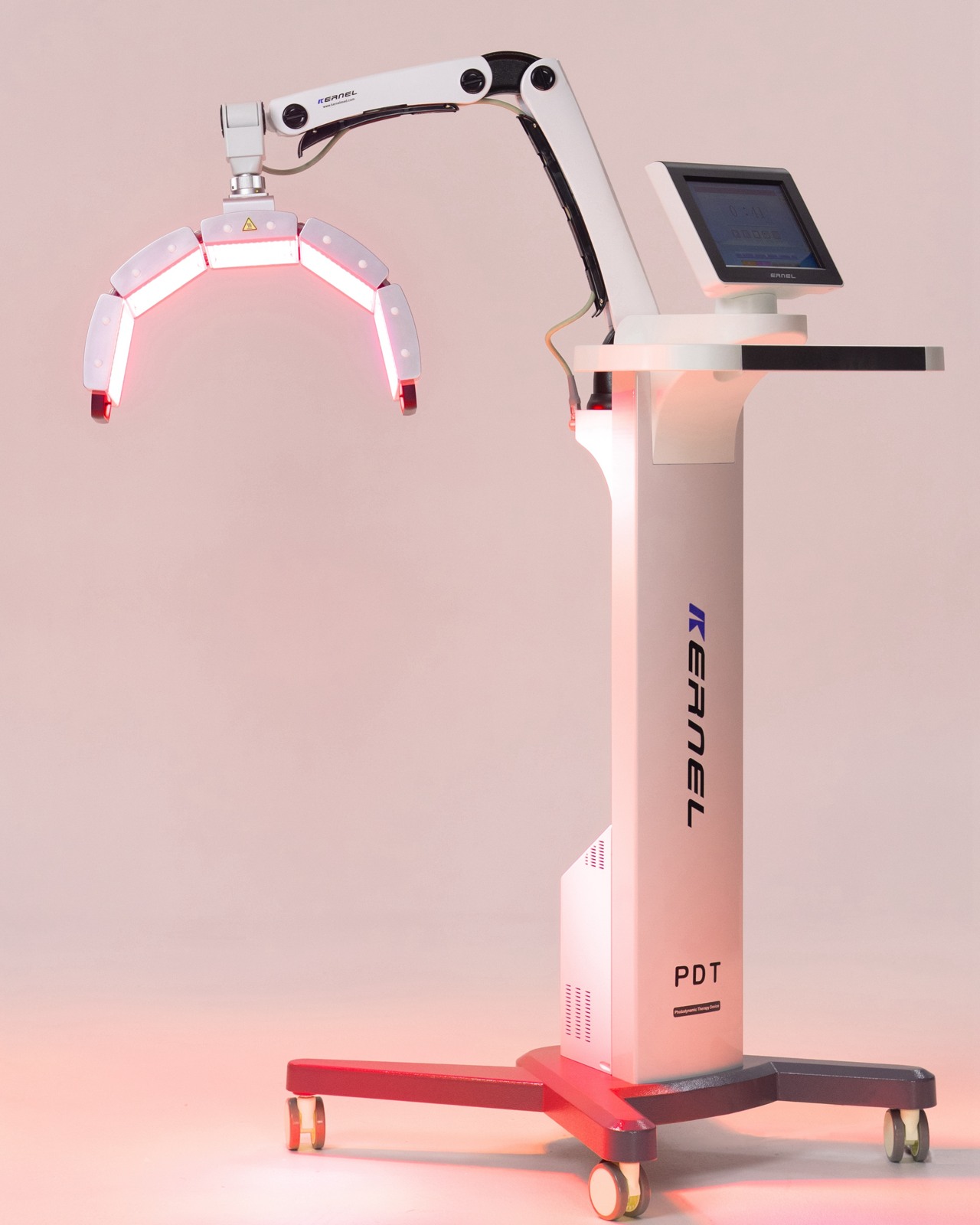
How does PDT reduce acne?
PDT works in two steps. First, a photosensitizer such as ALA (aminolevulinic acid) or MAL (methyl aminolevulinate), a substance that reacts to light, is applied to the face and left to absorb for a set time. This substance tends to build up especially well inside oil-producing sebaceous glands and acne bacteria, so it ends up marking the acne spots more heavily than anywhere else.
Once that marker has built up, shining light of a specific wavelength activates the photosensitizer and generates reactive oxygen species, reactive molecules that damage bacteria and cells. These reactive oxygen species shrink the sebaceous gland and kill acne bacteria, while also calming the inflammatory response itself.
Unlike topical medication or antibiotics, which suppress only one part of the inflammation, PDT addresses several causes of acne at once: excess oil, bacteria, and inflammation. That is why it is especially recommended for moderate to severe inflammatory acne that has not responded well to other treatments.
The procedure starts with cleansing, then the photosensitizer is applied and left to absorb for 30 minutes to an hour, followed by 10 to 20 minutes of exposure to light at a set wavelength. During the waiting period, you sit in a light-blocked room, and a longer wait can let the photosensitizer soak deeper into the sebaceous glands, which can affect results. This is not a one-visit treatment. The process repeats every few weeks, gradually shrinking the sebaceous glands over time.
Reduction rates by drug and light combination
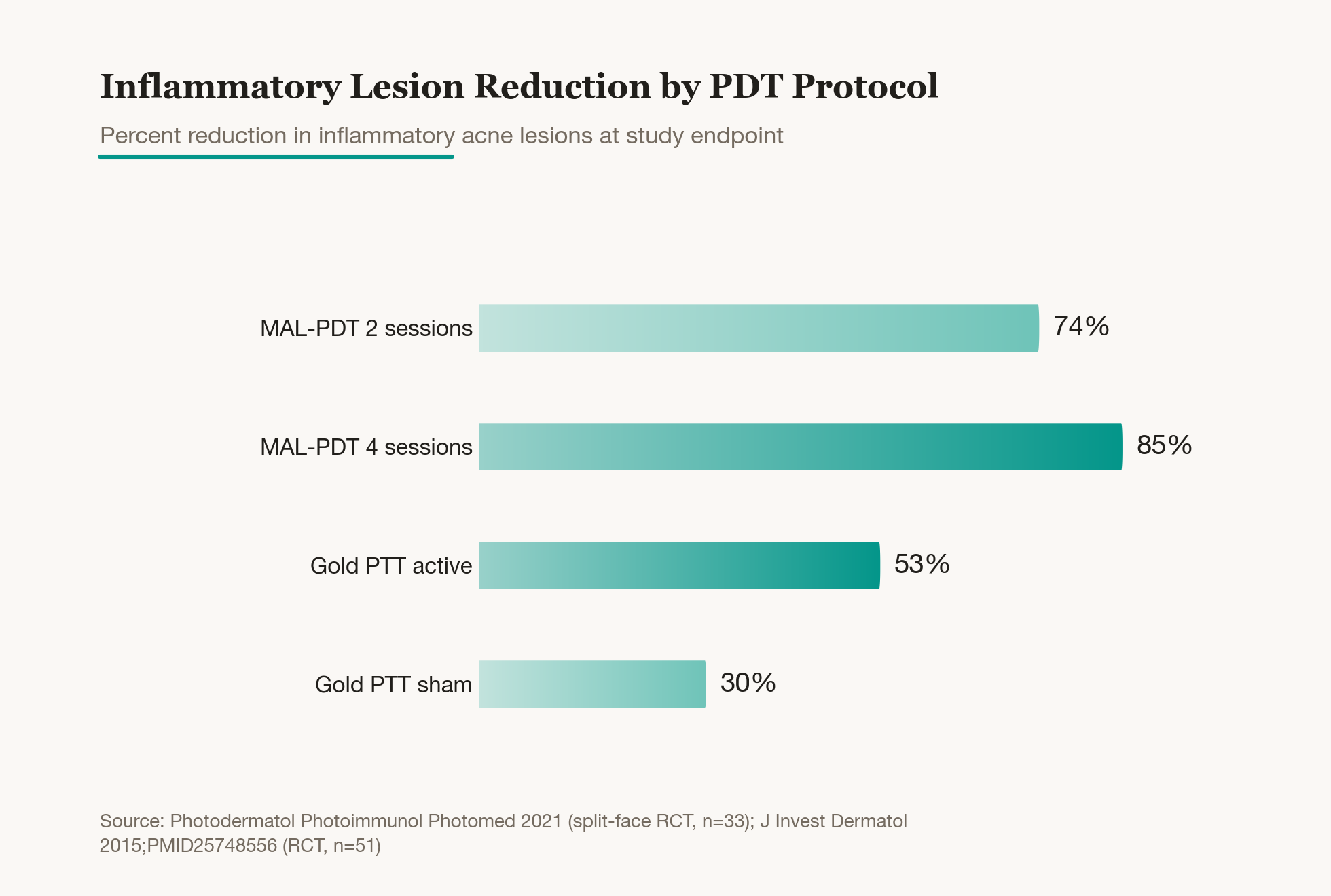
Even within PDT, results vary quite a bit depending on the photosensitizer, the light source, and the number of sessions. In one randomized controlled study using MAL as the photosensitizer, a rigorous design that randomly splits patients into treatment and comparison groups, cheeks treated twice showed a 74% reduction in inflammatory lesions from baseline at week 20, while cheeks treated four times reached 85%. More sessions meant a larger drop.
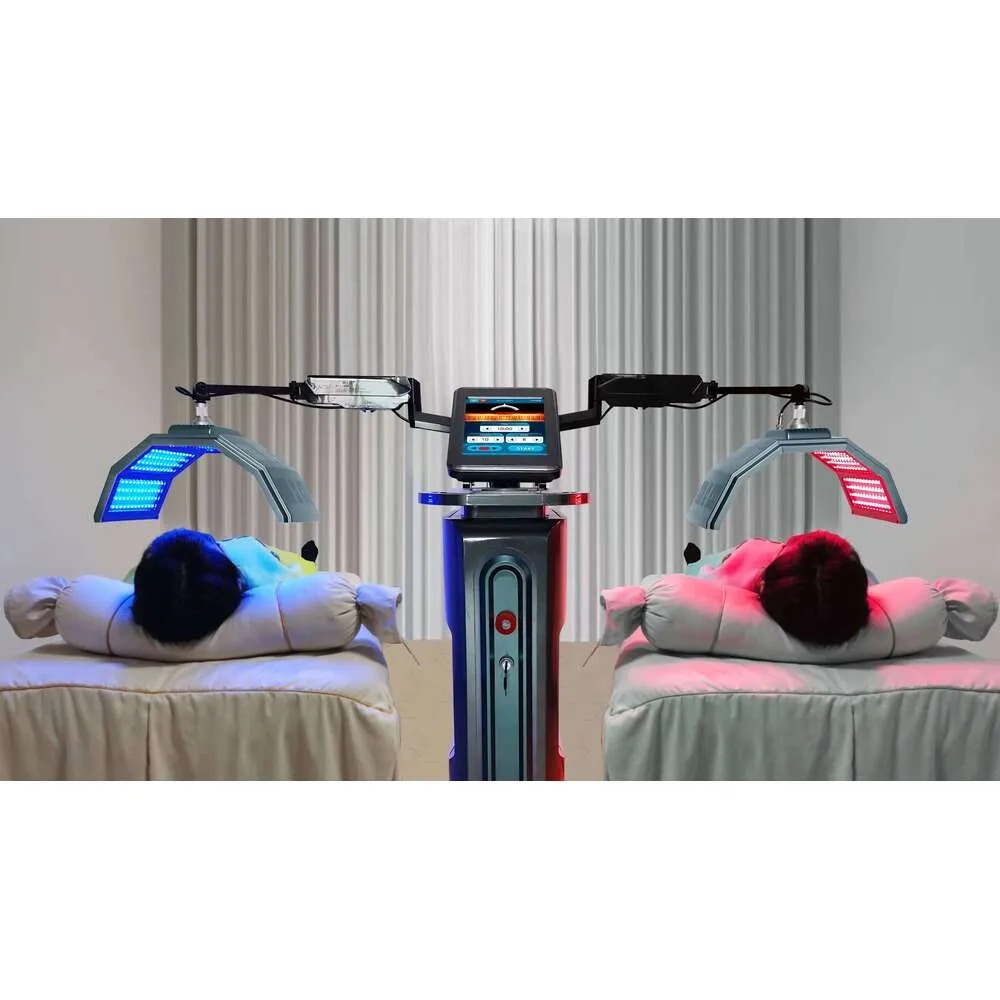
Red light, blue light, and IPL activate the photosensitizer at slightly different wavelengths, each with its own strengths. Red light reaches deeper into the skin and works well on deep inflammatory lesions. Blue light is better at suppressing acne bacteria directly. IPL blends several wavelengths in one session and covers a broader range, so it often improves redness and pigmentation along the way.
Sessions are usually spaced 1 to 2 weeks apart, for a total of 3 to 4 treatments. More sessions bring bigger results, but downtime and discomfort add up too, so the number of sessions is typically set based on both skin condition and schedule.
Gold PTT and the Platinum Angle method
Gold PTT differs from traditional PDT with ALA or MAL in that it skips the photosensitizer entirely. Instead, gold-coated microparticles are applied to the skin, then pushed into the hair follicle with vibration or ultrasound and settled right next to the sebaceous gland. In simple terms, tiny metal particles are planted beside the sebaceous gland first, then a near-infrared laser, an invisible light that passes deep into the skin, heats up only those particles. The heat they give off selectively damages the surrounding sebaceous gland and cuts oil production.
A study evaluating this method found that at week 12, the treatment group's inflammatory lesions dropped by an average of 14.3, clearly more than the 5.1 reduction in the control group, and by week 28 the reduction rate had grown to 61%. In a separate clinical trial, the active treatment group improved 53% by week 16 versus 30% for the sham group, a statistically significant difference.
In Korea, a second-generation version that adds platinum particles is sometimes called the platinum angle method. It is described as combining gold and platinum particles to fine-tune the heat reaction around the sebaceous gland and reduce irritation, but large-scale studies validating this specific combination are still limited, so it is safest to treat it as an extension of the existing Gold PTT evidence rather than a separately proven method.
How long does recovery take after treatment?
After PDT, redness and a stinging or burning sensation usually show up for about 24 to 48 hours. Swelling and inflammation peak on days 3 to 5, and peeling or scabbing starts between days 2 and 7. Scabs typically fall off between days 6 and 14, and redness mostly settles by day 10 to 14.
During this period, the photosensitizer has not fully cleared from the body, so the skin stays very sensitive to light. It helps to avoid direct sunlight and even bright indoor lighting for about 2 days after treatment, and sunscreen should be applied more carefully than usual.
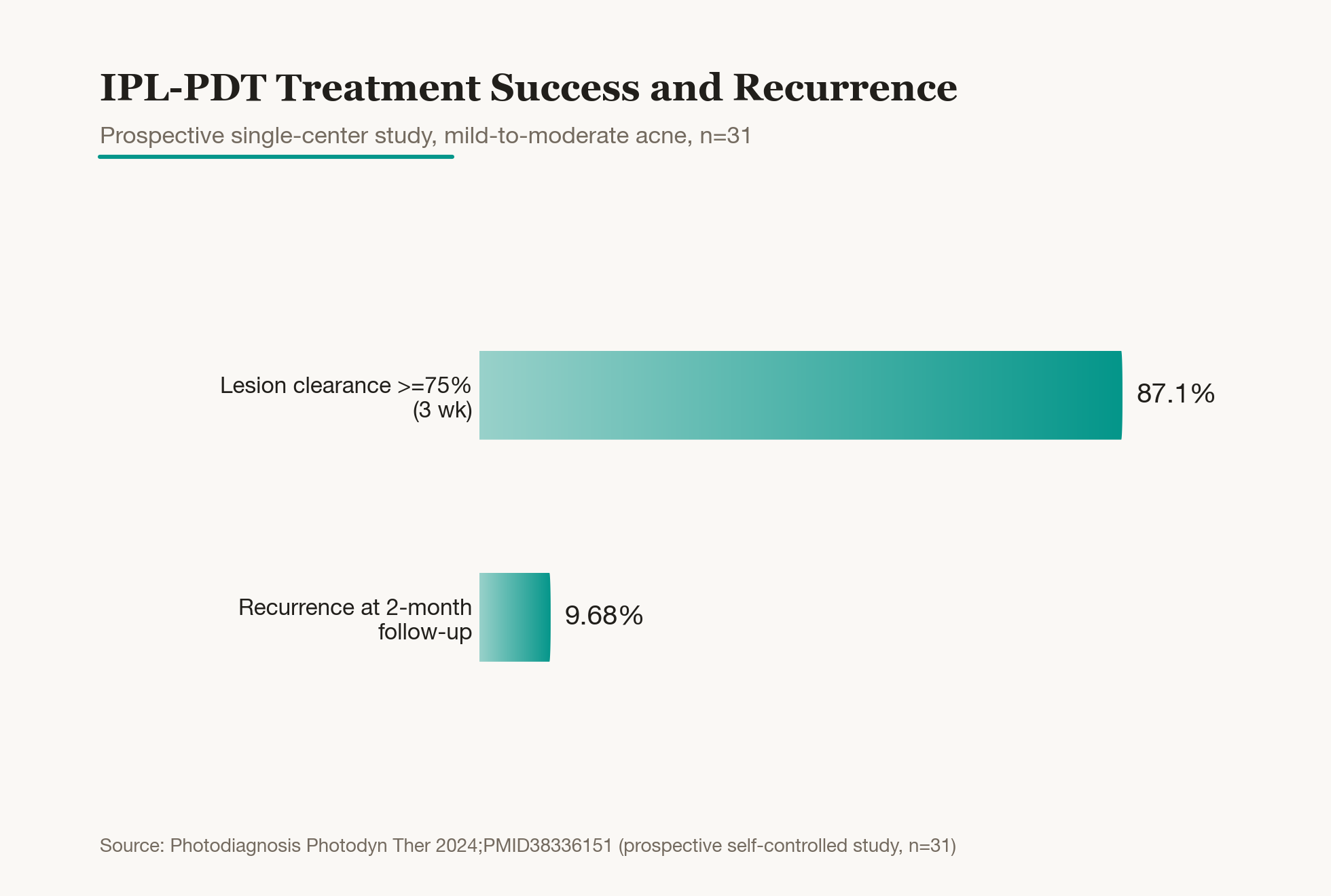
In a study combining IPL and PDT, 87.1% of patients reached the success threshold of a 75% or greater lesion reduction 3 weeks after treatment. At 2 months, the relapse rate was a relatively low 9.68%, and no serious side effects were observed. Getting through that downtime, the stretch of time it takes skin to fully recover after treatment, tends to go hand in hand with results that last longer.
How do the four methods differ?
These four methods differ in whether they use a photosensitizer, which light source they rely on, and how the procedure runs. Whatever the method, the goal is the same: shrink the sebaceous gland, suppress acne bacteria, and reduce how often inflammatory acne comes back. Still, whether a photosensitizer is applied and which wavelength is used changes the downtime and the extra benefits you get along the way. The table below lays out the comparison.
| Method | Photosensitizer | Light Source | Session Interval | Notes |
|---|---|---|---|---|
| ALA-PDT | ALA | Red or blue | 1–2 weeks, 3–4 sessions | Most common combination in Korea |
| MAL-PDT | MAL | Red light | 1–2 weeks, 2–4 sessions | Backed by extensive European research |
| Gold PTT | None, gold microparticles | Near-infrared laser | 1 week, 3 sessions | Lower photosensitivity burden |
| IPL-PDT | ALA combined | IPL | 2–4 weeks | Also improves redness and pigmentation |
ALA-PDT and MAL-PDT, both of which use a photosensitizer, have relatively more evidence behind them. Gold PTT skips the drug application, so photosensitivity reactions tend to be milder, making it an option if you want to cut down on downtime. IPL-PDT is worth considering if redness or pigmentation bother you alongside the acne itself.
No matter which method you choose, results do not appear after a single session. Since equipment and light sources vary by clinic, it helps to confirm during the consultation which combination will be used and how many sessions are recommended before you start.
What to check before treatment and who it suits
PDT fits especially well for moderate to severe inflammatory acne that has not responded to antibiotics or topical treatment, particularly when it spreads across the whole face. It is also often recommended for oily skin that relapses frequently.
Before the procedure, let your provider know if you are pregnant or breastfeeding, or if you are taking any photosensitizing medication that could react with the light. It also helps to plan ahead for a few days of redness and peeling afterward.
Since this treatment requires multiple visits, it is worth checking whether your schedule allows you to keep to the intervals between sessions. If the gaps stretch too long, the results may not build up as expected. Understanding both the realistic outcome and the recovery time before you start tends to lead to higher satisfaction.
| Item | What to Check |
|---|---|
| Good candidate | Moderate to severe inflammatory acne, widespread excess oil |
| Photosensitivity care | Avoid direct sun and use sunscreen for 48 hours after treatment |
| Pregnancy or breastfeeding | Discuss with your provider before treatment |
| Session structure | Usually 1–2 week intervals, 3–4 sessions |
PDT is not a one-time fix. It calls for several sessions spread over weeks, plus the downtime that comes with each one. That is why it matters to check the evidence on efficacy and relapse beforehand, then work with your provider to choose the method that fits your acne severity and schedule.
Was this helpful?
About this article
Written by a practising aesthetic physician and intended for general education — not a substitute for individual medical advice.
Read next

Fraxel for Acne Scars: Effects, Pigmentation, and Side Effects
How fractional lasers like Fraxel work on acne scars, why results differ so much by scar type, how real the PIH risk is on Asian skin, and what the research actually shows about how much improvement to expect: scars soften, they don't vanish.
By Dr. Kim
Subcision Effect and Combination Treatment, Including Side Effects and Recovery Time
What subcision actually involves, which acne scars it suits and which it doesn't, how results change when you add filler or laser, what bruising and downtime to expect, and who the right candidate is, explained with real study numbers and no inflating.
By Dr. Lee
Cafe-au-Lait Spots Returning After Laser: Causes, Number of Sessions and Expectations
A café au lait spot forms because the pigment-making cells in that one patch of skin are locally overactive. Laser treatment breaks up the pigment that has already built up, but it doesn't switch off those cells, which is why the color so often returns. Here's the biology behind it, why results differ so much from person to person, and what a realistic treatment timeline actually looks like.
By Dr. Kim