Oligio Versus Thermage: Differences, Plus Oligio X Cooling Compared
By Dr. Kim8 min read

When skin starts losing firmness and the jawline begins to blur, radiofrequency lifting tends to come up. Among the options, Oligio is one of the most frequently cited Korean alternatives to Thermage. Whether the results are comparable, why the price is lower, and how well it has actually been validated are the questions that naturally follow.
Oligio is a monopolar radiofrequency device made by Wontech, a Korean medical device company, and it belongs to the same family as Thermage. The core mechanism is identical: heating the dermis to contract existing collagen and stimulate new production. Where it differs is in the cooling design and the price point. For a Korean device in this class, Oligio has dedicated clinical data, and it has established itself as a reasonable domestic alternative that is not far behind Thermage in efficacy. The evidence, what changed with Oligio X, and the honest limits are worth examining one by one.
What kind of device is Oligio?
Oligio is a monopolar radiofrequency device. In monopolar RF, current flows from a single electrode through the body to a grounding pad placed on the skin, which allows energy to penetrate deeply and spread widely through the dermis. Thermage uses exactly this monopolar approach, and Oligio operates on the same principle.
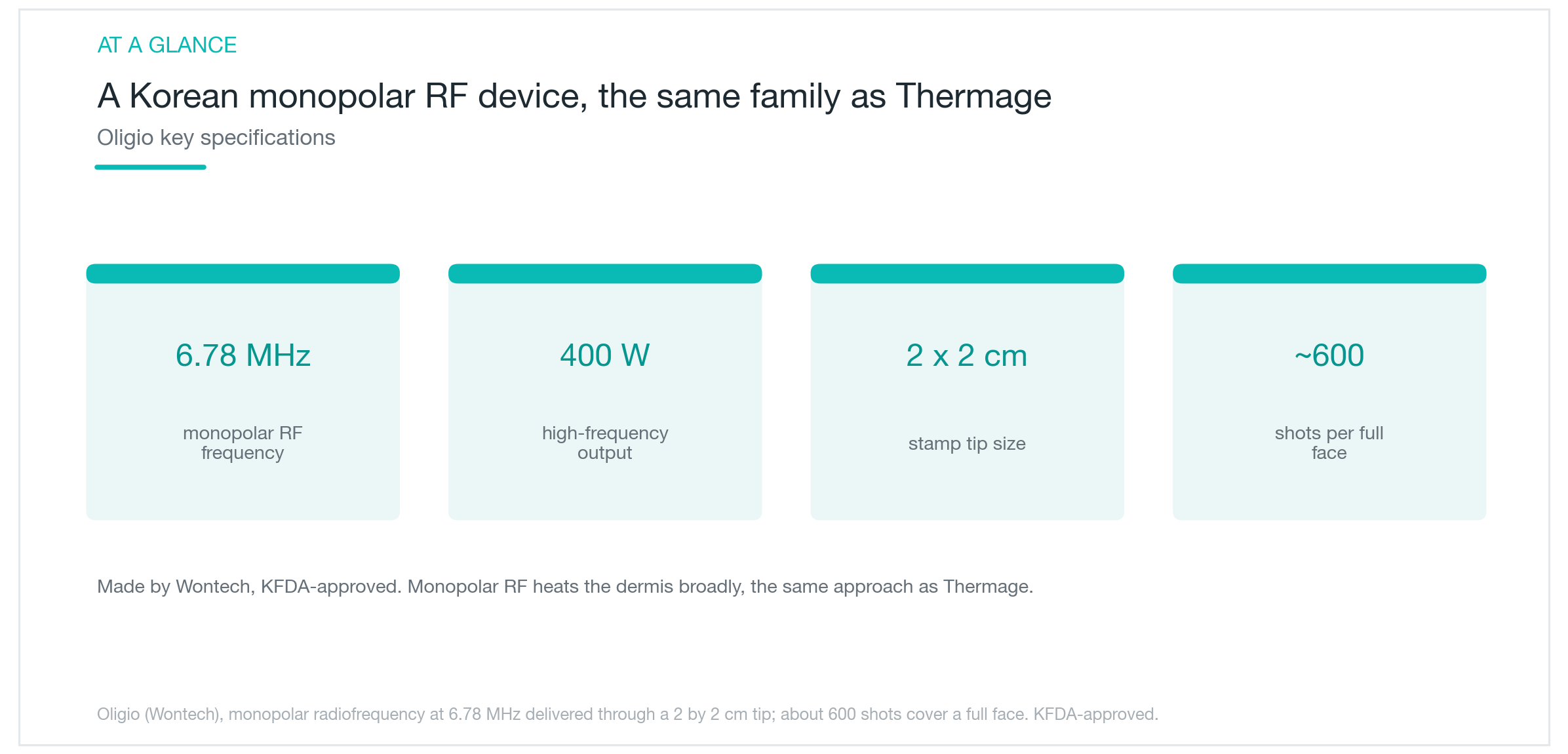
In terms of device specifications, it delivers 6.78 MHz RF energy through a 2 cm x 2 cm tip. During treatment, the tip is pressed in a stamp-like motion across the face, building up energy with each pass. A full session typically involves several hundred shots. The goal is to heat the dermis while keeping the surface intact, and the tip includes built-in cooling and vibration to protect the epidermis throughout. Oligio is KFDA-approved.
Wontech is a Korean aesthetic device company with a broader portfolio beyond Oligio. Oligio is its flagship RF lifting model and is widely distributed in Korean clinics. Being a domestic device means lower acquisition and maintenance costs, which is why the treatment price tends to be noticeably more accessible than Thermage's.
How does radiofrequency tighten skin?
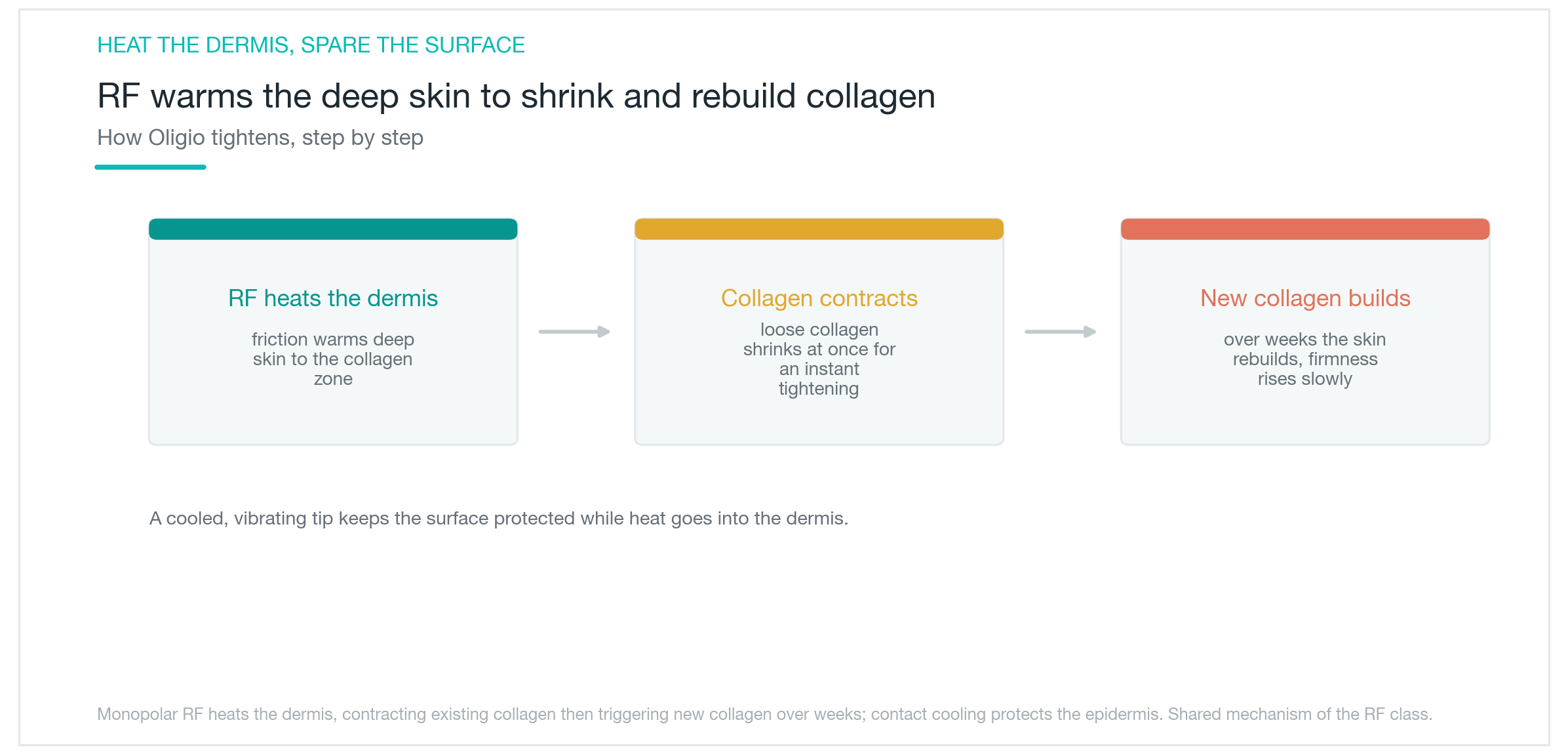
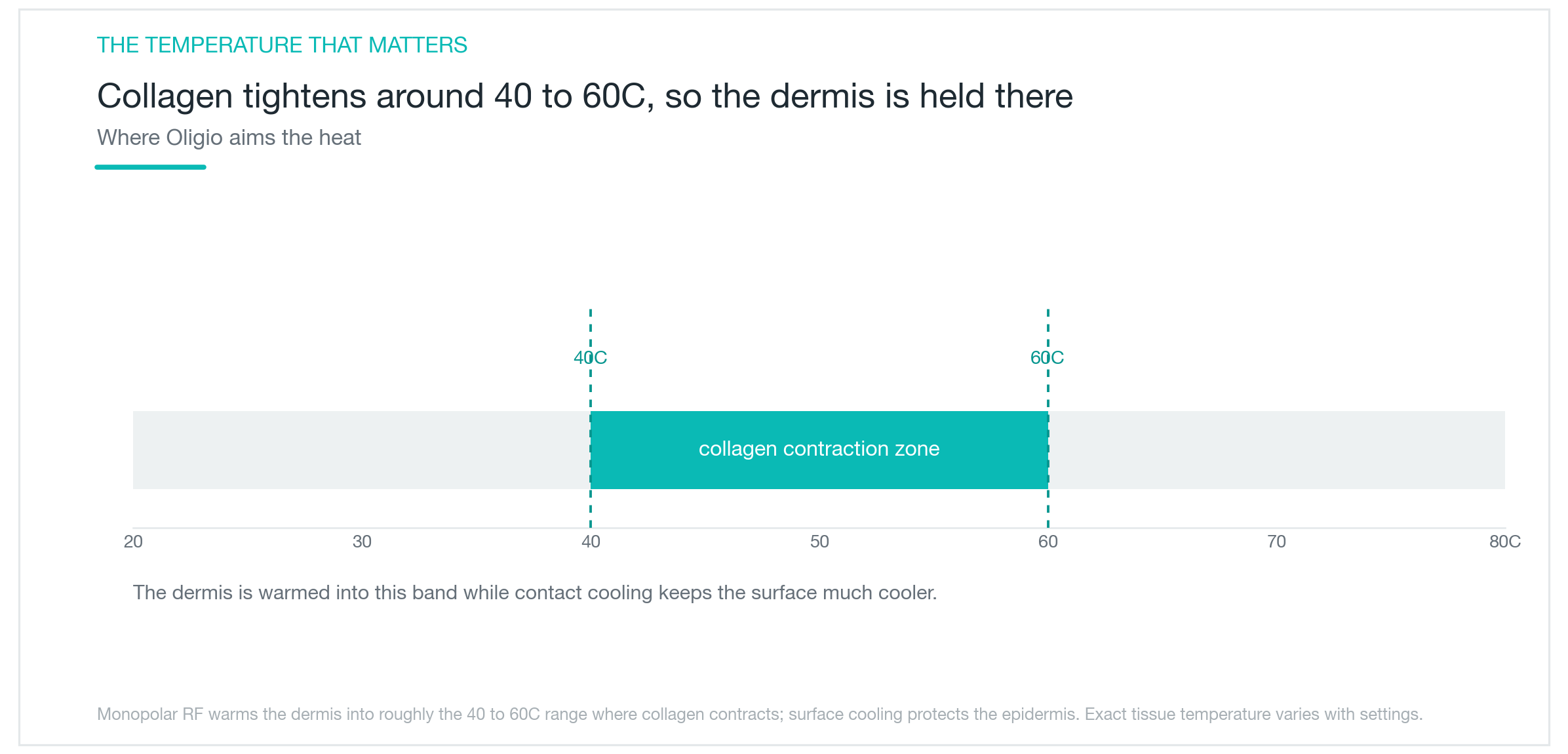
The mechanism is straightforward. RF energy agitates molecules in the dermis, generating frictional heat that raises the dermal temperature into the range at which collagen responds. That target zone is roughly 40 to 60 degrees Celsius. At these temperatures, loosened collagen contracts almost immediately, much like fabric that shrinks under heat.
Contraction is only part of the story. The thermal stimulus also triggers a wound-healing-like response, prompting the skin to produce new collagen. This is why the immediate post-treatment tightening differs from the fuller, longer-term improvement in firmness, which typically unfolds over two to three months. Keeping the surface cool is equally important. Oligio applies continuous tip cooling to protect the epidermis while directing heat exclusively into the dermis. Heating at a controlled depth while protecting the surface is the defining principle of monopolar RF lifting, and Oligio follows that design.
One more variable: the depth and intensity of dermal heating depend directly on the power setting. Too low and the effect is reduced; too high and the risk of pain and thermal injury rises. This is why the operator's judgment in calibrating output to each patient's skin makes a real difference in results.
Changes seen in a 20-patient clinical trial
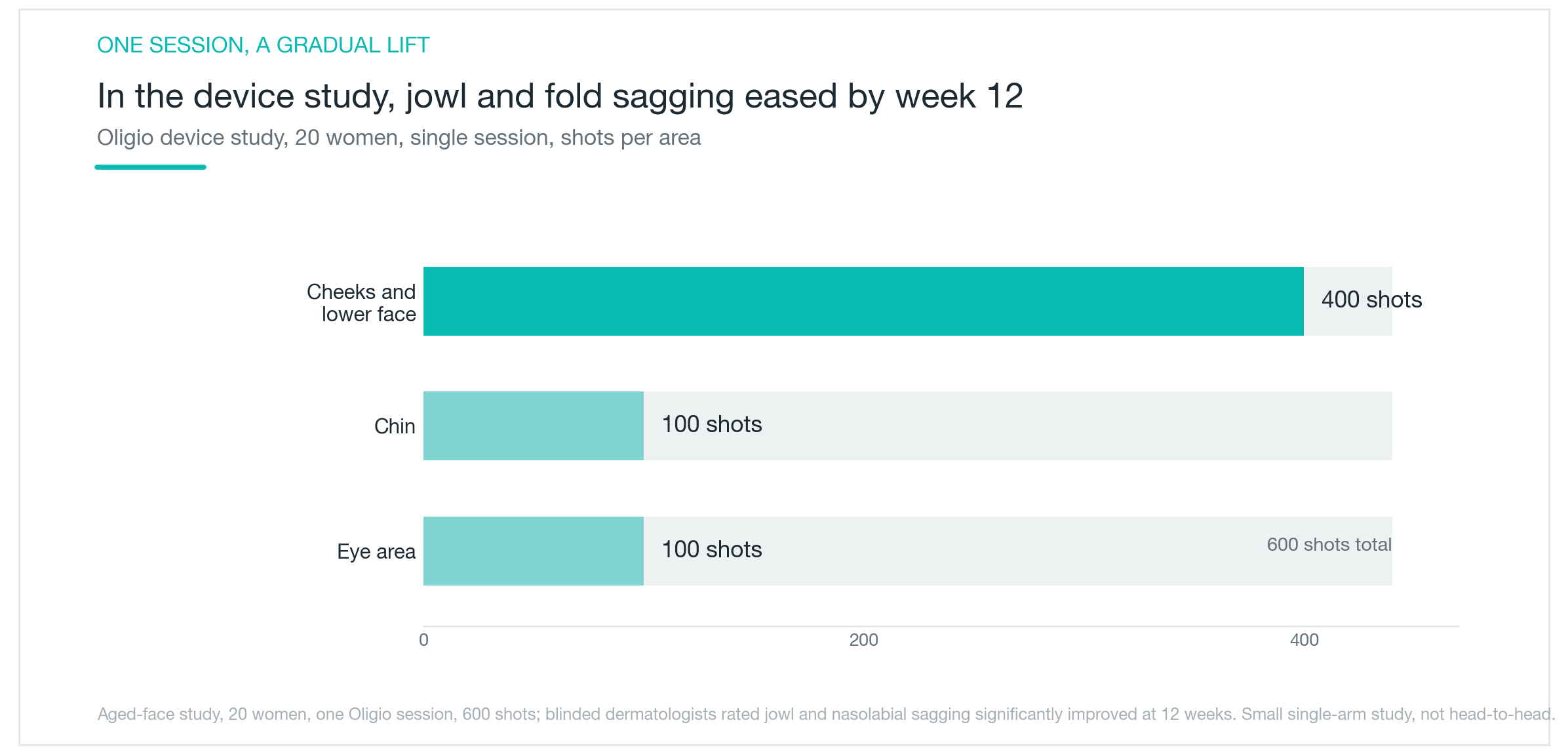
Among Korean RF lifting devices in this category, Oligio has dedicated clinical data. A study enrolled 20 women with age-related facial laxity and evaluated outcomes at weeks 4, 12, and 24 after a single Oligio treatment. At the week-12 mark, meaningful improvement was recorded in cheek laxity and the nasolabial fold area. The assessment was done by three blinded dermatologists who were unaware of treatment details.
The study protocol used 600 shots across the face: 400 to the cheeks and lower face, 100 to the chin, and 100 around the eyes. Results are not immediate. The transient tightening felt right after the session is short-lived; the real collagen-rebuilding change typically takes two to three months to become visible.
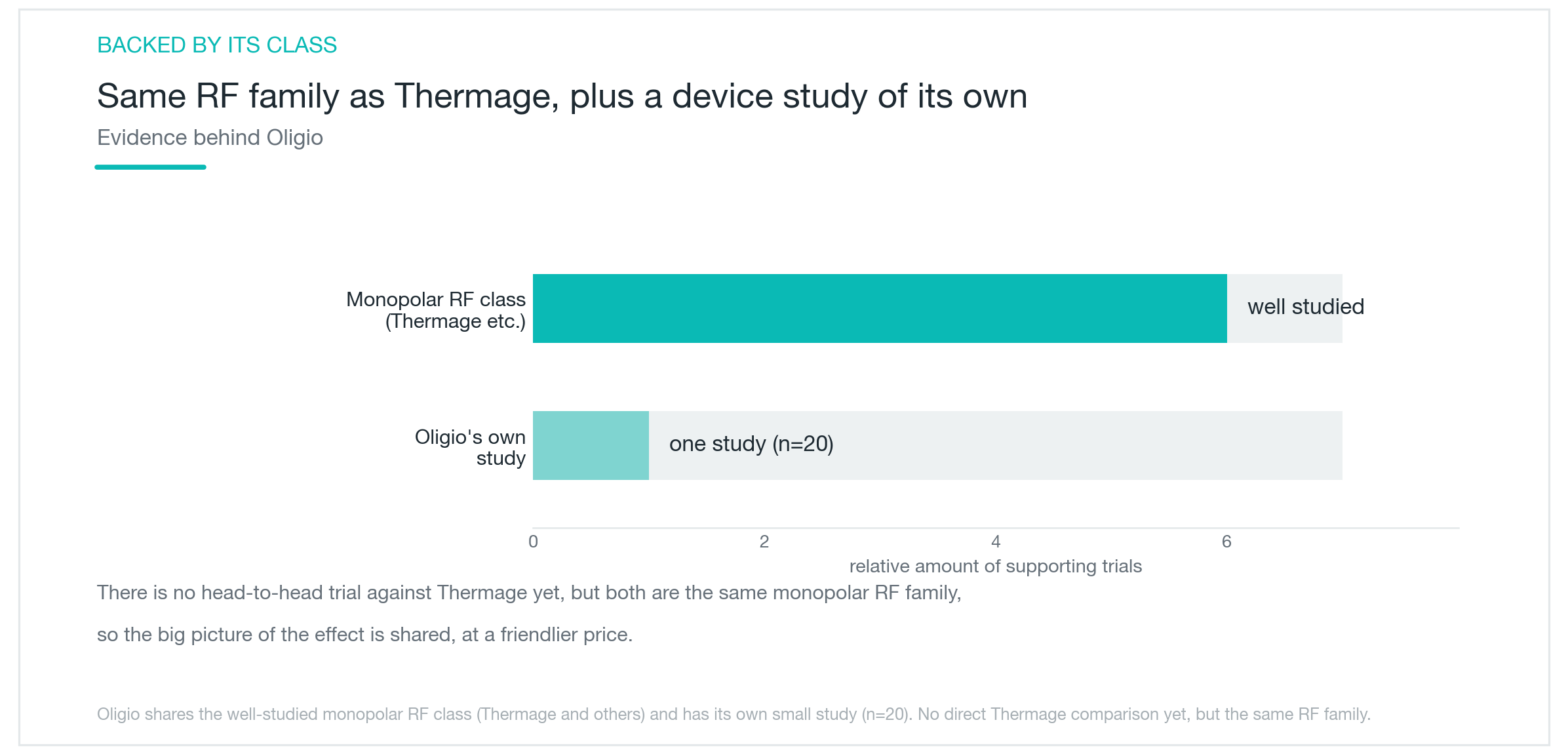
The study's limits are worth noting: 20 participants, no control group, no direct comparison with Thermage. What matters more, though, is that Oligio operates in the same monopolar RF family as Thermage, a class with a well-established evidence base built up over many years. Oligio shares that foundation and adds its own dedicated study on top of it. For a Korean device at a lower price point, that combination makes it a reasonable choice that is not meaningfully behind Thermage in efficacy.
How much pain and recovery should you expect?
RF lifting involves heating the dermis, so some heat sensation and stinging are part of the experience. Oligio's tip cooling and vibration are designed to dissipate heat at the surface and dampen nerve signals, reducing discomfort. It varies by individual, but the reported experience is tolerable stinging rather than sharp pain.
For those concerned about pain, topical anesthetic cream can be applied before the session. That said, reducing discomfort too aggressively often means lowering power output, which in turn reduces efficacy. The right balance is delivering enough energy while staying within what feels comfortably bearable.
Downtime is minimal. Some temporary redness and mild swelling can appear right after treatment, but these typically resolve within a day or two, with no bruising, no crusting, and no scabbing. Most people return to their normal routine the same day. Post-treatment care is simple: avoid saunas and strong physical friction for a few days, and keep up with moisturizer and SPF.
Real patient reviews tend to echo the same picture. Tolerable pain, little to no downtime, back to daily life the same day, and a natural-feeling lift over time are the recurring themes. The effect of one session typically lasts around six months. For anyone managing a busy schedule, Oligio's low disruption is a genuine practical advantage.
What is different about Oligio X?
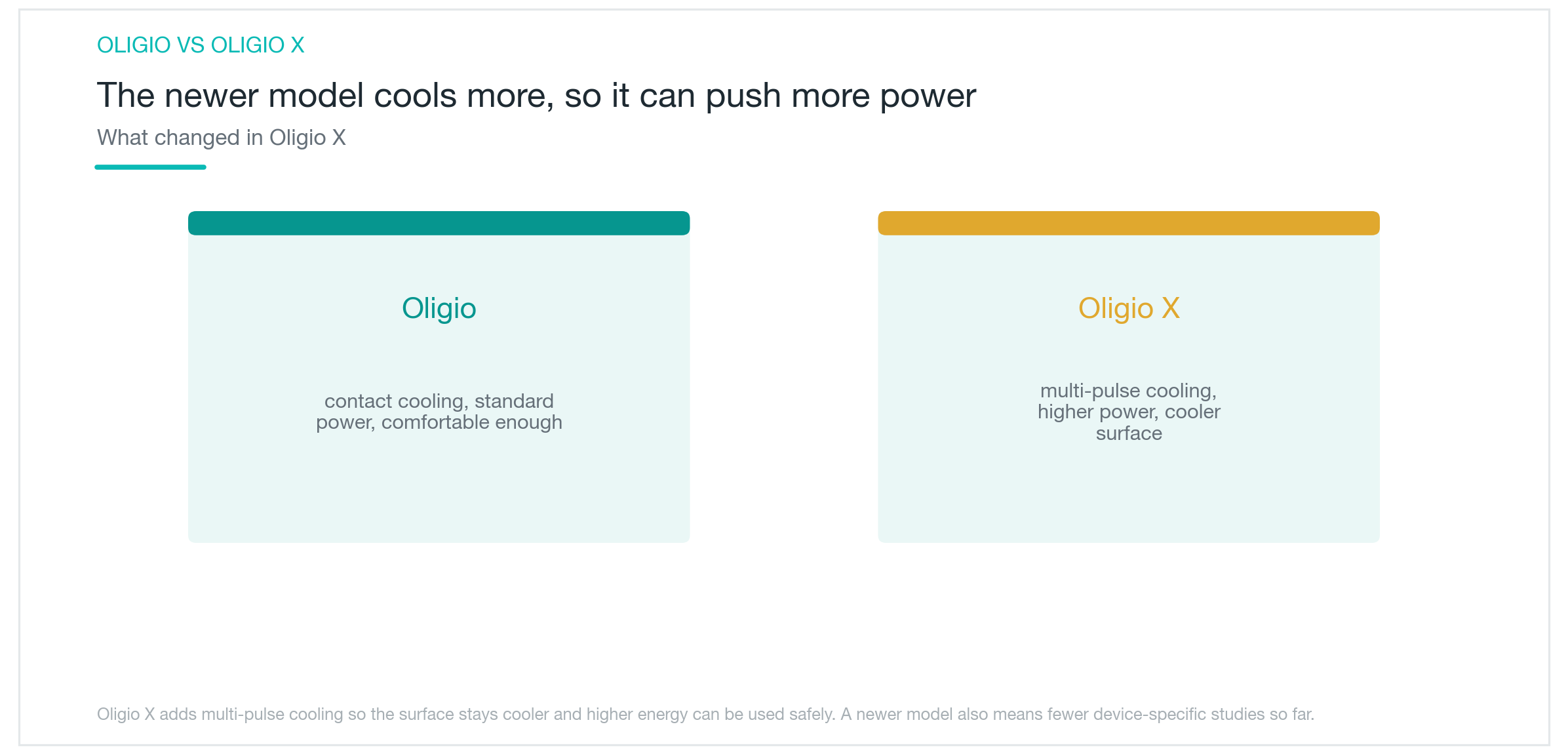
Oligio X is the upgraded version of the device. The biggest change is in the cooling system. Where the original Oligio uses contact cooling, Oligio X applies multi-pulse cooling: multiple cooling intervals per energy pulse, keeping the epidermis considerably cooler. A cooler surface allows higher power to be used safely, and higher power means more efficient heat delivery to the dermis.
In short, Oligio X is a refinement that pushes harder while keeping the surface more comfortable. The tradeoff to keep in mind is that newer models naturally have less dedicated research behind them. The table below summarizes the differences.
| Oligio | Oligio X | |
|---|---|---|
| Cooling | Contact cooling | Multi-pulse cooling |
| Power | Standard | Higher range available |
| Surface comfort | Comfortable | Noticeably cooler |
A newer model does not automatically mean proportionally better results. How the energy protocol is designed and how shots are distributed across treatment zones still drive outcomes more than the model name alone. The thinner evidence base for newer models is also worth factoring in. Paying more attention to the treatment protocol than the device generation tends to be the smarter approach.
Sagging levels it suits, and its limits
Oligio suits people at the early to moderate stages of skin laxity, as well as those who want to get ahead of visible aging before changes become prominent. It works particularly well for softening sagging along the cheeks, nasolabial folds, and jawline. The low pain and minimal downtime lower the barrier considerably.
Expectations are worth calibrating carefully. RF lifting is not surgery. It works by refilling collagen and tightening from within, not by physically repositioning tissue, so there are real limits for pronounced laxity. There is no direct comparative study between Oligio and Thermage, but operating in the same monopolar RF class means the underlying mechanism and expected outcomes are closely aligned. Oligio makes sense as an option that costs significantly less without sacrificing much efficacy.
That said, outcomes depend on the operator's power protocol and each patient's skin condition. RF lifting is inherently gradual. Results accumulate as collagen rebuilds over months, and one treatment should not be expected to produce dramatic change overnight. The most rational approach is to treat it as ongoing maintenance, repeated roughly every one to one and a half years, rather than a one-time fix.
Was this helpful?
About this article
Written by a practising aesthetic physician and intended for general education — not a substitute for individual medical advice.
Read next

10THERMA Lifting: Effect and Pain, and How It Differs From Thermage
A look at what 10THERMA actually is, how it compares to Thermage as a monopolar RF device, what dedicated clinical evidence shows, how much it hurts, and who it suits best.
By Dr. Kim

Density Lifting Effects: How Does It Compare With Thermage?
A plain look at what Density RF actually is, how its dual monopolar-bipolar mode differs from single-mode RF like Thermage, what the clinical evidence shows, how much it hurts, what downtime to expect, and who is and isn't a realistic candidate.
By Dr. Kim

Neuramis Filler Types Compared: Which Gel for Which Area?
A clear look at Neuramis, the Korean hyaluronic acid filler made by Medytox, and how gel firmness sets apart its Light, Classic, Deep, and Volume lines for different areas of the face. We also cover the clinical evidence behind its results and duration, plus where it stands next to other fillers.
By Dr. Lee