Nose Filler: Results, Side Effects, Blindness Risk, and How It Differs From Rhinoplasty
By Dr. Lee9 min read

A low bridge or a blunt-looking tip can leave you feeling a bit unsatisfied whenever you see your own profile in a photo. The idea that filler can build up the line without surgery naturally sparks interest, but hearing in the same breath that the nose is a risky area makes it hard to decide right away.
The nose really does sit close to blood vessels that lead to the eye, which is why complications here are handled with more caution than at almost any other filler site. That does not mean it is a treatment to avoid altogether, though. Knowing which vessels run through the area and injecting slowly, in small amounts, according to set standards can greatly reduce the risk. The look of the bridge and tip can change with just a few millimeters of height difference, so precise anatomical knowledge and a careful injection angle are what decide the outcome.
How much can nose filler change?
Nose filler is a treatment that injects a hyaluronic acid gel beneath the tissue around the bridge or tip. HA is a substance our own body already has, and it creates volume by holding onto water. When this gel fills a low area of the bridge or the front of the tip, that spot rises and fills out. Unlike surgery, which shaves down or builds up bone and cartilage, filler simply adds volume on top of the existing structure.
That means what filler can improve is fairly limited. A flat, low bridge can be filled and built up, and a tip that looks blunt can be given a small amount at the front to make it stand out a bit more. A bump on the bridge cannot be shaved down, but filling above and below it can create the illusion of a smoother line. Slightly raising the point where the bridge meets the tip to refine the angle of the profile is another common technique.
The biggest advantage is that the effect is visible right after treatment, but since it only adds volume, it cannot make a structural change like shrinking or lifting the nose itself. Swelling and bruising usually settle within a few days, but because the skin of the nose is thin with little extra room, even a very small difference in amount can change the look a lot, so starting with a small amount and watching the result is the safer approach the first time around.
Why is the nose especially risky?
The reason the nose calls for such care comes down to the path its blood vessels take. Vessels that lead to the eye run close to the surface along the bridge and beside the nostrils. The dorsal nasal artery, which runs along the bridge, is a branch of the ophthalmic artery that supplies the eye, so the blood vessels of the nose and the eye are, in effect, one connected pathway.
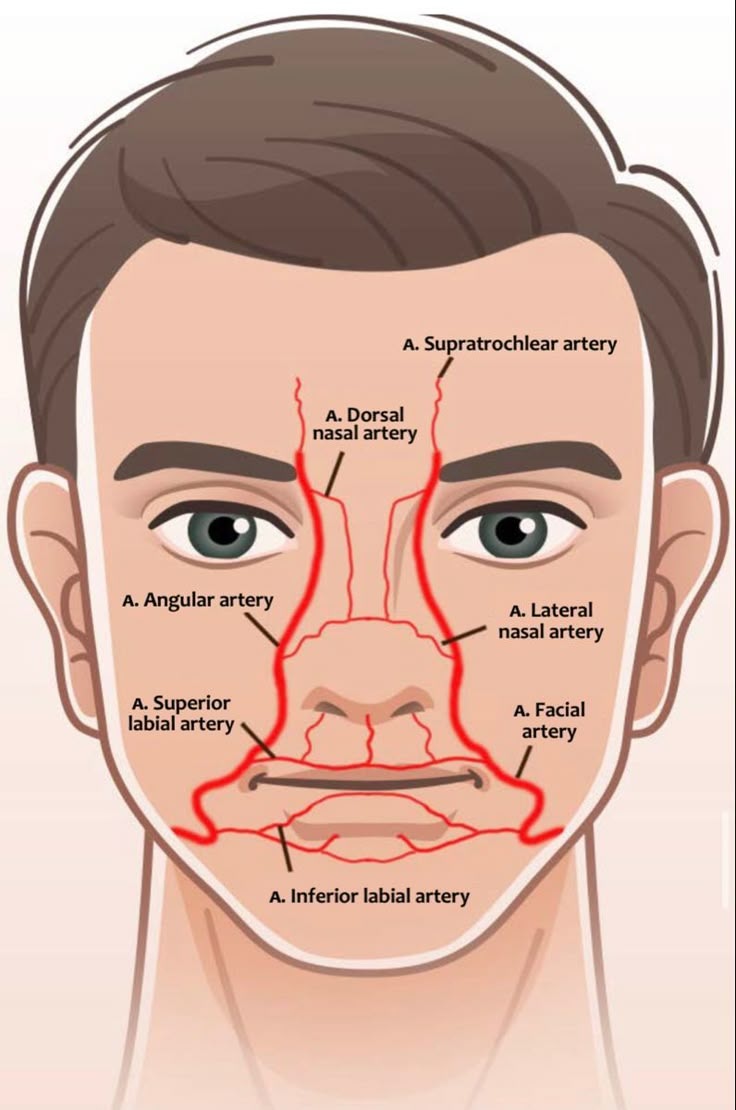
This connection is exactly where the problem arises. If the needle accidentally enters a vessel and filler is pushed in, it can travel backward along this path and block the vessels feeding the eye. This can happen with even a very small amount, which is why such caution is needed.
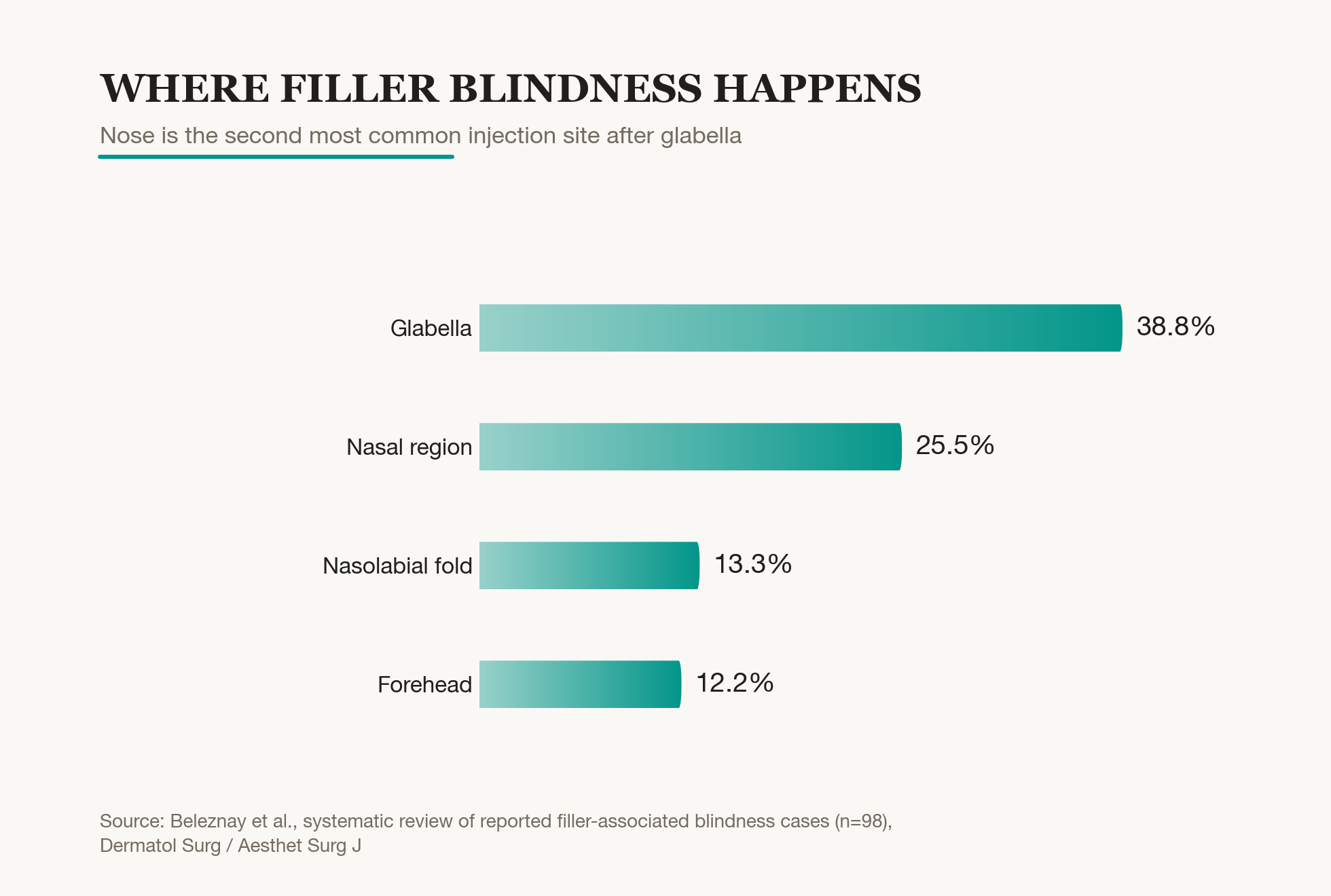
On top of that, the exact path of the vessels varies slightly from person to person, which is why it is hard to say a given spot is safe just by looking at the surface. In a pooled review of filler-related vision loss cases, the nose accounted for the second-highest share at 25.5%, and combined with the glabella's top share of 38.8%, the two sites together made up most of the cases. That is why the nose and glabella are handled with particular care.
Symptoms when a blood vessel is blocked
When a vessel becomes blocked, the body sends warning signs first. The earliest changes are usually pain that is far more severe than expected right at the moment of injection, and skin turning white or a mottled purple. A noticeably slower return of redness after the skin is pressed is another sign that blood flow has been blocked.
The more alarming signs involve the eye. Sudden vision loss in one eye or blurred vision, along with severe eye pain, drooping of the eyelid, or trouble moving the eye, is a medical emergency. These symptoms often appear during the procedure or within minutes afterward, which is why it matters whether the clinic you are treated at can recognize and respond to these signs immediately.
A study that analyzed 243 cases of filler-related skin ischemia found that a pattern of the nasolabial fold and the whole nose turning white together accounted for 75% of cases. This shows how closely the vessels of the nose and nasolabial fold are connected, meaning a problem in one can easily spread to the other. On the other hand, lingering redness or slight lumpiness a few days later is usually a mild reaction and should be viewed separately from the emergency signs described above.
| Sign | Meaning |
|---|---|
| Severe pain | Possible vessel compression |
| Pale or purple discoloration | Blood flow blocked |
| Delayed capillary refill | Tissue ischemia |
| Sudden vision loss | Ophthalmic artery occlusion, emergency |
| Drooping eyelid, eye pain | Emergency, seek care immediately |
Safe injection principles and emergency treatment
There are a few principles for injecting safely. Using a blunt-tipped cannula lowers the risk of piercing a vessel compared with a sharp needle, and the basic rule is to avoid pushing in a large amount at once, instead dividing it into very small amounts and pushing slowly, multiple times. Pulling back on the plunger to check for blood, known as aspiration, also helps, but it does not guarantee safety on its own, so in the end, having a practitioner who knows the anatomy well matters most.
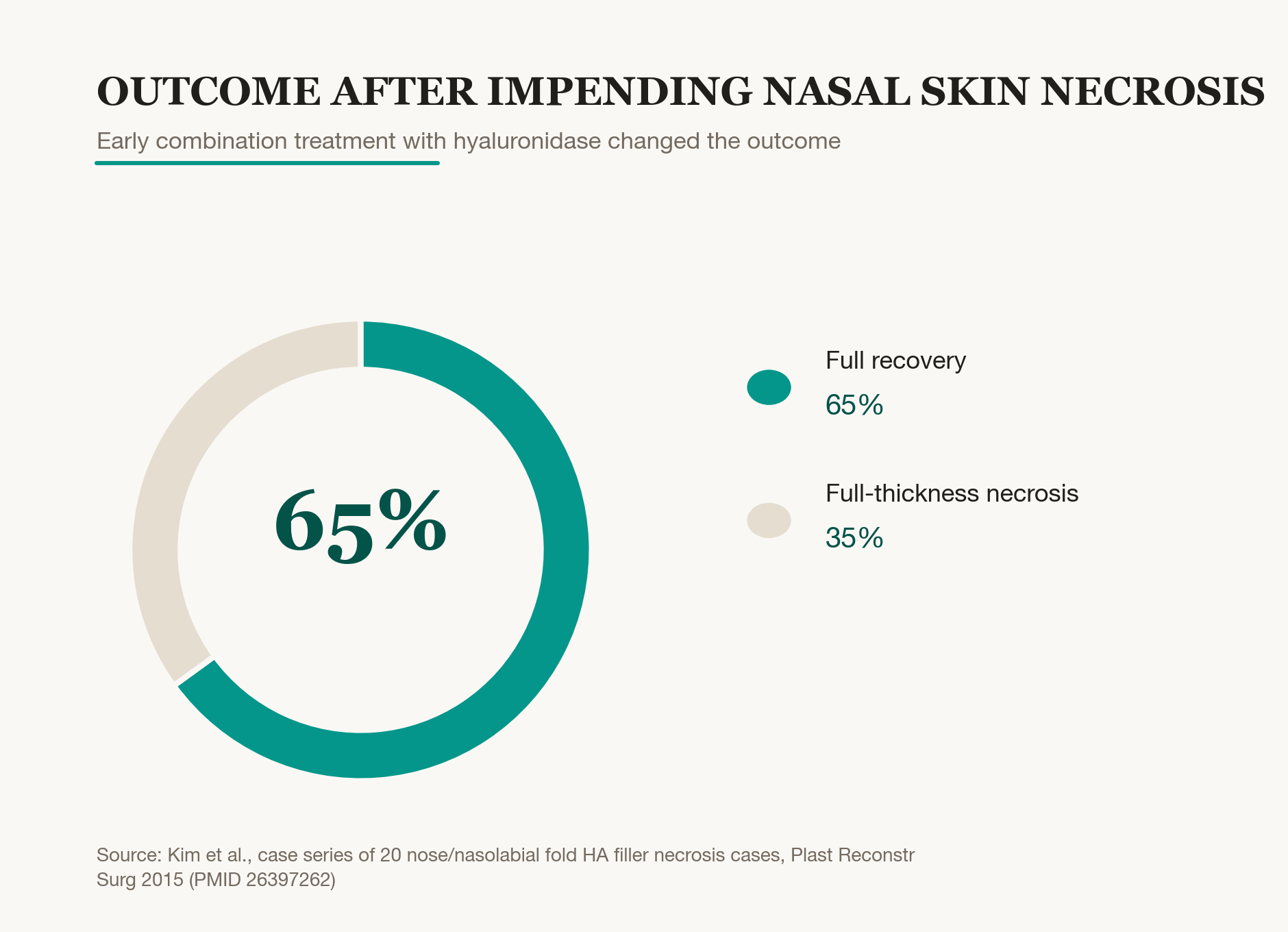
When something goes wrong, speed determines the outcome. As shown in the graph above, in a study analyzing 20 patients who showed signs of skin necrosis after filler injection in the nose and nasolabial fold, 13 (65%) who received hyaluronidase early as part of combination treatment recovered completely, while 7 (35%) still progressed to full-thickness necrosis. Tellingly, 85% of the cases that progressed to necrosis had not sought care until 2 days after symptoms appeared, a delay that made a real difference.
That is why it is safer to check beforehand whether the clinic you are treated at can administer hyaluronidase right away if a warning sign shows up. No matter how skilled the practitioner, the exact vessel location differs slightly from person to person, so the risk can never be eliminated entirely. If pain or a color change after treatment feels different from usual, speaking up right away rather than waiting it out is the most reliable form of prevention.
How is filler different from rhinoplasty?
The biggest difference between the two comes down to adding versus shaving away. Because filler adds volume on top of the existing structure, it excels at raising a low bridge or making the tip stand out slightly. In a study analyzing patients who received HA filler in the tip and bridge, the degree of convexity along the bridge decreased significantly, and first-impression scores rated by a panel of 224 reviewers looking at photos improved significantly across all eight categories.
Rhinoplasty, on the other hand, is surgery that changes the structure by shaving down or building up the bone and cartilage itself, so it can achieve changes that adding volume alone cannot, such as narrowing the nostrils or lifting a drooping tip. Which one to choose depends on the line you are aiming for.
The two approaches are not necessarily opposites, either. A retrospective study analyzing 2088 cases of filler used to refine minor asymmetry or unevenness left after rhinoplasty found that fine-tuning a surgically built line with filler can be an effective alternative to a second surgery. Changing the overall structure is the job of surgery, and refining the finer details on top of that is where filler does its best work.
| Area | Filler | Rhinoplasty |
|---|---|---|
| Low bridge | Possible | Possible |
| Dorsal hump | Softened by illusion | Directly corrected |
| Wide nostrils | Not possible | Possible |
| Drooping tip | Not possible | Possible |
| Tip projection | Possible in small amounts | Possible |
| Duration | Temporary | Semi-permanent |

How long does it last, and who should avoid it?
Duration depends on the injection site and the firmness of the product used, but the nose is known to hold results relatively longer than other areas because it moves less and has thin skin. Even so, the filler is gradually absorbed over time, so maintaining the line requires periodic touch-ups, and starting with a slightly conservative amount and adding a little at a time is safer and looks more natural than overfilling from the start.
There are also cases where it is better to skip the treatment. It should be avoided during pregnancy or breastfeeding, if you have had a hypersensitivity reaction to hyaluronic acid, or if there is inflammation or infection in the nose area. If you have had previous nose surgery that may have changed the path of your blood vessels, you should mention it beforehand, and if you smoke or have another habit that affects blood circulation, cutting back for a while before and after treatment can help recovery.
The nose is a small area, but since its vessels connect all the way to the eye, the most important standard is to be treated slowly and in small amounts by a practitioner who knows the anatomy well, at a clinic that can respond immediately with hyaluronidase if a problem occurs. Rather than treating it as a fix for a single profile photo, it helps to approach the consultation with an eye toward overall facial balance, aiming for a natural line instead of an aggressive amount. That mindset is what keeps satisfaction high over the long run.
Was this helpful?
About this article
Written by a practising aesthetic physician and intended for general education — not a substitute for individual medical advice.
Read next

Forehead Filler Effects and Blindness Risk: Which Layer Is Safe?
Why the forehead looks flat or uneven, why a high-viscosity HA filler is used, the vascular safety risks that can lead to vision loss, how hyaluronidase reverses a blockage, and how long results last, all explained with real clinical data.
By Dr. Kim

Filler Side Effect Symptoms: Blocked Vessels, Blindness Risk, and How to Respond
How common filler complications really are, why vascular occlusion is the one to take seriously, what the blindness data actually shows, what nodules, granulomas, and biofilm mean for you, and how far hyaluronidase can reverse things, no exaggeration, just what the evidence shows.
By Dr. Kim
Skin Booster Injection and Filler Differences: Hyaluronic Acid Hydration and Duration
Skin boosters feel far more hydrating than anything you apply topically. Here is why: how hyaluronic acid grabs water deep inside the dermis, how that inner glow actually forms, how it differs from dermal filler, and how long the effect really lasts, explained simply.
By Dr. Lee