Forehead Filler Effects and Blindness Risk: Which Layer Is Safe?
By Dr. Kim8 min read

When you look at your profile in the mirror, your forehead can sometimes look flat and sunken, or uneven, with certain spots standing out more than others. As the forehead bone itself gradually resorbs with age, and years of frontalis muscle movement thin out the fat layer beneath the skin, these contours become more noticeable. Unlike the nose or chin, the forehead looks best when it stays broad and flat, so even a small depression or side-to-side asymmetry catches the eye easily. HA filler is widely used to restore forehead volume and smooth its contour without surgery. The forehead is also a spot where blood vessels run close to the surface, and in rare cases, complications there can lead all the way to vision loss, which is why choosing the right filler and injecting at the correct depth matters most.
Why does a sunken forehead have a different shape in each spot?
The forehead is the broadest, flattest surface on the face. That means even a very small contour casts a shadow when viewed from the side. As the forehead bone gradually resorbs with age, and years of raising the eyebrows or frowning thin out the fat layer above the frontalis muscle, certain spots sink in more than others.
The most common pattern is a slight vertical dip down the center of the forehead. If the side profile leading into the temple sinks in along with it, the border between the forehead and temple can look angular and awkward. In other cases, a horizontal, wrinkle-like contour forms just above the eyebrows.
Each pattern calls for a different approach. A central depression is filled along the vertical line, while a sunken side profile needs volume added at the temple as well so it blends naturally into the forehead. A horizontal contour above the eyebrows can be softened just by gentle smoothing in a shallow layer.
Even when they look similar on the surface, different causes and depths call for different approaches. That is why checking the forehead from several angles, both from the side and from above, to see exactly where and how it has sunken, tends to give a more natural result before any filler goes in. The table below sums this up.
| Area | Feature | Approach |
|---|---|---|
| Center of forehead | Vertical depression | Fill the central line |
| Temple junction | Sunken side profile | Add lateral volume |
| Above eyebrows | Horizontal contour | Smooth in a shallow layer |
How long do forehead filler results last?
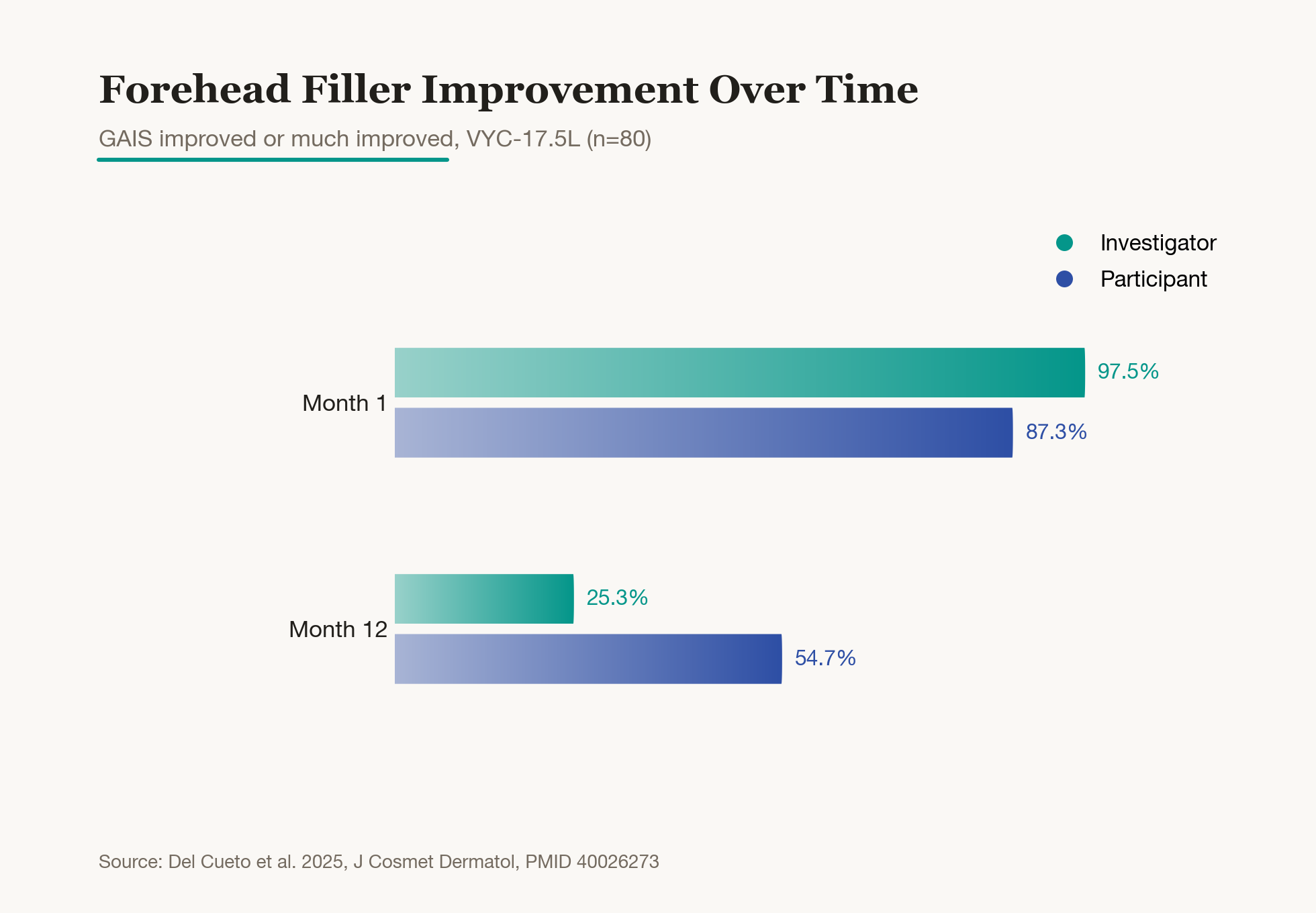
A 2025 clinical study tracked the effect of VYC-17.5L forehead filler in 80 people. One month after treatment, the physician-rated improvement rate was 97.5%, and the patient-rated improvement rate was 87.3%, meaning most people noticed a clear change.
The effect gradually fades over time. By the 12-month mark, the physician-rated improvement rate had dropped to 25.3%, but the patient-rated improvement rate stayed above half, at 54.7%. The average injection volume was 0.92mL, and when the effect fell short, 32.5% of participants received an average of 0.56mL more as a top-up.
These numbers reflect an average trend, not an absolute standard. How long the effect actually lasts depends on the injection volume, the type of filler, and each person's rate of metabolism. Still, the fact that a single session can leave a noticeable effect for close to a year explains why forehead filler continues to be popular.

Which filler suits the forehead?
Every filler has its own viscoelasticity. The value that expresses this firmness is G prime. It measures how strongly a gel springs back to its original shape after being pressed and released, so the higher the value, the better it holds its form under pressure and the more lifting support it provides.
On the forehead, a broad, flat area needs to be filled evenly over bone. If a softer filler is used here, it tends to spread sideways and feel lumpy every time you make an expression. That is why a high G prime filler is the standard choice for areas like the forehead or temple, where volume is built in a deep layer.
A 2024 study describing a five-step forehead shaping technique also used a high G prime HA filler injected close to the periosteum with a cannula to build volume. Among the 10 participants, improvement was greatest right after treatment, and much of the effect still remained at 6 and 12 months. Mild tenderness appeared in 10% and temporary swelling in 30%, but most of these resolved quickly.
Forehead vessel locations and blindness risk
The forehead is a spot where blood vessels run close to the surface. The supratrochlear artery runs above the inner eyebrow, and the supraorbital artery runs above the outer eyebrow; both connect to the ophthalmic artery that supplies the eye. If filler is accidentally injected into one of these vessels, it can travel backward and block the retinal artery, leading to vision loss.
Anatomical studies show that the shallow branch of the supratrochlear artery sits an average of just 1.5mm beneath the skin surface. It runs 15 to 25mm above the eyebrow, and its exact location and branching pattern vary slightly from person to person.
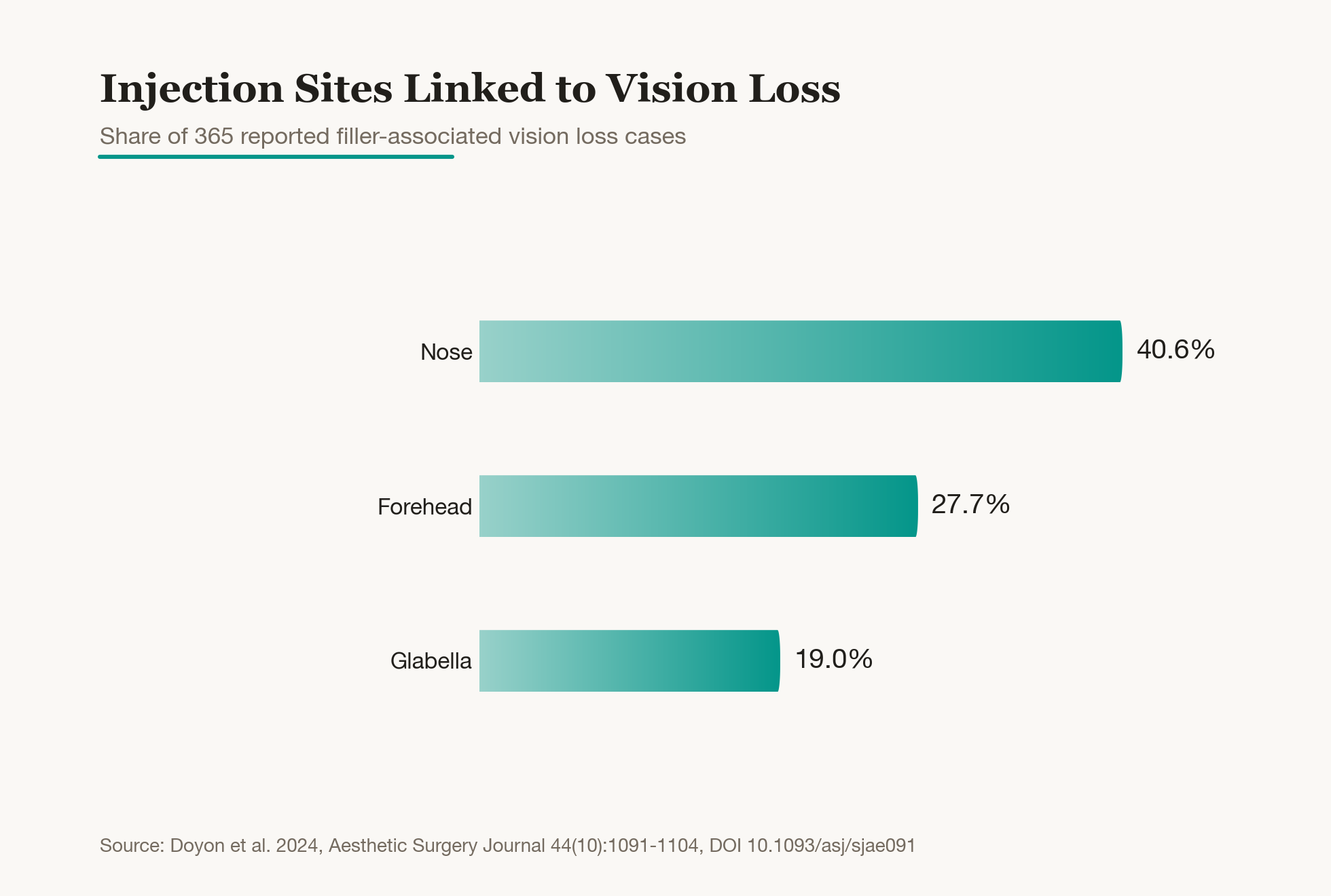
A 2024 review of filler-related vision loss cases found that among 365 cases, the nose accounted for 40.6%, the forehead 27.7%, and the glabella 19.0%. Since the forehead is the second most common site, it calls for just as precise an understanding of vessel location as the nose or glabella does.
Safe injection depth and speed
The most basic way to reduce the risk of a vascular accident is to control the injection depth. The broad upper area of the forehead should be injected in a deep layer, right above the periosteum, to avoid the layer where the vessels run. Near the eyebrows, on the other hand, the vessels run more shallowly, so it is actually safer to work in the shallowest possible layer, using small amounts.
A cannula has a blunt tip that pushes vessels aside as it passes through, so it is known to carry a lower risk than a sharp needle. Even so, the rule is to avoid pushing a large amount into one spot at once and instead inject slowly, in small divided amounts. Aspirating before injection to check for blood also helps.
If sudden severe pain, a feeling of the skin turning white, or any change in vision occurs during injection, the procedure should stop right away. To avoid missing these signs, it helps to go over the warning symptoms with the practitioner beforehand and to keep an eye on how you feel for a while after treatment.
| Area | Vessel at risk | Rule |
|---|---|---|
| Lower area, above eyebrows | Supratrochlear artery | As shallow as possible, in small amounts |
| Broad upper forehead | Supraorbital artery branches | Deep layer above the periosteum |
| Overall | Filler injection in general | Cannula, go slowly |

Can it be reversed if something goes wrong?
Most fillers used on the forehead are HA-based, so if a problem occurs, it can be dissolved and reversed with hyaluronidase. When signs of a blocked vessel appear, such as severe pain, skin turning white, or a mottled, net-like discoloration, a high dose of hyaluronidase is injected into that area right away so the dissolved filler can disperse away from the vessel.
The literature recommends a high dose of around 1500 units in this situation, spread thoroughly through the tissue. If vision changes are also present, additional hyaluronidase injected around the supratrochlear and supraorbital arteries, along with ocular massage, has been suggested as well. The success of reversal, though, depends heavily on timing. Once 4 to 6 hours have passed after the vessel becomes blocked, the tissue damage is known to reach a point that is difficult to reverse.
That is why it is safer to get forehead filler at a clinic with extensive experience, one that can administer hyaluronidase immediately if an emergency occurs. If pain or a color change continues after treatment, it is best not to wait it out and to contact the clinic right away.
Was this helpful?
About this article
Written by a practising aesthetic physician and intended for general education — not a substitute for individual medical advice.
Read next

Nose Filler: Results, Side Effects, Blindness Risk, and How It Differs From Rhinoplasty
Here is how nose filler builds up the bridge and tip line, using hyaluronic acid and the mechanics of injection. We cover why the nose carries an especially high risk of vascular occlusion and vision loss, the standards for injecting safely, how hyaluronidase can reverse a problem, and what filler can and cannot do compared with rhinoplasty.
By Dr. Lee

Chin Filler for the E-line: Which Product Suits a Recessed Chin?
When chin filler is used to correct a recessed chin in profile, here's why it calls for a firm filler rather than the soft kind used on cheeks or lips, which products are used, how long results last, and how safe the treatment is, laid out in plain terms with real clinical research.
By Dr. Kim

Forehead Botox Dose and Side Effects: Should It Be Done Together With the Frown Area?
A clear breakdown of which muscles forehead and glabella botox target, why treating the forehead alone can lower your brows, standard unit counts per area, when results appear, how long they last, and what side effects to watch for, all backed by clinical data.
By Dr. Lee