Forehead Botox Dose and Side Effects: Should It Be Done Together With the Frown Area?
By Dr. Lee8 min read

The forehead and glabella are the two areas people most commonly consider for a first botox treatment. Horizontal forehead lines and the vertical "11" lines between the brows that appear when you frown can make you look tired or tense, even when you are not. Naturally, you want to soften them. But questions come up: how many units do you actually need, will your brows droop, and how long does it really last?
The forehead and glabella involve different muscles, and the balance between them shapes the outcome. The forehead in particular calls for careful dosing and placement, because overtreating it can weigh down your brows. This article walks through which muscles are involved, why treating both together makes sense, standard unit counts, when results kick in, how long they hold, and what side effects to be aware of, all grounded in published research.
How do the forehead and frown muscles differ?
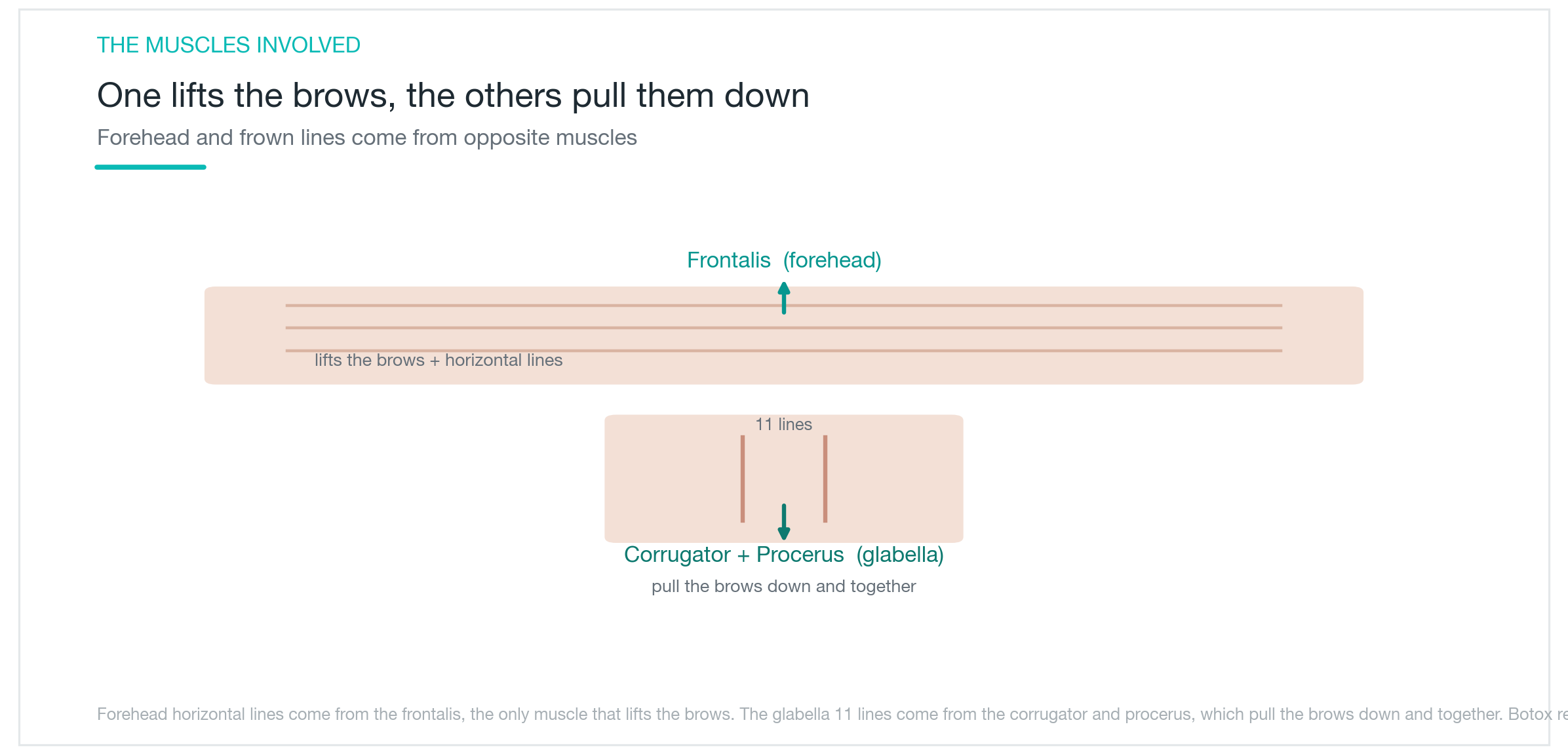
The two areas work through muscles that pull in opposite directions. Horizontal forehead lines come from the frontalis, a wide muscle covering the forehead from side to side. When it contracts, it draws the forehead skin upward, creating horizontal creases and lifting the brows at the same time. A key point: the frontalis is the only muscle that lifts the brows.
The glabella "11" lines come from a different set of muscles. The corrugator supercilii pulls the inner brow downward and inward, while the procerus, sitting on the bridge of the nose, pulls the central glabella downward. Together they produce vertical creases when you frown or squint. Both of these muscles pull the brows down.
So the frontalis lifts the brows and the corrugators and procerus lower them. The two areas hold each other in a kind of tug of war. Botox reduces the contractile force of whichever muscles it reaches. Because the directions are opposite, treating only one side of this balance can tip the whole system off balance. Treating just the forehead, for instance, can leave the glabella muscles with a relative advantage, and the brows end up lower. That is why forehead and glabella botox are best understood as a paired system rather than two separate treatments.
Why do the brows drop if only the forehead is injected?
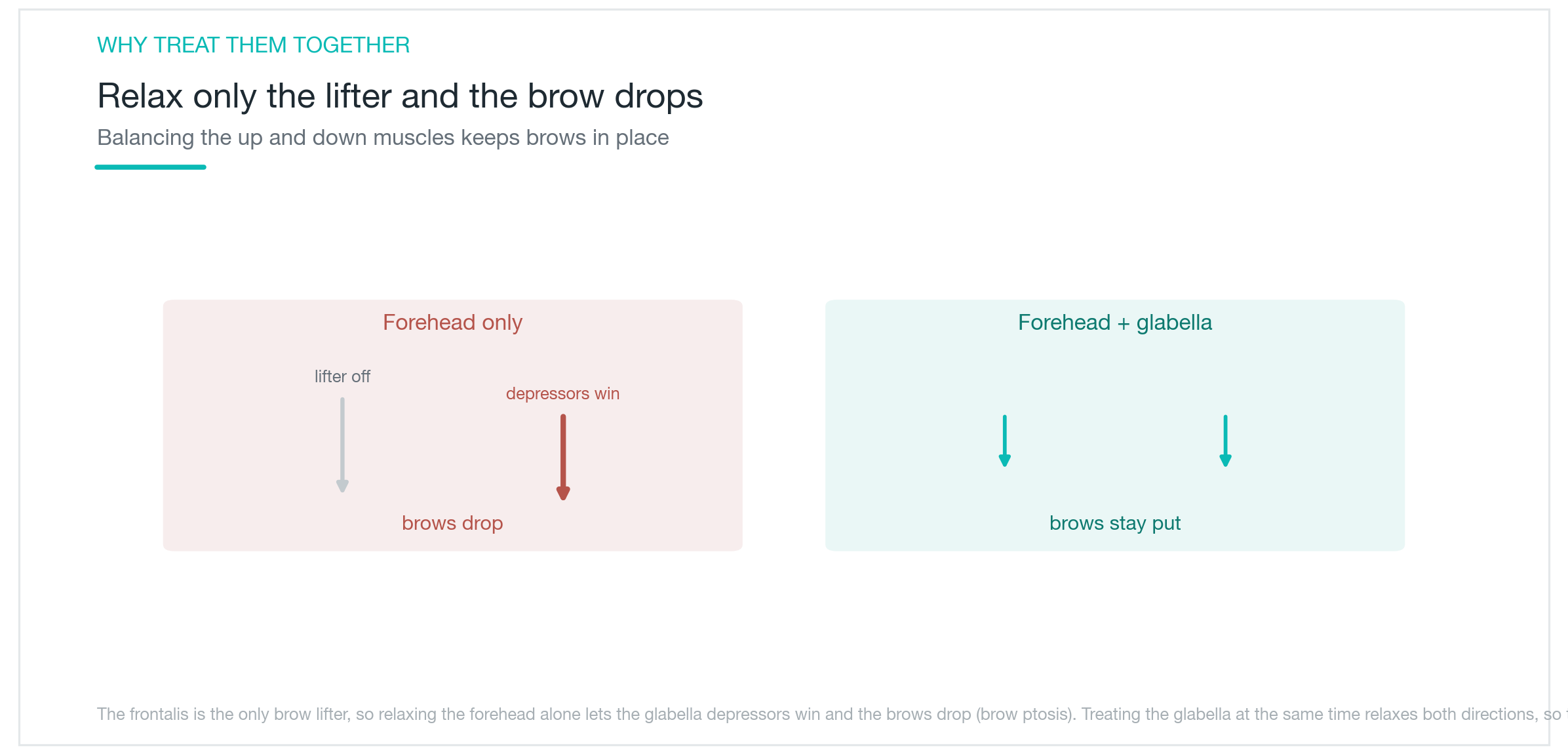
Because the frontalis is the sole brow elevator, relaxing it too much with botox leaves the glabella muscles (the depressors) unopposed. The result is brow ptosis, meaning the brows drift lower than their resting position. This shows up as a heavier or slightly hooded look.
The straightforward fix is to treat both areas together. When the elevator and depressors are both partially relaxed, the brows tend to stay where they started. This is reflected in FDA-approved labeling, which specifies that forehead botox should be performed alongside glabella treatment. Forehead botox as a standalone procedure is not standard practice for exactly this reason.
Placement height also matters. Injections into the forehead should sit at least 1.5 to 2 cm above the brow. Points placed too low significantly increase the risk of brow heaviness. The outcome depends less on the total dose and more on how well the injection height and the glabella-forehead dose ratio are balanced. People with naturally lower brows or mild upper lid heaviness need extra care here. That is why a thorough look at brow position and frontalis strength before treatment is part of good planning. Frontalis anatomy varies meaningfully from person to person, so placement really does need to be individualized.
How many units for the frown area and forehead?
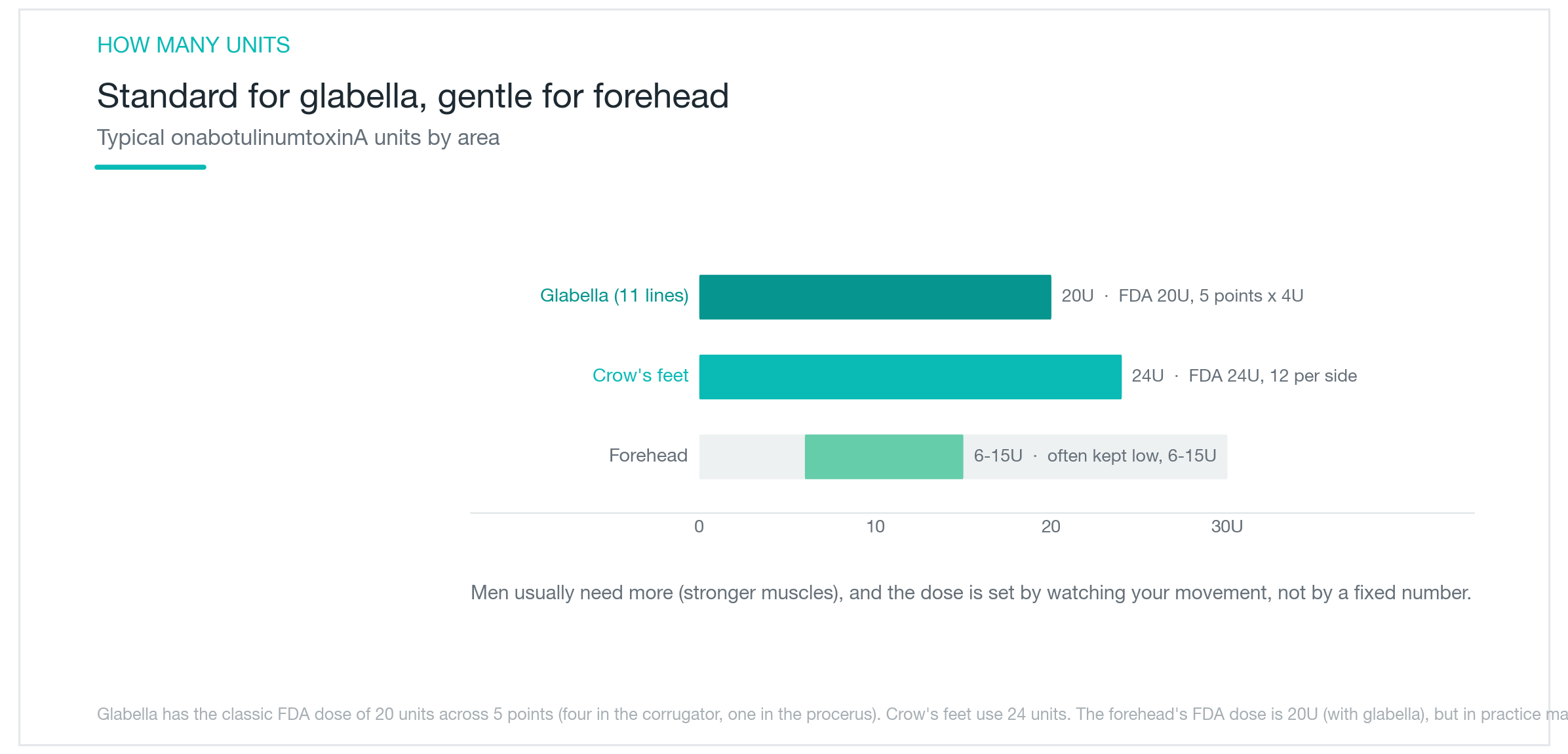
Each area has a reference dose. The glabella is the most thoroughly studied site: the FDA-approved dose is 20U, divided across five injection points (4U per point), with four points in the corrugator muscles bilaterally and one in the procerus centrally. This dosing protocol has a well-established track record across clinical trials.
The forehead is a little different. The approved dose for the forehead (when combined with glabella treatment) is also 20U, but in aesthetic practice the forehead is often dosed more conservatively, typically in the 6 to 15U range. The reason is the same as before: overtreating the frontalis risks brow heaviness, so practitioners tend to leave some residual movement rather than fully arresting the muscle. Those with stronger muscles or a broader forehead may need a little more; those with weaker muscles, a little less.
Male patients generally require higher doses than female patients because the frontalis and corrugators tend to be more powerful. Adding the lateral eye area (orbicularis oculi for crow's feet) to both glabella and forehead treatment is a common combination, and that full upper-face package often comes to around 24U total. Facial structure and muscle strength vary considerably between individuals, so dose decisions are best made by assessing live muscle movement rather than applying a fixed number. The conservative, then-adjust approach is especially useful for a first treatment: start on the lower side, reassess at 2 weeks, and add a small top-up if needed. It is much easier to add than to walk back an overtreatment.
When does it start working and how long does it last?
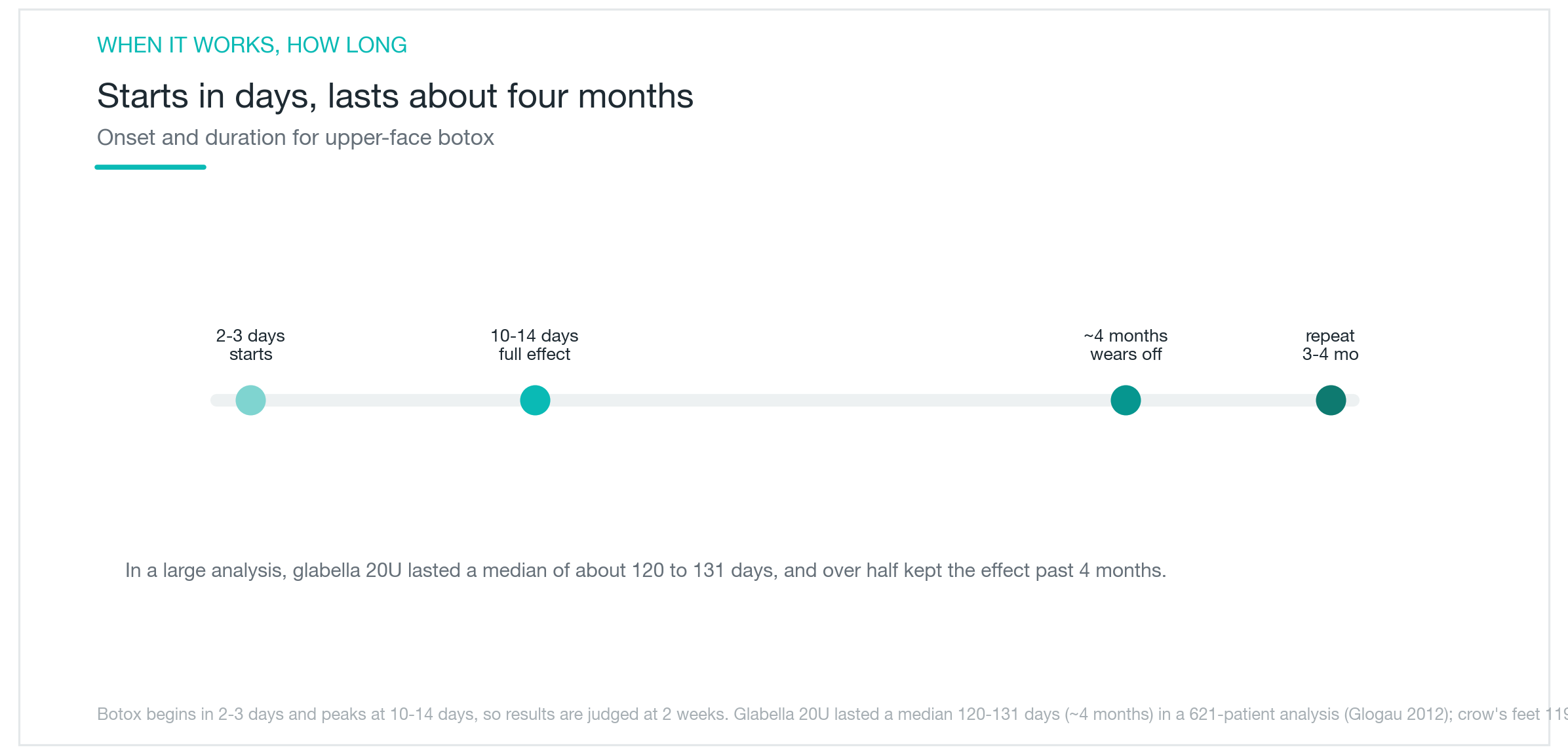
Results do not appear immediately. Muscle relaxation begins at about 2 to 3 days post-injection, and peak effect arrives at 10 to 14 days. The standard recommendation is to judge results at the 2-week mark. If you have an event or occasion where you want to look your best, schedule treatment at least 2 weeks in advance.
Duration matters just as much. A large pooled analysis of glabella treatment at 20U found a median effect duration of approximately 120 to 131 days, roughly 4 months. The forehead and crow's feet tend to follow a similar pattern, with most patients seeing results hold for 3 to 4 months. More than half of patients in the glabella data maintained benefit beyond 4 months, which works out to roughly one maintenance session per season.
After that window, nerve regeneration restores muscle contractility and the lines gradually return. A repeat interval of 3 to 4 months maintains the effect. With regular treatments over time, some patients find the muscles become habitually less active, allowing longer intervals between sessions. There is theoretical concern that very frequent injections could stimulate neutralizing antibodies that reduce efficacy, so a minimum 3-month interval between sessions is the general guideline. Timing treatment when the prior effect is clearly fading (not before) is the most practical approach.
How common are brow drooping and eyelid drooping?
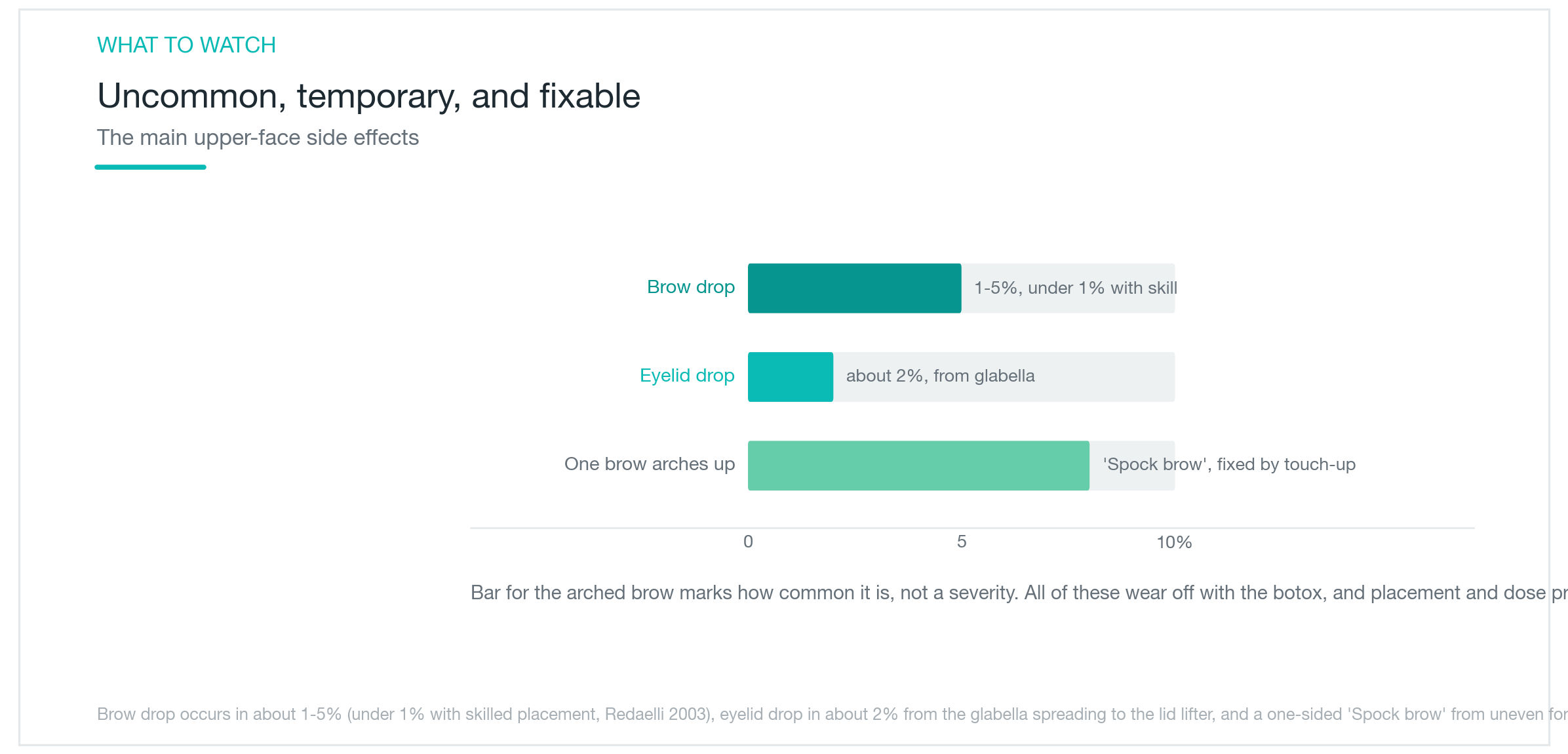
Side effects are almost always temporary and resolve without intervention as the botox wears off. The most commonly discussed one is brow ptosis, which occurs when the forehead is overtreated or injected too low. Reported incidence is roughly 1 to 5% across studies, and falls below 1% with experienced injectors. That figure underscores how much placement and dosing technique matter.
Glabella treatment can occasionally cause eyelid ptosis (drooping of the upper eyelid itself, distinct from brow ptosis). This happens when botox diffuses toward the levator palpebrae muscle. Incidence is around 2% in clinical data. It is temporary, and apraclonidine eye drops can partially counteract the effect while it resolves naturally.
A third pattern is the so-called "Mephisto sign" or uneven brow arch, where the outer portion of one brow lifts more than the other because the lateral frontalis remains relatively active. A small corrective dose to that lateral zone at the 2-week follow-up appointment typically resolves this quickly. This is also one of the main reasons a 2-week check-in after a first treatment is worthwhile. Minor bruising at injection sites or a brief mild headache can occur but typically clear within a few days. Most of these effects are preventable with precise placement and appropriate dosing, and even when they do occur, they are self-limiting.

Controlling strength for a natural result
The key to natural results is measured dosing. Fully arresting the frontalis to eliminate every last line tends to produce a frozen or heavy expression. Current aesthetic practice leans toward leaving some residual muscle movement and accepting a partial reduction in lines rather than complete erasure. This is often called "natural botox," and while duration may be slightly shorter, the overall look is noticeably more expressive.
This preference for movement over perfection is particularly pronounced in Korea and across much of Asia. A common combination is conservative dosing for the forehead paired with standard dosing for the glabella, softening lines while preserving readable facial expression. Aiming for softening and preservation rather than elimination tends to produce higher satisfaction.
For anyone having their first treatment, the practical approach is straightforward. Treat the forehead and glabella together, start at a conservative dose, and come back at 2 weeks to review. If you want more relaxation, a small addition at that point is easy and precise. Adding more is simple; reversing an overdose is not. And if you are not entirely happy with the result, the botox will wear off in 3 to 4 months regardless, so the commitment is genuinely limited. Finding an experienced injector who assesses your muscle movement before deciding on dose and placement is the single most important factor in getting a natural outcome. A face that looked tense or tired can genuinely shift to something calmer and more rested.
Was this helpful?
About this article
Written by a practising aesthetic physician and intended for general education — not a substitute for individual medical advice.
Read next

Botox for Excessive Sweating: Effects and Duration by Area, and Side Effects
Why botox works for excessive sweating, how effective it is for underarms, hands, feet, and forehead, how the treatment is done, how long results last, side effects, and how it compares to other options, backed by clinical trial data.
By Dr. Lee

Pebbled Chin Botox: Results, How Long It Lasts, Dosage, and Side Effects
Chin botox (mentalis botox) smooths out the pebbled, orange-peel texture that shows up on an overactive chin. Here's how relaxing the mentalis muscle evens out the skin, the typical dose and injection points, when results appear and how long they last, how this differs from a weak or protruding chin, and the side effects worth knowing about, all backed by real evidence.
By Dr. Kim
Under-Eye Hollow Filler: Effect and Side Effects, and the Tyndall Effect to Watch
The dark, sunken look under the eyes often comes less from pigment than from hollowing and the shadow it casts. Here's how the tear trough ligament and lost volume under the eye create that shadow, how a soft hyaluronic acid filler placed shallowly and sparingly smooths it out, why thin skin and the bluish Tyndall effect make this area tricky, and how long results actually last, all backed by real published numbers.
By Dr. Kim