Pebbled Chin Botox: Results, How Long It Lasts, Dosage, and Side Effects
By Dr. Kim10 min read

Look in the mirror sometime and you might notice the skin on your chin looking lumpy, almost like an orange peel, with little dimples that pucker up whenever you talk or make a face. This look is often called a "pebbled chin" or "cobblestone chin," and it tends to get more obvious the more expressive you are. One of the simpler ways to deal with it is chin botox. There's a small muscle under the chin called the mentalis that pushes the lower lip upward, and when it's habitually overworked, the skin sitting on top bunches up into that pebbly texture. Botox eases the muscle's pull just enough for the skin to lie flat again. That said, not every bumpy chin comes down to muscle activity. If the real issue is a weak, receding chin or a protruding jaw, the approach has to change. Here's why pebbled chins happen, how botox smooths them out, how much goes where, how long results last, and what side effects to watch for, all grounded in real evidence.
| Category | Key point |
|---|---|
| How it works | Relaxing the mentalis muscle lets the skin lie flat |
| Dose | 4 to 10 U total, at 1 to 2 points on the chin |
| Onset | Starts in 1 to 4 days, peaks at 1 to 2 weeks |
| Duration | 3 to 4 months |
| Watch for | Lower lip drooping, slurred speech, overdosing |
Why does a pebbled chin form?
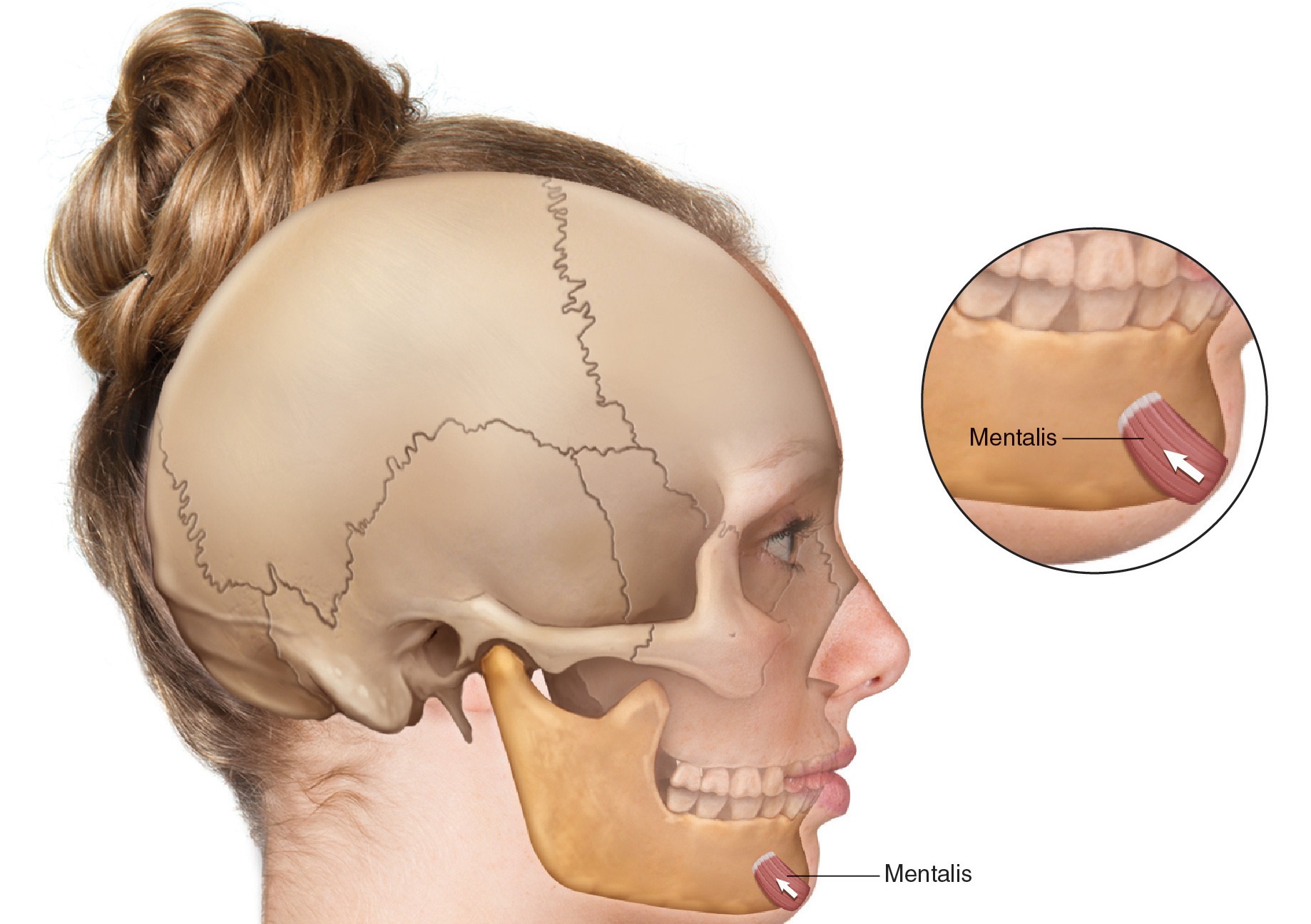
Right in the center of the chin sits a small, paired muscle. That's the mentalis, and it starts at the front of the jawbone and fans upward into the chin skin like a small sail. Its normal job is pushing the lower lip up or making a pouting expression.
The trouble starts when this muscle gets used too often, or when someone is simply born with a stronger one. Every time it contracts hard, the thin layer of skin sitting on top gets pulled inward and bunches up. The chin surface ends up looking like a scattering of pebbles, or like orange peel. This is what people usually mean by a "pebbled chin," sometimes also called a "prune chin."
This is usually much more noticeable while talking or pursing the lips than while the face is at rest, since it's a movement-driven wrinkle. On top of that, as skin thins and loses elasticity with age, a pebbled chin that barely showed up in your twenties can become far more visible over time. So if a pebbled chin bothers you, the first step is figuring out whether it comes from an overactive muscle, or from the underlying structure or volume of the chin itself.
How many units go where for a pebbled chin?
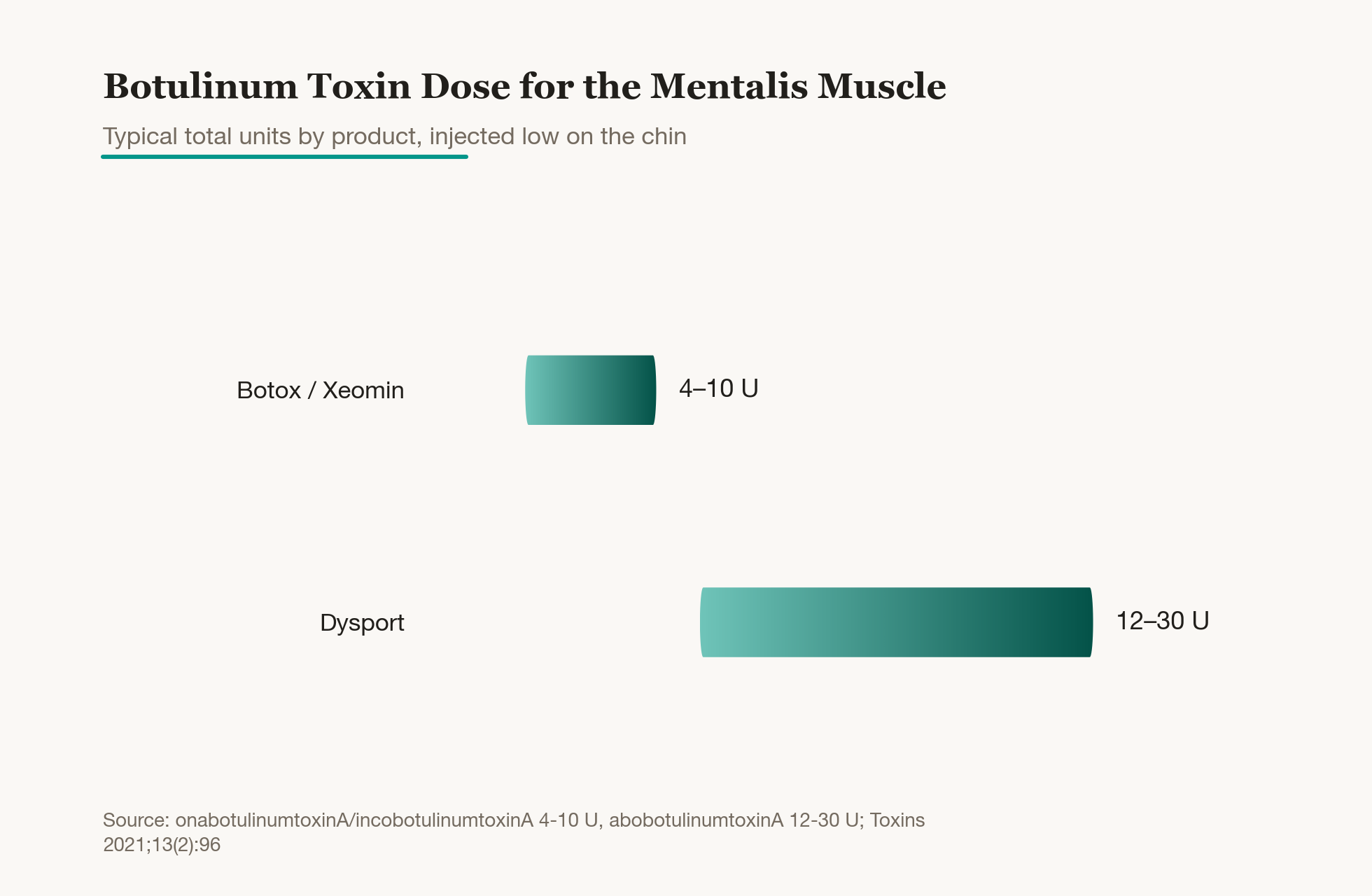
Chin botox uses a very small amount, simply because the muscle itself is tiny. With the most commonly used products, Botox or Xeomin, the total dose for the whole chin usually runs 4 to 10 units, just a few units placed carefully. Dysport uses a different unit system, so its numbers look larger even though the actual strength is comparable, which is why it matters more to know which product is being used than to compare unit counts directly.
Placement matters just as much as dose. Injections typically go deep, close to the bone, at one or two points on the lower chin. Some providers use a single point in the center, others split it into two points about 5 millimeters apart on either side of the midline. The needle is often advanced until it touches bone, then withdrawn slightly before the product is delivered, so it lands precisely in the deep layer of the muscle.
One rule that really matters is not injecting too far to the side or too high. Just outside the mentalis sits the depressor labii inferioris, the muscle that pulls the lower lip down, and if the product spreads sideways into it, the lower lip can end up moving unevenly. Going too high, too close to the lips, can also affect the muscles that keep the mouth closed. That's why the whole point of chin botox comes down to a small amount placed in exactly the right spot.

How does Botox smooth the tip of the chin?
Chin botox isn't about physically stretching the skin flat. It works by easing the pull of the muscle that was tugging the skin inward. Once botulinum toxin blocks the release of signaling chemicals at the nerve endings, less of a contraction signal reaches the mentalis. With the muscle no longer clenching as hard, the skin on top stops getting dragged in and settles back into a smooth surface.
This is a bit different from how jaw slimming botox works. For a square jaw, the chewing muscle is gradually thinned out over several weeks to reshape the jawline. A pebbled chin isn't about shrinking a muscle at all, it's about toning down an overactive movement so the skin stops folding when you make expressions. In that sense, it's closer in spirit to forehead or crow's feet botox.
| Category | Details |
|---|---|
| Target | An overactive mentalis muscle |
| Mechanism | Blocking the contraction signal |
| Result | Skin stops folding and lies flat |
| Type | Relief from expression-driven wrinkles |
That's why this treatment works especially well for pebbling that shows up with movement. Once the muscle stops yanking the skin into bunches, the chin looks noticeably smoother even while talking or pursing the lips. It's worth keeping in mind that the muscle isn't shut down completely, just eased, so expressions still look natural while the texture underneath quietly softens.
When it starts working and how long it lasts
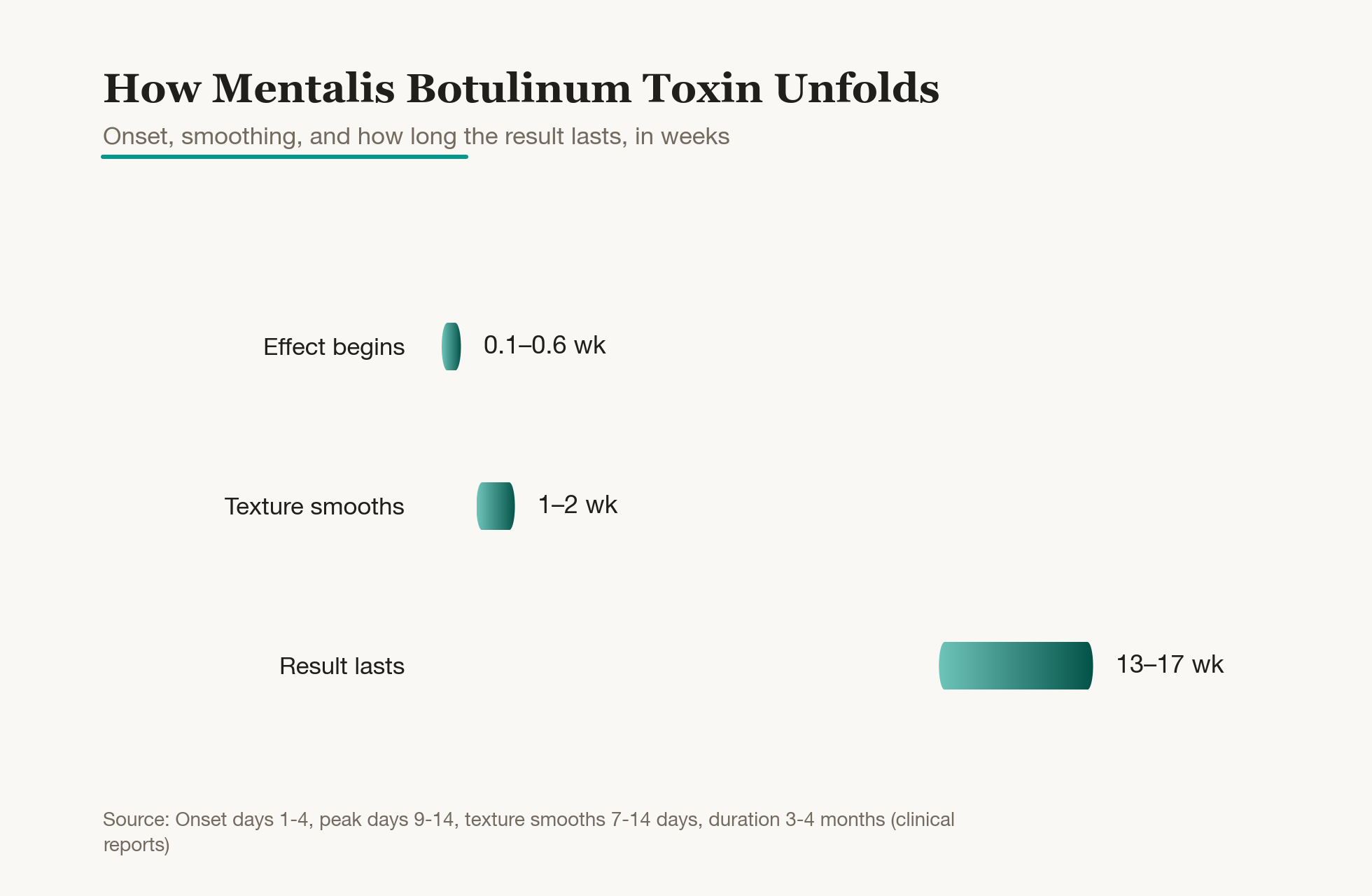
Chin botox doesn't smooth things out the moment you leave the office. It takes a few days for the toxin to block nerve signals and for the muscle to actually lose strength. Most people notice the chin starting to feel more relaxed somewhere between day 1 and day 4, and the bumpy texture usually looks its smoothest around the 1 to 2 week mark. So it's most accurate to judge the final result around the two-week point.
Results typically last 3 to 4 months per session. Some people go a bit longer, but because the area around the mouth is constantly moving from talking and eating, the effect tends to fade a little sooner here than in the forehead or between the brows. People who habitually clench the chin muscle hard also tend to see the effect wear off a bit faster. As the nerve endings gradually start firing again over time, muscle strength returns, and the pebbled texture slowly comes back too.
Keeping the results going means repeating the treatment. Early on, most people return every 3 to 4 months, and as the habit of clenching the chin eases up, the interval between sessions can stretch out. In the end, chin botox isn't really a one-and-done treatment, it's more of an ongoing way to maintain a smooth chin every few months.
Does it help a weak chin or a protruding jaw?
As mentioned earlier, not every case of a bothersome chin comes down to the same cause. Chin botox works well for bumpiness driven by an overactive muscle, but it has clear limits when the real issue is the chin's underlying structure or volume. Since the right approach depends entirely on the cause, it helps to break things down into three broad categories.
| Cause | Best approach |
|---|---|
| Overactive muscle | Chin botox |
| Weak chin, low volume | Filler or implant |
| Protruding jaw, bone excess | Jaw surgery |
A weak, receding chin usually comes down to a lack of bone and volume, which botox simply can't add. In that case, hyaluronic acid filler or a chin implant is used to build forward volume instead. On the flip side, a protruding jaw, where the lower jaw sits too far forward, is a bone issue at its core, and correcting it fundamentally usually means considering jaw surgery.
It's common to have both a structural issue and a pebbled texture at the same time. In those cases, botox handles the surface bumpiness while filler or surgery addresses the underlying structure. So if your chin bothers you, figuring out whether the cause is muscle, volume, or bone structure is really what determines the right path forward.
Side effects and the risk of spread to the lower lip
The single most important thing to know about chin botox is the risk of the product spreading toward the lower lip. Just outside the mentalis sits the depressor labii inferioris, the muscle that pulls the lower lip down. If the injection sits too far to the side, or the dose is too high and spreads into that muscle, the lower lip can end up pulling to one side, it can become harder to show the lower teeth, and speech can sound slightly slurred. This usually resolves as the effect wears off, but it can be uncomfortable for a few weeks to about two months, which is exactly why precise placement matters so much.
The next thing to watch for is an overly high dose. If the chin muscle relaxes too much, it can become harder to keep water from dribbling out of your mouth while drinking, and the mouth can start to look a bit flat or expressionless. That's why it's safer to start with a conservative amount and adjust gradually based on how the muscle responds, rather than going in aggressively from the start.
There's also a rare reaction called paradoxical bulging. It happens when only the deep layer of the muscle relaxes while the shallow layer stays active, which can actually make the chin look slightly more prominent. In one observation, this kind of bulging showed up in 1 out of 120 people treated with mentalis botox, and it's corrected by adding a small touch-up dose to the remaining shallow layer.
Beyond that, bruising or mild soreness at the injection site is common but fades quickly. Overall, serious complications are rare at cosmetic doses. That said, since the outcome depends heavily on exactly how many units go exactly where, it's worth having this done somewhere familiar with the muscle anatomy around the mouth and chin. Identify the cause correctly, and in cases where an overactive muscle really is the problem, chin botox is a quick treatment that can leave a bumpy chin noticeably smoother.
Was this helpful?
About this article
Written by a practising aesthetic physician and intended for general education — not a substitute for individual medical advice.
Read next
Mouth Corner Botox: Results, How Long It Lasts, Dosage, and Side Effects
A clear look at how Botox lifts downturned mouth corners, from weakening the depressor anguli oris so the elevator muscles win out, to injection sites and units, onset and duration, combining with filler, and the side effects worth knowing, all backed by real clinical data.
By Dr. Kim
Masseter Botox for a Square Jaw: When Does It Start Working and How Long Does It Last?
Masseter Botox uses botulinum toxin to shrink the chewing muscle and slim a square jawline. Here is what the evidence says about how it works, when results appear, how long they last, side effects, and its effect on teeth clenching.
By Dr. Kim
Under-Eye Hollow Filler: Effect and Side Effects, and the Tyndall Effect to Watch
The dark, sunken look under the eyes often comes less from pigment than from hollowing and the shadow it casts. Here's how the tear trough ligament and lost volume under the eye create that shadow, how a soft hyaluronic acid filler placed shallowly and sparingly smooths it out, why thin skin and the bluish Tyndall effect make this area tricky, and how long results actually last, all backed by real published numbers.
By Dr. Kim