Mouth Corner Botox: Results, How Long It Lasts, Dosage, and Side Effects
By Dr. Kim10 min read
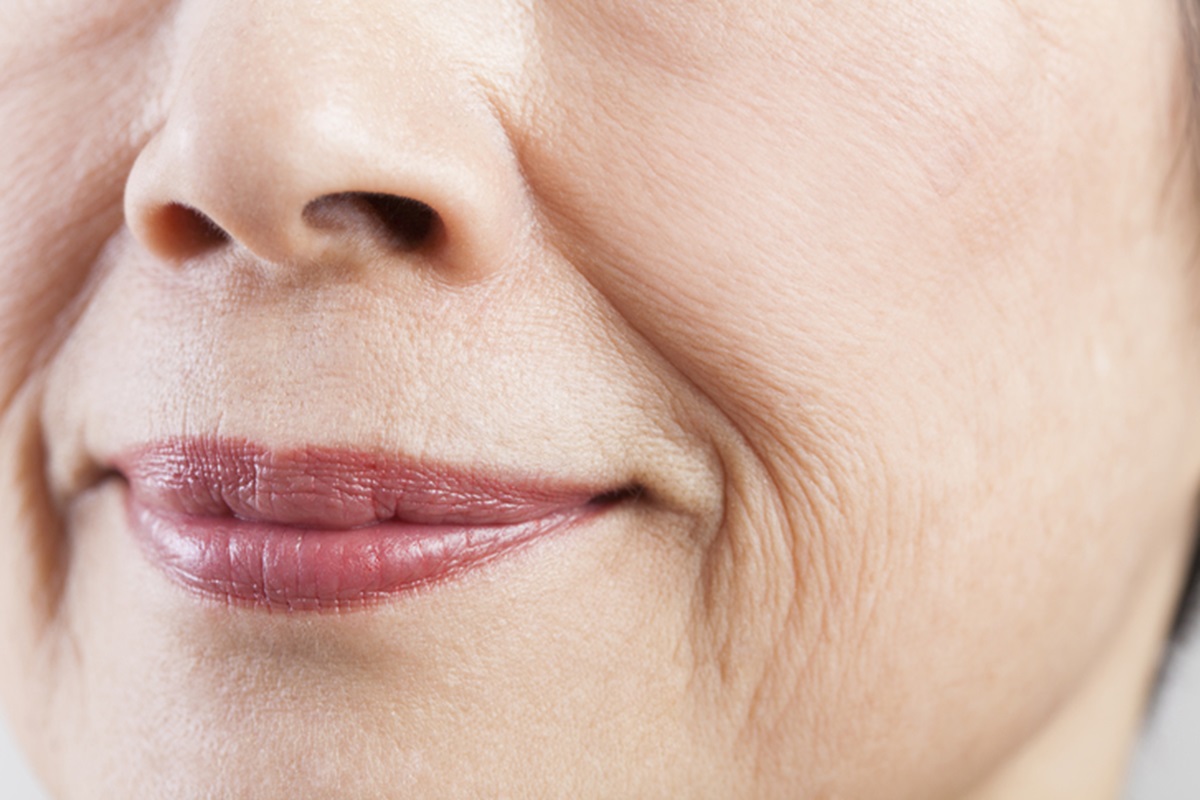
Many people catch their reflection and notice their mouth corners turning down, even when nothing is actually wrong. The face just reads as sad or annoyed, and that alone becomes a source of stress. Corner of mouth Botox is a fairly simple way to address this. The idea is to ease the pull of the muscle that drags the mouth corners downward, so the muscle that lifts them can win out and the corners sit a bit higher. Not every downturned mouth has the same cause, though. Botox works well when muscle pull is the issue, but it has real limits when volume loss or skin laxity is behind the sagging. Here is what actually causes the corners to droop, how Botox lifts them, where and how much gets injected, how long results last, and the side effects worth knowing, all drawn from real clinical studies.
| Category | Key point |
|---|---|
| Mechanism | Weakens the DAO so the elevator muscles win |
| Dose | 2 to 5 units per side, commonly 4 |
| Onset | Starts day 3 to 7, peaks at 1 to 2 weeks |
| Duration | 3 to 4 months |
| Watch for | Asymmetry, lower lip movement, injector skill |
Why do the corners of the mouth turn down?
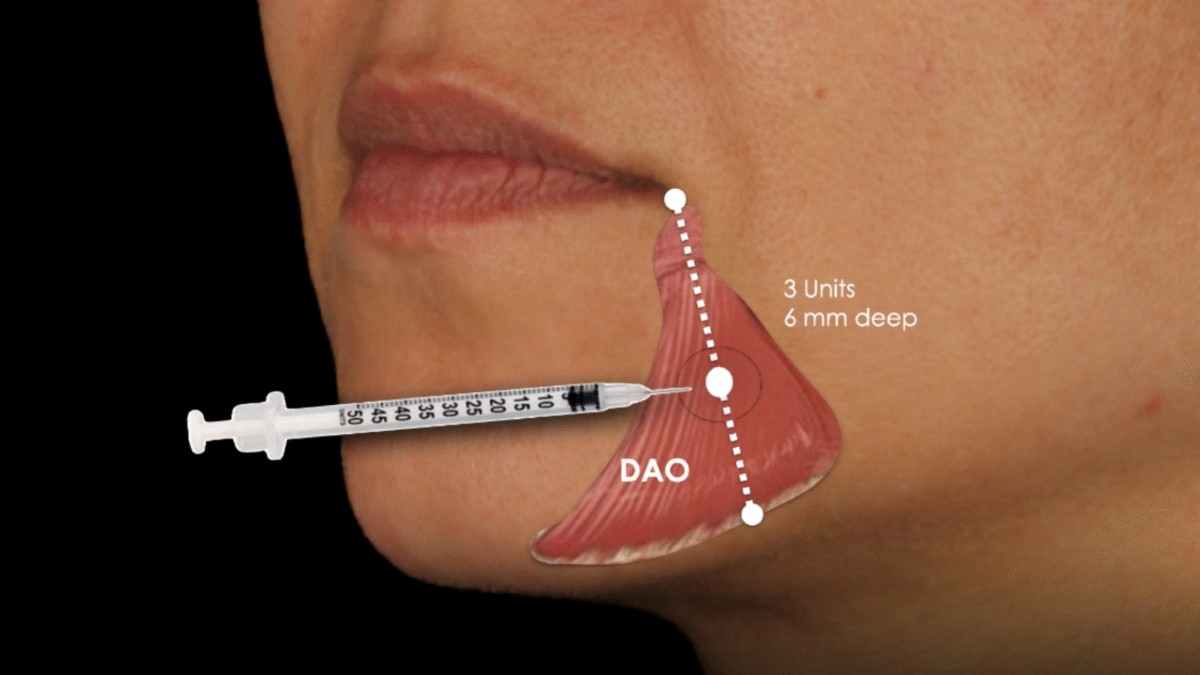
Around each corner of the mouth, a lifting muscle and a pulling-down muscle work side by side. The main muscle that drags the corner downward is the depressor anguli oris, known as the DAO. It fans upward from the edge of the jawbone toward the corner of the mouth. When it contracts, it pulls the corner down, so the mouth looks like it is drooping even when your face is completely at rest.
Normally the lifting muscle and the pulling muscle stay in balance and keep the mouth in place. But if the DAO gets used out of habit, or is simply strong to begin with, it keeps tugging the corner downward even when you are not making any expression at all. The result is a face that looks sullen or upset, with no actual sad feeling behind it.
Age makes the drooping more obvious. As fat and collagen around the cheeks and mouth diminish and the skin sags, the support that once held the corners up weakens. A mouth that looked fine in your twenties gradually turns downward, and vertical lines can appear beside the corners too. Even a small drop at the corners changes how the whole face reads, since people read mood largely from the mouth. That is why a downturned mouth can look unfriendly or tired regardless of how someone actually feels. Because the cause can be muscle pull in one person and volume or skin laxity in another, figuring out the cause before treatment is the first step.
How does Botox lift the mouth corners?
Corner of mouth Botox does not force the corners upward. It works by easing the pull of the DAO, the muscle dragging them down. Botulinum toxin blocks the release of the signaling chemical at the nerve ending, so that muscle contracts less. With less downward pull, the lifting muscle gets the upper hand and the corner rises on its own. It is similar to loosening a rope that had been pulling something down.
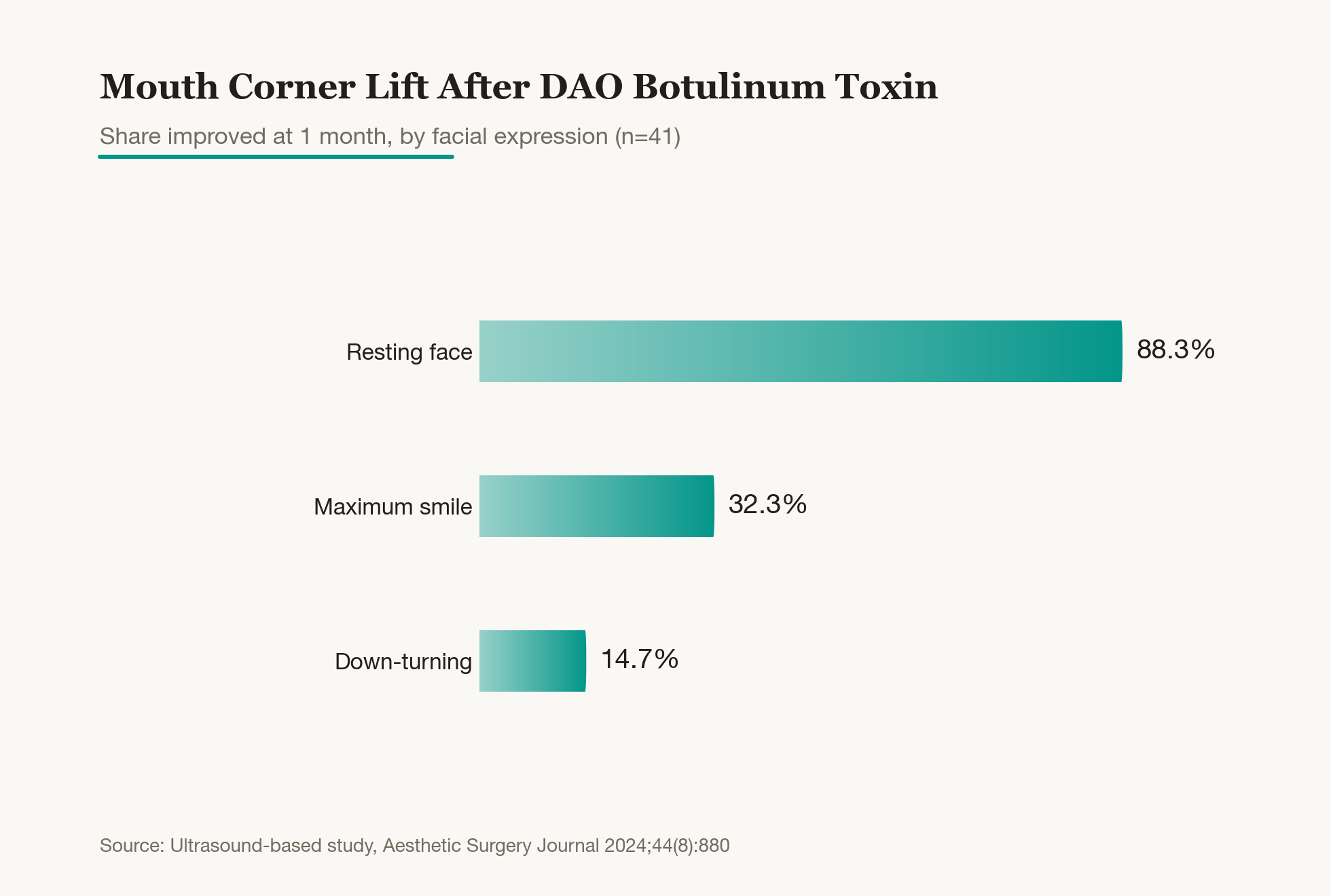
The effect looks different depending on the expression. In an ultrasound study of 41 people, 88.3% showed a clear improvement in corner drooping one month later when their face was relaxed. During a full smile, though, only 32.3% showed real improvement. When you smile broadly, the lifting muscles are already pulling hard, so weakening the depressor makes less of a visible difference.
This makes the treatment best suited for softening a mouth that looks downturned at rest, not for dramatically changing your smile. The goal is to soften a stern-looking expression, so think of it as making the resting mouth look more natural rather than expecting a big change when you smile. Before and after photos often show a subtle difference rather than a dramatic one, and that subtlety is exactly what keeps the result looking natural instead of obviously treated. That said, if the drooping is severe or volume loss is also part of the picture, Botox alone may not be enough, and other approaches are sometimes considered alongside it.
How many units per side, and where?
Corner of mouth Botox targets the DAO, the muscle that runs from near the edge of the jawbone up to the corner of the mouth. Dosing depends on the product and how strong the muscle is, but with Botox or Xeomin, injectors commonly use 2 to 5 units per side. One ultrasound study proposed 4 units per side, split into two points of 2 units each. Dysport uses a different unit system, so the equivalent dose runs 6 to 15 units per side.
| Category | Detail |
|---|---|
| Target muscle | Depressor anguli oris (DAO) |
| Injection site | Just below and outside the corner, 2 points per side |
| Depth | About 4 to 5mm |
| Caution | Avoid spread into the depressor labii inferioris |
Where the injection goes matters just as much. The DAO widens as it runs downward from the corner of the mouth, so injectors aim slightly below and outside the corner, at a depth of about 4 to 5 millimeters. Going too far inward risks letting the toxin spread into the depressor labii inferioris, the muscle that pulls the lower lip down. If that happens, the lower lip can look crooked, or it may become harder to show your lower teeth, so staying outside that inner boundary matters for safety. Too much product or any left-right mismatch can also make the expression look off, so starting with a conservative dose and carefully balancing both sides is the safer approach.
When does it start working and how long does it last?
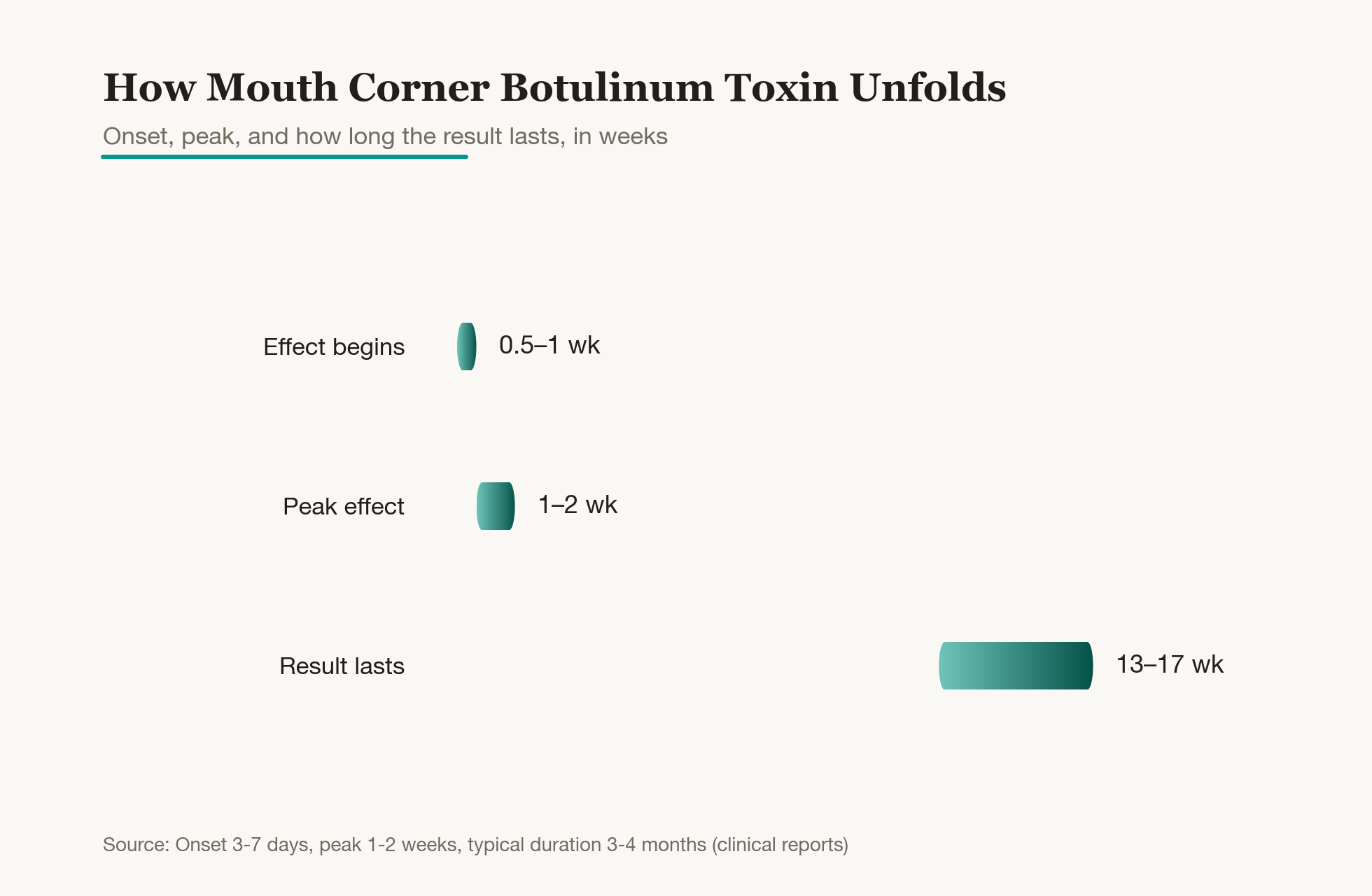
Corner of mouth Botox does not change anything the moment you leave the clinic. It takes several days for the toxin to block nerve signaling and for the muscle to actually weaken. The corners usually start lifting subtly between day 3 and day 7, and the effect looks most obvious around week 1 to 2. That is why it makes sense to judge the final result at around the two week mark, not right after treatment.
A single treatment typically lasts 3 to 4 months. Some people see it hold close to 6 months, but because the mouth area moves constantly with talking and eating, the effect tends to fade a bit sooner here than around the forehead or between the brows. People who use these muscles more actively also tend to see the effect wear off a little faster. Once the nerve endings start signaling again, muscle strength returns, and the corners gradually settle back to where they were.
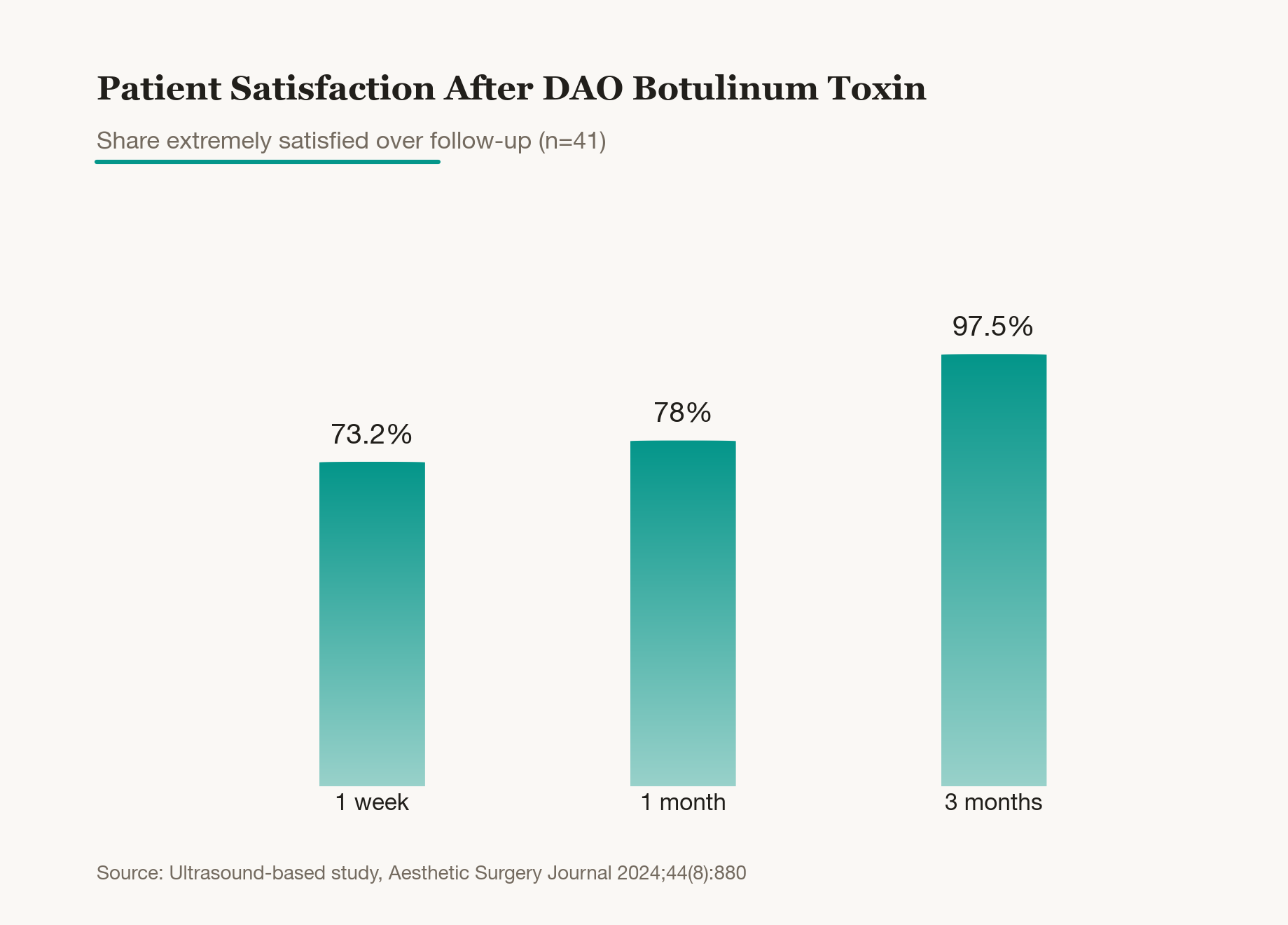
Keeping the result means repeating treatment. Most people start with sessions every 3 to 4 months, and the interval can stretch out later as the habitual muscle pull eases up. One encouraging pattern is that satisfaction tends to climb over time. In the same ultrasound study, the share of patients who were very satisfied rose from 73.2% at one week to 97.5% at three months, as the initial unfamiliarity faded and the mouth settled into its new, more natural look.
Filler and lifting when Botox alone isn't enough
As mentioned earlier, not every downturned mouth has the same cause, and the cause determines whether Botox alone works or whether it should be paired with something else. Splitting it into three broad categories makes the choice clearer.
| Cause | Best approach |
|---|---|
| Muscle pull | Corner of mouth Botox |
| Volume loss | Combine with filler |
| Skin laxity | Consider lifting |
When strong muscle pull is the main driver, Botox alone tends to work best. But when volume has dropped around the mouth and cheeks and the vertical lines beside the corners have deepened, Botox by itself usually is not enough. In that case, filling the hollow area beside the mouth corner or below the nasolabial fold with hyaluronic acid filler helps lift the corner along with the surrounding tissue. Studies have combined filler and Botox specifically to correct a downturned mouth. The two target different problems: Botox handles the muscle pull, filler restores the lost volume, and together they cover more ground than either one alone.
When the skin itself has genuinely sagged and loosened, the picture is different. This kind of structural laxity is hard to correct with Botox or filler, so thread lifting, radiofrequency, or ultrasound-based lifting treatments are usually considered instead. If your mouth corners look downturned, figuring out whether the cause is muscle, volume, or skin laxity first is what determines which approach actually gets you the result you want.
Side effects like asymmetry and spread
The most important thing to know about corner of mouth Botox is the risk of asymmetry and an unnatural looking expression. The muscles around the mouth sit close together, and their exact position varies from person to person, so if the dose or depth differs even slightly between the two sides, one corner can end up rising more than the other when you smile, or the mouth can look crooked. That is why matching both sides carefully and starting with a conservative dose while watching how the muscle responds matters so much.
The next thing to watch for is spread toward the lower lip. Just inside the DAO sits the depressor labii inferioris, the muscle that pulls the lower lip down. If the injection goes too far inward or too deep and reaches that muscle, the lower lip can end up crooked, speech can sound slightly slurred, and showing the lower teeth can become harder. This usually resolves as the toxin wears off, but it can be uncomfortable for weeks or even months, which is exactly why precise placement matters so much.
Beyond that, bruising or soreness at the injection site is common and settles quickly. In the study cited above, no notable side effects were reported over three months, though with only 41 participants, it is better to read that as a general trend than a firm statistic. In the end, this is a treatment where the exact units and placement make a real difference to the outcome, so getting it from someone experienced with the anatomy around the mouth is the safer route. When the cause really is muscle pull and the approach matches that, corner of mouth Botox can soften a stern looking expression in a short, simple treatment.
Was this helpful?
About this article
Written by a practising aesthetic physician and intended for general education — not a substitute for individual medical advice.
Read next

Pebbled Chin Botox: Results, How Long It Lasts, Dosage, and Side Effects
Chin botox (mentalis botox) smooths out the pebbled, orange-peel texture that shows up on an overactive chin. Here's how relaxing the mentalis muscle evens out the skin, the typical dose and injection points, when results appear and how long they last, how this differs from a weak or protruding chin, and the side effects worth knowing about, all backed by real evidence.
By Dr. Kim
Crow's Feet Botox: Effects, Duration and Dose
A clear look at how crow's feet Botox works. It eases the orbicularis oculi muscle that creases the outer eye corner when you smile, softening the lines it leaves behind. This guide covers the standard 24-unit dose split across both sides, where the injections go, when results show up, the roughly four-month duration, the limits for deep static wrinkles, and side effects, all backed by real clinical study numbers.
By Dr. Kim
Marionette Line Filler: Results, How Long It Lasts, and Combining With Botox
Marionette lines running from the corners of the mouth down toward the jaw form when the supporting ligaments loosen, the fat pad sags, and the muscle pulling down on the mouth corners adds to the strain. HA filler works by rebuilding this collapsed structure from the inside out, restoring lost volume layer by layer. Here's a look at recovery time, how long results last, and why Botox is often paired with it.
By Dr. Kim