Skin Booster Injection and Filler Differences: Hyaluronic Acid Hydration and Duration
By Dr. Lee9 min read
Some mornings your skin just looks luminous in the mirror. Other days, no matter how much lotion you layer on, it still feels tight and dull. One of the key substances behind that difference is hyaluronic acid, the same name you have probably seen on skincare ingredient lists, except your skin already makes its own supply of it.
A skin booster injection takes a very diluted form of this hyaluronic acid and places it into the skin's shallow layer through 150 to 300 tiny injection points spaced about 1cm apart. Below, we walk through why an injection pulls off a much stronger inner hydration effect than anything you apply on top.
How strongly hyaluronic acid holds water, and the limits of topical products
Hyaluronic acid is a long, thread-like sugar molecule. Its surface is lined with binding sites that grab hold of water molecules. Much like a magnet pulling in iron filings, a single hyaluronic acid molecule can hold onto water thousands of times its own weight. Research has found that one gram of hyaluronic acid can bind close to six liters of water. That is not one glass of water, but several full jugs, which gives you a sense of how much force this tiny molecule can generate inside the skin.
When these threads tangle together in the dermis, they form a mesh that behaves like a sponge. Just as a sponge plumps up once it soaks up water, this hyaluronic acid mesh causes the surrounding tissue to plump right along with it. That is the first reason skin looks fuller after treatment.
Hyaluronic acid in topical skincare mostly grabs water at the surface of the stratum corneum, the outermost layer of skin. That layer is a thin protective barrier, so it cannot hold onto water for long. On top of that, hyaluronic acid molecules are large, so they struggle to pass through this barrier, which means most of what you apply simply sits on the surface. Picture the stratum corneum as a tightly mortared brick wall with very narrow gaps, and the hyaluronic acid molecule as too bulky to slip through. Some skincare brands break the molecule into smaller pieces to help it penetrate, but the smaller the fragment, the weaker its grip on water becomes.
An injection sidesteps this problem entirely by placing hyaluronic acid directly into the deeper dermis with a needle, so there is no barrier to cross in the first place. This difference in where the water actually gets held is the most fundamental gap between topical application and injection.
Where does injected hyaluronic acid settle in the dermis?
The dermis is the middle layer of skin, woven through with collagen and elastin, two structural proteins that hold everything up. Think of collagen as the pillars holding up a building and elastin as the elastic bands connecting those pillars.
Hyaluronic acid and similar substances fill the space between those pillars and bands. When a skin booster injects hyaluronic acid, it settles right into that space. Like mortar filling the gaps between bricks, it fills the space between tissue fibers with moisture.
Once that space is filled with water, the skin gains volume and elasticity across the board. The surface is not just left looking dewy, the skin gains volume from the inside out, which is also why it feels different when you touch it.
Just as an old brick house grows loose and unstable once the mortar crumbles away, skin naturally becomes thinner and starts to sag as hyaluronic acid in the dermis declines with age for the same underlying reason. A skin booster is essentially the work of filling those loosened gaps back in.
How is inner hydration different from surface glow?
Inner hydration comes from that dermal mesh soaking up water, as explained above. That bounce-back feeling when you press on your skin and it springs right back is one sign that this inner hydration has been restored.
Surface glow forms through a slightly different path. When the skin's surface is uneven, light scatters in every direction as it reflects, which makes skin look dull. When the surface is smooth and evenly hydrated, light reflects back in one consistent direction instead. That even reflection is what our eyes register as glow, or that luminous look.
In other words, tightness and dryness come down to how much water is sitting inside the tissue, while glow comes down to surface smoothness and how light bounces off it. Reports suggest that skin boosters score high on satisfaction because they work on both fronts at once.
Stand bare-faced by a window and you will notice the difference right away between a smooth day and a dry, dull one, in how the light hits your skin. The same reason explains why some parts of your face look glowing in photos while other patches look flat.
How are skin booster injections different from fillers?
Filler also uses hyaluronic acid, but the purpose and injection depth are different. Filler is injected into the deeper dermis or even the subcutaneous fat layer to build volume or sharpen contour in specific spots like the nose, nasolabial folds, or cheeks. That is why the hyaluronic acid used in fillers is cross-linked into a firmer gel, designed to hold its shape in one spot for a long time.
Skin boosters work the opposite way. A very diluted hyaluronic acid is spread across the entire face or a broad area, injected mainly into the shallow dermis through 150 to 300 tiny points spaced about 1cm apart. The goal is not to raise a specific spot, it is to lift overall texture and hydration evenly across the skin.
Put simply, filler is like stacking bricks at one exact point to build a shape, while a skin booster is like spraying water evenly across an entire floor. Both use the same core ingredient, but how it is used and what it produces are completely different.
For example, to build up the tip of the nose, a single drop of filler goes into one precise point. A skin booster, on the other hand, gets spread shallowly across the forehead, cheeks, and chin in 150 to 300 separate points. Because the goals are different from the start, needle gauge, injection depth, and treatment time are all designed differently as well.
Why are several sessions given 3 to 4 weeks apart?
Hyaluronic acid injected into the skin gets broken down gradually by an enzyme in the body. That enzyme is called hyaluronidase, and breaking down a substance the body already makes is simply a normal part of metabolism.
The catch is that this breakdown speed varies from person to person, and even from area to area on the same face. People with faster metabolism break it down more quickly, and the mesh itself degrades faster when it is under stress from things like UV exposure or smoking.
That is why a single session can feel like it fades fast. Most protocols space three sessions about three to four weeks apart, since building it up in layers this way lets the mesh thicken gradually, and reports suggest the skin's own ability to hold water also improves along with it.
For example, even a younger person can see the mesh loosen faster than peers their age if they skip sun protection and smoke on top of it. That is why some clinics adjust the interval and number of sessions based on each person's individual skin condition.
Three factors that decide how long it lasts
How long a skin booster's results hold up is generally said to depend on a few key factors.
- How cross-linked the injected hyaluronic acid is: A lightly cross-linked product breaks down faster and does not last as long, while a slightly more cross-linked one tends to hold up longer. This comes down to differences in the physical structure that determines how fast it degrades.
- Your own skin's metabolic rate: Hyaluronidase activity varies with age, hormones, and lifestyle, so even two people getting the identical treatment can notice very different staying power.
- Sun exposure and daily habits: UV exposure is known to ramp up the activity of the enzymes that break hyaluronic acid down, so skipping sunscreen can make that hard-won hydration fade faster.
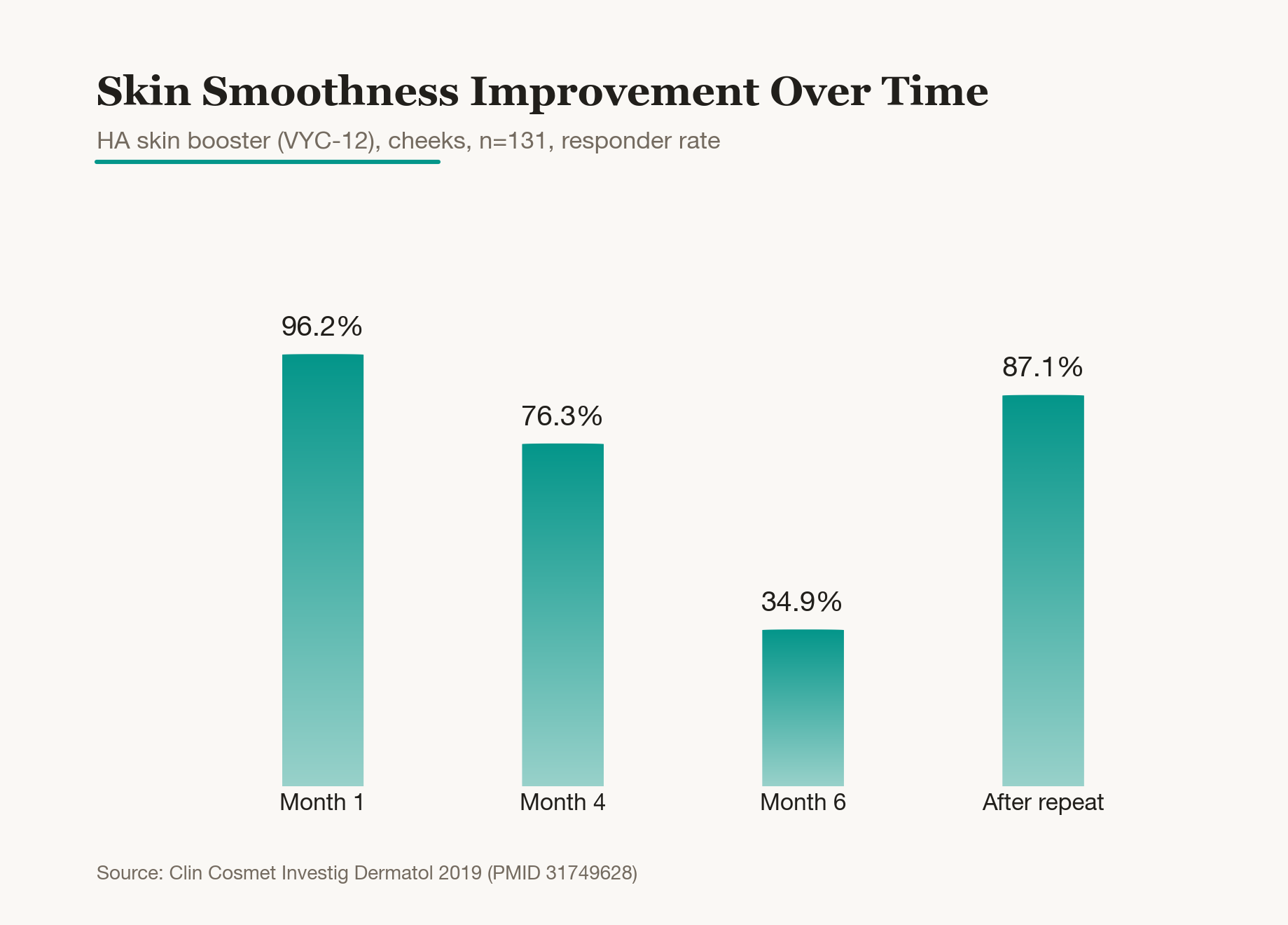
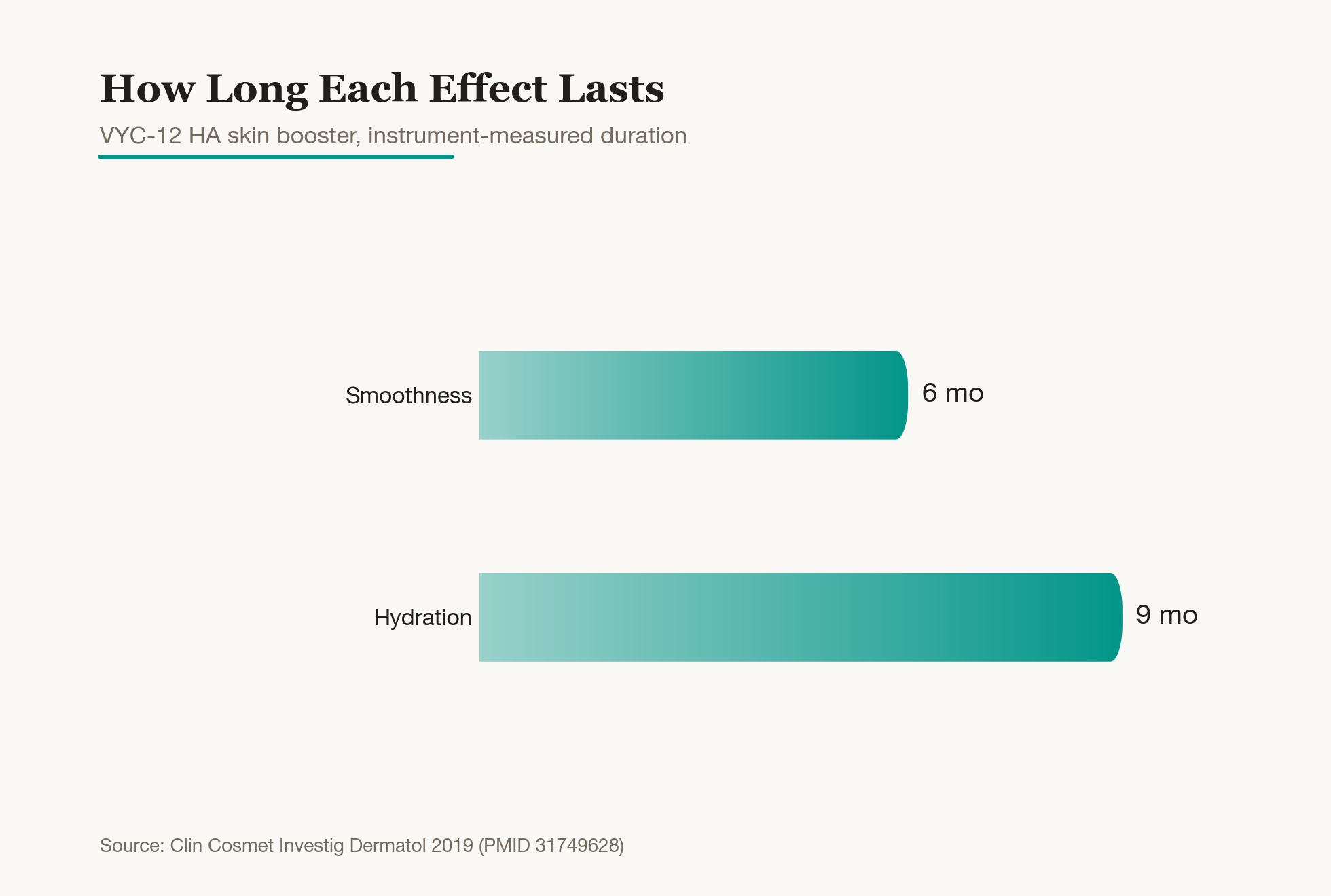
Most reports point to results lasting around four to eight weeks, though this varies quite a bit from person to person and depends heavily on aftercare. Since these three factors can stack on top of one another, two people who get the exact same treatment on the same day can walk away with noticeably different results.
Side effects and how to get it safely
Hyaluronic acid itself is already present in the body, so allergic reactions are known to be rare. That said, given that this is still an injection, some swelling, bruising, and redness at the injection sites is common. This is simply a normal response to the physical trauma of the needle passing through skin.
Rarely, an injection can accidentally enter a blood vessel and disrupt circulation, which is exactly why this should always be done by a clinician who knows the facial anatomy well. Blood vessels sit at different positions and depths across different areas of the face, so the practitioner's skill has a direct effect on how safe the procedure is.
If the treated area swells excessively, hurts intensely, or changes color, you should contact the clinic right away. Reports show that injecting hyaluronidase, the same enzyme mentioned earlier that breaks hyaluronic acid down, can quickly reverse a problem area, so there is a documented way to respond if something goes wrong. Before treatment, it also helps to ask how long swelling or bruising typically lasts and how to handle sun protection afterward.
For example, areas like the under-eye or forehead, where blood vessels run close to the surface, call for extra care. Being upfront during your consultation about your skin condition, allergy history, and any medications you are currently taking also goes a long way toward a safe outcome.
References
Korean Dermatological Association, Ministry of Food and Drug Safety (MFDS), American Academy of Dermatology (AAD), and U.S. Food and Drug Administration (FDA).
Was this helpful?
About this article
Written by a practising aesthetic physician and intended for general education — not a substitute for individual medical advice.
Read next

Restylane Vital Water-Glow Injection: Results, Number of Sessions, and How Long It Lasts
What Restylane Vital actually is, how NASHA hyaluronic acid differs from a standard filler, what the clinical data shows for hydration and skin texture, how many sessions you need and how often, how long results last, and which skin concerns it's best suited for, with no exaggeration.
By Dr. Kim

Water Glow Injection and Skin Booster: Differences and Purpose by Ingredient
A water glow injection is one type of skin booster that uses hyaluronic acid to add hydration, while skin boosters are a broader category that also includes ingredients supporting tissue regeneration. Here is a look at what each treatment actually contains and what it is designed to achieve.
By Dr. Lee
Under-Eye Hollow Filler: Effect and Side Effects, and the Tyndall Effect to Watch
The dark, sunken look under the eyes often comes less from pigment than from hollowing and the shadow it casts. Here's how the tear trough ligament and lost volume under the eye create that shadow, how a soft hyaluronic acid filler placed shallowly and sparingly smooths it out, why thin skin and the bluish Tyndall effect make this area tricky, and how long results actually last, all backed by real published numbers.
By Dr. Kim