Menopausal Skin: Causes of Dryness and Loss of Firmness, Collagen Loss, and Care
By Dr. Kim6 min read

A lot of women notice their skin just is not behaving the way it used to once menopause arrives. It feels tight minutes after washing, makeup stops sitting right, and fine lines show up seemingly out of nowhere. This is not just a subjective sense of aging. It is a real response to hormone levels dropping and the skin's underlying structure changing along with them.
The shift tends to move fastest in the years right around menopause. Even after that window passes, the changes keep going, just more slowly. Let us walk through why this happens, one piece at a time.
What changes happen to skin around menopause?
Menopause is the period when ovarian function gradually declines and estrogen, the primary female hormone, drops with it. People usually talk about the years surrounding menopause as a single stretch.
Four changes show up most often during this window: skin gets noticeably drier, firmness drops, fine lines and sagging increase, and the face becomes more prone to redness and sensitivity. The order and intensity vary from person to person, but the overall pattern tends to look similar across the board. These four changes might look like separate problems on the surface, but they all trace back to one root cause: falling estrogen. And rather than showing up independently, they tend to unfold as one continuous process, staggered over time. The sections below break down exactly how and in what order that happens.
Why does skin change when estrogen drops?
Estrogen stimulates fibroblasts, the cells in skin that produce collagen, prompting them to generate collagen and hyaluronic acid. Think of estrogen as the manager on a factory floor. With the manager present, production keeps humming along. Once the manager steps away, output slows down noticeably.
Skin cells carry receptors that estrogen binds to, and fibroblasts only become active once estrogen locks onto those receptors. During menopause, even though the receptors are still there, there simply is not enough estrogen circulating to bind them. That shortage slows the pace at which collagen and hyaluronic acid get made.
Wound healing, meaning how fast new tissue forms after an injury, is also influenced by estrogen. Small cuts tend to close within days in younger skin, but studies suggest the same wound can take noticeably longer to heal after menopause. It is like a factory where the manager is gone: when something breaks down, repairs simply take longer to arrive.
How much collagen is lost after menopause?
Collagen works like the support beams under skin, a structural protein holding everything up from below. Strong beams keep skin from sagging and losing its shape. But after menopause, collagen starts breaking down faster than it is being rebuilt.
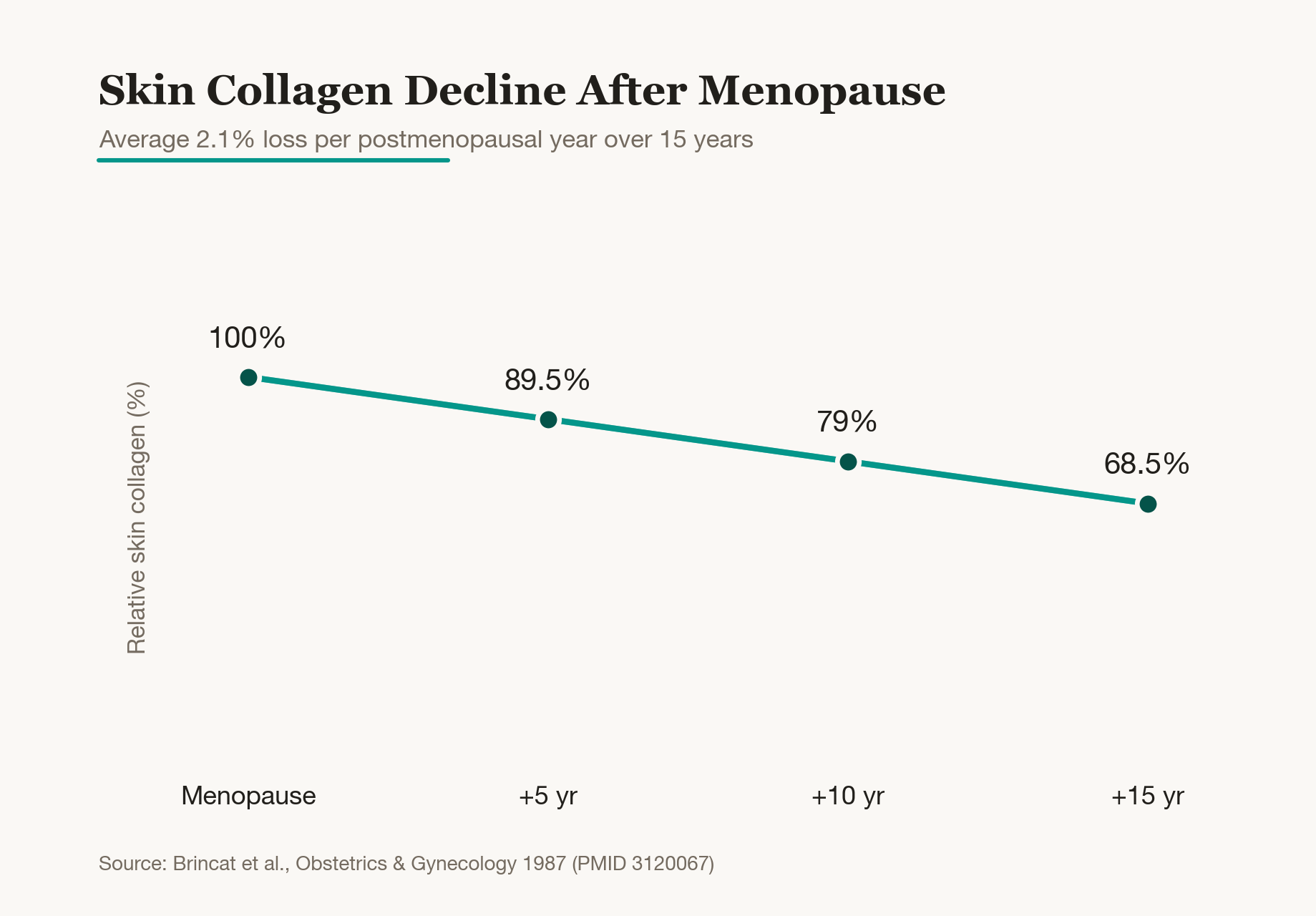
Research shows that postmenopausal skin loses roughly 1% to 2% of its collagen every year on average. That decline moves fastest in the first five years or so after menopause, with some studies reporting losses of up to 30% during that stretch alone. Since estrogen drops most sharply right at menopause, the collagen production line takes its biggest hit at the same moment. Once estrogen settles into a lower baseline, the rate of loss eases off gradually.
Why menopausal skin gets so dry
Dryness comes from this same root cause. Skin holds onto moisture using hyaluronic acid and ceramide, a lipid that fills the space between skin cells much like mortar between bricks, keeping the skin barrier intact. When estrogen declines, the skin's ability to produce both of these also drops.
Sebum production, which forms the skin's natural oil layer, also tends to decline after menopause. As that oil layer thins out, transepidermal water loss, the rate at which moisture escapes through the skin, increases. Picture a wall running low on mortar: water starts seeping out through the gaps. That is essentially what is happening, which is why menopausal skin tends to feel tighter and more prone to flaking than before.
Thinning of elastin and the epidermis
Elastin, the elastic fiber that lets skin stretch and spring back into place, follows a similar downward trend to collagen after menopause. If collagen is the support beam, elastin is more like the rubber band wrapped around it. Once that rubber band wears out, skin loses its ability to bounce back after stretching.
The epidermis, the outermost layer of skin, is also known to thin gradually during this period. As that layer thins, the blood vessels and pigment underneath become more visible, and the face becomes more reactive to even minor irritants. This is part of why facial flushing and a burning sensation often show up for the first time after menopause.
- Collagen loss: fewer support beams mean sagging and deeper wrinkles become more likely.
- Elastin loss: skin loses its ability to snap back after stretching, so firmness declines.
- Weaker moisture barrier: less hyaluronic acid and ceramide bring on dryness and sensitivity together.
- Thinning epidermis: blood vessels become more visible and skin reacts more easily to irritation.
How should you care for menopausal skin?
The goal is not to force back what has already been lost, but to protect the collagen and moisture still there and give the skin a bit of help with what it is still producing. A few ingredients are consistently cited as useful here.
- Retinol: acts on retinoic acid receptors in skin cells to stimulate fibroblasts and speed up new collagen production.
- Niacinamide: supports the production of barrier lipids like ceramide, helping reinforce a thinning skin barrier.
- Hyaluronic acid: since the skin makes less of it on its own, applying it topically helps hold on to moisture from the outside.
- Ceramide: directly replenishes the barrier lipids that have become scarce, slowing the rate at which moisture escapes.
Sunscreen matters at any age, but it deserves extra attention here. UV exposure accelerates the breakdown of collagen that is already declining, which makes it one of the more important habits for menopausal skin specifically.
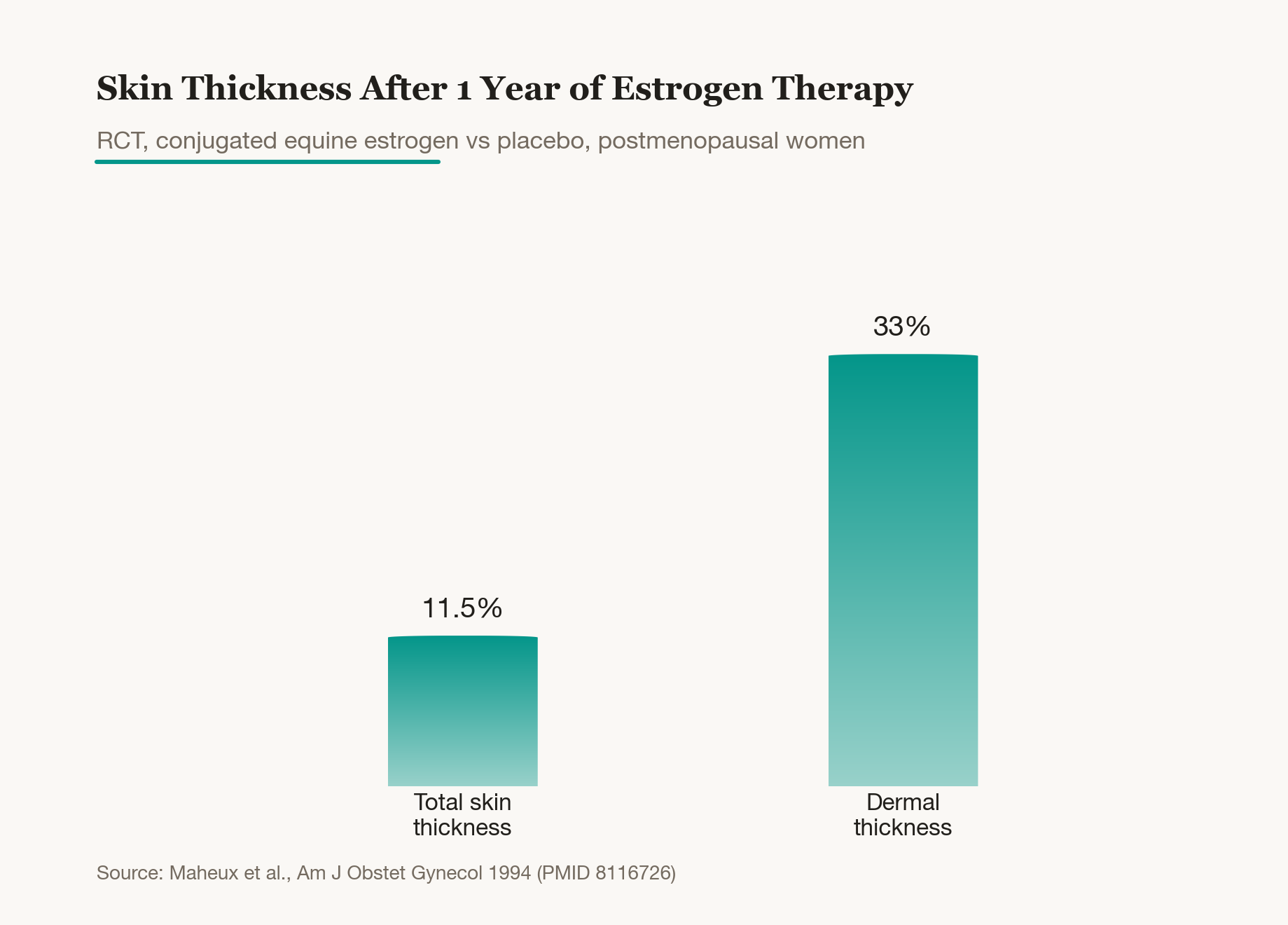
If dryness or flushing feels especially severe, hormone therapy is worth considering. Some studies report that women on hormone therapy maintain higher skin collagen density than those who are not. Since it directly replaces the estrogen the body has lost, the approach makes sense in principle, but the benefits and risks depend heavily on individual health history, so it is safest to make that decision together with an OB-GYN. If the changes feel significant, or if flushing and itching show up alongside them, a dermatology consultation is worth adding to that conversation as well.
References
Korean Dermatological Association, American Academy of Dermatology (AAD), and Ministry of Food and Drug Safety (MFDS).
Was this helpful?
About this article
Written by a practising aesthetic physician and intended for general education — not a substitute for individual medical advice.
Read next

How Does Fine Dust Affect the Skin Barrier and Collagen?
Fine dust particles are so small they slip past the pores and into the gaps of your stratum corneum, unsettling the skin barrier from the inside. Along the way, free radicals surge and enzymes that break down collagen switch on, leaving skin more reactive and less firm. Here is how fine dust actually affects skin, and what genuinely helps.
By Dr. Kim

Décolleté Aging: Causes, Care, Laser Treatment and Recovery Time
The décolleté has fewer oil glands and thinner skin than the face, so it takes UV damage harder and shows it sooner. Here's how collagen and elastic fibers break down first, why fine lines, discoloration, and broken capillaries settle in, and the sunscreen-to-retinoid-to-treatment routine that actually helps.
By Dr. Kim
Blackheads: Causes, Care and Is It Okay to Squeeze Them by Hand?
Blackheads aren't trapped dirt. They're a plug of sebum and dead skin cells inside the pore that turns dark through oxidation. Here's why extracting them often leaves marks, and which ingredients actually help, explained through the science behind it.
By Dr. Kim